Electric Baby Car Market Size
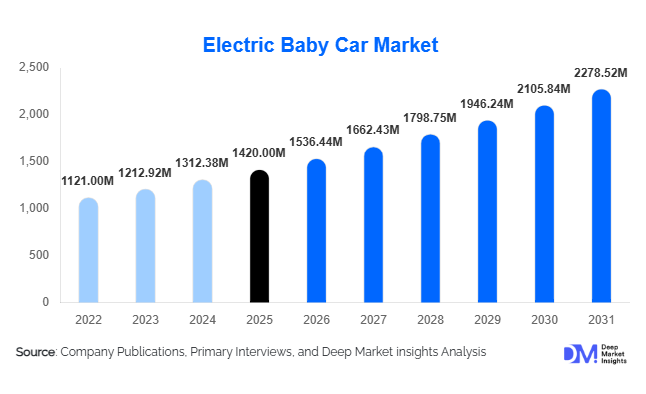
According to Deep Market Insights, the global electric baby car market size was valued at USD 1,420 million in 2025 and is projected to grow from USD 1,536.44 million in 2026 to reach USD 2,278.52 million by 2031, expanding at a CAGR of 8.2% during the forecast period (2026–2031). The electric baby car market growth is primarily driven by rising consumer spending on premium children's toys, increasing adoption of technologically enhanced ride-on vehicles, and expanding e-commerce distribution channels that enable wider global accessibility.
Electric baby cars, also known as battery-powered ride-on vehicles, are designed to provide interactive entertainment while supporting motor skill development among young children. The market has evolved significantly with the introduction of licensed miniature vehicles modeled after popular automotive brands, advanced safety features such as parental remote controls, and improved battery performance.
Rising urbanization and higher disposable income among middle-class households are fueling demand for premium ride-on toys globally. Parents increasingly seek toys that combine entertainment, technology, and developmental value. Additionally, collaborations between toy manufacturers and automotive brands are enhancing product appeal, enabling companies to offer miniature replicas of luxury vehicles, including SUVs, sports cars, and electric cars. The rapid expansion of online toy retail and cross-border e-commerce platforms has also contributed to market growth by enabling consumers to access a wide range of products at competitive prices. With continued product innovation, improved battery technologies, and growing demand in emerging economies, the electric baby car market is expected to maintain steady growth over the forecast period.
Key Market Insights
- Licensed replica ride-on vehicles are gaining strong traction, driven by collaborations between toy manufacturers and global automotive brands.
- Asia-Pacific dominates the electric baby car market, supported by strong manufacturing ecosystems and rapidly growing consumer demand in China and India.
- Online retail channels account for the majority of global sales, as e-commerce platforms enable wider product availability and competitive pricing.
- Technological integration such as Bluetooth audio systems and parental remote control features is enhancing product functionality and consumer appeal.
- Mid-range priced electric baby cars are witnessing the highest adoption, balancing affordability with advanced features.
- Commercial entertainment applications, including malls and amusement parks are emerging as a fast-growing end-use segment.
What are the latest trends in the electric baby car market?
Growing Popularity of Licensed Ride-On Vehicles
One of the most prominent trends shaping the electric baby car market is the increasing demand for licensed ride-on vehicles modeled after real automotive brands. Manufacturers are partnering with well-known car companies to produce miniature replicas of luxury vehicles including SUVs, sports cars, and electric sedans. These products carry strong aspirational value among parents and children alike, often commanding premium price points. Licensed models are particularly popular in North America and Europe, where brand recognition strongly influences purchasing decisions. The growing popularity of branded ride-on vehicles has encouraged toy companies to expand their licensing portfolios and introduce new designs that closely resemble real-world cars.
Technology-Enhanced Ride-On Toys
Technological innovation is significantly transforming electric baby cars. Manufacturers are integrating advanced features such as Bluetooth music systems, LED dashboards, smartphone connectivity, and parental remote control systems. These features enhance both entertainment value and safety for children using the vehicles. Modern ride-on cars also include soft-start acceleration systems, improved suspension, and anti-slip tires to provide smoother driving experiences. Future developments may include GPS tracking, mobile app control, and AI-enabled safety monitoring. Such innovations are helping manufacturers differentiate their products while attracting tech-savvy parents seeking interactive toys for their children.
What are the key drivers in the electric baby car market?
Rising Consumer Spending on Premium Children's Toys
Global consumer spending on children’s toys has been steadily increasing, particularly in urban households with higher disposable incomes. Parents are increasingly investing in premium toys that provide both entertainment and developmental value. Electric baby cars are viewed as high-engagement toys that encourage physical activity, coordination, and independent play. This perception has significantly boosted demand across developed economies as well as emerging consumer markets. The growing culture of gifting premium toys during holidays and birthdays also contributes to the rising adoption of electric ride-on vehicles.
Rapid Expansion of E-Commerce Toy Retail
The rise of online retail platforms has significantly improved the accessibility of electric baby cars worldwide. E-commerce platforms provide consumers with access to a wide variety of ride-on vehicles, enabling easy product comparisons and transparent pricing. Online marketplaces allow manufacturers to reach international consumers without extensive physical distribution networks. Additionally, direct-to-consumer business models are enabling brands to build stronger customer relationships and maintain higher profit margins. The convenience of home delivery and online product demonstrations further encourages consumers to purchase ride-on toys through digital channels.
What are the restraints for the global market?
Product Safety and Regulatory Compliance Challenges
Electric baby cars must comply with strict toy safety regulations in regions such as North America and Europe. Manufacturers must ensure compliance with standards related to battery safety, electrical components, materials, and mechanical stability. Failure to meet these standards can lead to product recalls and reputational damage. Compliance with global safety certifications increases manufacturing costs and complexity, particularly for companies exporting products to multiple markets with different regulatory frameworks.
Price Sensitivity in Emerging Markets
Although demand for electric ride-on toys is increasing in developing economies, affordability remains a challenge for many households. Premium electric baby cars can cost several hundred dollars, limiting accessibility for middle-income consumers. Manufacturers must therefore balance product quality, safety features, and affordability to achieve broader market penetration in price-sensitive regions.
What are the key opportunities in the electric baby car industry?
Smart and Connected Ride-On Vehicles
The integration of smart technologies presents significant growth opportunities for manufacturers in the electric baby car market. Features such as smartphone connectivity, app-controlled driving modes, GPS tracking, and educational audio modules can enhance product appeal while creating premium pricing opportunities. Smart ride-on vehicles that integrate learning and entertainment could transform traditional toys into interactive developmental tools. As parents increasingly seek technology-enabled products for children, the adoption of smart ride-on vehicles is expected to expand significantly.
Expansion into Emerging Consumer Markets
Emerging economies such as India, Brazil, Indonesia, and Vietnam offer substantial growth potential for the electric baby car industry. Rising middle-class income levels, increasing urbanization, and growing online retail penetration are driving demand for premium children’s toys in these regions. Manufacturers that offer affordable mid-range models tailored to local consumer preferences can capture significant market share. Establishing regional manufacturing hubs and improving distribution networks will further enhance market expansion opportunities.
Report Scope
| Report Metric | Details |
|---|---|
| Market Size in 2025 | USD 1420 Million |
| Market Size in 2026 | USD 1536.44 Million |
| Market Size in 2031 | USD 2278.52 Million |
| CAGR | 8.2% (2026-2031) |
| Base Year for Estimation | 2025 |
| Historical Data | 2022-2024 |
| Forecast Period | 2026-2031 |
| Report Coverage | Revenue Forecast, Competitive Landscape, Supply Chain Disruption, Growth Factors, Environment & Regulatory Landscape and Trends |
| Geographies Covered | North America, Europe, APAC, Middle East and Africa, LATAM |
| Countries Covered | U.S., Canada, U.K., Germany, France, Spain, Italy, Russia, Nordic, Benelux, Rest of Europe, China, Korea, Japan, India, Australia, Singapore, Taiwan, South East Asia, Rest of Asia-Pacific, UAE, Turky, Saudi Arabia, South Africa, Egypt, Nigeria, Rest of MEA, Brazil, Mexico, Argentina, Chile, Colombia, Rest of LATAM |
Explore more data points, trends and opportunities Download Free Sample Report
Product Type Insights
Single-seat electric ride-on cars represent the largest product category within the electric baby car market, accounting for a substantial share of global sales due to their affordability and compact design. These models are particularly popular among households with younger children and limited outdoor play space. Two-seat electric ride-on vehicles are also gaining popularity as they allow siblings or friends to ride together, enhancing play value. ATV-style ride-on vehicles and electric toy trucks are increasingly being introduced to cater to adventure-themed play experiences. Manufacturers are also expanding their product portfolios with miniature electric SUVs and sports cars designed to replicate real-world vehicles. Continuous innovation in vehicle design and safety features is enabling companies to cater to a broader consumer base across different price segments.
Application Insights
Household use remains the dominant application segment for electric baby cars, accounting for nearly 70% of global demand. Parents primarily purchase ride-on vehicles as outdoor toys for children to use in gardens, driveways, or residential playgrounds. However, commercial entertainment applications are emerging as a rapidly growing segment. Shopping malls, amusement parks, and family entertainment centers are increasingly offering electric ride-on vehicles as paid attractions for children. Rental services in recreational parks and tourist areas are also adopting ride-on vehicles as short-duration entertainment options. Educational activity centers and childcare facilities are beginning to incorporate ride-on toys into play-based learning programs, further expanding the application scope of the market.
Distribution Channel Insights
Online retail platforms dominate the distribution landscape for electric baby cars, accounting for more than half of global sales. E-commerce marketplaces enable consumers to explore a wide range of ride-on vehicles, compare prices, and access detailed product information. Direct-to-consumer brand websites are also becoming increasingly important as manufacturers expand their digital presence. Offline retail channels such as toy specialty stores, baby product retailers, and hypermarkets continue to play an important role in developed markets where consumers prefer to physically inspect products before purchasing. Retailers are also using in-store demonstrations and promotional campaigns to attract buyers during peak gifting seasons such as holidays and birthdays.
Explore more data points, trends and opportunities Download Free Sample Report
Electric Baby Car Market Segmentations
By Product Type
- Single-Seat Electric Ride-On Cars
- Two-Seat Electric Ride-On Cars
- ATV-Style Electric Ride-On Vehicles
- Electric Ride-On Trucks & SUVs
- Electric Ride-On Motorcycles & Quad Bikes
By Battery Type
- Sealed Lead Acid (SLA) Battery Powered
- Lithium-Ion Battery Powered
- Nickel-Metal Hydride (NiMH) Battery Powered
By Vehicle Design / Licensing
- Licensed Replica Ride-On Cars
- Non-Licensed Generic Ride-On Cars
By Distribution Channel
- Online Retail
- Toy Specialty Stores
- Hypermarkets & Supermarkets
- Baby Product Stores
By End-Use Application
- Household Consumer Use
- Commercial Entertainment Use
- Rental & Leisure Services
- Educational & Activity Centers
Regional Insights
Asia-Pacific
Asia-Pacific dominates the electric baby car market with approximately 38% share of global revenue in 2025. China serves as the largest manufacturing hub for ride-on toys due to its strong toy production ecosystem and cost-efficient supply chains. Domestic demand in China is also expanding rapidly as household incomes rise and consumer spending on children's products increases. India represents one of the fastest-growing markets within the region, driven by a young population, expanding e-commerce adoption, and increasing interest in premium toys. Japan and South Korea maintain steady demand due to strong toy retail industries and high consumer spending per child.
North America
North America accounts for roughly 27% of the global electric baby car market. The United States is the largest market in the region, driven by high disposable income, strong toy retail infrastructure, and consumer preference for branded and licensed ride-on vehicles. American consumers frequently purchase electric baby cars as gifts during holidays and birthdays. Canada also contributes to regional demand through online retail channels and specialty toy stores.
Europe
Europe holds approximately 22% of global market share, with strong demand from countries such as Germany, the United Kingdom, France, Italy, and Spain. European consumers place high importance on product quality and safety certifications, leading to strong demand for premium ride-on vehicles. Licensed miniature cars modeled after popular automotive brands are particularly popular among European consumers.
Latin America
The electric baby car market in Latin America accounts for around 6% of global demand, led by Brazil and Mexico. Rising disposable income and expanding toy retail networks are contributing to increased adoption of ride-on vehicles in the region. Growth is also supported by improving e-commerce infrastructure that allows international toy brands to reach consumers more effectively.
Middle East & Africa
The Middle East and Africa region represents approximately 7% of global market demand. Countries such as the United Arab Emirates and Saudi Arabia show strong demand for premium ride-on toys due to high consumer spending levels. In Africa, South Africa leads regional demand through growing toy retail markets and increasing urbanization.
Key Players in the Electric Baby Car Market
- Mattel Inc.
- Peg Perego
- Radio Flyer Inc.
- Rastar Group
- Zhejiang Jiajia Ride-On Toys
- Goodbaby International Holdings
- Injusa SA
- Dorel Industries Inc.
- Hauck GmbH
- Famosa
- Pilsan Toys
- Huffy Corporation
- Berg Toys
- Toyzone Impex Pvt Ltd
- Kids2 Inc.