Eco-Friendly Phone Cases Market Size
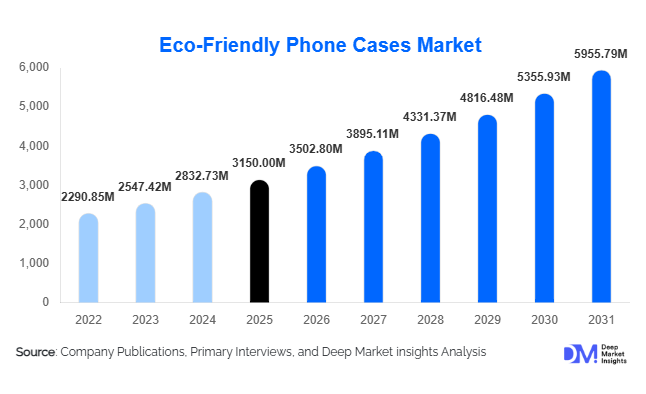
According to Deep Market Insights, the global eco-friendly phone cases market size was valued at USD 3,150 million in 2025 and is projected to grow from USD 3,502.80 million in 2026 to reach USD 5,955.79 million by 2031, expanding at a CAGR of 11.2% during the forecast period (2026–2031). The eco-friendly phone cases market growth is primarily driven by rising environmental awareness, increasing restrictions on plastic usage, and growing consumer preference for sustainable consumer electronics accessories. The proliferation of smartphones globally, combined with demand for biodegradable and recycled materials, is accelerating adoption across both developed and emerging markets.
Key Market Insights
- Eco-conscious consumer behavior is driving demand, with increasing preference for biodegradable, recycled, and plant-based phone cases.
- Recycled plastics dominate material usage, accounting for a significant share due to cost efficiency and scalability.
- North America leads the market, supported by high awareness and premium product adoption.
- Asia-Pacific is the fastest-growing region, driven by rising smartphone penetration and sustainability initiatives.
- Online distribution channels dominate, with D2C brands and e-commerce platforms expanding global reach.
- Technological advancements in biopolymers are improving the durability, design, and performance of eco-friendly cases.
What are the latest trends in the eco-friendly phone cases market?
Shift Toward Biodegradable and Compostable Materials
Manufacturers are increasingly focusing on biodegradable and compostable materials such as PLA, bamboo fiber, and wheat straw composites. These materials decompose naturally, reducing environmental impact compared to conventional plastics. Brands are emphasizing certifications for compostability and sustainability to enhance consumer trust. This trend is particularly strong in Europe and North America, where regulatory pressures and consumer awareness are high. Companies are also introducing take-back programs to recycle used cases, strengthening circular economy practices.
Direct-to-Consumer (D2C) and Digital-First Expansion
The rise of D2C business models is transforming the eco-friendly phone cases market. Brands are leveraging e-commerce platforms and their own websites to reach global consumers, reduce intermediaries, and improve margins. Social media marketing, influencer collaborations, and sustainability storytelling are key strategies driving customer engagement. Customization options and subscription-based case replacement services are also emerging, enhancing brand loyalty and repeat purchases.
What are the key drivers in the eco-friendly phone cases market?
Rising Environmental Awareness and Sustainability Goals
Growing awareness of plastic pollution and climate change is encouraging consumers to adopt sustainable products. Eco-friendly phone cases align with this shift, offering a practical way to reduce environmental footprint. Corporate ESG commitments and sustainability campaigns are further reinforcing demand, particularly among younger demographics.
Regulatory Push Against Plastic Usage
Governments worldwide are implementing regulations to reduce plastic waste, indirectly boosting demand for eco-friendly alternatives. Policies targeting single-use plastics and promoting recycling are encouraging manufacturers to innovate with sustainable materials. Compliance with environmental standards is becoming a competitive advantage for market players.
What are the restraints for the global market?
Higher Product Costs Compared to Conventional Cases
Eco-friendly phone cases are generally more expensive due to higher raw material and production costs. This limits adoption in price-sensitive markets, particularly in developing regions where affordability remains a key factor.
Perceived Durability Limitations
Despite advancements, some consumers perceive eco-friendly materials as less durable than traditional plastics. This perception can impact purchasing decisions, especially among users seeking long-lasting protective cases.
What are the key opportunities in the eco-friendly phone cases industry?
Expansion into Emerging Markets
Emerging economies such as India, Brazil, and Southeast Asia offer significant growth potential due to increasing smartphone penetration and rising environmental awareness. Affordable, eco-friendly options tailored to these markets can unlock large volumes of demand.
Circular Economy and Recycling Initiatives
Adopting circular economy models, including recycling programs and take-back initiatives, presents a major opportunity for market players. These initiatives not only reduce environmental impact but also enhance brand loyalty and long-term customer engagement.
Material Type Insights
Recycled plastics dominate the market, accounting for approximately 34% of the total market share in 2025, due to their cost-effectiveness and scalability. Natural materials such as bamboo, cork, and wood are gaining traction in premium segments, offering aesthetic appeal and sustainability. Biodegradable plastics and plant-based composites are witnessing rapid growth as technological advancements improve their durability and performance, making them viable alternatives to traditional materials.
Report Scope
| Report Metric | Details |
|---|---|
| Market Size in 2025 | USD 3150 Million |
| Market Size in 2026 | USD 3502.80 Million |
| Market Size in 2031 | USD 5955.79 Million |
| CAGR | 11.2% (2026-2031) |
| Base Year for Estimation | 2025 |
| Historical Data | 2022-2024 |
| Forecast Period | 2026-2031 |
| Report Coverage | Revenue Forecast, Competitive Landscape, Supply Chain Disruption, Growth Factors, Environment & Regulatory Landscape and Trends |
| Geographies Covered | North America, Europe, APAC, Middle East and Africa, LATAM |
| Countries Covered | U.S., Canada, U.K., Germany, France, Spain, Italy, Russia, Nordic, Benelux, Rest of Europe, China, Korea, Japan, India, Australia, Singapore, Taiwan, South East Asia, Rest of Asia-Pacific, UAE, Turky, Saudi Arabia, South Africa, Egypt, Nigeria, Rest of MEA, Brazil, Mexico, Argentina, Chile, Colombia, Rest of LATAM |
Explore more data points, trends and opportunities Download Free Sample Report
Product Type Insights
Back covers represent the largest product segment, holding around 42% of the global market share in 2025. The dominance of this segment is primarily driven by its affordability, lightweight construction, and high compatibility across a wide range of smartphone models. Back covers are easier to manufacture using eco-friendly materials such as recycled plastics and biodegradable polymers, making them the preferred choice for mass production. Additionally, the rising demand for minimalist aesthetics and slim-profile protection among younger consumers has further strengthened this segment’s leadership. Full protection and rugged cases are witnessing steady growth, particularly among users prioritizing durability and impact resistance, with eco-material innovations enabling improved shock absorption. Wallet and flip cases continue to attract consumers seeking multifunctionality, combining device protection with storage utility. Meanwhile, slim eco-friendly cases are gaining traction in premium segments, especially among high-end smartphone users who value design, sustainability, and portability. The continued expansion of smartphone models globally ensures sustained demand across all product categories, with back covers expected to maintain leadership due to their scalability and cost advantages.
Distribution Channel Insights
Online retail channels dominate the eco-friendly phone cases market, accounting for approximately 58% of the total market share in 2025. This leadership is driven by the rapid growth of e-commerce platforms, increasing internet penetration, and the rise of direct-to-consumer (D2C) brands specializing in sustainable products. Online platforms enable brands to communicate sustainability credentials effectively, offer product customization, and reach global audiences without extensive physical infrastructure. The convenience of price comparison, customer reviews, and doorstep delivery has further accelerated online adoption. Additionally, social media marketing and influencer-driven campaigns are playing a critical role in shaping consumer preferences and driving online sales. Offline channels, including electronics stores, specialty eco-retail outlets, and large-format retail chains, continue to contribute significantly by enhancing product visibility and building consumer trust through physical interaction. The integration of omnichannel strategies, such as click-and-collect, in-store experience zones, and hybrid retail models, is enabling companies to optimize customer engagement and expand market reach. Despite online dominance, offline retail remains essential in emerging markets where digital penetration is still developing.
End-Use Insights
The consumer electronics accessories segment leads the market, accounting for nearly 65% of total demand in 2025. This dominance is supported by the massive global smartphone installed base and annual shipments exceeding 1.2 billion units, ensuring a continuous replacement cycle for phone cases. Increasing consumer preference for sustainable accessories is driving adoption within this segment, particularly among environmentally conscious users. The corporate gifting segment is emerging as a high-growth area, with organizations increasingly adopting eco-friendly phone cases as part of their sustainability initiatives and branding strategies. Bulk procurement for promotional campaigns, employee engagement, and ESG-driven gifting programs is contributing to volume growth. Telecom operators and smartphone OEMs are also creating new demand streams by offering eco-friendly cases as complementary accessories with device purchases. This strategy not only enhances brand value but also aligns with corporate sustainability commitments. Additionally, the rise of sustainable lifestyle retail and eco-conscious consumer communities is expanding the application scope of eco-friendly phone cases beyond traditional usage patterns.
Explore more data points, trends and opportunities Download Free Sample Report
Eco-Friendly Phone Cases Market Segmentations
By Material Type
- Biodegradable Plastics
- Recycled Plastics
- Natural Materials
- Plant-Based Composites
- Recycled Silicone & Rubber
- Ocean-Recovered Plastics
By Product Type
- Back Covers
- Full Protection / Rugged Cases
- Flip / Folio Cases
- Wallet Cases
- Slim Cases
- Modular / Customizable Cases
By Price Range
- Economy
- Mid-Range
- Premium
By Distribution Channel
- Online Retail
- Brand-Owned Websites
- Electronics Stores
- Specialty Eco Stores
- Supermarkets / Hypermarkets
By End-Use Industry
- Consumer Electronics Accessories
- Corporate Gifting
- Sustainable Lifestyle Retail
- Telecom Operators & OEM Bundling
Regional Insights
North America
North America holds the largest share of approximately 32% in 2025, with the United States accounting for the majority of regional demand. The region’s dominance is driven by high consumer awareness regarding environmental sustainability, strong purchasing power, and a well-established premium smartphone user base willing to spend on eco-friendly accessories. The presence of leading sustainable brands and advanced e-commerce infrastructure further accelerates market growth. Additionally, increasing corporate ESG commitments and government initiatives promoting recycling and waste reduction are supporting demand. The growing trend of direct-to-consumer brands and subscription-based accessory models is also contributing to sustained expansion in the region.
Europe
Europe accounts for around 28% of the global market share, driven by stringent environmental regulations and a strong cultural emphasis on sustainability. Countries such as Germany, the UK, and France are key contributors, with Germany representing nearly 25% of regional demand. The European Union’s policies on reducing plastic waste and promoting circular economy practices are major growth drivers. Consumers in this region exhibit a high willingness to pay for eco-certified products, particularly those with verified compostability and recyclability. Additionally, the presence of eco-conscious retail networks and government incentives for sustainable manufacturing are supporting market expansion. The increasing popularity of ethical consumption among younger demographics is further accelerating demand.
Asia-Pacific
Asia-Pacific is the fastest-growing region, registering a CAGR of approximately 13% during the forecast period. China dominates global production and exports due to its large-scale manufacturing capabilities and cost advantages. India is emerging as a high-growth consumption market, driven by rising smartphone penetration, increasing environmental awareness, and government initiatives such as plastic reduction policies. Japan and South Korea contribute through innovation and premium product adoption. The region’s growth is also fueled by expanding middle-class populations, rapid urbanization, and increasing digital connectivity. The shift toward sustainable consumer products, supported by local manufacturing incentives and export opportunities, is expected to further boost regional demand.
Latin America
Latin America shows steady growth, with Brazil and Mexico leading regional demand. Brazil accounts for nearly 40% of the regional market, supported by a growing middle class and increasing adoption of sustainable consumer products. Rising smartphone penetration and improving e-commerce infrastructure are key drivers in the region. Additionally, growing awareness of environmental issues and government initiatives promoting sustainability are encouraging consumers to shift toward eco-friendly accessories. The expansion of international brands into the region and the increasing availability of affordable, eco-friendly products are further supporting market growth.
Middle East & Africa
The Middle East and Africa region is witnessing gradual growth, particularly in the UAE and South Africa. Rising urbanization, increasing disposable income, and growing adoption of premium smartphones are key drivers of demand for eco-friendly phone cases. The region is also benefiting from increasing awareness of sustainability and environmental protection, supported by government initiatives and corporate responsibility programs. In the Middle East, high-income consumers are driving demand for premium eco-friendly accessories, while in Africa, improving retail infrastructure and smartphone penetration are supporting market expansion. Although the market is still developing, increasing investments in sustainable products and expanding distribution networks are expected to drive long-term growth.