E-Card Market Size
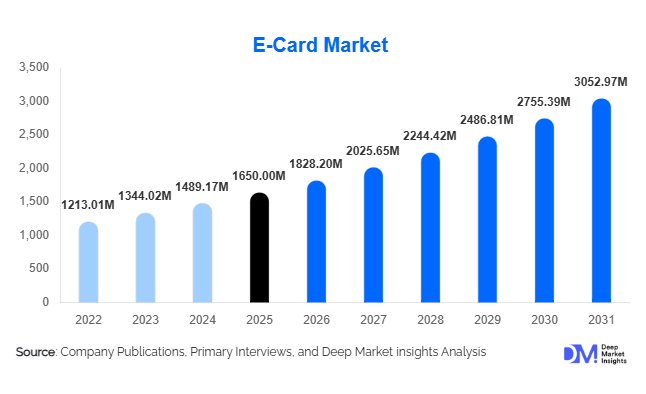
According to Deep Market Insights, the global E-Card market size was valued at USD 1,650 million in 2025 and is projected to grow from USD 1828.20 million in 2026 to reach USD 3,052.97 million by 2031, expanding at a CAGR of 10.8% during the forecast period (2026–2031). The market growth is primarily driven by increasing digital communication trends, rising preference for eco-friendly alternatives to paper cards, and the rapid adoption of smartphones and social media platforms. The shift toward personalized and interactive communication formats has further accelerated demand for multimedia and AI-powered E-cards. Additionally, corporate adoption for marketing campaigns, employee engagement, and customer relationship management is creating new revenue streams. Emerging markets across Asia-Pacific and Latin America are contributing significantly due to expanding internet penetration and digital literacy, while mature markets continue to innovate with premium and subscription-based offerings.
Key Market Insights
- E-cards are rapidly replacing traditional greeting cards due to cost efficiency, instant delivery, and environmental benefits.
- AI-driven personalization and multimedia integration are transforming user engagement and boosting premium adoption.
- North America dominates the market, supported by strong corporate adoption and high digital penetration.
- Asia-Pacific is the fastest-growing region, driven by smartphone adoption and regional content demand.
- Mobile platforms account for the majority of usage, reflecting mobile-first consumer behavior globally.
- Corporate (B2B) usage is expanding rapidly, particularly in marketing automation and employee engagement applications.
What are the latest trends in the E-card market?
AI-Powered Personalization and Automation
Artificial intelligence is significantly reshaping the E-card market by enabling highly personalized content creation. Platforms are leveraging AI to generate customized messages, suggest design templates, and automate large-scale campaigns for enterprise users. This trend is particularly impactful in the corporate segment, where businesses use E-cards for personalized marketing and customer engagement. AI also enhances user experience by recommending cards based on past behavior, seasonal trends, and recipient preferences. As personalization becomes a key differentiator, companies investing in AI capabilities are gaining a competitive advantage in user retention and monetization.
Rise of Interactive and Multimedia E-Cards
Interactive formats such as animated, video-based, and AR-enabled E-cards are gaining traction, replacing static digital cards. These formats offer higher engagement and shareability, especially across social media platforms. Users increasingly prefer rich-media experiences that include music, animations, and storytelling elements. Augmented reality features are also emerging, allowing recipients to interact with digital elements in real-world environments. This trend is particularly popular among younger demographics and is expected to drive premium segment growth.
What are the key drivers in the E-card market?
Growth in Digital Communication Ecosystems
The expansion of digital communication platforms, including messaging apps and social media, has significantly boosted E-card adoption. Consumers increasingly prefer instant and shareable greetings, aligning with the fast-paced nature of modern communication. Integration with these platforms has enhanced accessibility and visibility, making E-cards a default choice for celebrations and events.
Environmental Sustainability Awareness
Rising environmental concerns are encouraging consumers to shift away from paper-based greeting cards. E-cards eliminate the need for physical materials, logistics, and waste, aligning with global sustainability goals. This eco-friendly positioning is particularly appealing to younger, environmentally conscious consumers, driving long-term market growth.
Corporate Adoption and Marketing Applications
Businesses are increasingly using E-cards for marketing campaigns, customer engagement, and employee recognition. The ability to personalize content at scale and integrate with CRM systems makes E-cards an effective communication tool. This trend is driving the growth of subscription and enterprise licensing models, which offer higher revenue stability compared to traditional consumer-focused segments.
What are the restraints for the global market?
Monetization Challenges in Freemium Models
A large portion of users rely on free E-card services, limiting revenue generation for providers. Ad-supported models often struggle with low engagement and profitability, while converting free users to paid subscriptions remains a key challenge. This creates pressure on companies to continuously innovate and offer premium features that justify pricing.
Content Saturation and Differentiation Issues
The E-card market is highly competitive, with numerous platforms offering similar content. This leads to content saturation and makes differentiation difficult. Companies must invest in unique designs, advanced technologies, and personalized experiences to stand out, increasing operational costs and complexity.
What are the key opportunities in the E-card industry?
Expansion in Emerging Markets
Emerging economies such as India, Indonesia, and Brazil present significant growth opportunities due to increasing smartphone penetration and digital adoption. The demand for localized and culturally relevant content is particularly high in these regions. Companies that invest in regional language support and festival-specific offerings can capture substantial market share and drive user engagement.
Integration with Enterprise Platforms
The integration of E-card services with enterprise tools such as CRM, HR software, and marketing automation platforms is creating new revenue streams. Businesses are increasingly adopting E-cards for customer retention, employee engagement, and brand communication. This B2B segment offers higher margins and long-term contracts, making it a key growth area for market participants.
Report Scope
| Report Metric | Details |
|---|---|
| Market Size in 2025 | USD 1650 Million |
| Market Size in 2026 | USD 1828.20 Million |
| Market Size in 2031 | USD 3052.97 Million |
| CAGR | 10.8% (2026-2031) |
| Base Year for Estimation | 2025 |
| Historical Data | 2022-2024 |
| Forecast Period | 2026-2031 |
| Report Coverage | Revenue Forecast, Competitive Landscape, Supply Chain Disruption, Growth Factors, Environment & Regulatory Landscape and Trends |
| Geographies Covered | North America, Europe, APAC, Middle East and Africa, LATAM |
| Countries Covered | U.S., Canada, U.K., Germany, France, Spain, Italy, Russia, Nordic, Benelux, Rest of Europe, China, Korea, Japan, India, Australia, Singapore, Taiwan, South East Asia, Rest of Asia-Pacific, UAE, Turky, Saudi Arabia, South Africa, Egypt, Nigeria, Rest of MEA, Brazil, Mexico, Argentina, Chile, Colombia, Rest of LATAM |
Explore more data points, trends and opportunities Download Free Sample Report
Card Type Insights
Occasion-based E-cards dominate the global market, accounting for approximately 52% of the total market share in 2025. The leadership of this segment is primarily driven by the predictable and recurring nature of global celebrations such as birthdays, anniversaries, weddings, and culturally significant festivals, including Christmas, Diwali, and Lunar New Year. These events generate consistent year-round demand across geographies, making occasion-based cards the most stable revenue contributor. Additionally, increasing globalization and cross-cultural celebrations have expanded the frequency and diversity of occasions, further strengthening demand. The segment is also benefiting from growing integration with reminder systems, calendar apps, and automated scheduling tools, which encourage timely card sending and repeat usage.
Interactive E-cards, including animated, video-based, and GIF-enabled formats, represent the fastest-growing sub-segment within card types. Their growth is driven by higher engagement rates, enhanced emotional appeal, and seamless compatibility with social media platforms and messaging applications. Consumers, particularly younger demographics, increasingly prefer visually rich and shareable content, which has accelerated the adoption of multimedia formats. Meanwhile, non-occasion cards maintain steady demand for everyday communication such as appreciation, sympathy, and professional correspondence, supported by increased digital communication in both personal and workplace environments.
Revenue Model Insights
Subscription-based models account for around 28% of the global market revenue and represent the leading monetization driver in value terms. This segment is primarily fueled by corporate users and premium consumers who seek access to exclusive designs, advanced personalization features, ad-free experiences, and bulk distribution capabilities. The growth of this segment is further supported by increasing adoption of E-cards in enterprise communication, including customer engagement campaigns, employee recognition programs, and automated marketing workflows. Subscription models also provide predictable recurring revenue streams, making them highly attractive for platform providers.
While free and ad-supported models dominate in terms of user base, they generate comparatively lower revenue due to limited monetization potential and reliance on advertising. Pay-per-download models are gradually declining as users shift toward subscription services that offer better value and unlimited access. Enterprise licensing is emerging as a high-growth segment, driven by integration with CRM, HR, and marketing automation platforms, enabling businesses to scale personalized communication efficiently.
Platform Insights
Mobile applications lead the platform segment, accounting for approximately 61% of total market usage. This dominance is driven by the global shift toward mobile-first communication, supported by widespread smartphone penetration and the convenience of on-the-go access. Mobile apps enable instant creation, customization, and sharing of E-cards, making them the preferred choice for both individual and corporate users. Push notifications, app-based reminders, and in-app personalization tools further enhance user engagement and retention.
Web-based platforms continue to play a significant role, particularly among corporate users and professionals who require advanced design capabilities and bulk distribution features. Social media-integrated platforms are gaining rapid traction, as they enable seamless sharing across messaging apps and social networks, increasing virality and user engagement. The growing integration of E-card functionalities within communication ecosystems is further strengthening platform adoption.
End-User Insights
Individual consumers account for nearly 68% of the global market share, driven by widespread personal use for celebrations, greetings, and social interactions. The ease of use, cost-effectiveness, and instant delivery of E-cards make them highly appealing for everyday communication. This segment is also benefiting from increasing digital literacy and social media usage across all age groups.
However, corporate users represent the fastest-growing segment, with increasing adoption of E-cards for marketing campaigns, employee engagement, customer retention, and brand communication. Businesses are leveraging personalized E-cards to enhance customer experience and strengthen relationships, particularly in sectors such as retail, e-commerce, BFSI, and IT services. Institutional users, including NGOs, educational institutions, and government organizations, contribute a smaller but steady share, primarily using E-cards for awareness campaigns, outreach programs, and event communication.
Explore more data points, trends and opportunities Download Free Sample Report
E-Card Market Segmentations
By Card Type
- Occasion-Based E-Cards
- Non-Occasion/General E-Cards
- Interactive E-Cards
- AR/Advanced Experience E-Cards
By Revenue Model
- Free/Ad-Supported
- Subscription-Based
- Pay-Per-Download / Premium
- Enterprise Licensing (B2B)
By Platform
- Mobile Applications
- Web-Based Platforms
- Social Media Integrated Platforms
By End-User
- Individual Consumers (B2C)
- Corporate Users
- Institutional Users
By Distribution Channel
- Direct Platforms
- Third-Party Marketplaces
- Embedded Messaging & Email Platforms
By Technology
- Static Digital Cards
- Multimedia Cards
- AI-Personalized E-Cards
- AR/VR Enabled Cards
Regional Insights
North America
North America holds the largest share of the E-card market at approximately 35% in 2025, with the United States being the primary contributor. Regional growth is driven by high digital maturity, widespread smartphone and internet penetration, and strong adoption of digital communication tools across both personal and corporate segments. The presence of leading market players, early adoption of subscription-based models, and high consumer willingness to pay for premium services further support market dominance. Additionally, strong corporate demand for E-cards in marketing automation and employee engagement programs is a key growth driver in this region.
Europe
Europe accounts for around 25% of the global market, with major contributions from the UK, Germany, and France. The region’s growth is strongly influenced by increasing environmental awareness and stringent sustainability regulations, which are encouraging consumers to shift from paper-based cards to digital alternatives. High digital literacy, coupled with a cultural preference for thoughtful and personalized communication, is supporting steady adoption. Additionally, the rise of eco-conscious consumer behavior and demand for premium, design-focused E-cards are key drivers in this region.
Asia-Pacific
Asia-Pacific represents approximately 28% of the market and is the fastest-growing region, with a CAGR exceeding 13%. Growth is primarily driven by large population bases in countries such as China and India, rapid smartphone adoption, and increasing internet penetration. The region also benefits from a high frequency of cultural and religious festivals, which significantly boosts demand for occasion-based E-cards. Localization, including regional languages and culturally relevant designs, is a critical success factor. Additionally, the growing middle class and increasing digital engagement are accelerating market expansion.
Latin America
Latin America holds about 6% of the market, with Brazil and Mexico as key contributors. Growth in this region is driven by increasing internet access, rising smartphone usage, and expanding social media penetration. Younger demographics are particularly driving adoption, favoring interactive and multimedia E-cards. However, monetization remains a challenge due to lower willingness to pay, making freemium models dominant. Increasing digital payment adoption and regional content development are expected to support future growth.
Middle East & Africa
The Middle East & Africa region accounts for approximately 6% of the global market, with key growth markets including the UAE, Saudi Arabia, and South Africa. Growth is driven by ongoing digital transformation initiatives, increasing smartphone penetration, and government-led programs promoting digital ecosystems. High disposable income in the Middle East supports demand for premium and personalized E-cards, while Africa’s growth is fueled by expanding internet infrastructure and mobile connectivity. Additionally, the increasing adoption of digital communication tools in both personal and business contexts is contributing to steady market expansion.
Key Players in the E-card Market
- American Greetings Corporation
- Hallmark Cards Inc.
- Blue Mountain Arts
- JibJab Bros. Studios
- Smilebox Inc.
- Punchbowl Inc.
- Paperless Post
- 123Greetings.com
- Jacquie Lawson Cards
- Greetings Island
- Canva
- Evite
- Ojolie
- Kudoboard
- Someecard