Dry Herb Vaporizers Market Size
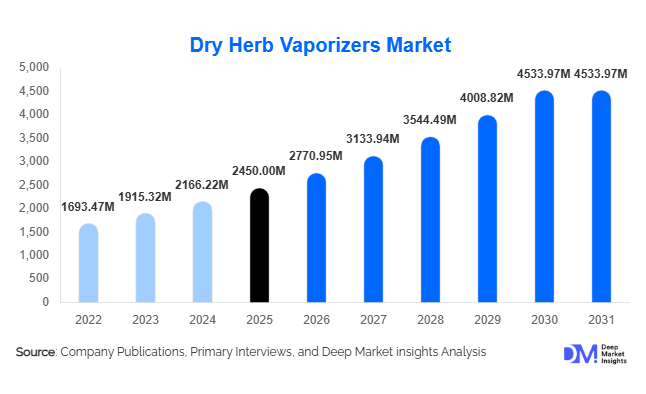
According to Deep Market Insights, the global dry herb vaporizers market size was valued at USD 2,450 million in 2025 and is projected to grow from USD 2,770.95 million in 2026 to reach USD 5,127.93 million by 2031, expanding at a CAGR of 13.1% during the forecast period (2026–2031). The dry herb vaporizers market growth is primarily driven by increasing consumer preference for smoke-free alternatives, expanding legalization of cannabis across key regions, and continuous technological advancements in vaporization devices.
Key Market Insights
- Portable vaporizers dominate the market, accounting for over 65% share due to convenience, compact design, and discreet usage.
- Hybrid heating technology is gaining traction, combining conduction and convection methods to deliver enhanced vapor quality.
- North America leads the market, supported by widespread cannabis legalization and strong retail infrastructure.
- Asia-Pacific is the fastest-growing region, driven by evolving regulations and rising awareness of herbal vaporization.
- Online retail channels dominate distribution, offering wider product selection and discreet purchasing options.
- Smart vaporizers with app integration are transforming user experience through temperature customization and usage analytics.
What are the latest trends in the dry herb vaporizers market?
Shift Toward Smart and Connected Devices
The integration of smart technologies is rapidly transforming the dry herb vaporizers market. Devices equipped with Bluetooth connectivity and mobile applications allow users to control temperature settings, monitor usage patterns, and customize vaporization profiles. This trend is particularly appealing to tech-savvy consumers who seek personalized experiences. Manufacturers are leveraging data analytics to improve product performance and enhance customer engagement. Additionally, firmware updates and AI-based optimization are emerging, enabling devices to adapt heating cycles based on user behavior, thereby improving efficiency and consistency.
Premiumization and Design Innovation
Consumers are increasingly gravitating toward premium vaporizers that offer superior build quality, advanced heating systems, and aesthetic appeal. High-end materials such as medical-grade components and precision engineering are becoming standard in premium models. Sleek, ergonomic designs combined with durability are key differentiators in a competitive market. This trend is supported by rising disposable incomes and the willingness among users to invest in high-performance devices. Premium brands are also focusing on sustainability, incorporating recyclable materials and energy-efficient technologies to appeal to environmentally conscious buyers.
What are the key drivers in the dry herb vaporizers market?
Rising Demand for Healthier Alternatives
Growing awareness of the harmful effects of combustion-based smoking is driving consumers toward vaporization technologies. Dry herb vaporizers heat plant material without burning it, reducing exposure to toxins and carcinogens. This harm-reduction benefit is a major factor influencing adoption among both recreational and medical users. Public health campaigns and increased access to information have further reinforced the perception of vaporizers as a safer alternative.
Expansion of Legal Cannabis Markets
The legalization of cannabis in countries such as the United States and Canada has significantly boosted demand for dry herb vaporizers. Regulatory frameworks are enabling the establishment of organized retail channels, including dispensaries that actively promote vaporization products. As more regions adopt progressive cannabis policies, the addressable market for vaporizers continues to expand, creating sustained growth opportunities for manufacturers.
What are the restraints for the global market?
Regulatory Uncertainty and Restrictions
Despite growth in certain regions, the market faces regulatory challenges in countries where vaping devices are restricted or banned. Inconsistent regulations create barriers to entry and limit product availability, particularly in emerging markets. Compliance with varying standards across jurisdictions also increases operational complexity for manufacturers.
High Cost of Premium Devices
Advanced vaporizers with smart features and high-quality components often come at a premium price point. This limits accessibility for price-sensitive consumers, especially in developing regions. While mid-range products are gaining traction, the high upfront cost of premium devices remains a key barrier to widespread adoption.
What are the key opportunities in the dry herb vaporizers industry?
Growth in Medical Applications
The increasing adoption of medical cannabis presents a significant opportunity for dry herb vaporizers. Patients seeking controlled dosage and reduced respiratory irritation prefer vaporizers over traditional smoking methods. Partnerships with healthcare providers and dispensaries can help manufacturers tap into this growing segment. The development of medical-grade vaporizers with precise dosing capabilities is expected to further drive demand.
Emerging Markets and Regulatory Liberalization
Countries in Latin America and the Asia-Pacific are gradually exploring cannabis legalization, particularly for medical use. These regions represent untapped markets with significant growth potential. Early entry and localization strategies can help companies establish a strong foothold as regulations evolve. Additionally, increasing awareness of herbal vaporization for non-cannabis applications is expanding the consumer base.
Report Scope
| Report Metric | Details |
|---|---|
| Market Size in 2025 | USD 2450 Million |
| Market Size in 2026 | USD 2770.95 Million |
| Market Size in 2031 | USD 5127.93 Million |
| CAGR | 13.1% (2026-2031) |
| Base Year for Estimation | 2025 |
| Historical Data | 2022-2024 |
| Forecast Period | 2026-2031 |
| Report Coverage | Revenue Forecast, Competitive Landscape, Supply Chain Disruption, Growth Factors, Environment & Regulatory Landscape and Trends |
| Geographies Covered | North America, Europe, APAC, Middle East and Africa, LATAM |
| Countries Covered | U.S., Canada, U.K., Germany, France, Spain, Italy, Russia, Nordic, Benelux, Rest of Europe, China, Korea, Japan, India, Australia, Singapore, Taiwan, South East Asia, Rest of Asia-Pacific, UAE, Turky, Saudi Arabia, South Africa, Egypt, Nigeria, Rest of MEA, Brazil, Mexico, Argentina, Chile, Colombia, Rest of LATAM |
Explore more data points, trends and opportunities Download Free Sample Report
Product Type Insights
Portable vaporizers continue to dominate the dry herb vaporizers market, accounting for approximately 68% of total revenue in 2025. This leadership position is primarily driven by increasing consumer preference for convenience, mobility, and discreet consumption. The rapid adoption of portable devices is further supported by advancements in battery efficiency, USB-C fast charging, and compact ergonomic designs, which have significantly improved usability. Additionally, younger consumer demographics and urban users favor portable vaporizers due to their compatibility with on-the-go lifestyles and ease of storage. The integration of smart features such as app connectivity and customizable temperature settings has also enhanced their appeal. In contrast, desktop vaporizers, while offering superior vapor quality, consistent heating, and enhanced flavor profiles, cater to a niche segment of experienced users and home-based consumption. Their relatively higher cost and lack of portability limit broader adoption, though they remain popular among enthusiasts seeking premium performance. Overall, innovation in portable device functionality and affordability continues to reinforce this segment’s global leadership.
Application Insights
Recreational use remains the dominant application segment, contributing approximately 62% of the global market share in 2025. This dominance is largely attributed to the increasing legalization of cannabis across North America and parts of Europe, along with growing cultural acceptance and lifestyle integration of vaporization products. The shift from traditional smoking methods to vaporization for a cleaner and more discreet experience is a key driver within this segment. However, the medical application segment is witnessing the fastest growth, supported by expanding medical cannabis programs and rising awareness of vaporization as a safer delivery method. Vaporizers are increasingly used in treatments for chronic pain, anxiety disorders, epilepsy, and other neurological conditions due to their ability to deliver controlled dosages with reduced respiratory irritation. Healthcare endorsements and clinical research supporting vaporization are further strengthening this segment. As regulatory frameworks continue to evolve globally, the medical segment is expected to significantly narrow the gap with recreational usage in the coming years.
Distribution Channel Insights
Online retail channels account for nearly 55% of the market share, making them the leading distribution segment. This growth is driven by the increasing penetration of e-commerce platforms, consumer preference for discreet purchasing, and access to a broader range of products compared to physical stores. Online platforms enable users to compare features, read customer reviews, and benefit from competitive pricing, which enhances purchasing confidence. Additionally, direct-to-consumer (D2C) brand websites are gaining traction, allowing manufacturers to build stronger customer relationships and offer exclusive product lines. Offline channels, including specialty vape stores, head shops, and dispensaries, continue to play a crucial role, particularly for first-time users who require product demonstrations and expert guidance. The growing adoption of omnichannel strategies, integrating online convenience with offline experience, is further optimizing customer engagement and expanding market reach. Retailers are increasingly leveraging digital marketing and influencer collaborations to drive traffic across both channels.
End-Use Insights
The recreational segment remains the primary end-use category, driven by widespread adoption among lifestyle users and increasing legalization trends. However, the medical segment is the fastest-growing, with a CAGR exceeding 15%, reflecting a significant shift toward therapeutic applications. The global medical cannabis market, valued at over USD 15 billion in 2025, is a major catalyst for vaporizer demand, as patients seek safer and more efficient consumption methods. Vaporizers are particularly favored for their ability to provide precise dosage control and minimize harmful byproducts, making them suitable for long-term medical use. Emerging applications in wellness, including herbal therapy and aromatherapy, are also contributing to market expansion, especially in regions with strict cannabis regulations. Furthermore, export-driven demand is becoming increasingly important, with North America acting as a key manufacturing and export hub supplying vaporizers to Europe, Latin America, and parts of Asia where domestic production is limited.
Explore more data points, trends and opportunities Download Free Sample Report
Dry Herb Vaporizers Market Segmentations
By Product Type
- Portable Dry Herb Vaporizers
- Desktop Dry Herb Vaporizers
By Heating Method
- Conduction Vaporizers
- Convection Vaporizers
- Hybrid Vaporizers
By Temperature Control
- Preset Temperature Vaporizers
- Variable Temperature Vaporizers
- Smart/App-Controlled Vaporizers
By Application
- Recreational Use
- Medical Use
By Distribution Channel
- Online Retail
- Specialty Vape Stores
- Head Shops
- Dispensaries
Regional Insights
North America
North America dominates the global dry herb vaporizers market, accounting for approximately 42% of the total market share in 2025. The United States represents the largest contributor, driven by the widespread legalization of both medical and recreational cannabis across multiple states. A well-established retail ecosystem, including dispensaries and online platforms, supports strong product accessibility. High consumer awareness regarding harm reduction, coupled with significant disposable income levels, further drives adoption. Additionally, the presence of leading vaporizer manufacturers and continuous product innovation strengthens regional growth. Canada also contributes significantly, supported by nationwide legalization and a mature regulatory framework that encourages product standardization and quality assurance.
Europe
Europe holds approximately 25% of the global market share, with Germany, the United Kingdom, and the Netherlands serving as key markets. Germany, in particular, is emerging as a major hub for medical cannabis, supported by government-backed healthcare programs and increasing patient enrollment. The region’s growth is driven by rising acceptance of vaporization as a safer alternative to smoking, along with stricter regulations on tobacco consumption. Additionally, increasing focus on wellness and herbal consumption in non-cannabis applications is expanding the addressable market. Regulatory harmonization across the European Union and improved distribution networks are further supporting regional expansion, although varying country-level policies still pose challenges.
Asia-Pacific
Asia-Pacific is the fastest-growing region, with a projected CAGR exceeding 16%. Growth in this region is driven by rising disposable incomes, rapid urbanization, and increasing awareness of alternative consumption methods for herbs and wellness products. Countries such as Australia and Thailand are gradually liberalizing cannabis laws, particularly for medical use, creating new growth avenues. Japan represents a unique market where demand is primarily driven by non-cannabis herbal vaporizers due to strict regulations. Additionally, the region benefits from strong manufacturing capabilities, particularly in China, which serves as a global production hub for vaporizer components and devices. Expanding e-commerce penetration is also facilitating market growth across the region.
Latin America
Latin America is an emerging market with growing demand in countries such as Brazil and Mexico. The region’s growth is primarily driven by evolving medical cannabis regulations and increasing public awareness regarding vaporization benefits. Government initiatives aimed at legalizing and regulating cannabis for therapeutic use are creating a favorable environment for market entry. Additionally, a growing middle-class population and increasing healthcare investments are supporting adoption. While the market is still in its early stages, improving regulatory clarity and rising imports of vaporization devices are expected to drive steady growth in the coming years.
Middle East & Africa
The Middle East & Africa region remains relatively nascent but presents significant long-term potential. Countries such as Israel and South Africa are key contributors, with Israel leading in medical cannabis research and innovation. This has created a strong foundation for vaporizer adoption in clinical and therapeutic applications. In Africa, gradual regulatory developments and increasing awareness are opening new markets, particularly in South Africa. In the Middle East, high disposable incomes and growing interest in wellness products are driving niche demand, although strict regulations limit widespread adoption. Over time, regulatory easing and increased investment in healthcare infrastructure are expected to unlock growth opportunities in this region.
Key Players in the Dry Herb Vaporizers Market
- Storz & Bickel
- Pax Labs
- DaVinci Vaporizers
- Arizer
- Boundless Technology
- Firefly Vapor
- Grenco Science (G Pen)
- Vapium
- Flowermate
- KandyPens
- XVape
- DynaVap
- AirVape
- Healthy Rips
- Linx Vapor