Down Alternative Mattresses Market Size
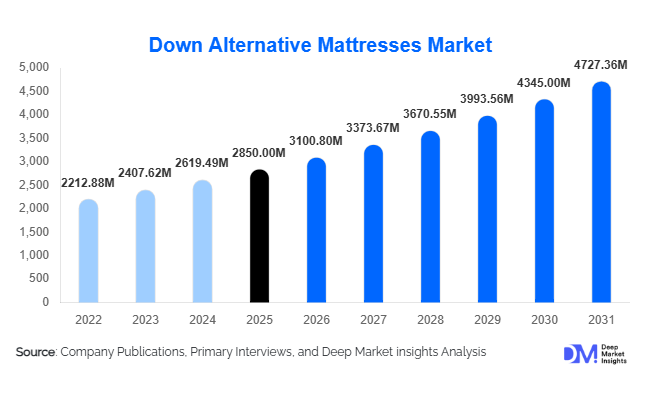
According to Deep Market Insights, the global down alternative mattresses market size was valued at USD 2,850 million in 2025 and is projected to grow from USD 3,100.80 million in 2026 to reach USD 4,727.36 million by 2031, expanding at a CAGR of 8.8% during the forecast period (2026–2031). The down alternative mattresses market growth is primarily driven by increasing consumer preference for hypoallergenic and cruelty-free bedding solutions, the rapid expansion of direct-to-consumer mattress brands, and rising awareness around sleep health and wellness.
Down alternative mattresses use synthetic microfiber or hollow fiber materials engineered to mimic the softness and loft of natural down without the allergen risks associated with feather bedding. The growing vegan and sustainable living movement is encouraging consumers to choose bedding products that avoid animal-derived materials, creating strong demand for down alternative options.
Advancements in synthetic fiber engineering have significantly improved breathability, durability, and pressure-relief properties, making down alternative mattresses competitive with memory foam and latex alternatives. Additionally, the rise of online mattress brands and bed-in-a-box shipping models has lowered distribution costs and improved accessibility for consumers worldwide. Growth in the hospitality sector and short-term rental industry is further accelerating adoption, as hotels and serviced apartments prefer hypoallergenic bedding materials that are easier to maintain and replace. As sleep wellness and sustainable consumer behavior continue to shape purchasing patterns, the down alternative mattresses market is expected to expand steadily across residential and commercial bedding segments.
Key Market Insights
- Demand for hypoallergenic bedding solutions is rising globally, driven by increasing allergy awareness and preference for dust-mite-resistant mattress materials.
- Direct-to-consumer online mattress brands are expanding rapidly, transforming the mattress retail model through compressed shipping and trial-based purchases.
- North America dominates the global market, supported by strong consumer spending on premium sleep products and widespread adoption of vegan bedding alternatives.
- Asia-Pacific is the fastest-growing regional market, fueled by urbanization, rising disposable incomes, and the growth of e-commerce mattress brands.
- Hospitality and short-term rental industries are increasing adoption, as down alternative mattresses offer lower maintenance costs and allergen-free sleep environments.
- Technological innovations in fiber materials, including recycled polyester and gel-infused synthetic fibers, are improving durability and thermal regulation.
What are the latest trends in the down alternative mattresses market?
Growing Demand for Vegan and Cruelty-Free Bedding
One of the most prominent trends shaping the down alternative mattresses market is the increasing demand for vegan bedding products. Consumers are becoming more conscious of ethical sourcing practices and animal welfare issues associated with traditional down harvesting. As a result, mattress manufacturers are investing in advanced synthetic fiber technologies designed to replicate the softness and insulation properties of natural down without using animal materials.
Retailers are also highlighting cruelty-free certifications and sustainable sourcing practices in their marketing strategies to attract environmentally conscious consumers. Many brands now offer fully vegan mattress collections alongside other eco-friendly bedding products such as organic cotton covers and recycled fiber fillings. This trend is particularly strong in North America and Europe, where consumer awareness around sustainability and ethical consumption is rapidly increasing.
Rise of Bed-in-a-Box and Direct-to-Consumer Mattress Brands
The growth of e-commerce and direct-to-consumer mattress brands has significantly reshaped the bedding industry. Down alternative mattresses are particularly well-suited to compressed packaging and bed-in-a-box delivery due to their lightweight fiber construction. This enables manufacturers to ship products directly to customers while minimizing logistics costs.
Online mattress brands are leveraging digital marketing, customer reviews, and extended trial periods to attract consumers who prefer purchasing mattresses online rather than visiting physical retail stores. The convenience of home delivery, combined with flexible return policies, has accelerated the adoption of down alternative mattresses among younger consumers and urban households.
What are the key drivers in the down alternative mattresses market?
Increasing Awareness of Sleep Health and Wellness
Global awareness of the importance of sleep quality has increased significantly in recent years. Medical research has linked poor sleep to a variety of health issues, including stress, obesity, and cardiovascular diseases. As a result, consumers are investing more in high-quality bedding products designed to improve sleep comfort and spinal alignment.
Down alternative mattresses offer soft pressure relief while maintaining structural support, making them attractive for individuals seeking improved sleep posture and overall wellness. Marketing campaigns by mattress manufacturers emphasizing ergonomic design and improved sleep quality have further strengthened demand.
Expansion of the Hospitality and Short-Term Rental Industry
The hospitality sector is another major driver of market growth. Hotels, resorts, and serviced apartments require bedding solutions that combine comfort, durability, and allergen control. Down alternative mattresses meet these requirements while being more cost-effective to maintain compared with natural down bedding.
The rapid expansion of short-term rental platforms has also increased demand for durable bedding products that can accommodate frequent guest turnover. Property managers prefer mattresses that offer consistent comfort while being easy to clean and replace.
What are the restraints for the global market?
Durability Concerns Compared to Foam-Based Mattresses
Despite improvements in fiber engineering, some consumers perceive down alternative mattresses as less durable compared to memory foam or latex mattresses. Over time, fiber fillings may compress or lose loft, particularly in lower-priced products. This perception can discourage buyers seeking long-term mattress durability.
Fluctuating Synthetic Fiber Raw Material Prices
The production of down alternative mattress fillings relies heavily on polyester and other petrochemical-based polymers. Volatility in oil prices and supply chain disruptions can increase manufacturing costs and impact profit margins for mattress producers.
What are the key opportunities in the down alternative mattresses industry?
Integration of Advanced Cooling and Smart Bedding Technologies
Manufacturers are increasingly integrating temperature-regulating technologies into mattress designs. Down alternative fiber layers can be combined with cooling gels, breathable polymer fabrics, and phase-change materials to enhance thermal comfort. This innovation creates opportunities for premium mattress categories that address common consumer complaints related to heat retention during sleep.
Additionally, smart bedding technologies such as sleep monitoring sensors and modular comfort layers are being incorporated into next-generation mattress products. These innovations allow consumers to personalize their sleep experience, creating opportunities for higher-margin product offerings.
Growing Demand from Hospitality and Institutional Buyers
Hotels, healthcare facilities, and institutional housing such as student dormitories are increasingly adopting hypoallergenic bedding materials. Down alternative mattresses are ideal for these environments because they reduce the risk of allergen exposure while offering comfort comparable to natural down products.
As global tourism and healthcare infrastructure continue to expand, institutional procurement of bedding products is expected to generate significant demand for down alternative mattresses.
Report Scope
| Report Metric | Details |
|---|---|
| Market Size in 2025 | USD 2850 Million |
| Market Size in 2026 | USD 3100.80 Million |
| Market Size in 2031 | USD 4727.36 Million |
| CAGR | 8.8% (2026-2031) |
| Base Year for Estimation | 2025 |
| Historical Data | 2022-2024 |
| Forecast Period | 2026-2031 |
| Report Coverage | Revenue Forecast, Competitive Landscape, Supply Chain Disruption, Growth Factors, Environment & Regulatory Landscape and Trends |
| Geographies Covered | North America, Europe, APAC, Middle East and Africa, LATAM |
| Countries Covered | U.S., Canada, U.K., Germany, France, Spain, Italy, Russia, Nordic, Benelux, Rest of Europe, China, Korea, Japan, India, Australia, Singapore, Taiwan, South East Asia, Rest of Asia-Pacific, UAE, Turky, Saudi Arabia, South Africa, Egypt, Nigeria, Rest of MEA, Brazil, Mexico, Argentina, Chile, Colombia, Rest of LATAM |
Explore more data points, trends and opportunities Download Free Sample Report
Product Construction Insights
Hybrid down alternative mattresses dominate the global market, accounting for nearly 38% of total revenue in 2025. These mattresses combine synthetic microfiber comfort layers with foam, latex, or pocket-spring support systems to deliver the plush softness associated with down while maintaining long-term structural stability and pressure relief. The segment’s leadership is primarily driven by consumer demand for mattresses that balance cushioning comfort with proper spinal support. Hybrid designs also offer improved airflow and durability compared with pure fiber mattresses, making them particularly attractive to households seeking mid-range and premium bedding solutions.
Pure fiber mattresses represent a smaller share of the market but remain significant in entry-level product categories due to their affordability, lightweight construction, and easy transportation. These mattresses are particularly popular in emerging markets and among temporary housing setups such as student dormitories and rental accommodations. Meanwhile, pillow-top and Euro-top fiber mattresses are gaining traction in the premium segment, especially in luxury hospitality environments where additional cushioning and plush comfort are important differentiators for guest satisfaction.
Material Type Insights
Polyester microfiber remains the most widely used filling material in down alternative mattresses, representing approximately 46% of the global market. Its dominance is attributed to its ability to replicate the softness, loft, and insulation properties of natural down at a significantly lower cost. Polyester microfiber is also highly durable, lightweight, and resistant to moisture absorption, which improves the longevity and hygiene of mattresses. The material’s hypoallergenic characteristics make it particularly attractive to consumers who suffer from dust mite or feather allergies.
Siliconized hollow fibers represent another important segment within the market. These fibers undergo a silicone coating process that reduces friction between individual fibers, preventing clumping and maintaining consistent loft over time. This improves mattress resilience and comfort durability. Additionally, recycled polyester fibers are gaining traction as sustainability becomes a key purchasing factor for environmentally conscious consumers and hospitality operators seeking eco-certified bedding solutions.
Firmness Level Insights
Medium-firm mattresses account for approximately 41% of global demand, making them the most widely preferred firmness level across the down alternative mattresses market. This segment’s leadership is largely driven by medical recommendations from orthopedic specialists who advocate medium-firm surfaces for optimal spinal alignment and pressure distribution during sleep. These mattresses offer a balanced feel that combines sufficient cushioning with adequate support, making them suitable for a broad range of sleeping positions.
The versatility of medium-firm mattresses makes them particularly attractive for hospitality operators and institutional buyers. Hotels often select medium-firm mattresses because they accommodate a wide variety of guest preferences, reducing the need for multiple mattress types across rooms. Similarly, healthcare facilities favor medium-firm mattresses for their ability to provide both comfort and support for patients. Soft mattresses continue to appeal to consumers seeking plush comfort, especially in luxury bedding collections. On the other hand, firm mattresses remain popular among consumers with back pain concerns and among institutional buyers such as hospitals and rehabilitation centers that require higher levels of support.
Distribution Channel Insights
Direct-to-consumer online sales represent the largest distribution channel for down alternative mattresses, accounting for nearly 39% of global market revenue. The rapid growth of this channel is largely attributed to the rise of digital mattress brands that sell products directly to consumers through e-commerce platforms. These brands leverage targeted digital advertising, influencer marketing, and extended trial periods to build consumer trust and reduce barriers to online mattress purchases. One of the major advantages of down alternative mattresses within the e-commerce channel is their compatibility with bed-in-a-box packaging models. The lightweight nature of synthetic fiber fillings allows manufacturers to compress and ship mattresses efficiently, reducing logistics costs and enabling global distribution through online channels.
Despite the growth of e-commerce, specialty bedding retailers and furniture stores remain important distribution channels, particularly for premium mattress categories. Many consumers prefer to physically test mattresses before purchasing, especially in higher price segments. As a result, omnichannel retail strategies, combining online sales with physical showrooms, are becoming increasingly common among leading mattress manufacturers.
End-Use Insights
The residential sector dominates the down alternative mattresses market, accounting for approximately 63% of total demand in 2025. Growth within this segment is driven by rising consumer spending on home comfort products, increasing awareness of sleep health, and the growing popularity of sustainable and hypoallergenic bedding solutions. The shift toward remote and hybrid working lifestyles has also encouraged consumers to invest more in home furnishings, including high-quality mattresses.
The hospitality industry represents the fastest-growing end-use segment within the market. Global tourism recovery and the expansion of luxury hotels, resorts, and serviced apartments are driving demand for durable and comfortable bedding products. Down alternative mattresses are particularly attractive for hospitality operators due to their allergen-resistant properties, ease of maintenance, and cost efficiency compared with traditional down bedding. Healthcare facilities and assisted living centers are also increasingly adopting down alternative mattresses. These environments prioritize hygiene, allergen control, and easy sanitation, making synthetic fiber mattresses an ideal solution. The aging global population and expansion of healthcare infrastructure are expected to drive long-term demand from this segment.
Explore more data points, trends and opportunities Download Free Sample Report
Down Alternative Mattresses Market Segmentations
By Material
- Cotton
- Wool
- Polyester
- Bamboo
- Silk
- Others (Kapok, Blended Fibers, etc.)
By Size
- Queen Size
- Twin or Single Size
- Twin XL Size
- Full or Double Size
- Others
By End Use
- Residential
- Commercial
- Hotels
- Hospitals
- Others (Educational Institutions, etc.)
By Distribution Channel
- Online / E-commerce Websites
- Company-Owned Websites
- Hypermarkets & Supermarkets
- Specialty Bedding Stores
- Other Retail Stores
Regional Insights
North America
North America accounts for approximately 34% of the global down alternative mattresses market, making it the largest regional market. The United States represents the dominant contributor to regional demand due to strong consumer spending on premium bedding products and a highly developed mattress retail ecosystem. The rapid growth of direct-to-consumer mattress brands and bed-in-a-box distribution models has significantly expanded the availability of down alternative mattresses in the region.
Another major growth driver in North America is the rising consumer preference for hypoallergenic and vegan bedding products. Increasing awareness about feather allergies and animal welfare concerns has encouraged many consumers to shift from natural down to synthetic alternatives. Additionally, the expansion of short-term rental platforms and hospitality infrastructure across the United States and Canada is generating steady demand for durable bedding solutions.
Europe
Europe holds nearly 27% of the global market, with major demand originating from Germany, the United Kingdom, France, and Italy. Consumers in this region place a strong emphasis on product quality, sustainability, and environmental responsibility, which has encouraged manufacturers to introduce eco-friendly down alternative mattresses made with recycled fibers and organic fabrics.
Regulatory frameworks promoting sustainable manufacturing and circular economy practices are also influencing the market. Many European mattress producers are investing in recyclable materials and low-emission production processes to comply with environmental standards. Additionally, the growth of premium hospitality and boutique hotels across Europe is creating strong demand for high-quality bedding products.
Asia-Pacific
Asia-Pacific is the fastest-growing regional market, with a projected CAGR exceeding 10%. China dominates regional demand due to its large bedding manufacturing base and rapidly expanding middle-class population. Increasing urbanization and rising disposable incomes have significantly boosted consumer spending on home furnishings, including mattresses.
India and Southeast Asian countries such as Indonesia, Vietnam, and Thailand are also witnessing strong growth. The rise of online mattress startups and e-commerce platforms has improved access to modern bedding products across these markets. Furthermore, rapid expansion in the hospitality sector and increasing residential construction activities are driving demand for affordable and durable mattress solutions.
Latin America
Latin America accounts for approximately 8% of global demand, with Brazil and Mexico representing the largest regional markets. Economic development and expanding middle-class populations are contributing to rising consumer spending on home furnishing products. Additionally, tourism growth and hospitality infrastructure development across major urban centers and coastal destinations are supporting demand for bedding products.
The region is also experiencing increasing penetration of international mattress brands through online retail channels. As e-commerce adoption continues to expand across Latin America, consumers are gaining access to a wider variety of bedding products, including down alternative mattresses.
Middle East & Africa
The Middle East and Africa region is experiencing steady growth driven primarily by the expansion of luxury tourism and hospitality infrastructure. Countries such as the United Arab Emirates and Saudi Arabia are investing heavily in hotel development, entertainment complexes, and tourism megaprojects, which is increasing demand for high-quality bedding solutions.
Government initiatives aimed at diversifying national economies through tourism development, such as Saudi Arabia’s large-scale tourism investment programs, are also contributing to increased demand for hospitality bedding products. In addition, rising urbanization and residential construction in African economies such as South Africa and Kenya are gradually expanding the consumer market for mattresses across the region.
Key Players in the Down Alternative Mattresses Market
- Tempur Sealy International
- Serta Simmons Bedding
- Sleep Number Corporation
- Purple Innovation
- Kingsdown Inc.
- Spring Air International
- Paramount Bed Holdings
- Southerland Sleep
- Corsicana Mattress Company
- Therapedic International
- Restonic Mattress Corporation
- Relyon Beds
- Silentnight Group
- Ashley Furniture Industries
- MLILY Home Technology