Door Handles Market Size
According to Deep Market Insights, the global door handles market size was valued at USD 9,850 million in 2025 and is projected to grow from USD 10,559.20 million in 2026 to reach USD 13,944.73 million by 2031, expanding at a CAGR of 7.2% during the forecast period (2026–2031). The market growth is primarily driven by rising construction activities, increasing demand for aesthetic and functional architectural hardware, and the growing adoption of smart and connected door handle systems. The transition from conventional hardware to technologically integrated and design-oriented solutions is reshaping demand patterns globally.
Key Market Insights
- Smart and connected door handles are gaining rapid traction, particularly in residential and commercial applications, driven by increasing security and convenience needs.
- Residential construction dominates demand, accounting for over half of total market consumption due to urbanization and housing expansion.
- Asia-Pacific leads the global market, supported by large-scale infrastructure development and growing middle-class housing demand.
- Stainless steel remains the most preferred material, owing to its durability, corrosion resistance, and cost-effectiveness.
- OEM distribution channels dominate, driven by bulk procurement in construction and real estate projects.
- Mid-range products hold the largest share, balancing affordability and quality, especially in emerging markets.
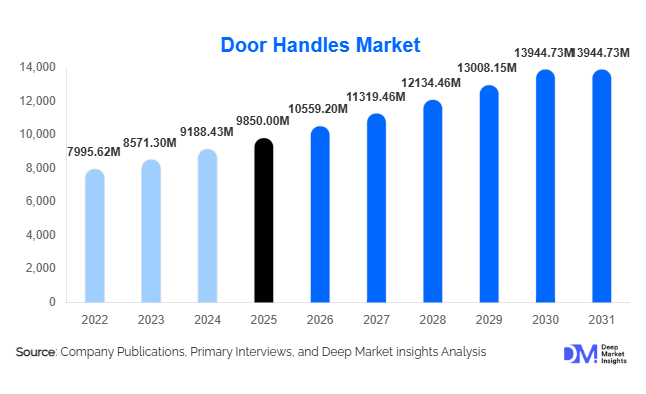
What are the latest trends in the door handles market?
Shift Toward Smart and IoT-Enabled Door Handles
The integration of smart technologies into door handles is one of the most transformative trends in the market. Features such as biometric authentication, RFID access, mobile app control, and cloud-based monitoring are increasingly being incorporated into premium and mid-range offerings. These solutions are widely adopted in smart homes, hospitality, and commercial spaces where security and convenience are critical. Manufacturers are investing in interoperability with home automation systems, enabling seamless integration with broader smart ecosystems. Additionally, cybersecurity features are becoming a key differentiator as digital locks become more prevalent.
Rising Demand for Aesthetic and Customized Designs
Consumers are increasingly viewing door handles as design elements rather than purely functional hardware. Demand for customized finishes, ergonomic shapes, and premium materials such as brass and glass is growing, particularly in luxury residential and commercial segments. Interior designers and architects are influencing purchasing decisions, leading to greater emphasis on visual appeal and brand differentiation. Matte finishes, minimalist designs, and antique styles are trending globally, reflecting evolving architectural preferences.
What are the key drivers in the door handles market?
Growth in Global Construction and Real Estate Sector
The expansion of residential and commercial construction is the primary driver of the door handles market. Rapid urbanization in emerging economies, coupled with infrastructure modernization in developed regions, is generating significant demand. Government housing initiatives and smart city projects are further accelerating consumption of door hardware products across multiple segments.
Increasing Adoption of Smart Security Solutions
Rising concerns over safety and security are driving demand for advanced locking mechanisms integrated with door handles. Smart locks and digital handles are gaining popularity in both residential and commercial sectors. The hospitality industry, in particular, is adopting keyless entry systems to enhance customer experience and operational efficiency.
Growing Preference for Premium and Durable Materials
Consumers and businesses are prioritizing durability, hygiene, and aesthetics, leading to increased demand for high-quality materials such as stainless steel and zinc alloys. Post-pandemic awareness has also boosted demand for antimicrobial coatings and touch-resistant surfaces, especially in healthcare and public infrastructure.
What are the restraints for the global market?
Price Sensitivity in Emerging Economies
Despite growing demand, affordability remains a major challenge in price-sensitive markets. Many consumers in developing regions prefer low-cost alternatives, limiting the penetration of premium and smart door handle solutions. This creates pressure on manufacturers to balance cost and quality.
Volatility in Raw Material Prices
Fluctuations in prices of key raw materials such as stainless steel, aluminum, and brass significantly impact production costs and profit margins. Manufacturers often face challenges in maintaining stable pricing, which can affect competitiveness and long-term planning.
What are the key opportunities in the door handles industry?
Expansion in Emerging Construction Markets
Rapid urban development in Asia-Pacific, Africa, and Latin America presents strong growth opportunities. Government-led housing programs and infrastructure investments are driving large-scale demand for door hardware. Companies that localize manufacturing and offer cost-effective solutions tailored to these markets can gain a competitive advantage.
Sustainability and Green Building Integration
Increasing focus on sustainability is creating demand for eco-friendly door handle solutions. Products made from recycled materials, low-emission coatings, and energy-efficient manufacturing processes are gaining traction. Compliance with green building certifications is becoming a key factor in procurement decisions, particularly in developed regions.
Report Scope
| Report Metric | Details |
|---|---|
| Market Size in 2025 | USD 9850 Million |
| Market Size in 2026 | USD 10559.20 Million |
| Market Size in 2031 | USD 13944.73 Million |
| CAGR | 7.2% (2026-2031) |
| Base Year for Estimation | 2025 |
| Historical Data | 2022-2024 |
| Forecast Period | 2026-2031 |
| Report Coverage | Revenue Forecast, Competitive Landscape, Supply Chain Disruption, Growth Factors, Environment & Regulatory Landscape and Trends |
| Geographies Covered | North America, Europe, APAC, Middle East and Africa, LATAM |
| Countries Covered | U.S., Canada, U.K., Germany, France, Spain, Italy, Russia, Nordic, Benelux, Rest of Europe, China, Korea, Japan, India, Australia, Singapore, Taiwan, South East Asia, Rest of Asia-Pacific, UAE, Turky, Saudi Arabia, South Africa, Egypt, Nigeria, Rest of MEA, Brazil, Mexico, Argentina, Chile, Colombia, Rest of LATAM |
Explore more data points, trends and opportunities Download Free Sample Report
Product Type Insights
Lever handles dominate the global door handles market with approximately 38% share in 2025, primarily driven by their superior ergonomic design, ease of operation, and compliance with accessibility standards across residential, commercial, and institutional environments. Their widespread adoption is further supported by building regulations in developed regions that favor lever-style handles for safety and inclusivity, particularly in healthcare and public infrastructure. Knob handles continue to maintain relevance in traditional and low-cost residential applications, especially in emerging markets where affordability remains a key consideration. Pull handles are increasingly preferred in commercial spaces, including offices, retail outlets, and glass door installations, due to their modern aesthetics and suitability for high-traffic environments. Meanwhile, smart door handles are the fastest-growing segment, driven by rising demand for integrated security solutions, smart homes, and contactless access systems. Push plates and pad handles serve niche industrial and institutional applications, particularly in heavy-duty environments, contributing to product diversification and specialized demand.
Application Insights
The residential segment leads the market with around 52% share, driven by large-scale housing construction, urbanization, and increasing renovation activities across both developed and emerging economies. The growing trend of home improvement and interior design customization is further boosting demand for aesthetically appealing and durable door handles. Commercial applications, including offices, retail spaces, hospitality, and healthcare, are expanding at a faster pace due to rising infrastructure investments and modernization of existing facilities. Demand in this segment is also supported by the need for compliance with safety, hygiene, and accessibility standards. Industrial applications, though smaller in overall share, require robust and specialized door handle solutions capable of withstanding harsh operating conditions in manufacturing plants, warehouses, and logistics hubs. Additionally, emerging applications in smart buildings, co-working spaces, and healthcare facilities, particularly those requiring antimicrobial and touchless solutions, are significantly broadening the scope of demand.
Distribution Channel Insights
OEM channels dominate the market, accounting for approximately 57% of total demand, as construction companies, contractors, and real estate developers procure door handles in bulk during new building projects. The dominance of this segment is driven by large-scale infrastructure development and long-term supply agreements with manufacturers. The aftermarket segment continues to play a crucial role, supported by renovation, repair, and replacement activities, particularly in mature markets such as North America and Europe. E-commerce is emerging as a rapidly growing distribution channel, fueled by increasing digital adoption, competitive pricing, and wider product availability. Online platforms are particularly attractive to individual consumers, interior designers, and small contractors, enabling easy comparison of designs, materials, and price points, thereby reshaping traditional distribution dynamics.
Price Segment Insights
The mid-range segment holds the largest share at around 48%, driven by its optimal balance between cost, durability, and design. This segment is particularly dominant in emerging markets where consumers seek value-for-money solutions without compromising on quality. Economy products cater primarily to price-sensitive customers and large-scale low-cost housing projects, especially in developing regions. In contrast, the premium and luxury segments are witnessing strong growth, supported by increasing demand for high-end materials, designer finishes, and technologically advanced features such as smart locking systems. The premium segment is particularly prominent in developed markets and urban centers, where consumers are willing to pay higher prices for enhanced aesthetics, brand value, and integrated security solutions.
Explore more data points, trends and opportunities Download Free Sample Report
Door Handles Market Segmentations
By Product Type
- Lever Handles
- Knob Handles
- Pull Handles
- Push Plates & Pad Handles
- Smart/Digital Door Handles
By Material Type
- Stainless Steel
- Aluminum
- Brass
- Zinc Alloy
- Plastic/Composite
- Glass/Wood
By Application
- Residential
- Commercial
- Industrial
By Distribution Channel
- OEM
- Aftermarket
- E-commerce
By Price Segment
- Economy
- Mid-range
- Premium/Luxury
Regional Insights
Asia-Pacific
Asia-Pacific dominates the global door handles market with approximately 42% share in 2025, making it the largest and fastest-growing regional market. China leads the region, contributing around 22% of global demand, driven by extensive construction activity, strong manufacturing capabilities, and large-scale urbanization. India is the fastest-growing country in the region, with a CAGR of approximately 9%, supported by government housing initiatives, infrastructure development programs, and increasing residential demand. Southeast Asian countries such as Indonesia, Vietnam, and Thailand are also experiencing robust growth due to rising foreign investments and expanding urban populations. The key drivers for regional growth include rapid urbanization, government-backed infrastructure projects, and the availability of low-cost manufacturing, which also positions the region as a major export hub.
North America
North America accounts for around 23% of the global market, with the United States being the dominant contributor. The region’s growth is primarily driven by strong renovation and remodeling activities, as well as high adoption of smart home technologies and advanced security solutions. Demand for premium and designer door handles is significantly higher in this region, reflecting consumer preference for aesthetics and functionality. Canada also contributes to regional growth through residential construction and commercial infrastructure upgrades. Key growth drivers include technological adoption, increasing demand for smart and connected devices, and a well-established construction industry focused on modernization and sustainability.
Europe
Europe holds approximately 20% market share, with major markets including Germany, the UK, France, and Italy. The region is characterized by high demand for aesthetically sophisticated and environmentally sustainable products. Stringent regulatory standards related to building safety, accessibility, and environmental sustainability are key drivers influencing product innovation and adoption. Additionally, the strong presence of the architectural and interior design industries supports demand for premium and customized door handles. Growth in renovation projects and green building initiatives further accelerates market expansion across the region.
Latin America
Latin America exhibits moderate growth, led by Brazil and Mexico, which are the primary contributors to regional demand. While economic fluctuations pose challenges to construction activity, ongoing urbanization and housing needs continue to support steady growth. Government initiatives aimed at improving housing infrastructure and increasing foreign investments in commercial real estate are also contributing to demand. The key drivers in this region include urban population growth, gradual economic recovery, and increasing investments in residential and commercial construction projects.
Middle East & Africa
The Middle East and Africa region is witnessing notable growth, driven by large-scale infrastructure and real estate development projects in countries such as the UAE and Saudi Arabia. Mega projects, including smart cities and tourism infrastructure developments, are significantly boosting demand for high-quality and technologically advanced door handle solutions. In Africa, countries like South Africa and Nigeria are experiencing gradual growth due to urbanization and improving construction activity. Key regional drivers include government-led infrastructure investments, increasing focus on smart city development, and rising demand for premium construction materials in the commercial and hospitality sectors.