Document Scanner Market Size
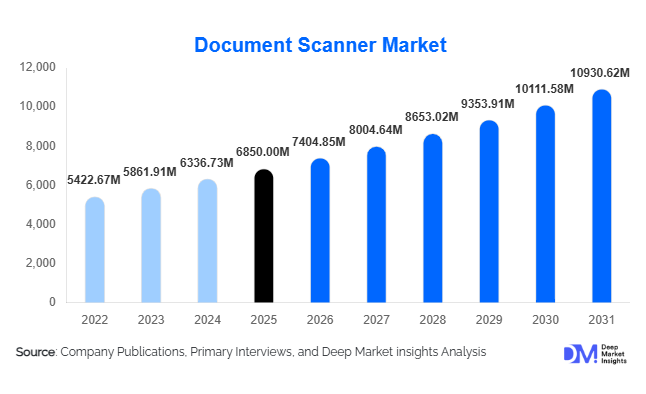
According to Deep Market Insights, the global document scanner market size was valued at USD 6,850 million in 2025 and is projected to grow from USD 7,404.85 million in 2026 to reach USD 10,930.62 million by 2031, expanding at a CAGR of 8.1% during the forecast period (2026–2031). The document scanner market growth is primarily driven by rapid enterprise digitization, increasing regulatory compliance requirements, and the growing need for efficient document management systems across industries such as BFSI, healthcare, and government.
Key Market Insights
- Document digitization initiatives across governments and enterprises are significantly accelerating demand for high-speed and network-enabled scanners.
- Cloud-connected and AI-integrated scanners are gaining traction, transforming traditional hardware into intelligent data capture systems.
- North America dominates the global market, supported by advanced IT infrastructure and early adoption of paperless workflows.
- Asia-Pacific is the fastest-growing region, driven by government-led digitization programs and expanding enterprise sectors in China and India.
- BFSI and healthcare sectors are primary demand drivers, due to strict compliance and documentation requirements.
- Portable and wireless scanners are increasingly preferred, particularly in remote work and SME environments.
What are the latest trends in the document scanner market?
AI-Powered Intelligent Document Processing
The integration of artificial intelligence (AI) and machine learning into document scanners is redefining the market landscape. Modern scanners are evolving beyond simple image capture devices to intelligent systems capable of extracting, classifying, and validating data in real time. Optical character recognition (OCR), natural language processing, and automated workflow integration are enabling businesses to process large volumes of documents with minimal manual intervention. This trend is particularly strong in BFSI and healthcare sectors, where accuracy and compliance are critical. Vendors are increasingly offering bundled solutions combining hardware with intelligent document processing software, enabling recurring revenue models and higher value capture.
Shift Toward Cloud-Connected and Mobile Scanning
The growing adoption of cloud computing is driving demand for scanners that seamlessly integrate with cloud platforms. Cloud-connected scanners allow users to scan, store, and access documents from anywhere, supporting distributed and hybrid work environments. Portable and mobile scanners are also gaining popularity among SMEs and field-based professionals who require flexible and compact solutions. This trend is further supported by the proliferation of SaaS-based document management systems, which rely on seamless document capture and integration. Enhanced connectivity features such as Wi-Fi, mobile app integration, and direct cloud uploads are becoming standard across mid-range and high-end devices.
What are the key drivers in the document scanner market?
Rapid Enterprise Digital Transformation
Organizations across industries are increasingly adopting digital transformation strategies to improve efficiency, reduce operational costs, and enhance data accessibility. Document scanners play a crucial role in enabling the transition from paper-based workflows to digital systems. Enterprises are investing in high-speed and network-enabled scanners to digitize legacy records and streamline business processes. This driver is particularly prominent in sectors such as BFSI, healthcare, and government, where large volumes of documents are generated and managed daily.
Regulatory Compliance and Data Management Requirements
Strict regulatory frameworks across industries are driving the need for efficient document capture and storage solutions. Financial institutions, healthcare providers, and legal firms are required to maintain accurate and accessible records for compliance and audit purposes. Document scanners enable organizations to digitize and securely store records, ensuring compliance with data protection and recordkeeping regulations. This has led to sustained demand for advanced scanning solutions with enhanced security and data management capabilities.
What are the restraints for the global market?
Declining Paper Usage in Digital-Native Environments
As organizations increasingly adopt digital-first workflows, the reliance on physical documents is gradually decreasing. Digital-native companies often generate and manage data electronically, reducing the need for scanning hardware. This trend may limit long-term demand growth in certain segments of the market, particularly among technology-driven enterprises.
High Initial Cost of Advanced Scanning Systems
Advanced document scanners, particularly high-speed and AI-enabled systems, involve significant upfront investment. This can be a barrier for small and medium enterprises, especially in price-sensitive markets. Although long-term efficiency gains justify the investment, cost considerations continue to restrict adoption among smaller organizations.
What are the key opportunities in the document scanner industry?
Government-Led Digitization Programs
Large-scale government initiatives focused on digitizing public records and enabling e-governance are creating significant opportunities for market growth. Emerging economies are investing heavily in digital infrastructure, including document digitization projects for administrative, legal, and citizen services. These initiatives require high-volume scanning solutions, providing a substantial market for both established players and new entrants.
Integration with AI and Workflow Automation
The integration of document scanners with AI-driven workflow automation systems presents a major growth opportunity. Intelligent document processing solutions that combine scanning, data extraction, and analytics are enabling organizations to automate complex workflows. Vendors that offer integrated hardware and software solutions can capture higher value and differentiate themselves in a competitive market.
Report Scope
| Report Metric | Details |
|---|---|
| Market Size in 2025 | USD 6850 Million |
| Market Size in 2026 | USD 7404.85 Million |
| Market Size in 2031 | USD 10930.62 Million |
| CAGR | 8.1% (2026-2031) |
| Base Year for Estimation | 2025 |
| Historical Data | 2022-2024 |
| Forecast Period | 2026-2031 |
| Report Coverage | Revenue Forecast, Competitive Landscape, Supply Chain Disruption, Growth Factors, Environment & Regulatory Landscape and Trends |
| Geographies Covered | North America, Europe, APAC, Middle East and Africa, LATAM |
| Countries Covered | U.S., Canada, U.K., Germany, France, Spain, Italy, Russia, Nordic, Benelux, Rest of Europe, China, Korea, Japan, India, Australia, Singapore, Taiwan, South East Asia, Rest of Asia-Pacific, UAE, Turky, Saudi Arabia, South Africa, Egypt, Nigeria, Rest of MEA, Brazil, Mexico, Argentina, Chile, Colombia, Rest of LATAM |
Explore more data points, trends and opportunities Download Free Sample Report
Product Type Insights
Sheetfed/ADF scanners dominate the document scanner market, accounting for approximately 38% of the global share in 2025. The primary driver behind this dominance is their ability to efficiently process high volumes of documents in enterprise environments, significantly reducing manual intervention and improving workflow productivity. These scanners are widely adopted in sectors such as BFSI, government, and logistics, where bulk document handling is a daily requirement. Their integration with automated document management systems and cloud platforms further strengthens their value proposition, making them the preferred choice for large organizations.
Flatbed scanners continue to hold relevance in niche applications, particularly for scanning delicate documents, books, and high-resolution images where precision is critical. Meanwhile, portable scanners are witnessing strong growth due to increasing demand from SMEs, remote workers, and field professionals who require mobility and real-time document capture capabilities. Network scanners are also gaining traction, especially in large enterprises, as they enable centralized document capture and seamless integration with enterprise IT ecosystems. The shift toward hybrid work environments and decentralized operations is further accelerating demand for connected and versatile scanning solutions.
Application Insights
Document archiving remains the largest application segment, contributing nearly 30% of the market share in 2025. The key driver for this segment is the global push toward digitization of legacy records across industries, enabling organizations to improve document accessibility, ensure compliance, and reduce physical storage costs. Governments, financial institutions, and healthcare providers are leading adopters of archiving solutions, particularly for long-term recordkeeping and audit purposes.
Financial and transactional processing represents another critical application area, especially within the BFSI sector, where scanners are extensively used for KYC documentation, loan processing, and transaction verification. The growing emphasis on regulatory compliance and fraud prevention continues to drive demand in this segment. Healthcare records digitization is emerging as the fastest-growing application, fueled by the rapid adoption of electronic health records (EHRs) and the need for efficient patient data management. Additionally, legal and educational sectors are increasingly adopting scanning solutions to streamline documentation processes and improve operational efficiency.
Distribution Channel Insights
Direct sales dominate the distribution landscape, particularly for large-scale enterprise deployments involving bulk procurement and customized solutions. This channel is driven by the need for tailored offerings, after-sales support, and integration services, which are critical for large organizations. Enterprise clients often prefer direct engagement with manufacturers to ensure compatibility with existing IT infrastructure and to benefit from long-term service agreements.
Distributors and resellers play a vital role in expanding market reach, especially in emerging economies where local presence and technical support are essential. These channels help bridge the gap between manufacturers and end-users, particularly in regions with fragmented markets. Online retail channels are rapidly gaining prominence, driven by increasing demand from SMEs and individual users seeking cost-effective and easily accessible solutions. The rise of e-commerce platforms has simplified product discovery, comparison, and purchasing, making it a key growth driver for entry-level and mid-range scanners. Additionally, digital marketing and direct-to-consumer strategies are further accelerating the growth of online sales channels.
End-Use Industry Insights
The BFSI sector accounts for the largest share of the document scanner market, contributing approximately 24% of total demand in 2025. The primary driver for this dominance is the sector’s heavy reliance on documentation for compliance, auditing, and transactional processes. Financial institutions require high-speed, secure scanning systems to manage large volumes of customer data, KYC documentation, and regulatory filings, making document scanners a critical component of their operations.
Healthcare is the fastest-growing end-use industry, driven by the rapid adoption of electronic health records and stringent regulatory requirements for patient data management. Hospitals and clinics are increasingly investing in scanning solutions to digitize patient records, improve data accessibility, and enhance operational efficiency. Government and public sector organizations also represent a significant demand segment, supported by large-scale digitization initiatives and e-governance programs. Emerging demand is observed in education and retail sectors, where document digitization is being leveraged to streamline administrative processes, enhance customer experience, and support digital transformation initiatives. The expansion of logistics and manufacturing sectors is also contributing to growing adoption, particularly for documentation related to supply chain and compliance.
Explore more data points, trends and opportunities Download Free Sample Report
Document Scanner Market Segmentations
By Product Type
- Flatbed Scanners
- Sheetfed/ADF Scanners
- Portable/Mobile Scanners
- Drum Scanners
- Overhead/Book Scanners
- Network Scanners
By Application
- Document Archiving
- Financial & Transaction Processing
- Healthcare Records Digitization
- Legal Documentation
- ID & Passport Scanning
- Educational Content Digitization
By Distribution Channel
- Direct Sales
- Distributors & Resellers
- Online Retail
By End-Use Industry
- BFSI
- Healthcare
- Government & Public Sector
- Education
- Retail & E-commerce
- Manufacturing & Logistics
- IT & Telecom
Regional Insights
North America
North America holds the largest share of the global document scanner market, accounting for approximately 34% in 2025. The United States dominates regional demand, with a market size of nearly USD 1,800 million. Growth in this region is primarily driven by advanced IT infrastructure, early adoption of digital transformation strategies, and strong demand from BFSI, healthcare, and legal sectors. Additionally, the presence of leading technology providers and continuous innovation in AI-enabled and cloud-connected scanning solutions are key growth drivers. The increasing focus on data security, compliance, and automation further accelerates adoption across enterprises.
Europe
Europe represents around 26% of the global market, led by Germany, the United Kingdom, and France. The region’s growth is strongly driven by stringent data protection regulations such as GDPR, which require secure and efficient document management systems. Enterprises are investing heavily in compliance-driven digitization initiatives, boosting demand for advanced scanning technologies. Additionally, the region’s focus on sustainability and paperless operations, along with the adoption of digital workflows across industries, is contributing to steady market growth.
Asia-Pacific
Asia-Pacific accounts for approximately 28% of the market and is the fastest-growing region, with a CAGR exceeding 9.5%. China, Japan, and India are key contributors to regional growth. The primary drivers include large-scale government digitization programs, rapid expansion of the BFSI and healthcare sectors, and increasing adoption of digital technologies among SMEs. In India, initiatives promoting digital governance and financial inclusion are significantly boosting demand for document scanners. Rising urbanization, growing enterprise ecosystems, and increasing investments in IT infrastructure are further supporting market expansion across the region.
Middle East & Africa
The Middle East & Africa region holds about 7% of the global market. Growth is driven by digital transformation initiatives in countries such as the UAE and Saudi Arabia, where governments are investing heavily in e-governance and smart city projects. The increasing adoption of digital document management systems in public administration and financial services is a key driver. Additionally, the region is witnessing growing demand from the healthcare and education sectors as they transition toward digital recordkeeping and operational efficiency.
Latin America
Latin America accounts for approximately 5% of the market, with Brazil and Mexico leading regional demand. Growth in this region is driven by increasing digitization in banking, government, and public administration sectors. Organizations are gradually transitioning toward digital workflows to improve efficiency and reduce operational costs. The expansion of SMEs and the rising adoption of cloud-based solutions are further supporting market growth. Additionally, government initiatives aimed at improving digital infrastructure and financial inclusion are expected to create new opportunities for document scanner adoption in the coming years.