Disposable Razor Market Size
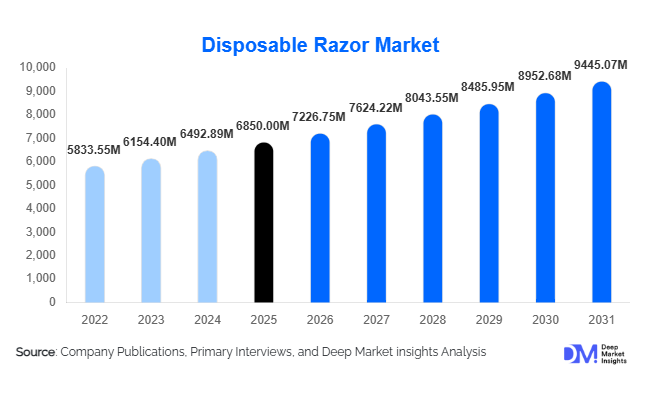
According to Deep Market Insights, the global disposable razor market size was valued at USD 6,850 million in 2025 and is projected to grow from USD 7,226.75 million in 2026 to reach USD 9,445.07 million by 2031, expanding at a CAGR of 5.5% during the forecast period (2026–2031). The disposable razor market is experiencing growth primarily driven by increasing global grooming awareness, the affordability of disposable products, and a rising demand for convenient, travel-friendly shaving solutions. Emerging economies, particularly in Asia-Pacific and Africa, are contributing significantly to volume growth, while developed markets are witnessing premiumization through advanced multi-blade and skin-sensitive product innovations.
Key Market Insights
- Disposable razors continue to dominate in price-sensitive markets, driven by affordability and widespread retail availability.
- Multi-blade razors are gaining traction globally, offering enhanced shaving comfort and efficiency.
- Asia-Pacific leads the global market, supported by population size and increasing grooming awareness.
- Online retail channels are expanding rapidly, enabling subscription-based and direct-to-consumer sales models.
- Sustainability concerns are reshaping product innovation, with companies investing in recyclable and biodegradable materials.
- The women’s grooming segment is emerging as a key growth driver, with increasing demand for specialized disposable razors.
What are the latest trends in the disposable razor market?
Sustainability and Eco-Friendly Product Development
The disposable razor market is witnessing a shift toward environmentally sustainable solutions. Manufacturers are increasingly introducing razors made from recycled plastics, biodegradable materials, and reduced packaging formats to address growing environmental concerns. Regulatory pressures in Europe and North America are accelerating this transition, compelling companies to innovate while maintaining cost efficiency. Consumers are also showing a willingness to pay a premium for eco-friendly products, encouraging brands to develop hybrid disposable models that strike a balance between convenience and sustainability. This trend is expected to redefine product portfolios and drive long-term market transformation.
Premiumization Through Advanced Features
Manufacturers are enhancing disposable razors with advanced features such as multiple blades, lubricating strips, pivoting heads, and ergonomic handles. These innovations are improving shaving performance and enabling companies to position disposable razors within higher price tiers. Premium disposable razors are gaining popularity in developed markets where consumers seek better shaving experiences without transitioning to reusable systems. This trend is also supported by branding and marketing strategies emphasizing comfort, skin protection, and precision.
What are the key drivers in the disposable razor market?
Growing Personal Grooming Awareness
Increasing awareness of personal hygiene and grooming standards is a major driver of the disposable razor market. Social media influence, professional expectations, and lifestyle changes are encouraging more frequent shaving habits across both men and women. Younger demographics are particularly driving demand, contributing to higher consumption frequency and sustained market growth.
Affordability and Accessibility Across Markets
Disposable razors are widely accessible and affordable, making them a preferred choice in developing regions. Their availability across supermarkets, convenience stores, and pharmacies ensures strong market penetration. In price-sensitive economies, disposable razors offer a cost-effective alternative to cartridge and electric razors, supporting consistent demand.
What are the restraints for the global market?
Environmental Impact and Regulatory Challenges
Disposable razors contribute significantly to plastic waste, leading to increasing scrutiny from regulators and environmental organizations. Restrictions on single-use plastics and growing consumer awareness are challenging market growth. Companies must invest in sustainable materials and production processes to remain competitive.
Competition from Reusable and Electric Razors
The growing adoption of reusable cartridge razors and electric grooming devices poses a challenge to disposable razor demand. These alternatives offer long-term cost savings and reduced environmental impact, attracting consumers in developed markets and limiting growth potential for disposable products.
What are the key opportunities in the disposable razor industry?
Expansion in Emerging Markets
Emerging economies in Asia-Pacific, Latin America, and Africa present significant growth opportunities due to rising disposable incomes and improving retail infrastructure. Increasing grooming awareness and urbanization are driving adoption, making these regions highly attractive for market expansion.
Growth in Women’s Grooming Segment
The women’s disposable razor segment is rapidly expanding, driven by evolving beauty standards and increased product availability. Companies focusing on ergonomic designs, skin-sensitive features, and targeted marketing campaigns can capture a growing consumer base in this segment.
Report Scope
| Report Metric | Details |
|---|---|
| Market Size in 2025 | USD 6850 Million |
| Market Size in 2026 | USD 7226.75 Million |
| Market Size in 2031 | USD 9445.07 Million |
| CAGR | 5.5% (2026-2031) |
| Base Year for Estimation | 2025 |
| Historical Data | 2022-2024 |
| Forecast Period | 2026-2031 |
| Report Coverage | Revenue Forecast, Competitive Landscape, Supply Chain Disruption, Growth Factors, Environment & Regulatory Landscape and Trends |
| Geographies Covered | North America, Europe, APAC, Middle East and Africa, LATAM |
| Countries Covered | U.S., Canada, U.K., Germany, France, Spain, Italy, Russia, Nordic, Benelux, Rest of Europe, China, Korea, Japan, India, Australia, Singapore, Taiwan, South East Asia, Rest of Asia-Pacific, UAE, Turky, Saudi Arabia, South Africa, Egypt, Nigeria, Rest of MEA, Brazil, Mexico, Argentina, Chile, Colombia, Rest of LATAM |
Explore more data points, trends and opportunities Download Free Sample Report
Product Type Insights
Multi-blade disposable razors are expected to dominate the global market, with an approximate 38% share in 2025, primarily driven by superior shaving performance, enhanced skin comfort, and an increasing consumer preference for smoother and irritation-free results. The integration of advanced features such as lubricating strips, pivoting heads, and precision-aligned blades has significantly improved user experience, making multi-blade razors the preferred choice in both developed and urban emerging markets. Additionally, the ongoing trend of premiumization, where consumers are willing to spend slightly more for better quality, continues to strengthen this segment’s leadership.
Twin and triple blade razors collectively hold a substantial share, particularly in emerging economies where affordability and performance balance are key purchasing factors. These variants offer acceptable shaving efficiency at a lower price point, making them highly attractive in price-sensitive regions such as Asia-Pacific, Latin America, and parts of Africa. Meanwhile, single-blade disposable razors remain relevant in ultra-economy segments, driven by rural demand, institutional usage, and bulk procurement scenarios. However, their share is gradually declining as consumers shift toward better-performing alternatives. Overall, innovation-led differentiation and rising consumer expectations are expected to further consolidate the dominance of multi-blade razors globally.
End-Use Insights
The men’s segment continues to dominate the disposable razor market, accounting for approximately 65% of the total market share in 2025. This dominance is largely attributed to higher shaving frequency, long-established grooming routines, and consistent demand across both developed and developing regions. Male consumers, particularly in urban areas, are increasingly adopting higher-quality disposable razors with advanced features, contributing to both volume and value growth. Additionally, cultural and professional grooming standards continue to reinforce regular usage, especially in corporate and service-driven economies.
However, the women’s segment is emerging as the fastest-growing category, driven by evolving beauty standards, increased awareness of personal care, and targeted product innovation. Manufacturers are introducing ergonomically designed razors with skin-sensitive features, moisturizing strips, and aesthetic appeal to cater specifically to female consumers. Marketing campaigns and expanding retail visibility are further accelerating adoption. The unisex/general-purpose segment, while smaller, plays a critical role in institutional demand such as hospitality, healthcare, and travel kits, where cost efficiency and convenience are key. Going forward, the expansion of women’s grooming and rising participation of younger consumers across genders are expected to significantly reshape end-use dynamics.
Distribution Channel Insights
Offline retail remains the dominant distribution channel, accounting for approximately 70% of the global market share in 2025. This dominance is driven by extensive product availability across supermarkets, hypermarkets, convenience stores, and pharmacies, particularly in emerging markets where physical retail infrastructure is more accessible than digital platforms. Impulse purchasing behavior and the ability to compare multiple brands in-store further support offline sales. Additionally, bulk purchasing by institutional buyers such as hotels and hospitals is largely conducted through offline channels, reinforcing its market leadership.
However, online retail is rapidly gaining momentum and represents the fastest-growing segment of distribution. The rise of e-commerce platforms, direct-to-consumer (D2C) brand websites, and subscription-based shaving solutions is transforming purchasing behavior, particularly in urban and digitally connected populations. Online channels offer advantages such as competitive pricing, convenience, product variety, and personalized recommendations. Subscription models, in particular, are gaining traction by ensuring recurring demand and enhancing customer retention. As internet penetration continues to rise globally, online retail is expected to capture a larger share of the market, gradually narrowing the gap with traditional retail formats.
Explore more data points, trends and opportunities Download Free Sample Report
Disposable Razor Market Segmentations
By Product Type
- Single Blade Disposable Razors
- Twin Blade Disposable Razors
- Triple Blade Disposable Razors
- Multi-Blade (4+ Blades) Disposable Razors
By End User
- Men
- Women
- Unisex/General Purpose
By Price Tier
- Economy
- Mid-Range
- Premium Disposable
By Distribution Channel
- Online Retail
- Supermarkets/Hypermarkets
- Convenience Stores
- Pharmacies/Drug Stores
- Direct-to-Consumer
Regional Insights
Asia-Pacific
The Asia-Pacific region leads the global disposable razor market, with an approximate 35% share in 2025, supported by large population bases, rising disposable incomes, and increasing grooming awareness. Countries such as China and India are key growth engines, with India emerging as one of the fastest-growing markets at a CAGR of around 7%. The region benefits from strong demand in both urban and rural areas, where disposable razors are preferred due to affordability and ease of use. Additionally, expanding retail networks, growing e-commerce penetration, and localized manufacturing capabilities, particularly in China, are driving regional growth. Government initiatives promoting domestic manufacturing and cost-efficient production further strengthen the Asia-Pacific’s position as both a consumption and export hub.
North America
North America accounts for approximately 25% of the global market, with the United States being the primary contributor. The region is characterized by high per capita consumption, strong brand loyalty, and a well-established grooming culture. Growth in North America is driven by premiumization trends, with consumers increasingly opting for multi-blade disposable razors that offer enhanced comfort and performance. Additionally, the presence of leading global manufacturers, continuous product innovation, and the rapid adoption of e-commerce and subscription-based models are key growth drivers. Sustainability initiatives and demand for eco-friendly products are also influencing purchasing decisions, shaping the future of the market in this region.
Europe
Europe holds approximately 20% of the global market share, with major contributions from countries such as Germany, the United Kingdom, and France. The region’s growth is primarily driven by strong consumer awareness regarding personal grooming and increasing demand for sustainable products. Stringent environmental regulations and consumer preference for eco-friendly alternatives are pushing manufacturers to innovate with recyclable and biodegradable materials. Additionally, the presence of well-developed retail infrastructure and high disposable incomes supports steady demand. The growing popularity of premium disposable razors and ethical consumerism trends are expected to further drive market expansion in Europe.
Latin America
Latin America accounts for approximately 10% of the global market, with Brazil and Mexico serving as key demand centers. The region’s growth is driven by affordability, urbanization, and expanding middle-class populations. Disposable razors are widely preferred due to their low cost and accessibility, particularly among price-sensitive consumers. Increasing penetration of modern retail formats and the gradual growth of e-commerce platforms are also contributing to market expansion. Additionally, rising awareness of personal grooming and hygiene, particularly among younger demographics, is supporting long-term growth in the region.
Middle East & Africa
The Middle East & Africa region holds around 10% of the global market share, with growth driven by urbanization, improving economic conditions, and rising grooming awareness. Key markets such as South Africa, Nigeria, and the Gulf countries are witnessing increasing demand due to growing disposable incomes and expanding retail infrastructure. In the Middle East, premium product adoption is higher due to higher purchasing power, while Africa remains largely price-driven, favoring economy and mid-range disposable razors. Additionally, population growth and increasing youth demographics are significant drivers of demand. The gradual expansion of distribution networks and the entry of global brands are expected to further accelerate growth across the region.
Key Players in the Disposable Razor Market
- Procter & Gamble
- Edgewell Personal Care
- BIC Group
- Dorco Co., Ltd.
- Feather Safety Razor Co.
- Super-Max
- Kaili Razor
- Ningbo Jiali Plastics
- Persona (AccuTec)
- Lord International
- Shanghai Cloud Blade
- Benxi Jincheng
- Laser Razor
- Treet Corporation
- Malhotra Shaving Products