Disposable Camera Market Size
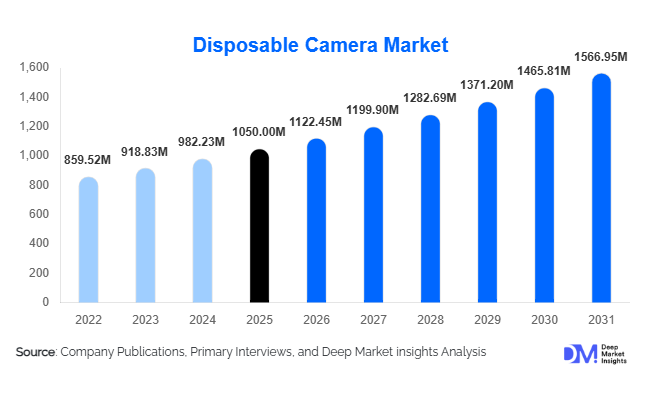
According to Deep Market Insights, the global disposable camera market size was valued at USD 1,050 million in 2025 and is projected to grow from USD 1,122.45 million in 2026 to reach USD 1,566.95 million by 2031, expanding at a CAGR of 6.9% during the forecast period (2026–2031). The disposable camera market growth is primarily driven by the resurgence of analog photography, increasing demand for nostalgic and experiential imaging formats, and growing adoption across events, travel, and social gatherings.
Key Market Insights
- Analog photography revival is driving strong demand, particularly among Gen Z and millennial consumers seeking authentic visual experiences.
- Event-based usage is expanding rapidly, with weddings and corporate functions adopting disposable cameras for candid photography.
- North America dominates the market, supported by high consumer spending and a mature events industry.
- Asia-Pacific is the fastest-growing region, driven by rising disposable income and increasing interest in retro products.
- Offline retail channels remain dominant, although online platforms are gaining traction through direct-to-consumer sales.
- Sustainability concerns are shaping product innovation, with companies exploring recyclable materials and eco-friendly designs.
What are the latest trends in the disposable camera market?
Rising Popularity of Retro and Analog Aesthetics
The growing cultural shift toward vintage and retro aesthetics is significantly influencing disposable camera demand. Consumers, particularly younger demographics, are increasingly drawn to the imperfect, grainy, and nostalgic quality of film photography. Social media platforms have amplified this trend, with users valuing authenticity over digitally enhanced images. Disposable cameras are being used to create unique storytelling formats, making them highly popular for personal and creative use. This trend is further supported by influencers and content creators who promote analog photography as a distinctive visual style.
Customization and Event Integration
Disposable cameras are increasingly being customized for specific events such as weddings, festivals, and corporate functions. Personalized branding, themed designs, and tailored packaging are becoming standard offerings. Event planners are incorporating disposable cameras as interactive tools, encouraging guests to capture candid moments. This trend is expanding the market beyond individual consumers and into organized event ecosystems. Businesses are leveraging this opportunity to create memorable brand experiences, positioning disposable cameras as both functional and promotional products.
What are the key drivers in the disposable camera market?
Growth in Events and Wedding Industry
The global events and wedding industry is a major driver of disposable camera demand. These cameras are widely used to capture spontaneous and candid moments, adding a unique dimension to event photography. Increasing spending on experiential events, particularly in North America and Europe, is fueling demand. Disposable cameras are often included as part of event packages, making them a recurring purchase for planners and organizers.
Expansion of Global Tourism
The rapid growth of international tourism is contributing significantly to market expansion. Travelers are seeking distinctive ways to document their experiences, and disposable cameras provide a tangible and nostalgic alternative to digital photography. Airports, tourist destinations, and travel retail outlets are key distribution points, further boosting accessibility and adoption.
What are the restraints for the global market?
Rising Cost and Limited Supply of Film
The declining number of film manufacturers has led to supply constraints and increased costs. This impacts the overall pricing of disposable cameras and limits production scalability. Fluctuations in raw material prices further add to cost pressures, posing challenges for market participants.
Environmental Concerns Around Single-Use Products
Disposable cameras face scrutiny due to their single-use nature and associated plastic waste. Increasing environmental regulations and consumer awareness regarding sustainability may hinder market growth. Companies must invest in eco-friendly alternatives to address these concerns and maintain market relevance.
What are the key opportunities in the disposable camera industry?
Emerging Market Expansion
Emerging economies in the Asia-Pacific and Latin America present significant growth opportunities. Rising disposable incomes, increasing urbanization, and expanding middle-class populations are driving demand for affordable and experiential products. Localized manufacturing and distribution strategies can help companies tap into these high-growth markets.
Hybrid Analog-Digital Integration
Integrating digital technologies with analog photography is creating new growth avenues. Features such as QR-enabled photo scanning and mobile app integration enhance user convenience while preserving the analog experience. This hybrid approach appeals to tech-savvy consumers and broadens the market’s appeal.
Report Scope
| Report Metric | Details |
|---|---|
| Market Size in 2025 | USD 1050 Million |
| Market Size in 2026 | USD 1122.45 Million |
| Market Size in 2031 | USD 1566.95 Million |
| CAGR | 6.9% (2026-2031) |
| Base Year for Estimation | 2025 |
| Historical Data | 2022-2024 |
| Forecast Period | 2026-2031 |
| Report Coverage | Revenue Forecast, Competitive Landscape, Supply Chain Disruption, Growth Factors, Environment & Regulatory Landscape and Trends |
| Geographies Covered | North America, Europe, APAC, Middle East and Africa, LATAM |
| Countries Covered | U.S., Canada, U.K., Germany, France, Spain, Italy, Russia, Nordic, Benelux, Rest of Europe, China, Korea, Japan, India, Australia, Singapore, Taiwan, South East Asia, Rest of Asia-Pacific, UAE, Turky, Saudi Arabia, South Africa, Egypt, Nigeria, Rest of MEA, Brazil, Mexico, Argentina, Chile, Colombia, Rest of LATAM |
Explore more data points, trends and opportunities Download Free Sample Report
Product Type Insights
Flash-enabled disposable cameras dominate the global market, accounting for approximately 42% of the total market share in 2025. The leadership of this segment is primarily driven by its versatility across multiple use cases, particularly in low-light environments such as indoor events, weddings, parties, and nightlife settings. The built-in flash functionality significantly enhances usability, making these cameras a preferred choice for both individual consumers and event planners. Additionally, the growing demand for candid photography in social gatherings has further accelerated the adoption of flash-enabled models. Waterproof disposable cameras are emerging as a strong secondary segment, gaining traction among travelers, beachgoers, and adventure enthusiasts due to their durability and ability to function in harsh environmental conditions. Meanwhile, standard disposable cameras continue to cater to entry-level users and cost-sensitive consumers, particularly in emerging markets, where affordability and simplicity remain key purchasing drivers.
Application Insights
Color film cameras lead the disposable camera market with a dominant share of approximately 68% in 2025, driven by strong consumer preference for vibrant, natural, and socially shareable images. The widespread use of color photography across events, tourism, and personal documentation has made this segment the default choice for most users. The growth of social media platforms has further reinforced this trend, as users prefer visually appealing outputs that require minimal post-processing. Black-and-white disposable cameras, while representing a smaller share, continue to appeal to niche segments such as professional photographers, artists, and photography students who value contrast, texture, and artistic expression. Specialty film cameras, including those offering retro tones or high-saturation effects, are gaining momentum among creative professionals and younger consumers seeking differentiated visual aesthetics. This segment is benefiting from the broader trend of personalization and creative storytelling in photography.
Distribution Channel Insights
Offline retail channels dominate the market, accounting for approximately 55% of the total share in 2025. This dominance is largely driven by impulse purchasing behavior, particularly in high-traffic locations such as airports, tourist destinations, supermarkets, and photography stores. Consumers often purchase disposable cameras for immediate use during travel or events, reinforcing the importance of physical retail presence. However, online retail is witnessing rapid growth, supported by the expansion of e-commerce platforms and direct-to-consumer (D2C) strategies adopted by manufacturers. Online channels offer greater product variety, customization options, and competitive pricing, making them increasingly attractive to younger, digitally native consumers. Additionally, event-based distribution is emerging as a high-growth channel, with bulk purchases by wedding planners, corporate organizers, and event management companies contributing significantly to overall market expansion.
End-User Insights
Individual consumers represent the largest end-user segment, accounting for approximately 48% of the market share in 2025. This dominance is driven by widespread usage in personal travel, social gatherings, and everyday photography. The increasing popularity of analog photography among younger demographics has further strengthened demand within this segment. Event planners, however, are the fastest-growing end-user category, leveraging disposable cameras as interactive tools to enhance guest engagement and capture candid moments during weddings, festivals, and corporate events. This segment is benefiting from the global expansion of the events industry and the growing emphasis on experiential elements. Corporate buyers are also emerging as a significant segment, utilizing disposable cameras for promotional campaigns, brand activations, and employee engagement initiatives, thereby expanding the market beyond traditional consumer use cases.
Price Range Insights
Mid-range disposable cameras, priced between USD 10 and USD 20, dominate the market with an estimated 50% share in 2025. The leadership of this segment is attributed to its optimal balance between affordability and product quality, making it accessible to a broad consumer base while still offering reliable performance. These cameras are widely preferred for events, travel, and casual photography, where consumers seek dependable output without significant investment. Economy models, priced below USD 10, cater to highly price-sensitive consumers and are particularly popular in emerging markets and bulk purchase scenarios. On the other hand, premium disposable cameras, priced above USD 20, are gaining traction among niche segments, including photography enthusiasts and high-end event organizers, who prioritize enhanced features such as higher ISO film, improved lens quality, and aesthetic design.
Explore more data points, trends and opportunities Download Free Sample Report
Disposable Camera Market Segmentations
By Product Type
- Standard Disposable Cameras
- Waterproof Disposable Cameras
- Flash-Enabled Disposable Cameras
- High ISO/Low-Light Disposable Cameras
- Themed/Customized Disposable Cameras
By Application
- Color Film Cameras
- Black & White Film Cameras
- Specialty Film Cameras
By Distribution Channel
- Online Retail
- Electronics & Photography Stores
- Supermarkets/Hypermarkets
- Convenience Stores
- Event-Based Sales
By End-User
- Individual Consumers
- Event & Wedding Planners
- Travel & Tourism Industry
- Corporate/Promotional Buyers
- Educational Institutions & Art Schools
By Price Range
- Economy
- Mid-Range
- Premium
Regional Insights
North America
North America remains the largest regional market, accounting for approximately 32% of the global disposable camera market in 2025. The United States dominates regional demand, contributing nearly three-quarters of the market share. Growth in this region is driven by a well-established events and wedding industry, high consumer spending on lifestyle and experiential products, and strong brand presence of leading manufacturers. Additionally, the resurgence of analog photography among younger consumers and the popularity of retro trends are key demand drivers. The region also benefits from a robust retail infrastructure and widespread availability of products across both offline and online channels.
Europe
Europe holds around 28% of the global market share, with major contributions from the UK, Germany, and France. The region’s strong cultural inclination toward photography and artistic expression supports sustained demand for disposable cameras. Growth is further driven by a thriving tourism sector, where travelers increasingly seek unique and nostalgic ways to document their experiences. Additionally, stringent environmental regulations are encouraging manufacturers to innovate with sustainable and recyclable camera designs, shaping product development trends. The increasing popularity of experiential travel and eco-conscious consumption is also fueling market expansion across the region.
Asia-Pacific
Asia-Pacific is the fastest-growing region, with a projected CAGR exceeding 8% during the forecast period. China, Japan, and India are the primary growth engines. Rising disposable incomes, rapid urbanization, and a growing youth population are key drivers of demand. In China and India, the expanding middle class and increasing adoption of experiential products are boosting market penetration. Japan, with its strong legacy in photography and an established film manufacturing industry, remains a mature yet stable market. Additionally, the influence of social media trends and the popularity of retro aesthetics among younger consumers are accelerating growth across the region.
Latin America
Latin America accounts for approximately 7% of the global market, with Brazil and Mexico leading regional demand. Growth in this region is driven by expanding middle-class populations, increasing urbanization, and rising participation in social events and celebrations. The growing tourism sector is also contributing to demand, as disposable cameras are widely used by travelers seeking affordable and unique photography solutions. Additionally, improving retail infrastructure and increasing penetration of e-commerce platforms are enhancing product accessibility across the region.
Middle East & Africa
The Middle East & Africa region holds a smaller share of around 5% of the global market but is witnessing steady growth. Key markets include the UAE and South Africa, where demand is driven by a strong tourism industry and a growing number of luxury events and social gatherings. In the Middle East, high disposable incomes and a preference for premium experiential products are supporting adoption. In Africa, increasing tourism inflows and the gradual expansion of retail networks are contributing to market growth. Additionally, rising consumer interest in unique and nostalgic products is creating new opportunities for market participants in the region.