Digital Camera Market Size
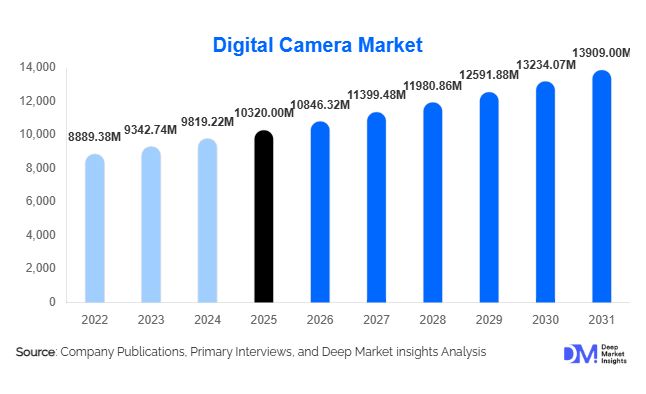
According to Deep Market Insights, the global digital camera market size was valued at USD 10,320 million in 2025 and is projected to grow from USD 10,846.32 million in 2026 to reach USD 13,909 million by 2031, expanding at a CAGR of 5.1% during the forecast period (2026–2031). The digital camera market growth is primarily driven by the rising demand for high-resolution photography equipment, increasing adoption of mirrorless camera systems, and the rapid expansion of digital content creation across social media and professional media platforms.
Key Market Insights
- Mirrorless cameras are rapidly replacing DSLR systems, offering compact design, faster autofocus, and superior video capabilities.
- Content creators and social media influencers are emerging as major consumers, driving demand for hybrid cameras capable of professional photography and 4K/8K video recording.
- Asia-Pacific dominates the global market, supported by strong manufacturing ecosystems and rising consumer demand in countries such as China, Japan, and India.
- North America remains a key revenue market, driven by professional photography, filmmaking, and digital media production industries.
- Premiumization is shaping the industry, with manufacturers focusing on high-end cameras and interchangeable lens systems rather than entry-level devices.
- Artificial intelligence and computational imaging technologies are enhancing autofocus performance, subject recognition, and low-light photography capabilities.
What are the latest trends in the digital camera market?
Shift Toward Mirrorless Camera Systems
The digital camera industry is undergoing a significant transformation as mirrorless camera systems continue to replace traditional DSLR cameras. Mirrorless cameras offer several advantages including lighter bodies, faster burst shooting speeds, and advanced autofocus capabilities that use on-sensor phase detection technology. These systems also support superior video recording features, making them highly attractive to content creators and filmmakers. As manufacturers increasingly invest in mirrorless ecosystems, the availability of compatible lenses and accessories has expanded significantly. Professional photographers and enthusiasts are gradually transitioning to mirrorless systems due to improved performance, portability, and technological innovation. The expansion of full-frame mirrorless cameras in both professional and mid-range segments is further accelerating the transition away from DSLR technology.
Integration of Artificial Intelligence and Computational Imaging
Artificial intelligence is increasingly becoming a central feature in modern digital cameras. AI-driven autofocus systems can detect and track human eyes, animals, vehicles, and moving subjects with high accuracy. These capabilities significantly enhance the ability to capture sharp images in fast-moving environments such as sports or wildlife photography. Computational imaging technologies are also improving low-light performance and dynamic range by combining multiple exposures in real time. In addition, connectivity features such as wireless image transfer, cloud storage integration, and smartphone compatibility are enabling photographers to instantly share and edit images. These technological advancements are transforming digital cameras from simple imaging devices into advanced computational photography systems.
What are the key drivers in the digital camera market?
Expansion of the Global Creator Economy
The rapid expansion of the creator economy has become one of the strongest drivers of digital camera demand. Content creators, vloggers, filmmakers, and social media influencers require high-quality visual content to maintain audience engagement and professional branding. As platforms such as YouTube, Instagram, and TikTok continue to grow, creators are investing in advanced cameras capable of delivering cinematic video quality and professional photography. Hybrid cameras that combine photography and video features are particularly popular among this segment, as they allow creators to produce diverse content with a single device.
Increasing Demand for Professional Photography Equipment
Professional photography continues to be a significant driver of digital camera sales. Industries such as wedding photography, fashion photography, advertising, and wildlife photography require high-resolution cameras and specialized lenses to capture detailed imagery. As global tourism and event industries expand, the demand for professional photographers is also increasing. Photographers often upgrade their equipment regularly to maintain competitive advantages, driving repeat purchases and market growth.
What are the restraints for the global market?
Competition from Smartphone Cameras
The continuous advancement of smartphone camera technology remains the most significant challenge for the digital camera industry. Modern smartphones incorporate multiple lenses, advanced image processing software, and artificial intelligence features that allow users to capture high-quality photos without dedicated cameras. As a result, demand for entry-level compact digital cameras has declined significantly over the past decade. Casual consumers increasingly rely on smartphones for everyday photography, limiting the market potential of low-cost camera segments.
High Cost of Professional Equipment
Professional digital cameras and lenses often require substantial financial investment. High-end camera bodies can cost thousands of dollars, while professional lenses and accessories further increase overall equipment costs. This pricing barrier can limit adoption among hobbyists and amateur photographers, particularly in emerging markets where disposable incomes are lower. Manufacturers are therefore focusing on mid-range products that balance advanced features with affordability.
What are the key opportunities in the digital camera industry?
Rising Demand in Emerging Markets
Emerging economies present significant opportunities for digital camera manufacturers. Countries such as India, Indonesia, Brazil, and Vietnam are witnessing rapid growth in professional photography services, particularly in wedding photography and event coverage. Rising disposable income, expanding tourism industries, and growing interest in photography as a hobby are contributing to increased camera adoption in these markets. Companies that develop competitively priced cameras tailored for emerging economies can capture new consumer segments.
Technological Innovation in Imaging Sensors
Advancements in sensor technology and image processors present another major opportunity for the industry. High-resolution sensors exceeding 50 megapixels, improved dynamic range, and better low-light performance are attracting professional photographers and filmmakers. Manufacturers are also integrating advanced video features such as 8K recording, slow-motion capture, and enhanced color science. These innovations allow digital cameras to remain relevant despite increasing competition from smartphones.
Report Scope
| Report Metric | Details |
|---|---|
| Market Size in 2025 | USD 10320 Million |
| Market Size in 2026 | USD 10846.32 Million |
| Market Size in 2031 | USD 13909 Million |
| CAGR | 5.1% (2026-2031) |
| Base Year for Estimation | 2025 |
| Historical Data | 2022-2024 |
| Forecast Period | 2026-2031 |
| Report Coverage | Revenue Forecast, Competitive Landscape, Supply Chain Disruption, Growth Factors, Environment & Regulatory Landscape and Trends |
| Geographies Covered | North America, Europe, APAC, Middle East and Africa, LATAM |
| Countries Covered | U.S., Canada, U.K., Germany, France, Spain, Italy, Russia, Nordic, Benelux, Rest of Europe, China, Korea, Japan, India, Australia, Singapore, Taiwan, South East Asia, Rest of Asia-Pacific, UAE, Turky, Saudi Arabia, South Africa, Egypt, Nigeria, Rest of MEA, Brazil, Mexico, Argentina, Chile, Colombia, Rest of LATAM |
Explore more data points, trends and opportunities Download Free Sample Report
Product Type Insights
The digital camera market is segmented by product type into mirrorless cameras, DSLR cameras, compact digital cameras, bridge cameras, and action or rugged cameras. Mirrorless cameras represent the leading product segment in the global market, accounting for approximately 42% of total revenue in 2025. The growth of this segment is primarily driven by the rapid technological advancements in mirrorless camera systems, including faster autofocus, enhanced image stabilization, and superior video recording capabilities. Mirrorless cameras are increasingly favored by both professional photographers and content creators because they offer a compact and lightweight design without compromising image quality. The integration of high-resolution sensors, advanced subject-tracking autofocus systems, and improved low-light performance has significantly strengthened the appeal of mirrorless systems across professional and enthusiast users. Additionally, the increasing demand for hybrid cameras capable of capturing both high-quality photos and professional-grade video content is further accelerating the adoption of mirrorless cameras worldwide.
DSLR cameras continue to maintain a substantial presence in the digital camera market, particularly among professional photographers who prefer optical viewfinders, robust battery life, and extensive lens ecosystems developed over decades. Many professionals working in fields such as wildlife, sports, and studio photography still rely on DSLR systems for their reliability and familiarity. However, while demand remains steady in professional circles, the overall growth of this segment has moderated due to the increasing transition toward mirrorless camera systems.
Compact digital cameras, especially premium compact models equipped with large sensors and advanced optics, continue to attract photography enthusiasts seeking portability without sacrificing image quality. These cameras appeal strongly to travelers and hobbyist photographers who require high-quality imaging capabilities in a small and convenient form factor. Bridge cameras occupy a unique position in the market by offering powerful zoom capabilities combined with user-friendly operation, making them an attractive option for consumers who want extended focal range without the complexity of interchangeable lens systems. Meanwhile, action cameras and rugged digital cameras are experiencing growing demand due to the expansion of adventure tourism, outdoor sports, and travel content creation. Their durable construction, waterproof capabilities, and compact size make them particularly suitable for capturing high-quality images and videos in challenging environments.
Application Insights
The digital camera market serves a wide range of applications, including professional photography, content creation, media and broadcasting, as well as scientific and industrial imaging. Professional photography represents the leading application segment, driven by the consistent demand for high-end camera equipment in industries such as wedding photography, fashion photography, wildlife photography, and commercial advertising. Professional photographers frequently upgrade their equipment to benefit from improved sensor technology, enhanced autofocus systems, and advanced video capabilities, which contributes to sustained demand within this segment.
The primary driver supporting the dominance of professional photography as a leading segment is the increasing demand for high-quality visual content across industries such as advertising, fashion, media production, and event documentation. Businesses are increasingly investing in professional-grade photography to enhance brand visibility, digital marketing campaigns, and e-commerce product presentation, further strengthening the importance of professional imaging equipment.
Content creation for digital media platforms has emerged as the fastest-growing application area in the digital camera market. The rapid expansion of social media platforms, video-sharing websites, and online education channels has created strong demand for high-quality cameras capable of producing cinematic video and professional-quality photographs. Independent creators, vloggers, educators, and influencers are increasingly investing in advanced camera systems to improve production quality and audience engagement.
Media and broadcasting organizations also represent a major application segment, relying on professional-grade digital cameras for news reporting, documentary filmmaking, television production, and digital journalism. High-resolution imaging and reliable performance in diverse environments make digital cameras an essential tool for professional media production. In addition, scientific and industrial imaging applications are gradually expanding, particularly in fields such as medical research, laboratory imaging, manufacturing inspection, and environmental monitoring, where high-resolution image capture is essential for analysis and documentation.
Distribution Channel Insights
The digital camera market is distributed through both online and offline retail channels, with online retail emerging as the dominant distribution channel globally. The growth of e-commerce platforms has significantly transformed the purchasing behavior of consumers and professional buyers. Online platforms allow customers to compare detailed product specifications, evaluate user reviews, access promotional discounts, and explore a wide range of camera models and accessories from multiple brands in one place. The increasing trust in online shopping, combined with convenient home delivery services and competitive pricing strategies, has made e-commerce the preferred channel for many consumers purchasing digital cameras.
Direct-to-consumer brand websites and global online marketplaces have also enabled camera manufacturers to reach a broader international customer base. These platforms allow companies to showcase product features, provide educational content, and offer bundled packages including lenses and accessories. As digital marketing strategies become more sophisticated, online sales channels continue to expand their influence across both consumer and professional segments.
Despite the rapid growth of online retail, offline distribution channels continue to play a critical role in the digital camera market. Electronics retail stores and specialty photography shops remain important for high-value purchases, as many customers prefer to physically evaluate camera ergonomics, test image quality, and receive professional guidance before making purchasing decisions. Specialty photography retailers provide expert consultation, equipment demonstrations, and rental services that allow customers to test different camera models and lenses before committing to an investment. This personalized customer experience helps maintain the relevance of brick-and-mortar stores within the overall distribution landscape.
End-Use Insights
The digital camera market serves several end-use segments, including professional photographers, content creators and influencers, consumer hobbyists, as well as industrial and scientific users. Professional photographers represent the leading end-use segment, accounting for a substantial share of equipment purchases worldwide. The primary driver supporting this segment is the continuous need for equipment upgrades and specialized accessories to maintain competitive standards in professional photography services. Professionals frequently invest in new camera bodies, advanced lenses, lighting equipment, and accessories to achieve higher image quality and improved workflow efficiency.
Content creators and social media influencers are emerging as the fastest-growing end-use segment in the digital camera market. The rapid growth of digital media platforms and online video content has significantly expanded the number of individuals producing professional-grade visual content. Influencers, vloggers, educators, and digital marketers increasingly rely on advanced digital cameras to produce high-quality videos, livestreams, and promotional content. As digital content consumption continues to grow globally, the demand for reliable and versatile camera systems among content creators is expected to rise further.
Consumer hobbyists also contribute to steady market demand, particularly for mid-range digital cameras designed for travel photography, family events, and creative pursuits. Many photography enthusiasts prefer dedicated cameras over smartphones for their superior image quality, optical zoom capabilities, and manual control features. Additionally, industrial and scientific users represent a smaller but steadily expanding segment. High-resolution digital cameras are increasingly being used in research laboratories, automated inspection systems, environmental monitoring programs, and technical documentation processes across multiple industries.
Explore more data points, trends and opportunities Download Free Sample Report
Digital Camera Market Segmentations
By Product Type
- Mirrorless Cameras
- DSLR Cameras
- Compact Digital Cameras
- Bridge Cameras
- Rugged/Action Cameras
- Instant Digital Hybrid Cameras
By Application
- Professional Photography
- Content Creation & Vlogging
- Consumer Photography
- Media & Broadcasting
- Industrial & Scientific Imaging
By Distribution Channel
- Online Retail
- Electronics Retail Stores
- Specialty Photography Stores
- Brand Stores
Regional Insights
North America
North America accounts for approximately 27% of the global digital camera market, with the United States representing the largest consumer market in the region. Demand across North America is strongly supported by the presence of a well-established professional photography industry and a rapidly expanding ecosystem of digital content creators. The United States plays a particularly significant role due to the influence of the entertainment and film production industries, including Hollywood studios and independent filmmakers, which require high-performance digital camera equipment for cinematic production.
One of the key drivers of regional growth is the increasing demand for high-quality video production equipment among online content creators and digital marketing agencies. The growth of video streaming platforms, online education services, and corporate marketing campaigns has increased the need for professional-grade cameras capable of producing high-resolution video content. In addition, the strong adoption of advanced imaging technology among professional photographers and filmmakers continues to drive demand for mirrorless camera systems and premium lenses. Canada also contributes to regional market growth, supported by expanding outdoor tourism, wildlife photography, and documentary filmmaking activities.
Europe
Europe represents around 23% of global digital camera market demand, with key markets including Germany, the United Kingdom, France, and Italy. The region has a well-established photography culture and a strong presence of professional photographers working in industries such as fashion, advertising, journalism, and commercial media production. European consumers also demonstrate strong interest in premium camera systems and high-quality optical lenses designed for travel and landscape photography.
The growth of the digital camera market in Europe is largely driven by the region's thriving creative industries and tourism sector. Fashion photography, luxury product advertising, and editorial media production generate consistent demand for professional imaging equipment. Additionally, Europe's extensive tourism destinations and natural landscapes encourage travel photography and wildlife photography, which further supports demand for advanced digital cameras and telephoto lenses. Photography education programs, creative workshops, and photography clubs are also gaining popularity across the region, encouraging enthusiasts to invest in professional-grade equipment.
Asia-Pacific
Asia-Pacific dominates the global digital camera market, accounting for approximately 39% of total market share in 2025. The region benefits from a strong manufacturing ecosystem, rising consumer demand, and rapid growth in digital media production. Japan remains a global center for camera innovation and manufacturing, hosting many of the leading companies responsible for developing advanced imaging technologies. These companies continue to introduce cutting-edge mirrorless camera systems, sensors, and lenses that influence the global market.
The rapid expansion of the digital camera market in Asia-Pacific is primarily driven by rising disposable income levels, increasing interest in photography as a profession, and the rapid growth of digital content creation industries. China represents one of the fastest-growing consumer markets for digital cameras due to its large population of content creators and expanding e-commerce sector. India is emerging as a particularly dynamic market, supported by strong demand for wedding photography, social media content production, and freelance photography services. In addition, the increasing number of digital marketing agencies and video production studios across the region is boosting demand for professional camera equipment. South Korea and Australia also contribute to regional demand through strong adoption of advanced imaging technology among professionals and enthusiasts.
Latin America
Latin America accounts for a smaller share of global digital camera demand but continues to demonstrate gradual and consistent market expansion. Brazil and Mexico represent the largest markets within the region, supported by the growing presence of creative industries, event photography services, and digital media production. Professional photographers and independent content creators are increasingly investing in modern digital camera systems to improve production quality and compete in expanding online markets.
The growth of tourism, cultural events, and social media marketing activities across Latin America is creating new opportunities for photographers and videographers. Wedding photography, event coverage, and tourism promotion campaigns are key factors contributing to the demand for high-quality digital imaging equipment. Additionally, the gradual expansion of e-commerce platforms and improved availability of international camera brands are helping increase market penetration throughout the region.
Middle East & Africa
The Middle East and Africa region is witnessing moderate growth in the digital camera market as investments in media production, tourism promotion, and creative industries continue to increase. Countries such as the United Arab Emirates and Saudi Arabia are emerging as key markets due to their expanding entertainment sectors and growing investments in film production, advertising, and digital marketing.
One of the primary drivers supporting regional growth is the increasing emphasis on tourism promotion and destination marketing across the Middle East. Governments and tourism organizations are investing in high-quality visual media to showcase cultural heritage sites, luxury destinations, and major international events, which drives demand for professional photography and videography equipment. In Africa, South Africa represents the largest digital camera market, supported by its well-established wildlife photography industry, documentary filmmaking sector, and growing creative economy. The increasing popularity of travel photography and wildlife documentation across African national parks is also contributing to the gradual expansion of the regional digital camera market.
Key Players in the Digital Camera Market
- Canon Inc.
- Sony Corporation
- Nikon Corporation
- Fujifilm Holdings Corporation
- Panasonic Corporation
- OM Digital Solutions Corporation
- Leica Camera AG
- Ricoh Company Ltd.
- GoPro Inc.
- Hasselblad
- Phase One A/S
- Sigma Corporation
- Kodak Company
- Samsung Electronics Co., Ltd.
- Casio Computer Co., Ltd.