Diaper Pail Market Size
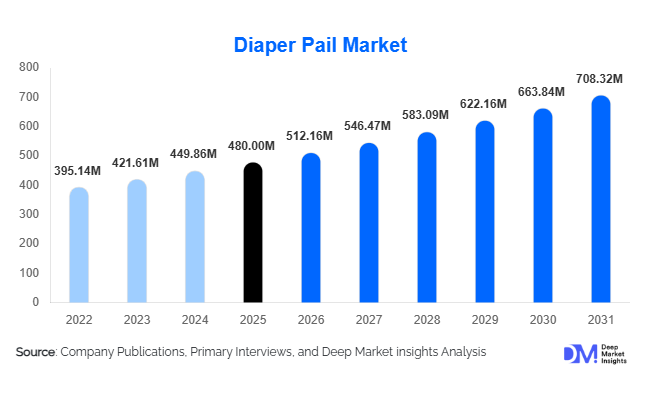
According to Deep Market Insights, the global diaper pail market size was valued at USD 480 million in 2025 and is projected to grow from USD 512.16 million in 2026 to reach USD 708.32 million by 2031, expanding at a CAGR of 6.7% during the forecast period (2026–2031). Market growth is primarily driven by increasing hygiene awareness among parents, rising birth rates in emerging economies, and growing adoption of odor-control disposal solutions in urban households. The shift toward premium baby-care products, coupled with expanding e-commerce penetration, is accelerating product visibility and consumer adoption globally.
Key Market Insights
- Sealing diaper pails dominate the market, accounting for nearly 42% of global revenue in 2025 due to superior odor-control and hygienic disposal systems.
- Residential households represent over 82% of total demand, reflecting strong consumer-centric adoption.
- North America leads the market, contributing approximately 34% of global revenue in 2025, driven by high disposable income and premium product penetration.
- Asia-Pacific is the fastest-growing region, expanding at an estimated CAGR of 8.5% due to urbanization and rising middle-class populations.
- Online retail channels account for nearly 38% of global sales, supported by increasing digital purchasing behavior.
- Premium and smart-enabled diaper pails are gaining traction, supported by demand for antimicrobial materials and hands-free systems.
What are the latest trends in the diaper pail market?
Premiumization and Smart Integration
Consumers are increasingly opting for premium diaper pails featuring stainless-steel construction, antimicrobial coatings, and advanced sealing mechanisms. Smart diaper pails equipped with sensor-based automatic lids, fill indicators, and enhanced odor-locking systems are emerging as differentiated offerings. These products command higher price points and contribute significantly to revenue growth. Premium models are particularly popular in North America, Western Europe, and urban Asia, where nursery aesthetics and hygiene standards are high priorities. Subscription-based refill cartridge models are also gaining traction, generating recurring revenue streams for manufacturers.
Sustainable Materials and Refill Systems
Environmental awareness is influencing purchasing decisions, encouraging brands to introduce recyclable plastics, reusable refill liners, and reduced-plastic packaging. European markets are particularly responsive to eco-certified baby products. Manufacturers are investing in biodegradable liners and carbon-reduction manufacturing processes to align with sustainability standards. This trend is reshaping product development strategies and positioning sustainability as a competitive differentiator in the diaper pail market.
What are the key drivers in the diaper pail market?
Rising Hygiene Awareness
Post-pandemic hygiene consciousness has increased demand for sealed disposal systems that prevent bacterial spread and eliminate odor. Parents in urban households prioritize sanitary environments, especially in apartments with limited ventilation. This trend has significantly accelerated adoption of advanced odor-locking pails.
Urbanization and Dual-Income Households
Rapid urbanization and growth in nuclear families are boosting demand for convenience-based childcare solutions. With both parents working, products that reduce time spent on waste management are gaining importance. Medium-capacity pails (21–40 diapers) are especially popular due to space efficiency and functionality.
What are the restraints for the global market?
Availability of Low-Cost Substitutes
Traditional trash bins with odor-control bags remain cost-effective alternatives, particularly in price-sensitive markets across Latin America and parts of Asia. This limits penetration in lower-income households and rural areas.
Raw Material Price Volatility
Fluctuations in polypropylene and stainless-steel prices impact production costs and profit margins. Price sensitivity in emerging markets makes it challenging to pass on cost increases to consumers.
What are the key opportunities in the diaper pail industry?
Institutional and Commercial Expansion
Hospitals, maternity centers, and daycare facilities represent high-growth opportunities. Commercial demand, currently valued at approximately USD 86 million in 2025, is growing at over 8% CAGR. Increasing hygiene regulations in childcare facilities are driving procurement of sealed disposal systems.
Emerging Market Penetration
Countries such as China, India, Brazil, and Indonesia present strong growth potential due to rising middle-class incomes and improving retail infrastructure. Strategic pricing and localized manufacturing can enhance market penetration and brand loyalty in these regions.
Report Scope
| Report Metric | Details |
|---|---|
| Market Size in 2025 | USD 480 Million |
| Market Size in 2026 | USD 512.16 Million |
| Market Size in 2031 | USD 708.32 Million |
| CAGR | 6.7% (2026-2031) |
| Base Year for Estimation | 2025 |
| Historical Data | 2022-2024 |
| Forecast Period | 2026-2031 |
| Report Coverage | Revenue Forecast, Competitive Landscape, Supply Chain Disruption, Growth Factors, Environment & Regulatory Landscape and Trends |
| Geographies Covered | North America, Europe, APAC, Middle East and Africa, LATAM |
| Countries Covered | U.S., Canada, U.K., Germany, France, Spain, Italy, Russia, Nordic, Benelux, Rest of Europe, China, Korea, Japan, India, Australia, Singapore, Taiwan, South East Asia, Rest of Asia-Pacific, UAE, Turky, Saudi Arabia, South Africa, Egypt, Nigeria, Rest of MEA, Brazil, Mexico, Argentina, Chile, Colombia, Rest of LATAM |
Explore more data points, trends and opportunities Download Free Sample Report
Product Type Insights
Sealing diaper pails lead the global market with approximately 42% share of 2025 revenue, primarily driven by rising hygiene consciousness and growing demand for effective odor-control solutions in urban households. The key growth driver for this segment is its superior sealing mechanism, such as twist-lock, clamp-and-seal, and refill cartridge systems, which significantly reduce odor leakage and bacterial exposure compared to standard bins. Parents living in compact apartments particularly prefer these systems, as they minimize frequent trash disposal and maintain indoor air quality. The recurring revenue model generated through proprietary refill cartridges further strengthens manufacturer profitability and brand loyalty.
Standard diaper pails continue to maintain relevance in cost-sensitive markets across parts of Asia, Latin America, and Africa, where affordability remains a decisive purchasing factor. Meanwhile, advanced odor-control models featuring carbon filters and antimicrobial coatings are gaining traction in the premium category. Smart diaper pails with motion sensors, automatic lids, and fill-level indicators represent a niche but high-growth segment, especially in North America and Western Europe, where consumers are willing to pay premium prices for convenience-driven innovations.
Capacity Insights
Medium-capacity diaper pails (21–40 diapers) account for nearly 46% of global demand, making them the leading capacity segment in 2025. The primary growth driver for this segment is its optimal balance between storage volume and space efficiency. Urban households prefer medium-capacity models as they reduce disposal frequency without occupying excessive nursery space. This segment benefits from the global trend toward apartment living and nuclear families.
Large-capacity pails are predominantly used in commercial settings such as daycare centers and hospitals, where diaper disposal volumes are significantly higher. Their demand is supported by institutional hygiene mandates and centralized waste management practices. Small-capacity pails cater to compact households and short-term usage scenarios, including travel or secondary nursery setups.
Material Insights
Plastic-based diaper pails dominate the market with approximately 58% market share in 2025. The leading driver for plastic models is cost-effectiveness combined with lightweight and durable construction. Polypropylene and ABS materials allow for flexible design integration, including advanced sealing systems, while maintaining competitive pricing. Plastic models also benefit from efficient mass production and lower logistics costs.
Metal variants, particularly stainless steel, are witnessing faster growth within the premium segment. Their adoption is driven by enhanced durability, resistance to odor absorption, and premium aesthetics that align with modern nursery design trends. Hybrid constructions combining metal bodies with plastic lids are also emerging to balance cost and performance.
Distribution Channel Insights
Online retail channels contribute approximately 38% of global sales, making them the fastest-growing distribution segment. The key driver behind online dominance is expanding e-commerce penetration, especially in North America, Europe, and Asia-Pacific. Digital platforms allow parents to compare product features, access user reviews, and subscribe to refill cartridge programs. Influencer marketing and parenting blogs further amplify digital sales conversion.
Offline retail remains highly relevant in emerging markets, where physical inspection and in-store demonstrations influence purchasing decisions. Specialty baby stores and hypermarkets continue to serve as important channels, particularly for first-time parents seeking expert guidance before purchase.
End-Use Insights
Residential households account for nearly 82% of total market revenue, valued at approximately USD 394 million in 2025. The leading driver for residential demand is increasing awareness of hygienic diaper disposal and the rise of dual-income families seeking convenience-oriented baby-care products. Growing urbanization and smaller living spaces further strengthen the need for odor-sealed disposal systems.
The commercial segment, though smaller in overall value, is expanding at a faster pace. Daycare centers, maternity hospitals, and pediatric clinics are increasingly adopting sealed diaper pails to comply with hygiene standards and infection-control protocols. Government regulations mandating sanitation in childcare facilities are expected to accelerate commercial adoption over the forecast period.
Explore more data points, trends and opportunities Download Free Sample Report
Diaper Pail Market Segmentations
By Product Type
- Standard Diaper Pails (Non-Sealing)
- Sealing Diaper Pails (Twist-Lock / Cartridge-Based)
- Advanced Odor-Control Pails (Carbon Filter / Antimicrobial)
- Smart / Sensor-Based Diaper Pails
By Capacity
- Small (Up to 20 Diapers)
- Medium (21–40 Diapers)
- Large (Above 40 Diapers)
By Material
- Plastic (Polypropylene / ABS)
- Metal (Stainless Steel / Powder-Coated Steel)
- Hybrid Construction
By Distribution Channel
- Online Retail
- Hypermarkets & Supermarkets
- Specialty Baby Stores
- Departmental Stores
By End Use
- Residential Households
- Hospitals & Maternity Centers
- Daycare Centers & Preschools
- Hotels & Childcare Facilities
Regional Insights
North America
North America holds approximately 34% of the global diaper pail market in 2025, with the United States accounting for nearly 28% of global revenue. The primary drivers for regional growth include high disposable income, strong premium product penetration, and widespread adoption of subscription-based refill systems. E-commerce maturity and high awareness of hygienic baby-care solutions further support demand. Institutional growth in daycare facilities and maternity hospitals also contributes to steady commercial expansion in both the U.S. and Canada.
Europe
Europe contributes about 27% of global revenue, led by Germany, the UK, and France. The key growth driver in this region is increasing consumer preference for sustainable and recyclable baby-care products. Regulatory emphasis on waste management and eco-friendly materials has accelerated the adoption of refillable and low-plastic models. High urbanization levels and rising participation of women in the workforce further support demand for convenience-oriented disposal solutions.
Asia-Pacific
Asia-Pacific accounts for roughly 24% of global revenue and is the fastest-growing region at an estimated 8.5% CAGR. China and Japan are major markets, while India represents the fastest-growing country in the region. The primary growth drivers include rising birth rates in developing economies, rapid urbanization, expanding middle-class income, and growing penetration of organized retail and online marketplaces. Increased awareness of structured baby-care products and improving living standards are significantly accelerating regional demand.
Latin America
Latin America holds around 9% of the global market share, with Brazil and Mexico leading regional demand. Growth drivers include expanding retail infrastructure, increasing middle-class income levels, and rising awareness of hygienic baby-care practices. Urban population growth and improved access to international brands through e-commerce platforms are gradually boosting product penetration in the region.
Middle East & Africa
The Middle East & Africa region accounts for nearly 6% of global demand. The UAE and Saudi Arabia are key premium markets, driven by high disposable incomes and preference for imported, high-quality baby products. In Africa, South Africa leads demand due to stronger retail infrastructure and urban population concentration. Increasing healthcare investments and expanding childcare facilities across the Gulf Cooperation Council (GCC) countries are expected to support steady regional growth.
Key Players in the Diaper Pail Market
- Playtex
- Munchkin
- Ubbi
- Tommee Tippee
- Dekor
- Safety 1st
- Diaper Genie
- Bubula
- Angelcare
- Prince Lionheart
- Skip Hop
- Baby Trend
- OXO
- Creative Baby
- Korbell