Designer Scarves Market Size
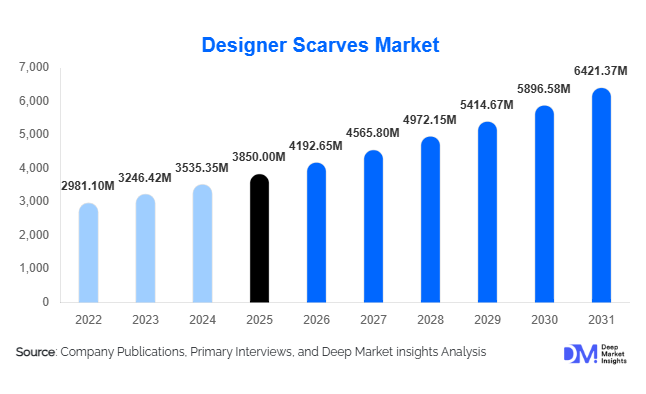
According to Deep Market Insights, the global designer scarves market size was valued at USD 3,850 million in 2025 and is projected to grow from USD 4,192.65 million in 2026 to reach USD 6,421.37 million by 2031, expanding at a CAGR of 8.9% during the forecast period (2026–2031). The designer scarves market growth is primarily driven by rising global luxury consumption, increasing fashion consciousness among consumers, expansion of e-commerce luxury retail channels, and growing demand for sustainable and personalized fashion accessories.
Key Market Insights
- Luxury accessibility is driving demand, with designer scarves emerging as entry-level luxury products for aspirational consumers globally.
- Silk-based premium scarves dominate high-value sales, supported by heritage luxury brands and strong perceived value.
- Europe remains the largest regional market, led by France, Italy, and the U.K., due to strong luxury fashion ecosystems.
- Asia-Pacific is the fastest-growing region, driven by rising disposable incomes and luxury adoption in China and India.
- E-commerce channels are transforming distribution, accounting for over one-third of global designer scarf sales.
- Sustainability and personalization trends are reshaping product innovation and consumer preferences across all regions.
What are the latest trends in the designer scarves market?
Sustainability and Ethical Luxury Fashion
One of the most significant trends in the designer scarves market is the rapid shift toward sustainable luxury. Consumers are increasingly demanding eco-friendly fabrics such as organic silk, recycled polyester blends, and ethically sourced wool. Luxury brands are responding by adopting transparent supply chains, fair-trade manufacturing practices, and environmentally responsible dyeing techniques. Many global fashion houses are also introducing limited “sustainable collections” that highlight reduced carbon footprints and biodegradable packaging. This trend is particularly strong among younger consumers, who associate sustainability with premium brand value and long-term brand loyalty.
Digital Personalization and Smart Design Integration
The integration of digital design tools and AI-driven customization platforms is reshaping product development in the designer scarves market. Consumers can now personalize scarves with monograms, custom patterns, and exclusive prints through online configurators. Brands are leveraging digital printing technologies to offer small-batch production without compromising profitability. Augmented reality (AR) previews and virtual try-on tools are also enhancing the online shopping experience. This digital transformation is increasing engagement rates, reducing return ratios, and enabling brands to scale personalization efficiently across global markets.
What are the key drivers in the designer scarves market?
Rising Global Luxury Consumption
The steady increase in high-net-worth individuals and aspirational middle-class consumers is a key driver of the designer scarves market. Scarves serve as an accessible luxury category compared to handbags and apparel, making them highly attractive entry-point products. Rising disposable incomes in emerging economies, especially in the Asia-Pacific and the Middle East, are further fueling demand. Luxury gifting culture and seasonal fashion consumption also contribute significantly to repeat purchases, strengthening overall market growth.
Expansion of E-Commerce Luxury Retail
The rapid growth of online luxury retail is another major growth driver. Digital platforms enable global accessibility to premium brands, allowing consumers to purchase designer scarves without geographical limitations. Brand-owned websites, luxury marketplaces, and social commerce channels are expanding reach, especially among younger demographics. Enhanced logistics, digital payments, and virtual shopping experiences are accelerating online adoption across both developed and emerging markets.
What are the restraints for the global market?
Counterfeiting and Brand Dilution
The proliferation of counterfeit luxury scarves remains a major restraint for the market. Fake products not only reduce brand exclusivity but also lead to revenue losses for established players. The availability of low-cost imitations through online platforms further intensifies this challenge. Luxury brands are investing heavily in authentication technologies, blockchain-based tracking, and anti-counterfeit labeling to protect brand integrity.
Price Sensitivity in Emerging Markets
Despite rising demand, high price points of designer scarves restrict wider adoption in emerging economies. Middle-income consumers often find premium pricing barriers difficult to overcome, limiting market penetration. Economic instability, inflation, and currency fluctuations further impact purchasing behavior, especially in price-sensitive regions such as Latin America and parts of Asia.
What are the key opportunities in the designer scarves industry?
Expansion into Emerging Luxury Markets
Emerging economies such as India, China, Brazil, and the UAE present significant growth opportunities for designer scarf brands. These markets are witnessing rapid growth in affluent populations and increasing interest in accessible luxury products. Designer scarves are often seen as aspirational entry products into luxury fashion, making them highly attractive in these regions. Localization strategies, regional design adaptations, and targeted pricing models can significantly enhance market penetration.
Growth of Personalized and Limited-Edition Collections
Personalization is emerging as a key differentiator in the luxury accessories space. Brands offering customized scarves, monogramming services, and limited-edition collections are gaining strong traction. These offerings enhance exclusivity and brand engagement while enabling higher price realization. Collaborations with artists and influencers further amplify demand, particularly among younger luxury consumers.
Report Scope
| Report Metric | Details |
|---|---|
| Market Size in 2025 | USD 3850 Million |
| Market Size in 2026 | USD 4192.65 Million |
| Market Size in 2031 | USD 6421.37 Million |
| CAGR | 8.9% (2026-2031) |
| Base Year for Estimation | 2025 |
| Historical Data | 2022-2024 |
| Forecast Period | 2026-2031 |
| Report Coverage | Revenue Forecast, Competitive Landscape, Supply Chain Disruption, Growth Factors, Environment & Regulatory Landscape and Trends |
| Geographies Covered | North America, Europe, APAC, Middle East and Africa, LATAM |
| Countries Covered | U.S., Canada, U.K., Germany, France, Spain, Italy, Russia, Nordic, Benelux, Rest of Europe, China, Korea, Japan, India, Australia, Singapore, Taiwan, South East Asia, Rest of Asia-Pacific, UAE, Turky, Saudi Arabia, South Africa, Egypt, Nigeria, Rest of MEA, Brazil, Mexico, Argentina, Chile, Colombia, Rest of LATAM |
Explore more data points, trends and opportunities Download Free Sample Report
Product Type Insights
Silk designer scarves continue to dominate the global market, accounting for approximately 38% of total market share in 2025, primarily driven by their premium appeal, lightweight texture, and strong association with heritage luxury brands. The leadership of silk scarves is further reinforced by their versatility across seasons, high perceived value, and strong presence in iconic collections from leading fashion houses. Additionally, silk offers superior print quality, which enhances intricate designs and brand signatures, making it the preferred material for high-margin products.
Within the design category, printed designer scarves lead with nearly 42% share, supported by rapid advancements in digital printing technologies and increasing consumer demand for unique, expressive fashion statements. The ability of brands to quickly adapt to changing fashion cycles and introduce limited-edition prints has significantly contributed to the growth of this segment. Meanwhile, cashmere and wool scarves form a substantial premium sub-segment, particularly in colder regions such as Europe and North America, where seasonal demand remains strong. Blended fabric scarves are gaining traction due to their cost efficiency and durability, allowing brands to target the mid-tier luxury segment without compromising design flexibility. Synthetic scarves, although smaller in value share, are expanding within the accessible luxury segment due to affordability and scalability. Overall, the dominance of silk and printed scarves is expected to continue, driven by innovation in materials and design customization capabilities.
Application Insights
Everyday fashion wear represents the largest application segment, contributing approximately 40% of total global demand, as designer scarves are increasingly positioned as year-round style essentials rather than seasonal accessories. The growth of this segment is driven by evolving fashion trends, social media influence, and the increasing adoption of scarves as versatile styling elements across casual and semi-formal outfits. Formal and occasion wear constitutes a strong premium segment, supported by luxury gifting trends and high-end fashion consumption during events, celebrations, and festive seasons. Designer scarves are frequently used as statement accessories, enhancing outfit aesthetics and brand visibility. Seasonal applications, particularly winter-focused scarves, continue to drive consistent demand in colder climates such as Europe and North America, where wool and cashmere variants see peak sales during colder months.
Emerging niche applications include personalized scarves and travel-themed accessories, which are gaining popularity due to increasing demand for experiential and customized fashion. These applications are further supported by growth in tourism, retail, and digital customization platforms, enabling brands to expand their product offerings and cater to evolving consumer preferences.
Distribution Channel Insights
E-commerce platforms dominate the distribution landscape, accounting for approximately 35% of the global market share, driven by increasing internet penetration, convenience, and the growing influence of digital marketing and social media. The leadership of this segment is supported by the ability of brands to reach global audiences, offer personalized experiences, and provide seamless purchasing journeys through mobile and web platforms. Influencer collaborations and targeted advertising have further accelerated online sales growth.
Brand-owned retail stores remain a critical channel for maintaining premium brand positioning and delivering curated customer experiences. These stores allow luxury brands to showcase craftsmanship, heritage, and exclusivity, which are key differentiators in the high-end segment. Multi-brand luxury outlets continue to serve affluent consumers seeking diverse product selections under one roof, particularly in metropolitan cities. Duty-free and travel retail channels are experiencing steady growth, especially in international airports and tourist hubs. Designer scarves are popular in this channel due to their portability, gifting appeal, and relatively lower price points compared to other luxury goods, making them ideal impulse purchases for international travelers.
End-Use Analysis
The designer scarves market is intrinsically linked to the broader global luxury fashion industry, which continues to expand due to rising disposable incomes, urbanization, and increasing consumer inclination toward premium lifestyle products. Women remain the dominant end-user segment, accounting for the majority of purchases due to higher engagement with fashion accessories and greater product variety. However, the men’s segment is emerging as the fastest-growing category, driven by evolving fashion norms, increasing acceptance of accessories in menswear, and the influence of celebrity and social media trends. The expansion of men’s luxury fashion collections by leading brands is further supporting this growth trajectory.
Corporate gifting and premium promotional products represent an emerging end-use segment, as companies increasingly adopt luxury accessories such as designer scarves for branding and relationship-building purposes. Additionally, travel retail continues to play a significant role in driving cross-border demand, particularly in regions with high tourist inflows. Export-driven demand remains strong, with European luxury brands serving as key suppliers to global markets, particularly Asia-Pacific and North America. This export orientation enhances global market integration and supports consistent demand across regions.
Explore more data points, trends and opportunities Download Free Sample Report
Designer Scarves Market Segmentations
By Product Type
- Silk Designer Scarves
- Cashmere Designer Scarves
- Wool Designer Scarves
- Cotton Designer Scarves
- Blended Fabric Designer Scarves
- Synthetic Designer Scarves
By Design Category
- Printed Designer Scarves
- Embroidered Designer Scarves
- Handcrafted / Artisan Scarves
- Digital / Graphic Pattern Scarves
- Monogrammed / Personalized Scarves
By Distribution Channel
- Brand-Owned Retail Stores
- Multi-Brand Luxury Retail Stores
- E-commerce Platforms
- Brand-Owned Online Stores
- Duty-Free / Travel Retail
By End User
- Women
- Men
- Unisex / Gender-Neutral
By Application
- Everyday Wear
- Formal / Occasion Wear
- Seasonal Collections
- Travel & Fashion Accessories
Regional Insights
North America
North America accounts for approximately 22% of the global designer scarves market, with the United States being the primary contributor. The region’s growth is driven by high disposable incomes, strong consumer spending on luxury goods, and a well-established e-commerce ecosystem. Additionally, the increasing influence of digital marketing, celebrity endorsements, and fashion influencers has significantly boosted demand for designer accessories. Seasonal fashion trends and frequent product launches further support repeat purchases. The presence of major luxury retailers and robust logistics infrastructure also enables seamless distribution and market expansion.
Europe
Europe remains the largest regional market, contributing around 36% of global share, led by France, Italy, and the United Kingdom. The region’s dominance is primarily driven by its strong luxury fashion heritage, concentration of leading global brands, and high export capabilities. France alone accounts for nearly 12% of global demand, supported by iconic fashion houses and strong tourism-driven retail sales. Additionally, Europe benefits from a well-developed artisanal ecosystem, skilled craftsmanship, and continuous innovation in textile design. High tourist inflows and duty-free retail further enhance demand, while sustainability initiatives and regulatory frameworks are shaping future growth trends.
Asia-Pacific
Asia-Pacific holds approximately 30% of the global market share and is the fastest-growing region, driven by rapid economic development and increasing luxury consumption. China leads the region with nearly 15% global share, supported by a large affluent population, strong digital retail penetration, and growing preference for premium brands. India is emerging as the fastest-growing market with a CAGR exceeding 10%, fueled by rising disposable incomes, urbanization, and expanding middle-class aspirations. The growth of e-commerce platforms, increasing brand awareness, and localization strategies by global players are further accelerating regional demand.
Latin America
Latin America accounts for approximately 5% of the global market, with Brazil and Mexico leading regional demand. Growth in this region is driven by increasing urbanization, rising middle-class incomes, and greater exposure to global fashion trends through digital media. Although economic volatility remains a challenge, the growing popularity of affordable luxury products is supporting market expansion. International brands are gradually increasing their presence in key urban centers, while e-commerce is playing a crucial role in improving accessibility.
Middle East & Africa
The Middle East & Africa region represents around 7% of the global market share, with strong demand from countries such as the UAE and Saudi Arabia. The region’s growth is driven by high-income populations, strong luxury consumption culture, and significant tourism inflows. Luxury malls, duty-free retail, and premium shopping experiences contribute to robust demand for designer scarves. Additionally, the region’s climatic conditions support year-round usage of lightweight scarves. In Africa, the market is gradually expanding due to increasing urbanization and the development of local textile industries, positioning the region as both a production hub and an emerging consumer market.
Key Players in the Designer Scarves Market
- Hermès International
- LVMH (Louis Vuitton)
- Chanel
- Gucci (Kering Group)
- Burberry Group
- Prada Group
- Dolce & Gabbana
- Versace
- Salvatore Ferragamo
- Ralph Lauren Corporation
- Tory Burch
- Michael Kors
- Etro
- Missoni
- Alexander McQueen