Derma Cosmetics Market Size
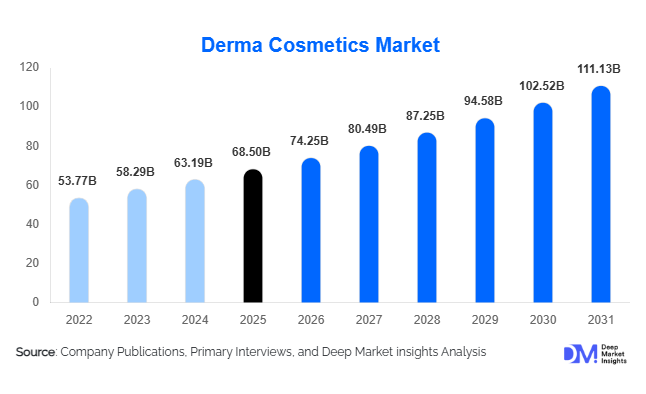
According to Deep Market Insights, the global derma cosmetics market size was valued at USD 68.5 billion in 2025 and is projected to grow from USD 74.25 billion in 2026 to reach USD 111.13 billion by 2031, expanding at a CAGR of 8.4% during the forecast period (2026–2031). The market growth is primarily driven by rising dermatological awareness, increasing prevalence of skin disorders, and a growing shift toward clinically validated skincare solutions. The convergence of pharmaceuticals and cosmetics, coupled with increasing consumer preference for ingredient-driven products, is further accelerating adoption globally.
Key Market Insights
- Clinically backed skincare products are gaining strong traction, as consumers increasingly prefer scientifically validated formulations over traditional cosmetics.
- Facial care products dominate the market, accounting for over 40% share, driven by anti-aging and acne treatment demand.
- North America leads the global market, supported by high dermatological awareness and premium product adoption.
- Asia-Pacific is the fastest-growing region, fueled by urbanization, pollution-related skin concerns, and rising disposable incomes.
- E-commerce and direct-to-consumer channels are transforming distribution, enabling wider access and personalized engagement.
- Advanced ingredients such as hyaluronic acid, retinoids, and peptides are shaping innovation and product differentiation.
What are the latest trends in the derma cosmetics market?
Personalized and AI-Driven Skincare Solutions
The derma cosmetics market is witnessing a significant shift toward personalized skincare solutions powered by artificial intelligence and data analytics. Brands are leveraging skin diagnostic tools, mobile apps, and AI-based imaging systems to assess individual skin conditions and recommend customized formulations. This trend is particularly prominent in premium segments, where consumers are willing to pay higher prices for tailored solutions. Companies are also exploring microbiome-based skincare, which considers individual skin flora to design targeted treatments. This level of personalization enhances customer satisfaction, improves treatment outcomes, and increases brand loyalty, making it a critical trend shaping future market growth.
Clean-Label and Sustainable Formulations
Consumers are increasingly prioritizing transparency, safety, and sustainability in skincare products. As a result, clean-label derma cosmetics—free from parabens, sulfates, and synthetic additives—are gaining widespread acceptance. Manufacturers are incorporating plant-based ingredients, biodegradable packaging, and eco-friendly production processes to meet evolving consumer expectations. Sustainability certifications and ethical sourcing practices are becoming key differentiators in competitive markets. This trend is particularly strong in Europe and North America, where regulatory frameworks and consumer awareness are driving demand for environmentally responsible products.
What are the key drivers in the derma cosmetics market?
Rising Prevalence of Skin Disorders
The increasing incidence of skin conditions such as acne, eczema, psoriasis, and rosacea is a major driver of the derma cosmetics market. Environmental factors such as pollution, UV exposure, and changing lifestyles have contributed to the growing burden of dermatological issues. As a result, consumers are actively seeking clinically tested products that offer therapeutic benefits alongside cosmetic appeal. Dermatologists are increasingly recommending derma cosmetics as part of treatment regimens, further boosting market demand.
Growing Consumer Awareness of Active Ingredients
Consumers are becoming more knowledgeable about skincare ingredients and their efficacy. Active ingredients such as retinol, niacinamide, hyaluronic acid, and salicylic acid are gaining popularity due to their proven benefits. Social media, dermatology influencers, and digital platforms have played a significant role in educating consumers, leading to a shift from traditional cosmetics to derma cosmetics. This trend is driving demand for transparent labeling and clinically validated formulations.
What are the restraints for the global market?
High Cost of Premium Products
One of the primary restraints in the derma cosmetics market is the high cost associated with premium and clinically tested products. Advanced formulations, extensive R&D, and clinical trials contribute to higher production costs, which are passed on to consumers. This limits accessibility in price-sensitive markets, particularly in developing regions, where affordability remains a key concern.
Regulatory and Compliance Challenges
The classification of derma cosmetics between pharmaceuticals and cosmetics creates regulatory complexities across different regions. Compliance with varying standards for safety, efficacy, and labeling can delay product launches and increase operational costs. Companies must navigate diverse regulatory frameworks, which can act as a barrier to market entry and expansion.
What are the key opportunities in the derma cosmetics industry?
Expansion in Emerging Markets
Emerging economies such as India, China, Brazil, and the UAE present significant growth opportunities for derma cosmetics manufacturers. Rapid urbanization, increasing disposable incomes, and growing awareness of skincare are driving demand in these regions. The expansion of dermatology clinics, pharmacies, and e-commerce platforms is further supporting market penetration. Companies that tailor their products to local skin concerns and price sensitivities are likely to gain a competitive advantage in these high-growth markets.
Integration with Medical and Aesthetic Treatments
The integration of derma cosmetics with dermatological and aesthetic procedures is creating new growth avenues. Products designed for post-procedure care, such as after laser treatments or chemical peels, are gaining popularity due to their effectiveness in enhancing treatment outcomes. Partnerships between dermatologists, clinics, and cosmetic brands are strengthening product credibility and driving repeat purchases. This synergy between medical and cosmetic applications is expected to expand the market significantly.
Report Scope
| Report Metric | Details |
|---|---|
| Market Size in 2025 | USD 68.5 Billion |
| Market Size in 2026 | USD 74.25 Billion |
| Market Size in 2031 | USD 111.13 Billion |
| CAGR | 8.4% (2026-2031) |
| Base Year for Estimation | 2025 |
| Historical Data | 2022-2024 |
| Forecast Period | 2026-2031 |
| Report Coverage | Revenue Forecast, Competitive Landscape, Supply Chain Disruption, Growth Factors, Environment & Regulatory Landscape and Trends |
| Geographies Covered | North America, Europe, APAC, Middle East and Africa, LATAM |
| Countries Covered | U.S., Canada, U.K., Germany, France, Spain, Italy, Russia, Nordic, Benelux, Rest of Europe, China, Korea, Japan, India, Australia, Singapore, Taiwan, South East Asia, Rest of Asia-Pacific, UAE, Turky, Saudi Arabia, South Africa, Egypt, Nigeria, Rest of MEA, Brazil, Mexico, Argentina, Chile, Colombia, Rest of LATAM |
Explore more data points, trends and opportunities Download Free Sample Report
Product Type Insights
Facial care products dominate the global derma cosmetics market, accounting for approximately 42% of the total market share in 2025. The leadership of this segment is primarily driven by the strong and sustained demand for dermatologist-recommended anti-aging creams, acne treatment solutions, pigmentation correctors, moisturizers, and skin barrier repair products. Rising consumer concerns regarding pollution-induced skin damage, UV exposure, premature aging, and lifestyle-related skin sensitivity are significantly accelerating demand for targeted facial skincare solutions. In addition, increasing consumer preference for clinically proven active ingredients such as retinol, niacinamide, ceramides, hyaluronic acid, and vitamin C is further supporting segment expansion. Sun care products are also witnessing steady growth, particularly dermatological sunscreens and mineral-based UV protection products, supported by increasing awareness regarding skin cancer prevention, photoaging, and year-round sun protection. Meanwhile, hair and scalp care products are emerging as niche yet fast-growing categories, fueled by rising incidences of hair thinning, scalp sensitivity, dandruff, and stress-related hair loss concerns.
Application Insights
Anti-aging applications lead the derma cosmetics market, contributing nearly 30% of the global share. The segment’s dominance is primarily driven by rapidly aging populations across developed economies, growing demand for preventive skincare among younger consumers, and rising interest in scientifically formulated products that address wrinkles, fine lines, skin laxity, and uneven texture. The increasing adoption of early-age skincare regimens, particularly among millennials and Gen Z consumers, is further strengthening demand for anti-aging solutions. Acne treatment products also represent a significant share, supported by the increasing prevalence of acne among adolescents and adults due to hormonal changes, stress, pollution, and dietary factors. Hyperpigmentation, melasma, and sensitive skin treatment products are gaining strong traction, especially in regions characterized by high UV exposure, environmental pollution, and diverse skin tones. Additionally, the rising prevalence of chronic dermatological conditions such as eczema, rosacea, psoriasis, and dermatitis is expanding the therapeutic scope of derma cosmetics, driving demand for clinically tested and dermatologist-endorsed formulations.
Distribution Channel Insights
Pharmacies and drugstores account for approximately 35% of the total market share, making them the leading distribution channel in the derma cosmetics market. The segment’s leadership is largely attributed to high consumer trust in pharmacist recommendations, easy product accessibility, and the strong positioning of dermocosmetic brands within medical and OTC skincare categories. Consumers increasingly prefer purchasing dermatologist-recommended skincare through pharmacies due to perceived product authenticity, clinical credibility, and professional guidance. E-commerce platforms are rapidly gaining market share, supported by growing digital penetration, convenience, extensive product assortments, subscription models, AI-driven skin diagnostics, and personalized product recommendations. Direct-to-consumer (DTC) channels are also expanding steadily, enabling brands to strengthen customer relationships, collect first-party consumer insights, improve profit margins, and launch customized skincare regimens. Specialty beauty retailers continue to play a critical role in premium and luxury dermocosmetic distribution, particularly across urban and high-income consumer markets.
End-Use Insights
Individual consumers represent the largest end-use segment, driven by rising self-care awareness, increasing spending on preventive skincare, and growing demand for clinically validated daily-use products. The expansion of social media skincare education, influencer-led ingredient awareness, and increasing dermatologist content across digital platforms are further encouraging at-home adoption. Dermatology clinics and hospitals are the fastest-growing end-use segment, with growth exceeding 10% CAGR, fueled by rising demand for physician-dispensed products, prescription-adjacent skincare, and post-procedure formulations used after chemical peels, laser resurfacing, microneedling, and cosmetic dermatology treatments. Aesthetic clinics and medical spas are also emerging as important consumption channels, particularly in developed economies and metropolitan regions where demand for minimally invasive aesthetic procedures continues to rise. In addition, export-driven demand remains strong from key manufacturing hubs such as France, South Korea, and the United States, which continue to supply premium derma cosmetics across global markets.
Explore more data points, trends and opportunities Download Free Sample Report
Derma Cosmetics Market Segmentations
By Product Type
- Facial Care Products
- Body Care Products
- Hair & Scalp Care
- Sun Care Products
- Specialty Dermatology Products
By Active Ingredient Type
- Retinoids-Based Formulations
- Hyaluronic Acid-Based Formulations
- Peptides & Growth Factors
- Antioxidants
- AHAs/BHAs
- Mineral-Based Ingredients
- Botanicals & Dermaceutical Extracts
By Indication / Application
- Acne & Oil Control
- Anti-Aging & Wrinkle Reduction
- Hyperpigmentation & Skin Tone Correction
- Sensitive Skin & Allergy Care
- Chronic Dermatological Conditions
By Distribution Channel
- Dermatology Clinics & Hospitals
- Pharmacies & Drugstores
- E-commerce Platforms
- Specialty Beauty Retailers
- Direct-to-Consumer Channels
By Consumer Type
- Prescription-Based Users
- Over-the-Counter (OTC) Consumers
- Professional/Clinical Users
Regional Insights
North America
North America holds approximately 32% of the global market share in 2025, led by the United States. Regional growth is primarily driven by high consumer awareness regarding skin health, strong dermatologist accessibility, rising prevalence of acne and aging-related skin concerns, and strong demand for premium clinically tested skincare solutions. The region also benefits from robust innovation pipelines, high spending on medical aesthetics, and widespread adoption of science-backed ingredient-based skincare products. The U.S. dominates regional demand, accounting for over 75% of the North American market, supported by advanced healthcare systems, strong pharmacy networks, high disposable incomes, and the rapid expansion of cosmeceutical product launches.
Europe
Europe accounts for around 28% of global market share, with France, Germany, and the UK leading demand. Growth in the region is driven by strong regulatory standards, high product quality expectations, growing preference for dermatologically certified skincare, and the presence of globally established dermocosmetic manufacturers. France remains a global innovation and export hub for premium derma cosmetic brands, supported by strong R&D capabilities and pharmaceutical-cosmetic convergence. Germany continues to witness strong expansion through pharmacy-led distribution, while the UK market is benefiting from increasing consumer focus on active ingredient transparency, anti-aging demand, and sensitive skin solutions.
Asia-Pacific
Asia-Pacific is the fastest-growing regional market, with a CAGR exceeding 10%. Growth is primarily driven by rising disposable incomes, rapid urbanization, worsening pollution-related skin issues, increasing dermatological awareness, and the growing influence of K-beauty and J-beauty innovations. China and India are key growth engines due to their large consumer bases, expanding middle-class populations, and rising demand for pigmentation, acne, and sun protection products. South Korea serves as a major global innovation hub, driving advanced formulation technologies, ingredient trends, and product exports. The region’s strong digital commerce ecosystem, social media-driven beauty trends, and increasing male skincare adoption are expected to further accelerate long-term growth.
Latin America
Latin America accounts for approximately 7% of the global market, with Brazil and Mexico leading regional demand. Market growth is supported by increasing beauty consciousness, rising urbanization, growing middle-class spending, and expanding access to pharmacy and online retail channels. Brazil, in particular, remains a high-potential market due to strong consumer interest in sun care, anti-aging, and pigmentation treatments driven by climatic exposure and strong beauty culture. Expanding dermatologist access and premiumization trends are also supporting the gradual adoption of advanced derma cosmetic products.
Middle East & Africa
The Middle East & Africa market is experiencing steady growth, particularly across the UAE and Saudi Arabia. Regional expansion is primarily driven by high spending on premium skincare, increasing demand for hydration and sun protection products, and rising dermatological concerns caused by harsh climatic conditions, intense UV exposure, and dry environments. The growing popularity of luxury skincare brands, medical aesthetic procedures, and dermatology clinics is further strengthening market demand. South Africa also represents a key market, supported by improving healthcare infrastructure, rising skincare awareness, and expanding availability of dermatologist-recommended products.
Key Players in the Derma Cosmetics Market
- L'Oréal
- Galderma
- Johnson & Johnson
- Unilever
- Beiersdorf
- Pierre Fabre
- Procter & Gamble
- Shiseido
- Amorepacific
- Bayer
- AbbVie (Allergan)
- Estée Lauder Companies
- Himalaya Wellness
- Cipla
- ISDIN