Dark Tourism Market Size
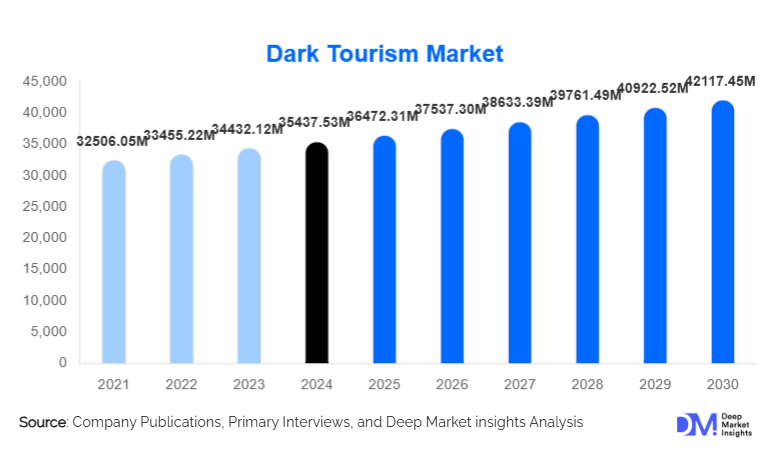
According to Deep Market Insights, the global dark tourism market size was valued at USD 35,437.53 million in 2025 and is projected to grow from USD 36,472.31 million in 2026 to reach USD 42,117.45 million by 2031, expanding at a CAGR of 2.92% during the forecast period (2026–2031). The dark tourism market growth is driven by increasing global interest in experiential and educational travel, rising visitation to war memorials and tragedy-related heritage sites, and stronger institutional and government support for historical preservation and remembrance tourism.
Key Market Insights
- War and conflict-related destinations dominate global demand, accounting for the largest share due to strong educational, commemorative, and institutional travel flows.
- Educational and historical learning is the leading travel motivation, supported by universities, schools, and research institutions integrating dark tourism into curricula.
- Europe holds the largest regional share, driven by World War heritage sites, genocide memorials, and structured preservation policies.
- Asia-Pacific is the fastest-growing region, led by Japan, China, Vietnam, and Cambodia, supported by rising inbound tourism and government-backed remembrance initiatives.
- Group and institutional travel represents a stable revenue base, offering predictable demand and higher per-trip value through guided experiences.
- Digital storytelling and immersive technologies such as AR-based site interpretation are enhancing visitor engagement while maintaining ethical standards.
Dark Tourism Market Trends
Rising Integration of Educational and Institutional Travel
Dark tourism is increasingly embedded within formal education and institutional travel programs. Universities, military academies, and international organizations are incorporating visits to war memorials, genocide remembrance sites, and political history landmarks into structured learning experiences. This trend has strengthened year-round demand and reduced seasonality, particularly in Europe and North America. Governments are also collaborating with academic bodies to enhance site interpretation, develop multilingual educational content, and standardize ethical guidelines, reinforcing the credibility and long-term sustainability of dark tourism destinations.
Digital and Immersive Interpretation at Sensitive Sites
Technology-enhanced interpretation is becoming a defining trend in dark tourism. Augmented reality guides, virtual reconstructions, and audio-based storytelling allow visitors to understand historical events without physical alteration of sensitive locations. These tools are particularly valuable at sites where preservation limits infrastructure development. Digital ticketing, mobile-guided tours, and virtual access experiences are also expanding reach to global audiences who may not be able to travel physically, creating supplementary revenue streams for site operators.
Dark Tourism Market Drivers
Growth in Experiential and Purpose-Driven Travel
Modern travelers increasingly seek meaningful experiences that provide emotional depth, historical context, and educational value. Dark tourism aligns strongly with this shift, offering authentic engagement with significant historical events. This driver is especially prominent among travelers aged 31–50, who combine higher disposable income with a desire for culturally enriching travel. The preference for experience-led tourism has positioned dark tourism as a resilient niche within the broader tourism ecosystem.
Government and Public Sector Support for Heritage Preservation
Governments worldwide are investing heavily in preserving historical sites associated with conflict, tragedy, and remembrance. Funding for museums, memorial centers, and visitor infrastructure has improved site accessibility and interpretation quality. Public sector endorsement has also reduced stigma associated with dark tourism, positioning it as a legitimate form of cultural and educational travel rather than a niche curiosity.
Dark Tourism Market Restraints
Ethical and Regulatory Sensitivities
Dark tourism operators face strict ethical considerations regarding commercialization, representation, and visitor conduct. Poorly managed sites risk public backlash, reputational damage, and regulatory intervention. Compliance with preservation standards and cultural sensitivity guidelines can limit pricing flexibility and promotional strategies, acting as a restraint on aggressive revenue expansion.
Geopolitical and Accessibility Challenges
Many dark tourism destinations are located in politically sensitive or previously conflict-affected regions. Travel restrictions, security concerns, and diplomatic tensions can disrupt visitor flows and reduce international demand. Insurance limitations and infrastructure constraints further add to operational risks for site managers and tour operators.
Dark Tourism Market Opportunities
Digital Heritage and Virtual Dark Tourism Experiences
The development of virtual dark tourism platforms presents a significant growth opportunity. Digitally reconstructed experiences, virtual museum tours, and online educational programs allow destinations to reach global audiences while preserving physical sites. These offerings are particularly attractive to educational institutions and international learners, creating scalable and low-impact revenue streams.
Expansion in Emerging and Underdeveloped Regions
Emerging markets in Eastern Europe, Southeast Asia, Africa, and Latin America hold substantial untapped potential. Many regions possess historically significant sites that remain under-commercialized due to infrastructure gaps. Strategic public-private partnerships and international funding can unlock long-term growth while promoting cultural preservation and regional tourism development.
Report Scope
| Report Metric | Details |
|---|---|
| Market Size in 2025 | USD 35437.53 Million |
| Market Size in 2026 | USD 36472.31 Million |
| Market Size in 2031 | USD 42117.45 Million |
| CAGR | 2.92% (2026-2031) |
| Base Year for Estimation | 2025 |
| Historical Data | 2022-2024 |
| Forecast Period | 2026-2031 |
| Report Coverage | Revenue Forecast, Competitive Landscape, Supply Chain Disruption, Growth Factors, Environment & Regulatory Landscape and Trends |
| Geographies Covered | North America, Europe, APAC, Middle East and Africa, LATAM |
| Countries Covered | U.S., Canada, U.K., Germany, France, Spain, Italy, Russia, Nordic, Benelux, Rest of Europe, China, Korea, Japan, India, Australia, Singapore, Taiwan, South East Asia, Rest of Asia-Pacific, UAE, Turky, Saudi Arabia, South Africa, Egypt, Nigeria, Rest of MEA, Brazil, Mexico, Argentina, Chile, Colombia, Rest of LATAM |
Explore more data points, trends and opportunities Download Free Sample Report
Site Type Insights
War and conflict sites represent the largest segment, accounting for approximately 38% of the global dark tourism market in 2025. These sites benefit from global historical relevance, strong institutional demand, and extensive government support. Disaster and tragedy sites form the second-largest segment, driven by interest in nuclear history, natural disaster remembrance, and industrial accident memorials. Crime and punishment sites, including historic prisons and execution grounds, continue to attract curiosity-driven visitors, while death and burial sites appeal to cultural and spiritual travelers. Paranormal and folklore-based attractions remain niche but are gaining popularity among younger demographics.
Application Insights
Educational and historical learning applications dominate demand, accounting for over 40% of total market revenue. Commemorative and memorial travel is another major application, particularly around anniversaries of significant historical events. Curiosity-driven experiential travel is expanding rapidly, supported by digital media exposure and social storytelling, while spiritual and reflective travel remains a smaller but stable segment.
Distribution Channel Insights
Tour operators and specialized travel agencies account for approximately 44% of bookings, reflecting the need for guided interpretation and ethical context. Direct bookings through site authorities and museums are growing as digital infrastructure improves. Online experience platforms are gaining traction, particularly among younger travelers seeking flexible and short-duration visits.
Traveler Type Insights
Group and educational travelers represent the largest share of demand, driven by institutional visits and organized tours. Individual travelers form a growing segment, particularly among culturally curious and repeat international tourists. Government and institutional delegations provide high-value, low-frequency demand, contributing to revenue stability.
Age Group Insights
Travelers aged 31–50 years account for the largest market share at approximately 39%, combining strong purchasing power with interest in historical understanding. The 18–30 age group is driving growth in curiosity-led and digital-first experiences, while travelers aged 51+ contribute significantly to commemorative and reflective tourism segments.
Explore more data points, trends and opportunities Download Free Sample Report
Dark Tourism Market Segmentations
By Site Type
- War & Conflict Sites
- Disaster & Tragedy Sites
- Crime & Punishment Sites
- Death & Burial Sites
- Paranormal & Folklore-Based Sites
By Visitor Motivation
- Educational & Historical Learning
- Commemorative & Memorial Travel
- Curiosity-Driven & Experiential Travel
- Spiritual & Reflective Travel
By Traveler Type
- Individual Travelers
- Group & Educational Tours
- Institutional & Government Delegations
By Distribution Channel
- Tour Operators & Travel Agencies
- Direct Booking (Museums & Site Authorities)
- Online Experience Platforms
By Age Group
- 18–30 Years
- 31–50 Years
- 51+ Years
Regional Insights
Europe
Europe leads the global dark tourism market with approximately 41% market share, driven by Germany, Poland, France, and the United Kingdom. Poland alone contributes nearly 9% of global demand due to World War II memorial tourism.
North America
North America accounts for around 24% market share, led by the United States. Demand is supported by memorial museums, Civil War heritage sites, and strong educational travel flows.
Asia-Pacific
Asia-Pacific is the fastest-growing region, expanding at over 9.2% CAGR. Japan is the fastest-growing country market due to Hiroshima and Nagasaki remembrance tourism, followed by Vietnam, Cambodia, and China.
Latin America
Latin America holds approximately 6% market share, with growing interest in political history and memorial tourism in Mexico, Argentina, and Colombia.
Middle East & Africa
The region accounts for roughly 7% of global demand, led by Israel, Rwanda, and South Africa, supported by genocide memorials and apartheid-era heritage tourism.
Leading Players in the Dark Tourism Industry
- TUI Group
- G Adventures
- Intrepid Travel
- Trafalgar Group
- EF Educational Tours
- Exodus Travels
- Globus Journeys
- Viking Cruises
- Abercrombie & Kent
- Tauck
- Contiki
- Rick Steves’ Europe
- Audley Travel
- Backroads
- Martin Randall Travel