Cycling Apparel Market Size
According to Deep Market Insights, the global cycling apparel market size was valued at USD 6,850 million in 2025 and is projected to grow from USD 7,398.00 million in 2026 to reach USD 10,870.09 million by 2031, expanding at a CAGR of 8.0% during the forecast period (2026–2031). The cycling apparel market growth is primarily driven by increasing health awareness, rising adoption of cycling as a sustainable commuting option, and growing participation in recreational and professional cycling activities worldwide.
The market is witnessing strong momentum due to urban mobility transitions and government investments in cycling infrastructure. Technological advancements such as moisture-wicking fabrics, UV protection, and aerodynamic designs are enhancing product performance and attracting premium consumers. Additionally, the rise of e-commerce platforms and direct-to-consumer models has improved accessibility and product penetration globally. Emerging markets in Asia-Pacific and Latin America are contributing significantly to volume growth, while developed regions continue to drive premiumization. Overall, the cycling apparel market is evolving at the intersection of performance innovation, sustainability, and lifestyle adoption.
Key Market Insights
- Recreational cycling dominates global demand, accounting for nearly 50% of total market consumption, driven by fitness and lifestyle trends.
- Europe leads the global market with approximately 35% share, supported by a strong cycling culture and infrastructure.
- Asia-Pacific is the fastest-growing region, expanding at a CAGR of around 9.5% due to rising urbanization and disposable income.
- Mid-range products hold the largest share, contributing nearly 45% of total revenue due to the affordability-performance balance.
- Online retail channels account for ~40% of sales, driven by convenience and product variety.
- Technological innovations in textiles, including smart fabrics and sustainable materials, are reshaping product development.
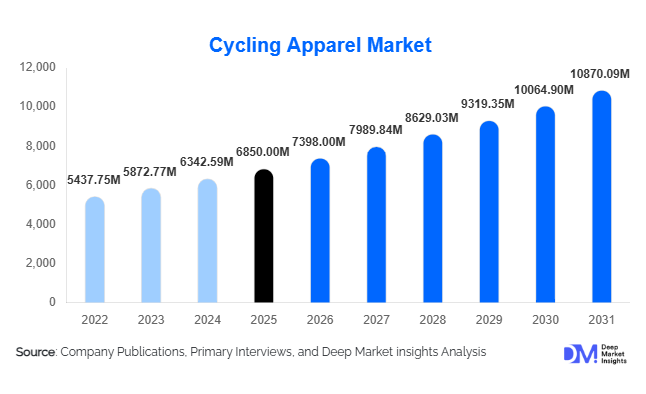
What are the latest trends in the cycling apparel market?
Sustainability and Eco-Friendly Materials Gaining Momentum
The cycling apparel industry is increasingly shifting toward sustainable manufacturing practices. Brands are adopting recycled polyester, organic cotton, and biodegradable materials to meet consumer demand for eco-friendly products. Sustainability certifications and transparent supply chains are becoming key differentiators. Companies are also reducing water consumption and carbon emissions during production. This trend is particularly strong in Europe and North America, where environmentally conscious consumers are willing to pay a premium for sustainable apparel. The integration of circular economy models, including recycling and resale programs, is further strengthening this trend.
Rise of Smart and Performance-Enhancing Apparel
Technological advancements are driving innovation in cycling apparel. Smart fabrics capable of regulating temperature, monitoring biometrics, and enhancing aerodynamics are gaining traction, particularly in premium segments. Features such as anti-microbial coatings, UV protection, and compression technology are becoming standard in high-performance gear. These innovations improve comfort and efficiency, appealing to both professional athletes and serious recreational cyclists. Integration with wearable devices and fitness tracking ecosystems is also enhancing user experience, making cycling apparel more functional and data-driven.
What are the key drivers in the cycling apparel market?
Growing Health and Fitness Awareness
Increasing global awareness around health and wellness is a major driver for cycling apparel demand. Consumers are actively participating in outdoor and fitness activities, with cycling emerging as a preferred option due to its low-impact nature. This trend is particularly prominent among urban populations seeking convenient and effective exercise routines. As participation increases, so does the demand for specialized apparel that enhances comfort and performance.
Expansion of Urban Cycling Infrastructure
Governments worldwide are investing in cycling infrastructure, including dedicated lanes, bike-sharing programs, and commuter-friendly policies. These initiatives are encouraging daily cycling, thereby increasing demand for functional and durable apparel. Urban commuters require versatile clothing that combines performance with everyday usability, driving innovation in hybrid apparel designs.
Advancements in Fabric Technology
Continuous innovation in textile technology is significantly boosting market growth. Moisture-wicking materials, lightweight fabrics, and aerodynamic designs improve rider performance and comfort. These advancements enable brands to command premium pricing while delivering enhanced value to consumers.
What are the restraints for the global market?
High Cost of Premium Apparel
Premium cycling apparel often involves advanced materials and technologies, resulting in higher prices. This limits adoption in price-sensitive markets and creates a barrier for entry-level consumers. Despite growing demand, affordability remains a key challenge for widespread market penetration.
Seasonal Demand Fluctuations
The cycling apparel market is influenced by seasonal variations, with demand peaking during favorable weather conditions. This leads to uneven sales cycles and inventory management challenges for manufacturers and retailers. Seasonal dependency can also impact revenue stability.
What are the key opportunities in the cycling apparel industry?
Urban Mobility and Commuter Apparel
The global push toward sustainable transportation presents a significant opportunity for cycling apparel manufacturers. Urban commuters require apparel that balances functionality with style, enabling seamless transition between cycling and daily activities. Brands focusing on commuter-specific designs can tap into this growing segment.
Expansion in Emerging Markets
Emerging economies in the Asia-Pacific and Latin America offer substantial growth potential. Rising disposable incomes, increasing health awareness, and expanding cycling adoption are driving demand in these regions. Localization strategies, including affordable product lines and region-specific designs, can help companies capture market share.
Women’s Segment Growth
The women’s cycling apparel segment is rapidly expanding, driven by increased participation and targeted product offerings. Brands focusing on ergonomic design, inclusive sizing, and dedicated marketing campaigns can unlock significant growth opportunities in this underpenetrated segment.
Report Scope
| Report Metric | Details |
|---|---|
| Market Size in 2025 | USD 6850 Million |
| Market Size in 2026 | USD 7398 Million |
| Market Size in 2031 | USD 10870.09 Million |
| CAGR | 8.0% (2026-2031) |
| Base Year for Estimation | 2025 |
| Historical Data | 2022-2024 |
| Forecast Period | 2026-2031 |
| Report Coverage | Revenue Forecast, Competitive Landscape, Supply Chain Disruption, Growth Factors, Environment & Regulatory Landscape and Trends |
| Geographies Covered | North America, Europe, APAC, Middle East and Africa, LATAM |
| Countries Covered | U.S., Canada, U.K., Germany, France, Spain, Italy, Russia, Nordic, Benelux, Rest of Europe, China, Korea, Japan, India, Australia, Singapore, Taiwan, South East Asia, Rest of Asia-Pacific, UAE, Turky, Saudi Arabia, South Africa, Egypt, Nigeria, Rest of MEA, Brazil, Mexico, Argentina, Chile, Colombia, Rest of LATAM |
Explore more data points, trends and opportunities Download Free Sample Report
Product Type Insights
Jerseys continue to dominate the cycling apparel market, accounting for approximately 28% of the total market share in 2025, primarily due to their essential role across all cycling formats, professional, recreational, and commuting. The leading driver for this segment is the increasing demand for high-performance, breathable, and aerodynamic apparel that enhances rider efficiency and comfort over long durations. Jerseys are frequently upgraded by consumers due to wear-and-tear and evolving fashion trends, further supporting repeat purchases. Additionally, advancements in fabric technology, such as moisture-wicking, UV protection, and lightweight materials, have reinforced their dominance.
Shorts and bib shorts represent the second-largest category, driven by ergonomic design improvements and padding technologies that enhance rider comfort, especially for endurance cycling. Jackets and outerwear are witnessing strong demand in colder regions, supported by seasonal cycling trends and the need for weather-resistant apparel. Base layers are increasingly adopted due to their role in temperature regulation across varying climates. Accessories such as gloves, arm warmers, and socks, while niche, are driven by performance optimization and safety considerations, particularly among professional and serious recreational cyclists.
Application Insights
Recreational cycling remains the largest application segment, contributing nearly 50% of total market demand. The primary growth driver for this segment is the global surge in health and fitness awareness, with consumers increasingly adopting cycling as a low-impact exercise. The accessibility of recreational cycling, combined with rising participation in outdoor leisure activities, continues to expand this segment.
Professional cycling, although smaller in volume, plays a critical role in driving premium product innovation and brand positioning. High-performance apparel developed for professional athletes often trickles down to the consumer market, influencing purchasing decisions. Meanwhile, commuting is the fastest-growing application segment, driven by urban mobility initiatives, government investments in cycling infrastructure, and rising fuel costs. This segment is also benefiting from the demand for hybrid apparel that combines functionality with everyday wearability. Indoor cycling and fitness training represent emerging applications, supported by the growth of home fitness trends and spin studios, further diversifying market demand.
Distribution Channel Insights
Online retail channels account for approximately 40% of total sales, making them the leading distribution segment. The key driver behind this dominance is the rapid expansion of e-commerce ecosystems and direct-to-consumer (D2C) strategies, which allow brands to offer competitive pricing, wider product assortments, and personalized shopping experiences. Consumers increasingly prefer online platforms for convenience, product comparison, and access to global brands.
Brand-owned websites are particularly gaining traction due to higher margins and stronger customer engagement. Offline retail, including specialty cycling stores and multi-sport outlets, continues to play a vital role in premium product sales, where product trial, expert guidance, and personalized fitting are critical. The market is witnessing a strong shift toward omnichannel retail strategies, enabling seamless integration between online and offline touchpoints, thereby enhancing customer experience and retention.
End-User Insights
Men dominate the cycling apparel market with around 62% share, primarily driven by historically higher participation rates in both professional and recreational cycling. The leading driver for this segment is the strong presence of male cyclists in competitive sports and endurance activities, which drives consistent demand for performance apparel.
However, the women’s segment is the fastest-growing, supported by increasing inclusivity, targeted product innovation, and rising participation in cycling events. Brands are focusing on ergonomic designs, improved fit, and dedicated marketing strategies to capture this expanding demographic. The kids segment, while relatively small, is gaining momentum due to growing awareness of outdoor activities and family-oriented cycling trends. This segment presents long-term growth opportunities as early adoption can influence lifelong cycling habits.
Explore more data points, trends and opportunities Download Free Sample Report
Cycling Apparel Market Segmentations
By Product Type
- Jerseys
- Shorts & Bib Shorts
- Tights & Pants
- Jackets & Outerwear
- Base Layers
- Accessories
By Application
- Recreational Cycling
- Professional/Competitive Cycling
- Commuting/Urban Mobility
- Indoor Cycling & Fitness Training
By Distribution Channel
- Online Retail
- Brand-Owned Websites
- Specialty Cycling Stores
- Multi-Sport Retail Chains
By End User
- Men
- Women
- Kids
By Price Segment
- Economy
- Mid-Range
- Premium/Performance
Regional Insights
Europe
Europe holds the largest share of the cycling apparel market at approximately 35% in 2025, driven by a deeply entrenched cycling culture and advanced infrastructure. Countries such as Germany, the Netherlands, France, and Italy are key contributors, with the Netherlands exhibiting one of the highest cycling adoption rates globally. The primary drivers for regional growth include strong government support for cycling infrastructure, stringent environmental policies promoting sustainable transport, and high consumer preference for premium and eco-friendly apparel. Additionally, Europe’s well-established professional cycling ecosystem further boosts demand for high-performance apparel.
North America
North America accounts for around 28% of the global market, with the United States leading regional demand. Growth in this region is driven by increasing health consciousness, rising participation in recreational cycling, and expanding urban cycling infrastructure. The region also exhibits strong demand for premium products, supported by high disposable incomes and a growing preference for technologically advanced apparel. The presence of leading brands and strong e-commerce penetration further accelerates market growth.
Asia-Pacific
Asia-Pacific represents approximately 25% of the market and is the fastest-growing region, with a CAGR of around 9.5%. China dominates both production and consumption, benefiting from large-scale manufacturing capabilities and increasing domestic demand. India is emerging as a high-growth market due to rising fitness awareness, urbanization, and government initiatives promoting cycling. Japan and Australia contribute a steady demand through mature markets. The key growth drivers for APAC include an expanding middle-class population, increasing disposable income, and rapid urban mobility adoption.
Latin America
Latin America accounts for a smaller share but is experiencing steady growth, particularly in Brazil and Mexico. The primary drivers include increasing urbanization, rising disposable incomes, and growing interest in outdoor fitness activities. Government initiatives promoting cycling as a cost-effective transportation option are also contributing to market expansion. Additionally, the region is witnessing increased penetration of international brands through e-commerce platforms.
Middle East & Africa
The Middle East & Africa region is gradually expanding, with demand concentrated in countries such as the UAE and South Africa. Growth is driven by urban development, rising health awareness, and increasing adoption of cycling as a recreational and fitness activity. In the Middle East, high disposable incomes and a growing preference for premium lifestyle products are supporting demand. In Africa, improving infrastructure and tourism-related cycling activities are contributing to gradual market growth. Climate-specific apparel innovations are also playing a role in driving adoption in this region.