Customized Furniture Market Size
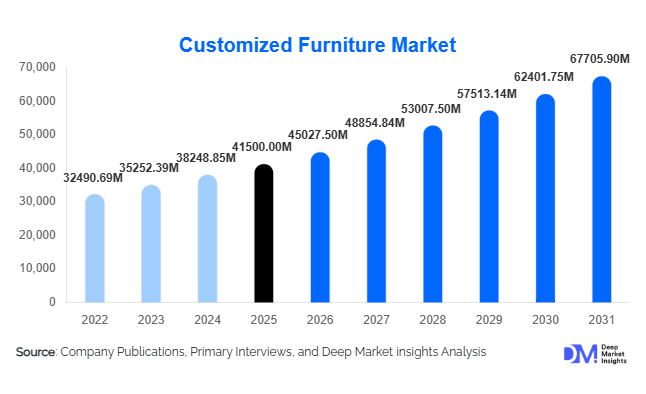
According to Deep Market Insights, the global customized furniture market size was valued at USD 41,500 million in 2025 and is projected to grow from USD 45,027.50 million in 2026 to reach USD 67,705.90 million by 2031, expanding at a CAGR of 8.5% during the forecast period (2026–2031). The customized furniture market growth is primarily driven by increasing consumer demand for personalized interiors, rapid urbanization, and the growing influence of digital design technologies that enable made-to-order furniture solutions at scale.
Key Market Insights
- Customization is becoming mainstream across residential and commercial sectors, driven by demand for space optimization and personalized aesthetics.
- Asia-Pacific dominates the global market, supported by strong manufacturing capabilities and rising middle-class demand in China and India.
- Online customization platforms are rapidly expanding, allowing consumers to design furniture using 3D visualization and AR tools.
- Sustainability is emerging as a major differentiator, with increasing demand for eco-friendly materials and circular furniture models.
- Residential applications account for the majority of demand, supported by growth in homeownership and remote working trends.
- Fully customized furniture leads the market, reflecting strong consumer preference for unique, made-to-order products despite higher costs.
What are the latest trends in the customized furniture market?
Digitalization and Mass Customization
The adoption of digital tools such as 3D configurators, augmented reality (AR), and AI-based design engines is transforming the customized furniture industry. Customers can now visualize and personalize furniture in real time before purchase, significantly improving engagement and reducing return rates. Manufacturers are leveraging automation and CNC technologies to produce customized products at scale, bridging the gap between personalization and cost efficiency. This trend is particularly strong among younger, tech-savvy consumers who expect seamless online design experiences integrated with direct-to-consumer delivery models.
Sustainable and Eco-Friendly Customization
Sustainability is becoming a core trend in the customized furniture market, with increasing use of recycled materials, certified wood, and low-emission finishes. Consumers are actively seeking environmentally responsible products, particularly in Europe and North America. Manufacturers are responding by offering transparency in sourcing, adopting circular economy practices, and designing furniture that can be refurbished or repurposed. This shift not only enhances brand value but also allows companies to command premium pricing in environmentally conscious markets.
What are the key drivers in the customized furniture market?
Urbanization and Compact Living Spaces
Rapid urbanization, especially in the Asia-Pacific region, is leading to smaller living spaces that require optimized furniture solutions. Customized furniture enables efficient space utilization, making it highly desirable in apartments and urban housing projects. The demand for multifunctional and modular furniture is rising, further supporting market growth.
Growth of E-Commerce and Direct-to-Consumer Channels
The expansion of online platforms has made customized furniture more accessible to a broader audience. Consumers can now design, compare, and order furniture online, reducing dependency on physical showrooms. This has lowered entry barriers for new players while enabling established companies to expand globally with reduced operational costs.
What are the restraints for the global market?
High Costs and Longer Lead Times
Customized furniture typically involves higher production costs due to specialized labor, design processes, and a lack of economies of scale. Additionally, longer delivery timelines compared to ready-made furniture can discourage price-sensitive and time-constrained consumers.
Fragmented Supply Chain
The market remains highly fragmented, with many small-scale manufacturers lacking standardization in quality and delivery. This creates inconsistencies and limits scalability, posing challenges for global expansion and large-volume production.
What are the key opportunities in the customized furniture industry?
Expansion in Emerging Markets
Emerging economies in Asia-Pacific, Latin America, and Africa present significant growth opportunities due to rising disposable incomes and rapid urbanization. Increasing housing development and government initiatives supporting infrastructure are further boosting demand for customized furniture solutions tailored to local needs.
Integration of Smart and Multifunctional Furniture
The growing adoption of smart homes is creating opportunities for customized furniture integrated with technology, such as IoT-enabled desks, smart storage units, and convertible furniture. These innovations cater to modern lifestyles and are expected to drive premium segment growth.
Report Scope
| Report Metric | Details |
|---|---|
| Market Size in 2025 | USD 41500 Million |
| Market Size in 2026 | USD 45027.50 Million |
| Market Size in 2031 | USD 67705.90 Million |
| CAGR | 8.5% (2026-2031) |
| Base Year for Estimation | 2025 |
| Historical Data | 2022-2024 |
| Forecast Period | 2026-2031 |
| Report Coverage | Revenue Forecast, Competitive Landscape, Supply Chain Disruption, Growth Factors, Environment & Regulatory Landscape and Trends |
| Geographies Covered | North America, Europe, APAC, Middle East and Africa, LATAM |
| Countries Covered | U.S., Canada, U.K., Germany, France, Spain, Italy, Russia, Nordic, Benelux, Rest of Europe, China, Korea, Japan, India, Australia, Singapore, Taiwan, South East Asia, Rest of Asia-Pacific, UAE, Turky, Saudi Arabia, South Africa, Egypt, Nigeria, Rest of MEA, Brazil, Mexico, Argentina, Chile, Colombia, Rest of LATAM |
Explore more data points, trends and opportunities Download Free Sample Report
Product Type Insights
Customized seating furniture continues to dominate the global market, accounting for approximately 28% of the 2025 market share. This leadership is primarily driven by rising demand for ergonomic, modular, and multifunctional seating solutions across both residential and commercial environments. In residential spaces, consumers increasingly prefer sofas and recliners tailored to room dimensions and personal comfort preferences, particularly in urban apartments where space optimization is critical. In commercial settings, especially offices and co-working spaces, there is strong demand for ergonomic chairs and flexible seating arrangements that support employee productivity and well-being. Additionally, evolving lifestyle trends such as home offices and entertainment-centric living spaces are further boosting demand for customized seating. Storage units and beds are also witnessing accelerated adoption, supported by growing demand for space-saving and integrated furniture designs such as hydraulic beds and modular wardrobes, particularly in densely populated urban regions.
Material Type Insights
Wood-based furniture leads the customized furniture market with nearly 45% share, supported by its superior durability, aesthetic versatility, and strong consumer preference for natural materials. Solid wood remains a premium choice in high-end markets due to its longevity and visual appeal, while engineered wood products such as MDF and plywood are gaining widespread popularity due to their affordability and adaptability to customization. The growth of engineered wood is further driven by its compatibility with automated manufacturing processes, making it ideal for scalable mass customization. Additionally, increasing awareness around sustainability is encouraging the use of certified wood and eco-friendly finishes, particularly in Europe and North America. Hybrid materials combining wood with metal or glass are also emerging as a growing trend, catering to modern design preferences and enhancing product differentiation.
End-User Insights
The residential segment dominates the market, contributing approximately 55% of the global customized furniture demand. This dominance is largely attributed to rising homeownership rates, increasing disposable incomes, and growing consumer awareness of interior aesthetics and functionality. The shift toward remote and hybrid work models has significantly increased demand for customized home office furniture, further strengthening this segment. Additionally, the proliferation of smaller living spaces in urban areas has amplified the need for multifunctional and space-efficient furniture solutions. The commercial segment is also experiencing strong growth, particularly in offices, retail spaces, and the hospitality industry. Businesses are increasingly investing in customized furniture to enhance brand identity, improve customer experience, and optimize space utilization. The hospitality sector, in particular, is driving demand for bespoke furniture to create unique and differentiated guest experiences.
Distribution Channel Insights
Direct sales channels account for approximately 35% of the market share, as customers prefer engaging directly with manufacturers, carpenters, or interior designers to achieve precise customization. This channel enables better communication, higher design accuracy, and greater customer satisfaction, especially for high-value projects. However, online platforms are emerging as the fastest-growing distribution channel, driven by advancements in digital visualization tools, augmented reality, and seamless ordering processes. E-commerce platforms allow customers to design, customize, and purchase furniture from the comfort of their homes, significantly expanding market reach. The integration of direct-to-consumer (D2C) models is also reducing dependency on intermediaries, improving profit margins for manufacturers while offering competitive pricing to consumers.
Customization Level Insights
Fully customized furniture leads the market with nearly 60% share, reflecting strong global demand for unique, made-to-order products that align with individual preferences and spatial requirements. This segment is particularly dominant in premium residential and commercial applications, where personalization and exclusivity are key decision factors. Advances in digital design and manufacturing technologies are making full customization more accessible, further supporting growth. Meanwhile, semi-customized furniture is gaining traction among price-sensitive consumers due to its balance between personalization, affordability, and shorter delivery timelines. Modular furniture systems, which allow limited customization within predefined designs, are particularly लोकप्रिय in urban markets, offering flexibility and scalability.
Explore more data points, trends and opportunities Download Free Sample Report
Customized Furniture Market Segmentations
By Product Type
- Customized Seating Furniture
- Customized Tables
- Customized Storage Units
- Customized Beds & Bedroom Furniture
- Customized Kitchen Furniture
- Customized Office Furniture
By Material Type
- Wood-Based Furniture
- Metal-Based Furniture
- Plastic & Polymer-Based Furniture
- Glass-Based Furniture
- Hybrid/Composite Materials
By End-User
- Residential
- Commercial
- Institutional
By Distribution Channel
- Direct Sales
- Online Platforms
- Specialty Stores & Showrooms
- Interior Designers/Architect Partnerships
By Customization Level
- Fully Customized
- Semi-Customized
Regional Insights
Asia-Pacific
Asia-Pacific dominates the global customized furniture market with approximately 38% share in 2025, driven by strong manufacturing capabilities, rapid urbanization, and expanding middle-class populations. China remains the largest market due to its well-established furniture manufacturing ecosystem, cost advantages, and significant export volumes. India is emerging as the fastest-growing market in the region, supported by rising disposable incomes, increasing urban housing demand, and government initiatives such as smart city development. Southeast Asian countries, including Vietnam and Indonesia, are also gaining prominence as manufacturing hubs and consumption markets. Key growth drivers in the region include rapid real estate development, increasing adoption of modular living solutions, and the growing influence of digital commerce platforms.
North America
North America holds around 25% market share, with the United States leading demand. The region’s growth is driven by high disposable incomes, strong consumer preference for premium and personalized interiors, and widespread adoption of e-commerce and digital customization tools. The increasing focus on home renovation and remodeling activities is further boosting demand for customized furniture. Additionally, sustainability trends are playing a crucial role, with consumers favoring eco-friendly materials and ethically sourced products. The presence of established market players and advanced manufacturing technologies also supports innovation and market expansion.
Europe
Europe accounts for approximately 22% of the global market, led by Germany, Italy, and the UK. The region is characterized by strong design heritage, high demand for premium furniture, and stringent sustainability regulations. Growth is driven by increasing consumer preference for eco-friendly and high-quality customized furniture, supported by certifications and environmental standards. Additionally, Europe’s robust interior design industry and emphasis on craftsmanship contribute to the adoption of bespoke furniture solutions. The rise of urban living and smaller apartments is also encouraging demand for multifunctional and space-saving designs.
Latin America
Latin America is experiencing moderate growth, with Brazil and Mexico emerging as key markets. Urban expansion, improving economic conditions, and rising middle-class income levels are driving demand for customized residential furniture. The region is also witnessing increasing adoption of modern retail formats and online platforms, which are enhancing accessibility to customized furniture solutions. However, price sensitivity remains a key factor, encouraging growth in semi-customized and cost-effective product offerings. Investments in housing and infrastructure development are expected to further support market growth in the coming years.
Middle East & Africa
The Middle East & Africa region is witnessing steady growth, driven by large-scale luxury real estate developments and infrastructure investments, particularly in the UAE and Saudi Arabia. High-end customized furniture is in strong demand for premium residential, hospitality, and commercial projects, where exclusivity and design differentiation are critical. Government initiatives aimed at diversifying economies and boosting tourism are also contributing to market expansion. In Africa, growing urbanization and rising consumer awareness are gradually increasing demand for customized furniture, although the market remains relatively nascent compared to other regions. Overall, key drivers include luxury construction projects, increasing foreign investments, and the expansion of the hospitality sector.