Crystal Barware Market Size
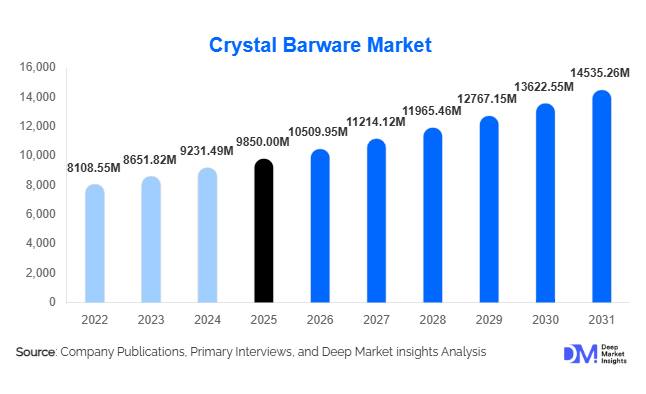
According to Deep Market Insights, the global crystal barware market size was valued at USD 9,850 million in 2025 and is projected to grow from USD 10,509.95 million in 2026 to reach USD 14,535.26 million by 2031, expanding at a CAGR of 6.7% during the forecast period (2026–2031). The crystal barware market growth is primarily driven by the increasing demand for premium dining and beverage experiences, rising global consumption of wine and premium spirits, and the rapid expansion of the hospitality and luxury tourism industries. Crystal barware, known for its superior clarity, brilliance, and aesthetic appeal compared to traditional glassware, is widely used in fine dining restaurants, luxury hotels, bars, and households seeking elevated beverage presentation.
Key Market Insights
- Premium beverage culture is expanding globally, boosting demand for specialized crystal glasses designed for wine, whiskey, champagne, and craft cocktails.
- The hospitality industry represents the largest demand segment, accounting for over half of global crystal barware consumption through hotels, bars, and fine-dining establishments.
- Europe dominates the crystal barware market, supported by strong heritage crystal manufacturing and high wine consumption across the region.
- Asia-Pacific is emerging as the fastest-growing regional market, driven by rising disposable incomes and expanding urban hospitality sectors.
- Lead-free crystal products are gaining traction, replacing traditional lead crystal due to environmental regulations and consumer safety concerns.
- E-commerce and direct-to-consumer luxury retail are transforming the distribution landscape by enabling global access to premium crystal brands.
What are the latest trends in the crystal barware market?
Shift Toward Lead-Free and Sustainable Crystal Production
Environmental regulations and increasing consumer awareness regarding health and sustainability are pushing manufacturers to shift toward lead-free crystal production. Traditional lead crystal, which contains high levels of lead oxide, is gradually being replaced with advanced formulations using titanium, barium, or zinc compounds. These alternatives maintain the brilliance and durability of crystal while meeting safety regulations in major markets such as the United States and the European Union. Sustainability is also becoming a critical differentiator, with manufacturers investing in energy-efficient glass furnaces, recyclable packaging, and environmentally responsible production techniques. Several brands are emphasizing eco-friendly manufacturing and carbon reduction strategies to align with the growing demand for sustainable luxury products.
Design-Driven Premium Barware Collections
Crystal barware is increasingly being positioned as a lifestyle and interior décor product rather than just functional drinkware. Manufacturers are collaborating with designers, hospitality brands, and mixologists to launch limited-edition collections and aesthetically distinctive barware pieces. Minimalist designs, geometric cuts, and modern silhouettes are gaining popularity among younger consumers who value design and functionality. Luxury crystal decanter sets, engraved whiskey glasses, and handcrafted cocktail coupes are also being marketed as collectible items and premium gifts. These design-focused product strategies are helping manufacturers differentiate their offerings in a competitive luxury tableware market.
What are the key drivers in the crystal barware market?
Growing Global Consumption of Premium Spirits and Wines
The rising global popularity of premium alcoholic beverages is a major driver of crystal barware demand. Wine, whiskey, and champagne enthusiasts increasingly prefer specialized crystal glasses that enhance the aroma, taste, and visual presentation of beverages. Wine culture remains deeply embedded in Europe and North America, while emerging markets such as China and India are witnessing increasing interest in premium wines and craft cocktails. The expansion of premium beverage brands and luxury dining experiences is encouraging both hospitality establishments and individual consumers to invest in high-quality crystal drinkware.
Expansion of Global Hospitality and Luxury Dining
The growth of luxury hotels, fine-dining restaurants, cocktail lounges, and premium resorts worldwide has significantly increased demand for crystal barware. Hospitality establishments rely on premium glassware to enhance beverage service and elevate guest experiences. The global hospitality sector continues to expand as international travel rebounds and tourism infrastructure improves in emerging economies. New hotel developments across regions such as the Middle East, Southeast Asia, and Europe are contributing to strong procurement demand for crystal wine glasses, whiskey tumblers, and champagne flutes.
What are the restraints for the global market?
High Manufacturing and Production Costs
Crystal manufacturing is energy-intensive and requires specialized raw materials such as silica sand, lead oxide alternatives, and high-temperature furnaces. Handcrafted crystal products also involve skilled labor and detailed cutting processes, which significantly increase production costs. Rising energy prices and raw material cost fluctuations can affect the profitability of manufacturers, particularly smaller crystal producers. These high costs can limit market penetration in price-sensitive regions where consumers may prefer lower-cost glassware alternatives.
Fragility and Transportation Challenges
Crystal barware products are inherently fragile and susceptible to breakage during transportation and handling. This presents logistical challenges for manufacturers, especially when shipping internationally through e-commerce channels. Protective packaging requirements, insurance costs, and potential product damage can increase operational expenses. For online retailers and global distributors, ensuring safe transportation while maintaining cost efficiency remains a persistent challenge within the crystal barware supply chain.
What are the key opportunities in the crystal barware industry?
Rising Home Entertainment and Premium Lifestyle Consumption
The growing popularity of home entertaining and cocktail preparation is creating new opportunities within the crystal barware market. Consumers are increasingly investing in premium drinkware to recreate bar-quality experiences at home. Home bars, wine collections, and cocktail kits have become popular lifestyle trends, particularly in North America and Europe. Manufacturers are responding by launching curated barware sets, mixology kits, and personalized crystal products designed specifically for home use. These offerings allow brands to target lifestyle-oriented consumers and expand their market presence beyond hospitality establishments.
Expansion of Luxury Hospitality in Emerging Markets
Rapid growth in luxury tourism and hospitality infrastructure across emerging economies presents significant opportunities for crystal barware manufacturers. Countries such as the United Arab Emirates, Thailand, India, and Vietnam are witnessing increasing investments in high-end hotels, resorts, and fine-dining establishments. These venues require premium barware to support upscale beverage service, creating consistent procurement demand. Partnerships with global hospitality chains and luxury restaurant brands can provide manufacturers with stable long-term contracts and expand their international footprint.
Report Scope
| Report Metric | Details |
|---|---|
| Market Size in 2025 | USD 9850 Million |
| Market Size in 2026 | USD 10509.95 Million |
| Market Size in 2031 | USD 14535.26 Million |
| CAGR | 6.7% (2026-2031) |
| Base Year for Estimation | 2025 |
| Historical Data | 2022-2024 |
| Forecast Period | 2026-2031 |
| Report Coverage | Revenue Forecast, Competitive Landscape, Supply Chain Disruption, Growth Factors, Environment & Regulatory Landscape and Trends |
| Geographies Covered | North America, Europe, APAC, Middle East and Africa, LATAM |
| Countries Covered | U.S., Canada, U.K., Germany, France, Spain, Italy, Russia, Nordic, Benelux, Rest of Europe, China, Korea, Japan, India, Australia, Singapore, Taiwan, South East Asia, Rest of Asia-Pacific, UAE, Turky, Saudi Arabia, South Africa, Egypt, Nigeria, Rest of MEA, Brazil, Mexico, Argentina, Chile, Colombia, Rest of LATAM |
Explore more data points, trends and opportunities Download Free Sample Report
Product Type Insights
Wine glasses represent the largest product segment within the crystal barware market, accounting for approximately 32% of global demand in 2025. The dominance of this segment is driven by widespread wine consumption in Europe and North America, where specialized crystal wine glasses are considered essential for enhancing aroma and flavor profiles. Whiskey glasses also represent a major segment, supported by the growing popularity of premium whiskey consumption and tasting culture. Champagne flutes and cocktail glasses are widely used in hospitality establishments and luxury events, contributing to strong demand from restaurants and bars. Specialty barware products such as crystal decanters and mixing glasses are gaining popularity among collectors and premium beverage enthusiasts who seek aesthetically appealing accessories for home bars.
Application Insights
The hospitality industry represents the largest application segment for crystal barware, accounting for approximately 52% of global demand. Hotels, restaurants, and bars rely heavily on premium crystal glassware to maintain service standards and deliver visually appealing beverage presentations. Household consumption is also growing steadily as consumers increasingly invest in luxury lifestyle products for home entertaining. Corporate gifting represents another emerging application, with crystal decanter sets and engraved glasses commonly used as executive gifts and commemorative items. Luxury cruise lines, private aviation services, and high-end event venues are also expanding their procurement of premium crystal barware to enhance customer experiences.
Distribution Channel Insights
Specialty retail stores and luxury department stores have historically dominated crystal barware sales due to their ability to showcase craftsmanship and premium design. However, online retail platforms are rapidly gaining market share as consumers increasingly purchase luxury tableware through e-commerce channels. Brand-owned websites, online marketplaces, and luxury e-retailers are enabling manufacturers to reach global consumers directly. Duty-free retail stores in airports and tourism hubs also represent an important distribution channel, particularly for international travelers seeking premium crystal products as gifts or collectibles.
End-Use Industry Insights
The hospitality sector remains the most significant end-use industry for crystal barware, supported by global expansion in luxury tourism and fine-dining establishments. Hotels and resorts frequently procure large volumes of wine glasses, whiskey tumblers, and champagne flutes to support beverage service operations. The residential segment is also experiencing strong growth as consumers adopt premium lifestyle products for home décor and entertaining. Corporate gifting and luxury events such as weddings and banquets further contribute to market demand. The rising popularity of craft cocktail culture and premium beverage appreciation continues to expand the relevance of crystal barware across both commercial and residential applications.
Explore more data points, trends and opportunities Download Free Sample Report
Crystal Barware Market Segmentations
By Product Type
- Wine Glasses
- Whiskey Glasses
- Champagne Flutes
- Cocktail Glasses
- Crystal Decanters
- Specialty Barware
By Application
- Hospitality
- Household / Residential Use
- Corporate Gifting
- Luxury Events & Catering
By Distribution Channel
- Online Retail / E-commerce
- Specialty Retail Stores
- Luxury Department Stores
- Duty-Free & Travel Retail
- Direct-to-Consumer Brand Stores
Regional Insights
North America
North America accounts for approximately 28% of the global crystal barware market. The United States represents the largest market in the region due to high consumption of premium wines, whiskey, and craft cocktails. Rising interest in home entertainment and luxury kitchenware is also supporting growth in residential demand. Canada contributes additional demand through hospitality expansion and strong consumer interest in premium lifestyle products.
Europe
Europe dominates the global crystal barware market with approximately 38% share in 2025. Countries such as Germany, France, Italy, Austria, and the Czech Republic are major producers and consumers of crystal glassware. The region benefits from a strong tradition of crystal craftsmanship and a deeply rooted wine culture that drives consistent demand for premium wine glasses. Luxury hospitality and tourism industries across Western Europe further contribute to strong market growth.
Asia-Pacific
Asia-Pacific is the fastest-growing regional market, supported by rising disposable incomes and rapid urbanization. China, Japan, India, and South Korea are key markets where interest in Western dining culture and premium beverages is expanding. Luxury hotels, high-end restaurants, and urban cocktail bars are increasingly adopting crystal barware, driving demand across the region.
Latin America
Latin America accounts for a smaller share of global crystal barware demand but is gradually expanding due to hospitality sector growth. Brazil and Mexico represent the largest markets in the region, with rising urban middle-class consumption supporting demand for premium drinkware products.
Middle East & Africa
The Middle East and Africa region is experiencing increasing demand for crystal barware due to strong luxury tourism growth. Countries such as the United Arab Emirates and Saudi Arabia are investing heavily in hospitality infrastructure, including luxury hotels and restaurants that require premium glassware products. Africa also hosts several high-end tourism destinations where premium beverage service is becoming increasingly important.