Cruise Safari Market Size
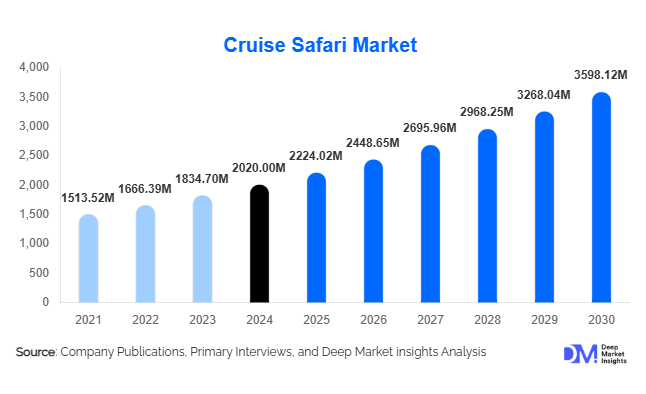
According to Deep Market Insights, the global cruise safari market size was valued at USD 2,020.00 million in 2025 and is projected to grow from USD 2,224.02 million in 2026 to reach USD 3,598.12 million by 2031, expanding at a CAGR of 10.10% during the forecast period (2026–2031). The cruise safari market growth is fueled by rising demand for immersive wildlife-focused voyages, the rapid expansion of small expedition vessels, and increasing consumer preference for sustainable, experience-driven travel. Growing adoption of hybrid-powered fleets, enhanced onboard technology, and curated expedition itineraries are transforming the cruise safari landscape into one of the fastest-growing segments within the adventure tourism industry.
Key Market Insights
- Cruise safaris are increasingly shifting toward eco-conscious, low-impact expedition models, aligning with global sustainability expectations and conservation mandates.
- Small expedition vessels (≤50 passengers) dominate wildlife routes due to their maneuverability and ability to access protected coastal and polar zones.
- North America accounts for the largest share of cruise safari travelers, driven by strong demand for Alaska, polar, and Galápagos routes.
- Asia-Pacific is the fastest-growing source market, supported by rising middle-class wealth in China and India and a surge in outbound adventure tourism.
- Technological integration, AI wildlife tracking, AR/VR education, and smart navigation are reshaping customer engagement and enabling premium pricing for enhanced experiences.
- Hybrid and electric expedition vessels are becoming the industry standard, reducing emissions and enabling navigation within ecologically sensitive regions.
Cruise Safari Market Trends
Conservation-Centric Expedition Cruising
Cruise safari operators are integrating conservation initiatives directly into their itineraries, allowing travelers to actively participate in marine and wildlife protection programs. Activities such as guided wildlife tagging, habitat monitoring, coastal cleanups, and scientific data collection have become integral components of premium cruise packages. Operators increasingly collaborate with environmental NGOs to fund conservation programs, with many offering "sustainability surcharges" that contribute to species preservation, anti-poaching efforts, and local community development. This shift has enhanced the appeal of cruise safaris among environmentally conscious travelers and solidified the segment’s reputation as a responsible form of eco-tourism.
Technology-Enhanced Wildlife Exploration
Expedition vessels are rapidly adopting next-generation technologies to elevate the cruise safari experience. AI-powered wildlife spotting tools, AR/VR-based learning modules, and real-time marine ecology dashboards help travelers better understand the ecosystems they encounter. Mobile apps now offer species recognition capabilities, interactive route maps, and geo-tagged wildlife logs, creating a highly immersive educational experience. Drone-assisted viewing is emerging in regions where aerial monitoring supports wildlife protection efforts, while VR-based pre-cruise previews allow travelers to sample expedition routes before booking. These technologies have become a defining feature for attracting younger, tech-savvy travelers.
Cruise Safari Market Drivers
Growing Affluent Travel Demand
The global rise of high-net-worth and upper-middle-class travelers is fueling the popularity of luxury and ultra-luxury cruise safaris. These travelers seek exclusive wildlife encounters, private deck viewing, fine dining, and personalized expedition services. Premium cruise safaris often include top-tier naturalists, custom landing excursions, boutique cabins, and hybrid-powered vessels designed for minimal ecological impact. Demand is especially strong from the Middle East, Asia-Pacific, Europe, and North America, regions where affluent consumers increasingly prioritize high-value experiential travel.
Acceleration of Sustainable and Experiential Tourism
Modern tourists are increasingly favoring eco-friendly and experience-driven travel that offers deeper engagement with nature. Cruise safaris align perfectly with these preferences, combining wildlife observation, scientific learning, and cultural immersion. Governments and private operators are investing heavily in green ports, low-emission systems, and eco-certified expedition programs. Travelers are drawn to itineraries that offer guided wildlife education, indigenous cultural experiences, and conservation-led excursions, reinforcing sustainability as a core market driver.
Cruise Safari Market Restraints
High Travel and Operational Costs
Cruise safaris remain cost-intensive due to the premium nature of wildlife routes, vessel fuel requirements, specialized expedition staff, and limited berth capacity on small expedition ships. Remote ports, seasonal restrictions, and complex logistics further raise operational expenses. High consumer pricing restricts affordability to upper-income travelers, limiting market penetration among broader tourism segments. Air travel cost fluctuations and limited flight connectivity to remote cruise departure points add additional constraints.
Environmental and Regulatory Challenges
Sensitive ecosystems such as the Galápagos, Antarctica, and Arctic zones impose strict caps on cruise entries, vessel sizes, and landing rights. Regulatory inconsistencies across regions complicate operator planning and increase compliance costs. Climate change, manifested through melting ice, shifting wildlife migration, and unpredictable weather, affects cruising windows and wildlife sightings. Ensuring tourism demand does not compromise fragile habitats remains a core challenge for long-term market stability.
Cruise Safari Market Opportunities
Wellness-Adventure Expedition Hybrids
Combining wellness tourism with wildlife expedition cruising presents a significant growth opportunity. Many operators are introducing programs that blend guided wildlife excursions with onboard yoga sessions, mindfulness workshops, nature therapy, and wellness cuisine. This positions cruise safaris as restorative escapes, appealing to wellness-focused travelers seeking stress relief and nature immersion. Hybrid offerings extend guest stay duration and expand the market beyond conventional adventure travelers.
Community-Integrated Cruise Safari Experiences
Indigenous and local community participation in cruise safari itineraries is gaining strong traction. Cruiser-led cultural experiences, such as traditional ceremonies, artisanal workshops, and indigenous-guided wildlife walks, enhance authenticity and deliver economic benefits directly to local populations. Such initiatives strengthen social sustainability and improve the perception of tourism within host regions. Governments and NGOs increasingly support community-based models, providing funding and capacity-building programs to develop locally managed marine tourism activities.
Report Scope
| Report Metric | Details |
|---|---|
| Market Size in 2025 | USD 2020 Million |
| Market Size in 2026 | USD 2224.02 Million |
| Market Size in 2031 | USD 3598.12 Million |
| CAGR | 10.10% (2026-2031) |
| Base Year for Estimation | 2025 |
| Historical Data | 2022-2024 |
| Forecast Period | 2026-2031 |
| Report Coverage | Revenue Forecast, Competitive Landscape, Supply Chain Disruption, Growth Factors, Environment & Regulatory Landscape and Trends |
| Geographies Covered | North America, Europe, APAC, Middle East and Africa, LATAM |
| Countries Covered | U.S., Canada, U.K., Germany, France, Spain, Italy, Russia, Nordic, Benelux, Rest of Europe, China, Korea, Japan, India, Australia, Singapore, Taiwan, South East Asia, Rest of Asia-Pacific, UAE, Turky, Saudi Arabia, South Africa, Egypt, Nigeria, Rest of MEA, Brazil, Mexico, Argentina, Chile, Colombia, Rest of LATAM |
Explore more data points, trends and opportunities Download Free Sample Report
Product Type Insights
Luxury cruise safaris dominate the market, driven by affluent travelers seeking exclusivity, immersive wildlife encounters, and premium ship amenities. These itineraries include private zodiac tours, refined dining, expert naturalists, and eco-certified vessels. Premium cruise safaris attract mid-to-upper income travelers seeking comfort and adventure without ultra-premium pricing. Standard safari cruises offer more accessible options, appealing to mainstream tourists and families through cost-efficient packages and group excursions. Expedition-class vessels with low passenger capacity remain a key asset for wildlife-dense regions, offering superior access and ecological compliance.
Application Insights
Wildlife-oriented cruises remain the most popular application, offering encounters with whales, penguins, marine mammals, sea birds, and Arctic or African coastal wildlife. Photographic expeditions are rapidly expanding, supported by digital content trends and partnerships with professional wildlife photographers. Cultural expedition cruises integrate indigenous experiences and marine heritage exploration, broadening demographic appeal. Eco-volunteering cruises that incorporate conservation activities, such as species tagging or marine habitat assessment, are attracting travelers seeking purpose-driven travel. Adventure extensions such as kayaking, guided hikes, and polar plunges are increasingly popular among repeat travelers.
Distribution Channel Insights
Digital booking platforms and direct-to-consumer websites dominate the cruise safari market, enabling travelers to explore itineraries, compare wildlife routes, and access dynamic pricing. Specialist expedition travel agencies remain valuable for high-net-worth clients requiring personalized consultation. Direct cruise line bookings are growing as operators expand digital engagement through virtual tours, online wildlife briefings, and mobile booking apps. Social media, influencer campaigns, and experiential marketing are increasingly shaping traveler decisions, especially among younger demographics.
Traveler Type Insights
Group travelers, including multi-generational families and organized adventure groups, represent a significant share of bookings. Solo travelers increasingly seek flexible itineraries emphasizing cultural immersion and guided wildlife education. Couples and honeymooners remain a premium segment, often opting for luxury cabins, private balconies, and tailored excursions. Families are a growing category, supported by educational wildlife programs and child-safe expedition activities. This demographic diversification is expanding the cruise safari addressable market.
Age Group Insights
Travelers aged 31–50 years represent the largest market segment, driven by strong spending power and interest in immersive, experience-led travel. Young adults aged 18–30 play a major role in the growth of adventure and budget safari cruises, leveraging digital booking platforms and seeking social, content-driven travel. The 51–65 age group contributes significantly to luxury cruise safari demand, valuing guided expeditions and comfort. Travelers above 65 represent a niche but high-value segment seeking accessible onboard amenities and slower-paced wildlife itineraries.
Explore more data points, trends and opportunities Download Free Sample Report
Cruise Safari Market Segmentations
By Cruise Type
- Ocean-Based Safari Cruises
- River Safari Cruises
- Coastal/Island Safari Cruises
- Arctic & Antarctic Safari Cruises
By Duration
- Short (1–4 days)
- Medium (5–9 days)
- Long (10–14 days)
- Extended (15+ days)
By Customer Demographics
- Families
- Couples & Honeymooners
- Solo Explorers
- Luxury Travelers
- Adventure/Expedition Enthusiasts
- Eco-tourism Travelers
By Booking Channel
- Direct Booking (Company Website/App)
- Travel Agencies & Tour Operators
- Online Travel Platforms (OTAs)
- Corporate/Group Bookings
By Vessel Capacity
- Small (≤50 passengers)
- Medium (51–150 passengers)
- Large (151–300 passengers)
- Expedition Mega-Cruisers (300+ passengers)
Regional Insights
North America
North America accounts for the largest share of global cruise safari travelers, with strong demand from the U.S. and Canada for Alaska wildlife cruises, Arctic expeditions, and Galápagos routes. High disposable incomes, strong conservation interests, and robust air connectivity support sustained growth. Photographic and luxury expedition cruises are particularly popular among North American travelers.
Europe
Europe remains a key outbound market, with travelers from the U.K., Germany, France, Norway, and the Netherlands fueling demand for polar and coastal wildlife cruises. Europeans show a strong preference for sustainable expedition vessels, low-impact operations, and scientific enrichment programs. Younger demographics drive interest in budget-friendly expedition cruises, while retirees favor longer, premium voyages.
Asia-Pacific
Asia-Pacific is the fastest-growing region, driven by China, India, Japan, and Australia. Rising middle-class wealth and expanding outbound tourism are increasing demand for wildlife expeditions, particularly to the Galápagos, Antarctica, and East Africa. China shows strong demand for luxury cruises, while India drives growth in premium and mid-range expedition segments. Japan and Australia maintain mature markets with consistent interest in photography and polar expeditions.
Latin America
Latin American demand is concentrated in Brazil, Argentina, Chile, and Mexico. The Galápagos Islands serve as the region’s primary cruise safari hub, attracting both domestic and outbound travelers. Affluent consumers in Brazil and Mexico show growing interest in luxury and family-oriented expedition cruises.
Middle East & Africa
Africa is central to the global cruise safari industry, offering unique coastal and river wildlife routes across South Africa, Namibia, Kenya, and Tanzania. Middle Eastern demand, especially from the UAE and Saudi Arabia, is rising rapidly due to strong luxury travel trends and increased outbound tourism to polar and African destinations. Intra-African cruise tourism is also growing, supported by improved regional connectivity.
Key Players in the Cruise Safari Market
- Hurtigruten Expeditions
- Lindblad Expeditions
- Silversea Expeditions
- Ponant
- Quark Expeditions
- Celebrity Cruises (Expedition Division)
- Aurora Expeditions
- Viking Expeditions
- Seabourn
- UnCruise Adventures
- Oceanwide Expeditions
- Albatros Expeditions
- Paul Gauguin Cruises
- Coral Expeditions
- Aqua Expeditions