Cruelty-Free Cosmetics Market Size
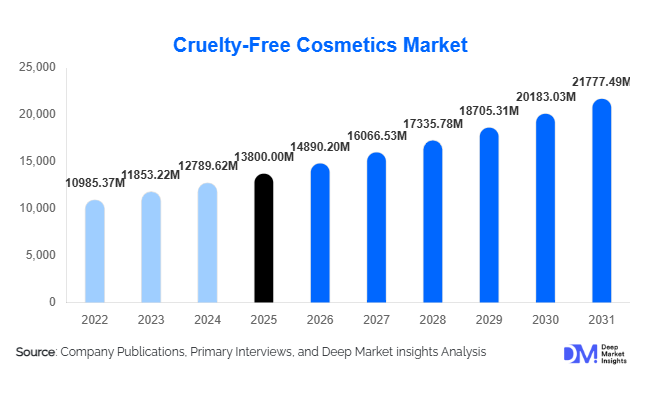
According to Deep Market Insights, the global cruelty-free cosmetics market size was valued at USD 13,800 million in 2025 and is projected to grow from USD 14,890.20 million in 2026 to reach USD 21,777.49 million by 2031, expanding at a CAGR of 7.9% during the forecast period (2026–2031). The cruelty-free cosmetics market growth is primarily driven by increasing consumer awareness regarding animal welfare, rising demand for ethical and sustainable beauty products, and the global shift toward regulatory bans on animal testing. The convergence of clean beauty, vegan formulations, and transparency in sourcing is further strengthening market expansion, positioning cruelty-free cosmetics as a mainstream category within the global beauty and personal care industry.
Key Market Insights
- Consumer preference is shifting toward ethically sourced and cruelty-free beauty products, particularly among millennials and Gen Z demographics.
- Online retail channels dominate distribution, accounting for over 50% of total sales due to ease of access and product transparency.
- North America leads the global market, supported by strong regulatory frameworks and high consumer awareness.
- Asia-Pacific is the fastest-growing region, driven by rising disposable incomes and increasing adoption of ethical beauty trends.
- Organic and natural ingredient-based products are gaining traction, representing over 40% of the total market share.
- Technological advancements in alternative testing methods, including AI-based toxicology and lab-grown tissue models, are reshaping product development.
What are the latest trends in the cruelty-free cosmetics market?
Rise of Clean and Vegan Beauty Convergence
The cruelty-free cosmetics market is increasingly overlapping with the clean and vegan beauty segments. Consumers are no longer satisfied with only cruelty-free products; they demand formulations free from harmful chemicals and animal-derived ingredients. This convergence is driving brands to reformulate existing products and introduce new lines that meet multiple ethical standards simultaneously. Companies are also investing in plant-based alternatives and sustainable ingredient sourcing, which enhances brand positioning and attracts premium consumers. Packaging innovation, including biodegradable and recyclable materials, is further strengthening this trend, aligning with broader environmental concerns.
Digital-First Brand Growth and Influencer Marketing
Digital platforms are playing a transformative role in the growth of cruelty-free cosmetics. Social media influencers, beauty bloggers, and dermatologists are educating consumers about cruelty-free certifications and ethical consumption. Direct-to-consumer (DTC) models are enabling brands to build strong relationships with customers, offer personalized recommendations, and maintain higher margins. E-commerce platforms are also integrating certification filters, making it easier for consumers to identify cruelty-free products. This digital-first approach is particularly effective in emerging markets, where awareness is rapidly increasing through online channels.
What are the key drivers in the cruelty-free cosmetics market?
Growing Ethical Consumerism
Rising awareness about animal rights and environmental sustainability is a major driver of the cruelty-free cosmetics market. Consumers are actively seeking brands that align with their ethical values, leading to increased demand for certified cruelty-free products. Advocacy campaigns and transparency initiatives have significantly influenced purchasing behavior, particularly among younger demographics.
Regulatory Support and Global Bans on Animal Testing
Government regulations banning animal testing for cosmetics are accelerating market growth. Regions such as Europe and countries like India have implemented strict laws, encouraging manufacturers to adopt alternative testing methods. These regulations are creating a standardized framework that supports the expansion of cruelty-free products globally.
What are the restraints for the global market?
High Certification and Compliance Costs
Obtaining cruelty-free certifications involves rigorous testing and compliance procedures, which can be costly for manufacturers. Small and medium-sized enterprises may face challenges in meeting these requirements, limiting their ability to compete with established brands.
Consumer Skepticism and Greenwashing Concerns
The presence of self-declared cruelty-free claims without third-party verification has led to consumer skepticism. This lack of trust can hinder market growth, as consumers may find it difficult to differentiate between genuine and misleading claims.
What are the key opportunities in the cruelty-free cosmetics industry?
Expansion in Emerging Markets
Emerging economies such as India, Brazil, and Indonesia present significant growth opportunities due to rising disposable incomes and increasing awareness of ethical beauty products. Companies entering these markets early can establish strong brand loyalty and capture untapped demand.
Technological Innovation in Product Development
Advancements in biotechnology and artificial intelligence are enabling the development of alternative testing methods that eliminate the need for animal testing. These innovations not only reduce costs but also improve product safety and efficacy, creating a competitive advantage for early adopters.
Report Scope
| Report Metric | Details |
|---|---|
| Market Size in 2025 | USD 13800 Million |
| Market Size in 2026 | USD 14890.20 Million |
| Market Size in 2031 | USD 21777.49 Million |
| CAGR | 7.9% (2026-2031) |
| Base Year for Estimation | 2025 |
| Historical Data | 2022-2024 |
| Forecast Period | 2026-2031 |
| Report Coverage | Revenue Forecast, Competitive Landscape, Supply Chain Disruption, Growth Factors, Environment & Regulatory Landscape and Trends |
| Geographies Covered | North America, Europe, APAC, Middle East and Africa, LATAM |
| Countries Covered | U.S., Canada, U.K., Germany, France, Spain, Italy, Russia, Nordic, Benelux, Rest of Europe, China, Korea, Japan, India, Australia, Singapore, Taiwan, South East Asia, Rest of Asia-Pacific, UAE, Turky, Saudi Arabia, South Africa, Egypt, Nigeria, Rest of MEA, Brazil, Mexico, Argentina, Chile, Colombia, Rest of LATAM |
Explore more data points, trends and opportunities Download Free Sample Report
Product Type Insights
Skincare continues to dominate the cruelty-free cosmetics market, accounting for approximately 38% of the total market share in 2025. The segment’s leadership is primarily driven by strong consumer focus on daily skincare routines, higher product consumption frequency, and increasing awareness of ingredient safety. The rapid shift toward natural, organic, and vegan formulations has significantly accelerated demand, particularly for facial care products such as serums, moisturizers, and cleansers. Additionally, advancements in dermatologically tested formulations and personalized skincare solutions, leveraging AI-based skin analysis, are further strengthening this segment’s position. The growing trend of “skinimalism,” which emphasizes fewer but more effective products, is also contributing to higher-value purchases within skincare.
Haircare and color cosmetics segments follow, supported by innovation in sulfate-free, paraben-free, and vegan formulations. The color cosmetics segment is benefiting from social media influence and rising demand for ethical makeup products, while haircare is expanding due to increasing concerns over scalp health and sustainable ingredient sourcing. However, skincare remains the leading segment due to its essential nature and higher consumer trust in certified cruelty-free formulations.
Application Insights
Personal use remains the dominant application segment, contributing over 80% of total market demand in 2025. This dominance is driven by rising consumer awareness, increasing disposable incomes, and the growing importance of self-care and grooming across all demographics. The shift toward ethical consumption and transparency in product sourcing has made cruelty-free cosmetics a preferred choice for everyday use, particularly among urban populations.
The professional segment, including salons, spas, and dermatology clinics, is the fastest-growing application area, expanding at a CAGR exceeding 9%. This growth is driven by increasing customer preference for ethical and sustainable services, prompting service providers to adopt cruelty-free product lines as a differentiation strategy. Additionally, premium salons are incorporating cruelty-free and vegan product offerings to align with luxury and wellness trends. Emerging applications such as personalized beauty solutions, subscription-based skincare services, and influencer-led product lines are further expanding the scope of the market, creating new revenue streams and enhancing customer engagement.
Distribution Channel Insights
Online retail channels dominate the cruelty-free cosmetics market, accounting for approximately 52% of total sales in 2025. The leading position of this segment is driven by increasing digital penetration, widespread smartphone usage, and the convenience of accessing a broad range of certified products. E-commerce platforms provide detailed product information, ingredient transparency, and certification verification, which are critical factors influencing consumer purchasing decisions. Direct-to-consumer (DTC) models have also gained traction, enabling brands to build stronger relationships with customers and maintain higher profit margins.
Offline channels, including specialty stores, supermarkets, and pharmacies, continue to play a significant role, particularly in developing regions where digital infrastructure is still evolving. Specialty stores, in particular, are benefiting from personalized customer experiences and expert consultations. However, the long-term growth trajectory clearly favors online channels due to their scalability, global reach, and ability to leverage data-driven marketing strategies.
Consumer Demographics Insights
Millennials represent the largest consumer segment, contributing nearly 47% of total market demand in 2025. This demographic is highly influenced by ethical considerations, environmental awareness, and brand transparency. Millennials are also more likely to research product certifications and ingredients before making purchasing decisions, making them a key driver of demand for cruelty-free cosmetics.
Gen Z consumers are emerging as a rapidly growing segment, driven by strong social media influence and a preference for innovative, sustainable, and inclusive beauty products. This group is particularly responsive to influencer marketing and digital campaigns, which significantly shape purchasing behavior. Meanwhile, older demographics are gradually adopting cruelty-free products, driven by increasing awareness and the availability of premium, dermatologically tested formulations. The expanding appeal across all age groups is contributing to the overall growth and diversification of the market.
Explore more data points, trends and opportunities Download Free Sample Report
Cruelty-Free Cosmetics Market Segmentations
By Product Type
- Skincare
- Haircare
- Color Cosmetics
- Fragrances
- Personal Hygiene Products
By Certification Type
- Leaping Bunny Certified
- PETA Cruelty-Free Certified
- Vegan & Cruelty-Free Certified
- Self-Declared
By Ingredient Type
- Organic/Natural Ingredients
- Synthetic but Cruelty-Free Ingredients
- Vegan Formulations
By Price Range
- Mass Market
- Mid-Range
- Premium/Luxury
By Distribution Channel
- Online Retail
- Specialty Stores
- Supermarkets/Hypermarkets
- Pharmacies/Drugstores
- Department Stores
Regional Insights
North America
North America holds approximately 32% of the global market share in 2025, making it the largest regional market. The United States dominates regional demand, supported by high consumer awareness, strong advocacy for animal rights, and the presence of leading global cosmetic brands. Regulatory support, including restrictions on animal testing in several states, further strengthens market growth. Additionally, the region benefits from a highly developed e-commerce ecosystem and strong adoption of premium and organic beauty products. Canada is also witnessing steady growth, driven by increasing demand for sustainable and ethically sourced cosmetics, as well as rising penetration of clean beauty brands.
Europe
Europe accounts for around 30% of the global market share, with major contributions from Germany, France, and the United Kingdom. The region’s growth is primarily driven by stringent regulations banning animal testing, which have effectively made cruelty-free compliance a standard across the cosmetics industry. High consumer awareness regarding sustainability and environmental impact further supports demand. Additionally, Europe’s strong presence of established cosmetic manufacturers and innovation in natural ingredient sourcing enhances market expansion. The growing popularity of vegan beauty products and eco-friendly packaging solutions is also contributing to sustained growth across the region.
Asia-Pacific
Asia-Pacific is the fastest-growing region in the cruelty-free cosmetics market, with a CAGR exceeding 9%. Key countries such as China, India, Japan, and South Korea are driving demand due to rising disposable incomes, urbanization, and increasing awareness of ethical beauty practices. India, in particular, is emerging as a major growth engine due to its regulatory ban on animal testing, large consumer base, and expanding middle class. South Korea and Japan are contributing through innovation in skincare and beauty technology, while China is gradually shifting toward cruelty-free alternatives as regulatory frameworks evolve. The rapid growth of e-commerce platforms and social media influence in the region is further accelerating market penetration.
Latin America
Latin America is witnessing steady growth, led by Brazil and Mexico. The region’s expansion is driven by increasing consumer awareness, rising middle-class incomes, and the emergence of local cruelty-free brands. Brazil, in particular, has a strong domestic cosmetics industry and is seeing increased adoption of ethical beauty products. Government initiatives promoting sustainable practices and the growing influence of social media are also contributing to market development. However, limited regulatory enforcement in some countries remains a challenge, which may impact the pace of growth.
Middle East & Africa
The Middle East & Africa region is gradually expanding, with the UAE and South Africa leading demand. Growth in this region is driven by rising disposable incomes, increasing urbanization, and the expansion of premium retail channels. The Middle East, particularly the UAE, is witnessing strong demand for luxury and premium cruelty-free products, supported by a high-income population and a preference for high-quality imported brands. In Africa, South Africa is emerging as a key market due to growing awareness and the presence of local ethical beauty brands. The expansion of modern retail infrastructure and increasing adoption of e-commerce platforms are further supporting market growth across the region.
Key Players in the Cruelty-Free Cosmetics Market
- L’Oréal Group
- The Estée Lauder Companies
- Unilever
- Coty Inc.
- Shiseido Company
- e.l.f. Beauty
- Natura & Co.
- The Body Shop
- Too Faced Cosmetics
- Urban Decay
- Pacifica Beauty
- Milk Makeup
- Herbivore Botanicals
- Charlotte Tilbury
- Rare Beauty