Cotton Pads Market Size
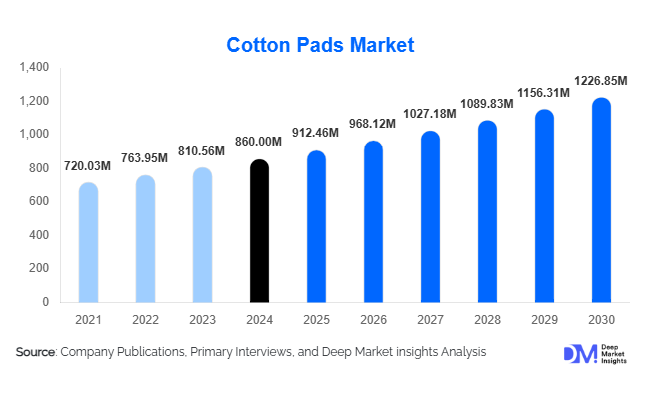
According to Deep Market Insights, the global cotton pads market size was valued at USD 860.00 million in 2025 and is projected to grow from USD 912.46 million in 2026 to reach USD 1,226.85 million by 2031, expanding at a CAGR of 6.1% during the forecast period (2026–2031). The cotton pads market growth is primarily driven by rising consumer awareness of hygiene and skincare, increasing adoption of cosmetic routines, and the growing demand for sustainable and eco-friendly cotton pads.
Key Market Insights
- Personal care and cosmetics applications dominate global demand, with cotton pads becoming essential for facial cleansing, makeup removal, toner application, and nail polish removal.
- Emerging markets in the Asia-Pacific present high growth potential, driven by rising disposable incomes, urbanization, and increasing beauty and hygiene awareness.
- Eco-friendly and reusable cotton pads are gaining traction, reflecting consumer preference for sustainable, biodegradable, and organic products.
- North America and Europe hold the largest market share, due to established personal care habits and premium product adoption.
- Online retail and e-commerce are emerging as key distribution channels, enabling subscription-based sales and greater consumer convenience.
- Technological integration in manufacturing, such as non-woven hydroentangled pads and pre-soaked pads, is enhancing product differentiation.
What are the latest trends in the cotton pads market?
Rising Demand for Sustainable and Organic Products
Consumers increasingly prefer cotton pads made from organic cotton or biodegradable materials. Manufacturers are responding with eco-friendly, reusable, or pre-soaked pads to meet demand for sustainable and chemical-free options. Packaging innovations using recyclable materials are also becoming standard. This trend is particularly strong in Europe, North America, and urban segments in Asia-Pacific, where consumers are willing to pay a premium for environmentally responsible products.
Growth of Pre-Soaked and Specialty Pads
Pre-soaked pads with toner, micellar water, or exfoliating solutions are gaining popularity as consumers seek convenience in their skincare routines. Specialty pads for nail polish removal, textured exfoliation, or professional use in spas and salons are creating niche segments. This product innovation not only differentiates brands but also encourages higher per-unit pricing and recurring purchases.
What are the key drivers in the cotton pads market?
Increasing Consumer Awareness about Hygiene and Skincare
Rising health and hygiene consciousness has resulted in more frequent adoption of cotton pads for facial cleansing, makeup removal, and general personal care. The expansion of multi-step skincare routines in urban households is directly driving consumption, particularly among women and younger demographics. This trend is reinforced by growing awareness campaigns and social media influence on beauty and personal care habits.
Expansion of the Cosmetics and Beauty Industry
The booming cosmetics and beauty sector globally is a major driver. As more consumers engage in daily skincare and make-up routines, demand for cotton pads for application and removal has increased. Salons, spas, and dermatology clinics are also contributing to steady institutional demand, complementing retail consumption.
Rising Preference for Eco-Friendly and Organic Products
Growing environmental concerns and sustainability awareness are pushing manufacturers to introduce organic cotton pads, reusable options, and biodegradable packaging. Premium segments benefit from higher margins, while manufacturers gain brand differentiation and loyalty among eco-conscious consumers.
What are the restraints for the global market?
Environmental Concerns Related to Single-Use Products
Traditional disposable cotton pads contribute to waste, creating pressure for sustainable alternatives. Regulatory and consumer expectations for biodegradable or reusable products may challenge manufacturers reliant on conventional production, restraining growth unless adaptation occurs.
Price Sensitivity and Competitive Pressure
Intense competition from low-cost local and private-label producers puts pressure on profit margins. Premium products face adoption challenges in price-sensitive emerging markets, limiting growth potential without strategic product differentiation.
What are the key opportunities in the cotton pads market?
Expansion in Emerging Markets
Asia-Pacific, Latin America, and parts of Africa offer high growth potential due to rising disposable incomes, urbanization, and increased hygiene and beauty awareness. Manufacturers can target these markets with localized pricing, marketing, and distribution strategies to gain market share.
Eco-Friendly and Organic Product Development
The shift toward sustainable consumption presents opportunities to launch organic, reusable, and biodegradable cotton pads. Early entrants in this segment can establish brand loyalty and secure premium pricing while aligning with global environmental trends and regulatory support.
Institutional and Professional Use
Healthcare facilities, salons, spas, and cosmetic clinics are increasing their use of cotton pads. Bulk and specialized offerings such as medical-grade pads or pre-soaked variants provide opportunities for long-term contracts and recurring revenue streams, adding stability to market demand.
Report Scope
| Report Metric | Details |
|---|---|
| Market Size in 2025 | USD 860 Million |
| Market Size in 2026 | USD 912.46 Million |
| Market Size in 2031 | USD 1226.85 Million |
| CAGR | 6.1% (2026-2031) |
| Base Year for Estimation | 2025 |
| Historical Data | 2022-2024 |
| Forecast Period | 2026-2031 |
| Report Coverage | Revenue Forecast, Competitive Landscape, Supply Chain Disruption, Growth Factors, Environment & Regulatory Landscape and Trends |
| Geographies Covered | North America, Europe, APAC, Middle East and Africa, LATAM |
| Countries Covered | U.S., Canada, U.K., Germany, France, Spain, Italy, Russia, Nordic, Benelux, Rest of Europe, China, Korea, Japan, India, Australia, Singapore, Taiwan, South East Asia, Rest of Asia-Pacific, UAE, Turky, Saudi Arabia, South Africa, Egypt, Nigeria, Rest of MEA, Brazil, Mexico, Argentina, Chile, Colombia, Rest of LATAM |
Explore more data points, trends and opportunities Download Free Sample Report
Product Type Insights
Round cotton pads dominate the global cotton pads market, capturing approximately 45% of the market in 2024. Their versatility makes them the preferred choice for personal care, makeup removal, and medical applications, driving consistent demand across both retail and professional segments. Pre-soaked pads and reusable cotton pads are emerging as significant growth niches, fueled by consumer preference for convenience, time-saving solutions, and sustainable alternatives. Pre-soaked pads, often infused with toners or cleansing solutions, appeal to urban and working consumers seeking ready-to-use solutions, while reusable pads cater to eco-conscious buyers and premium market segments. Square and oval cotton pads, though currently representing smaller shares, serve specialized applications in medical settings, spas, and beauty salons, providing opportunities for product differentiation in niche markets.
Application Insights
Personal care and cosmetics remain the leading application segment, representing about 55% of global demand. The consistent adoption of skincare routines, makeup removal, and facial cleansing practices across urban and semi-urban populations drives this segment. Medical and healthcare applications account for approximately 25% of the market, including wound care, antiseptic applications, and professional clinic use, supported by rising healthcare standards and hygiene awareness. Household and professional salon applications contribute the remaining 20%, reflecting growing usage in beauty salons, spas, and institutional care. Emerging applications, such as pre-soaked cosmetic pads and reusable options, are expanding, particularly in markets with high environmental awareness and premium disposable income, offering manufacturers opportunities to innovate and capture niche consumer segments.
Distribution Channel Insights
Offline retail continues to dominate cotton pad distribution, encompassing supermarkets, pharmacies, drugstores, and beauty specialty stores. However, online retail is rapidly gaining traction, especially in developed markets such as North America and Europe, driven by convenience, subscription-based purchasing models, and the ability to access premium or specialty products directly. E-commerce platforms also allow targeted marketing and personalized recommendations, fostering brand loyalty. Institutional and bulk sales, including hospitals, clinics, and salons, provide steady demand for premium and medical-grade cotton pads, ensuring consistent volume sales and long-term contracts, particularly in regions with expanding healthcare infrastructure.
End-User Insights
Individual consumers remain the largest end-use segment, with urban households in high-income regions exhibiting strong demand for both standard and premium cotton pads. Professional users, such as salons, spas, and healthcare facilities, are increasingly important for bulk and specialty product adoption. Emerging urban middle-class populations in Asia-Pacific and Latin America represent the fastest-growing end-use segments, as rising awareness of personal care and wellness, coupled with increasing disposable incomes, drives higher consumption. Additionally, institutional users are adopting pre-soaked and medical-grade pads for hygiene and efficiency, further contributing to overall market growth.
Explore more data points, trends and opportunities Download Free Sample Report
Cotton Pads Market Segmentations
By Product Type
- Round Cotton Pads
- Pre-Soaked Cotton Pads
- Reusable Cotton Pads
- Square Cotton Pads
- Oval Cotton Pads
By Application
- Personal Care & Cosmetics
- Medical & Healthcare
- Household & Professional Salons
- Specialty/Pre-Soaked Use
By Distribution Channel
- Offline Retail (Supermarkets, Pharmacies, Beauty Stores)
- Online Retail / E-Commerce
- Institutional & Bulk Sales (Hospitals, Clinics, Salons)
By End-User
- Individual Consumers
- Professional Users (Salons, Spas)
- Healthcare Institutions
Regional Insights
North America
North America remains a key market, accounting for approximately 40% of global revenue in 2024. The market is driven by strong consumer preference for premium, organic, and eco-friendly products, supported by high disposable incomes, well-established cosmetic routines, and sophisticated e-commerce infrastructure. The U.S. leads regional demand, fueled by increasing adoption of multi-step skincare routines and premium pre-soaked pads. Canada also exhibits steady growth, particularly in urban areas with higher hygiene and cosmetic awareness. Drivers of regional growth include rising health consciousness, expanding professional beauty and healthcare segments, and the integration of online channels that facilitate subscription-based and direct-to-consumer sales.
Europe
Europe holds approximately 30% of the global market in 2024, led by Germany, France, and the U.K. High consumer awareness regarding sustainability, organic products, and environmental impact drives the adoption of eco-friendly cotton pads. The widespread use of premium personal care products and established cosmetic habits further support growth. Western European markets are increasingly adopting biodegradable and pre-soaked cotton pads, while Eastern Europe shows a gradual uptake in urban centers. Regional growth is propelled by stringent environmental regulations, rising disposable income, and the presence of well-established retail and e-commerce networks facilitating premium product access.
Asia-Pacific
Asia-Pacific is the fastest-growing region, with China, India, Japan, and Southeast Asian countries leading demand. Rising middle-class affluence, urbanization, and growing adoption of skincare and cosmetic routines are primary drivers. China dominates the premium and pre-soaked pad market, driven by evolving beauty habits, increased online shopping penetration, and growing awareness of hygiene. India is experiencing rapid growth in mass-market cotton pads, supported by urbanization and increasing awareness of personal hygiene. Japan and South Korea are mature markets with demand for specialized and high-quality pads, particularly reusable and pre-soaked options. Regional growth is further fueled by expanding e-commerce platforms, rising female workforce participation, and increased health and beauty education among urban consumers.
Latin America
Latin America, with Brazil, Mexico, and Argentina at the forefront, represents an emerging market for cotton pads. Urban populations adopting personal care routines, growing cosmetic industry penetration, and rising awareness of hygiene standards are key drivers. Brazil contributes the largest share, supported by increasing disposable incomes and rising female workforce participation. Mexico and Argentina show moderate but steady growth, driven by retail expansion and rising e-commerce adoption. Regional growth is influenced by rising beauty and skincare awareness, increased access to global product brands, and growing middle-class purchasing power in urban centers.
Middle East & Africa
The Middle East shows significant growth potential, led by the UAE, Saudi Arabia, and Qatar, driven by high-income populations, premium consumption patterns, and growing awareness of personal hygiene and skincare. Africa, being a major cotton-producing region, is increasingly engaging in both domestic consumption and export-driven demand. Adoption of cotton pads in healthcare, personal care, and hygiene applications is rising across urban centers in countries such as South Africa, Nigeria, and Kenya. Drivers include expanding healthcare infrastructure, increasing urbanization, rising disposable incomes, and growing international trade of cotton products from local producers to global markets.
Key Players in the Cotton Pads Market
- Procter & Gamble
- Kimberly-Clark Corporation
- Unicharm Corporation
- Johnson & Johnson
- Ontex Group
- Vinda International Holdings
- Essity AB
- Hengan International Group
- Marico Limited
- KimCare Hygiene Products
- Abena Group
- First Quality Enterprises
- Domtar Corporation
- Medline Industries
- Oji Holdings Corporation