Cosmetics and Toiletries Market Size
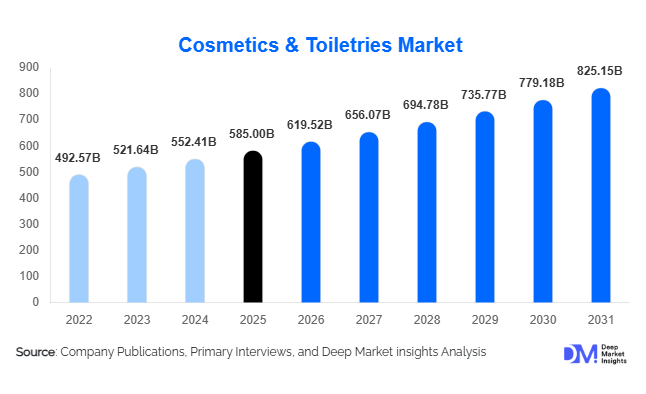
According to Deep Market Insights, the global cosmetics and toiletries market size was valued at USD 585 billion in 2025 and is projected to grow from USD 619.52 billion in 2026 to reach USD 825.15 billion by 2031, expanding at a CAGR of 5.9% during the forecast period (2026–2031). The market growth is primarily driven by rising consumer awareness of personal grooming, increasing demand for natural and organic products, rapid urbanization in emerging economies, and the proliferation of digital sales channels, including e-commerce and D2C platforms.
Key Market Insights
- Skin care products dominate the market, led by anti-aging, sun protection, and moisturization products, accounting for 34% of the global market share in 2025.
- Mass-market products hold the largest price segment share (72%), due to affordability and high penetration in developing countries.
- Offline retail remains significant (60%), though online and D2C channels are growing rapidly, especially in Asia-Pacific and North America.
- Women’s products dominate consumption (55%), while men’s grooming and baby care are fast-growing segments.
- Conventional products still lead (65%), although natural, organic, and dermatologically tested products are gaining momentum globally.
- Technological adoption, including AI-based personalized formulations and virtual try-ons, is transforming product development and consumer engagement.
What are the latest trends in the cosmetics and toiletries market?
Shift Towards Clean and Natural Beauty
Consumers are increasingly prioritizing clean-label and organic formulations free from parabens, sulfates, and other synthetic chemicals. Natural ingredients, plant-based extracts, and cruelty-free certification are now key purchase drivers. This trend is particularly strong in North America and Europe but is rapidly expanding in Asia-Pacific, where rising awareness of personal care and health is driving demand. Brands are investing in sustainable sourcing, eco-friendly packaging, and dermatologically tested formulations to meet this demand.
Digital and E-Commerce Transformation
E-commerce and D2C channels are redefining how cosmetics and toiletries are marketed and sold. AI-driven skincare diagnostics, virtual try-on applications, and personalized product recommendations are becoming mainstream, enhancing consumer experience. Smaller indie brands are leveraging digital platforms to enter new markets, while larger companies are strengthening their online presence. Social media influencers and content-driven campaigns are increasingly shaping consumer preferences and accelerating the adoption of new products.
Personalization and Technology-Driven Innovation
Technological advancements allow consumers to access personalized products tailored to their skin type, hair needs, and lifestyle. From AI-powered skin analysis to DNA-based hair and skincare solutions, personalized offerings are gaining traction. Companies are also integrating biotechnology to develop novel active ingredients, enhancing efficacy while positioning themselves as innovators in the competitive market. This shift towards personalized beauty experiences is boosting repeat purchases and fostering brand loyalty.
What are the key drivers in the cosmetics and toiletries market?
Rising Disposable Income and Urbanization
Growing middle-class populations, especially in the Asia-Pacific region, are increasingly spending on personal care and luxury beauty products. Urban consumers are more exposed to global beauty trends, leading to higher adoption of premium and multifunctional products. Expanding retail infrastructure and rising online penetration further support growth.
Influence of Social Media and Digital Platforms
Beauty influencers, tutorials, and viral trends on platforms like Instagram, TikTok, and YouTube strongly affect consumer behavior. Brands leveraging influencer partnerships, live-streamed launches, and targeted digital campaigns are capturing younger demographics and driving market growth.
Product Innovation and Sustainability Focus
Innovative formulations in anti-aging, hair care, cosmeceuticals, and multifunctional skincare, combined with sustainable packaging, are attracting environmentally conscious consumers. Companies investing in R&D for clean, dermatologically safe, and natural products are capturing a premium segment and expanding market share.
What are the restraints for the global market?
Regulatory and Compliance Challenges
Stringent regulations for safety, labeling, and ingredient usage vary across regions, increasing compliance costs and delaying product launches. Companies must navigate complex approvals, particularly for cosmetics imported into North America and Europe.
Volatility in Raw Material Prices
Fluctuating prices of key ingredients such as essential oils, palm oil derivatives, and synthetic chemicals affect profitability and pricing strategies. Supply chain disruptions can further challenge manufacturers in maintaining stable margins.
What are the key opportunities in the cosmetics and toiletries market?
Natural and Organic Product Expansion
The growing consumer preference for clean beauty and chemical-free products provides a significant opportunity for brands to develop organic formulations and eco-friendly packaging. Certification programs and transparent ingredient sourcing can enhance brand trust and create a premium positioning.
Emerging Markets and Untapped Demographics
Countries such as India, Indonesia, Brazil, and Nigeria are witnessing rising middle-class populations and awareness of personal grooming. The men’s grooming segment and gender-neutral products are gaining momentum globally, creating new revenue streams. Tailoring products to local climate and cultural preferences can further enhance market penetration.
Technological Integration in Personalization
AI-driven skin and hair analysis, DNA-based cosmetic solutions, and virtual try-on technologies are transforming consumer engagement. Personalized products increase loyalty and repeat purchase rates. Digital platforms also allow niche brands to scale quickly and compete with established players.
Report Scope
| Report Metric | Details |
|---|---|
| Market Size in 2025 | USD 585 Billion |
| Market Size in 2026 | USD 619.52 Billion |
| Market Size in 2031 | USD 825.15 Billion |
| CAGR | 5.9% (2026-2031) |
| Base Year for Estimation | 2025 |
| Historical Data | 2022-2024 |
| Forecast Period | 2026-2031 |
| Report Coverage | Revenue Forecast, Competitive Landscape, Supply Chain Disruption, Growth Factors, Environment & Regulatory Landscape and Trends |
| Geographies Covered | North America, Europe, APAC, Middle East and Africa, LATAM |
| Countries Covered | U.S., Canada, U.K., Germany, France, Spain, Italy, Russia, Nordic, Benelux, Rest of Europe, China, Korea, Japan, India, Australia, Singapore, Taiwan, South East Asia, Rest of Asia-Pacific, UAE, Turky, Saudi Arabia, South Africa, Egypt, Nigeria, Rest of MEA, Brazil, Mexico, Argentina, Chile, Colombia, Rest of LATAM |
Explore more data points, trends and opportunities Download Free Sample Report
Product Type Insights
Skin care products continue to dominate the cosmetics and toiletries market, holding approximately 34% of the global market share in 2025. This leadership is primarily driven by rising consumer focus on anti-aging solutions, moisturizers, sunscreens, and facial serums, with an emphasis on multifunctional formulations that combine hydration, UV protection, and skin brightening. Hair care products, particularly shampoos and conditioners, are experiencing steady growth, supported by increasing consumer awareness of scalp health, hair damage prevention, and styling innovations. Color cosmetics are expanding rapidly, influenced by social media trends, influencer marketing, and the growing demand for expressive, customizable makeup. Fragrances and personal hygiene products remain stable in demand, with premium fragrances gaining popularity among luxury consumers seeking personalized scent experiences. Across all product types, the ongoing trend toward natural, organic, and dermatologically tested ingredients is shaping product development and consumer preference, further fueling market growth.
Application Insights
The primary applications in the cosmetics and toiletries market remain personal care and grooming, accounting for approximately 75% of total demand. Consumers increasingly seek multifunctional products that combine beauty, wellness, and therapeutic benefits. The emergence of cosmeceuticals—products that merge cosmetic appeal with dermatological efficacy—is gaining traction in dermatology clinics and wellness centers, creating new growth avenues. The men’s grooming segment and baby care products are witnessing accelerated adoption due to rising awareness of personal hygiene and grooming among men, as well as increased focus on infant and toddler skin safety. Export-driven demand, particularly from France, South Korea, and the U.S., supports international expansion, with these countries acting as major hubs for premium and innovative product supply. Overall, the application landscape is shifting toward personalized, sustainable, and multifunctional solutions, providing both growth opportunities and avenues for product differentiation.
Distribution Channel Insights
Offline retail remains a dominant channel, accounting for roughly 60% of the market. Supermarkets, hypermarkets, specialty stores, and pharmacies drive mass-market sales, particularly for essential personal care and grooming products. Meanwhile, online platforms and direct-to-consumer (D2C) channels are rapidly gaining market share, fueled by growing e-commerce penetration, influencer-led marketing campaigns, and consumer preference for convenience. Asia-Pacific and North America are witnessing the fastest online adoption, with brands leveraging AI-based recommendations, virtual try-on technologies, and subscription-based models to engage premium consumers. Membership programs and loyalty initiatives are emerging as key strategies to retain high-value customers, while personalized digital experiences are shaping the way consumers discover, test, and purchase beauty products.
Consumer Type Insights
Women’s products dominate consumption, accounting for approximately 55% of total demand, driven by a broad product range and willingness to invest in premium skincare and cosmetics. Men’s grooming is the fastest-growing segment, expanding at a CAGR of 7%, driven by rising awareness of appearance, professional grooming standards, and availability of specialized products. Baby and kids’ care products maintain steady growth, supported by increasing focus on hygiene, sensitive skin formulations, and parental willingness to invest in quality care. Urban consumers generally prioritize premium, multifunctional, and innovative products, while younger consumers are gravitating toward clean, sustainable, and socially responsible brands, reflecting an ongoing shift in consumption patterns.
Explore more data points, trends and opportunities Download Free Sample Report
Cosmetics & Toiletries Market Segmentations
By Product Type
- Skin Care
- Hair Care
- Color Cosmetics
- Fragrances
- Personal Hygiene
By Application
- Personal Care & Grooming
- Cosmeceuticals
- Men’s Grooming
- Baby & Kids Care
By Distribution Channel
- Offline Retail
- Online Retail & E-commerce Platforms
- Direct-to-Consumer (D2C) Channels
- Subscription & Membership Programs
By Consumer Type
- Women
- Men
- Baby & Kids
- Urban Consumers
- Younger Demographics
Regional Insights
North America
North America holds 22% of the global market, led by the U.S., which drives demand for premium, technologically advanced, and natural products. Canada contributes to growing e-commerce adoption and rising preference for organic and dermatologically tested solutions. Key drivers include high disposable income, strong brand awareness, and digitally savvy consumers who actively engage with social media trends and online beauty platforms. Innovation in product personalization, AI-based skin diagnostics, and multifunctional formulations is further boosting regional demand, particularly for skincare and color cosmetics.
Europe
Europe accounts for 20% of the market, with France, Germany, and the U.K. leading growth. French luxury brands dominate the skincare and fragrance segments, while Germany and the U.K. are driving demand for natural and organic products. Key growth drivers include sustainability trends, ethical sourcing, and stringent regulatory standards, which encourage the development of safe, premium, and eco-friendly products. The strong consumer focus on wellness, clean beauty, and multifunctional formulations continues to support the premium segment. Digital marketing, influencer campaigns, and high urban penetration of retail outlets further amplify demand across the region.
Asia-Pacific
Asia-Pacific is the largest market (38%), driven primarily by China (18% share) and India (fastest-growing at 8% CAGR). Japan and South Korea represent mature markets with high demand for advanced skincare and beauty tech. Key drivers include rapid urbanization, rising disposable incomes, digital adoption, and a growing middle-class population. E-commerce growth, influencer marketing, and the popularity of multifunctional skincare and color cosmetics fuel regional expansion. In China and India, consumer preference for natural and cosmeceutical products, combined with awareness of personal grooming, supports the rapid adoption of both premium and mass-market offerings.
Latin America
Latin America accounts for 10% of the market, led by Brazil and Mexico. The region shows rising demand for hair care, fragrances, and personal hygiene products. Key growth drivers include expanding middle-class populations, increasing awareness of grooming and wellness, and a growing preference for imported premium products. Outbound travel and exposure to global beauty trends are also influencing consumer preferences, encouraging the adoption of multifunctional and luxury products. Investments in retail modernization and e-commerce platforms are further supporting market expansion.
Middle East & Africa
The region holds 10% of the market. The Middle East, led by the UAE and Saudi Arabia, shows strong demand for luxury and premium products, driven by high disposable income, lifestyle aspirations, and digital retail adoption. Africa, although smaller, is witnessing growth in urban centers due to rising consumer awareness, domestic manufacturing, and the expansion of modern retail chains. Key drivers include urbanization, increasing youth population, rising e-commerce penetration, and government support for local manufacturing initiatives. Skincare, hair care, and fragrances are emerging as leading segments, fueled by a combination of premiumization and exposure to global trends.
Key Players in the Cosmetics and Toiletries Market
- L’Oréal
- Unilever
- Procter & Gamble
- Estée Lauder
- Shiseido
- Beiersdorf
- Coty
- Kao Corporation
- Amorepacific
- Johnson & Johnson
- Colgate-Palmolive
- Revlon
- Henkel
- Natura & Co
- Oriflame