Cosmetic Skin Care Market Size
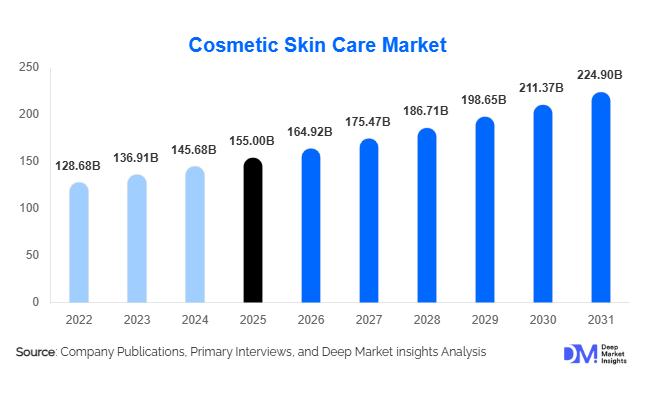
According to Deep Market Insights, the global cosmetic skin care market was valued at USD 155 billion in 2025 and is projected to grow from USD 164.92 billion in 2026 to reach USD 224.90 billion by 2031, expanding at a CAGR of 6.4% during the forecast period (2026–2031). The market growth is primarily driven by rising consumer awareness of skin health, increasing demand for premium and personalized products, and continuous innovation in active ingredient formulations and dermatological solutions.
Key Market Insights
- Consumer preference is shifting toward preventive and personalized skincare, with increasing adoption of serums, actives, and dermatology-backed products.
- Clean beauty and natural ingredient-based formulations are gaining traction, particularly in North America and Europe.
- Asia-Pacific dominates the global market, led by strong demand from China, South Korea, Japan, and India.
- E-commerce and direct-to-consumer channels are expanding rapidly, accounting for a growing share of total sales.
- The premium skincare segment continues to grow, supported by urban consumers and higher disposable incomes.
- Technological integration, such as AI-based skin analysis and biotech ingredients, is transforming product development and consumer engagement.
What are the latest trends in the cosmetic skin care market?
Rise of Clean and Sustainable Beauty
The demand for clean, sustainable, and environmentally friendly skincare products is accelerating globally. Consumers are increasingly opting for formulations that are free from harmful chemicals, cruelty-free, and packaged in recyclable materials. Brands are investing in green chemistry, waterless formulations, and biodegradable packaging to align with sustainability goals. This trend is particularly strong in Europe and North America, where regulatory frameworks and consumer awareness are driving rapid adoption.
Growth of Personalized and Tech-Driven Skincare
Advancements in artificial intelligence and data analytics are enabling personalized skincare solutions tailored to individual skin types and concerns. AI-powered diagnostic tools, mobile apps, and smart devices are helping consumers select customized products. This trend is enhancing customer engagement and driving premiumization, especially among younger, tech-savvy consumers. Companies are increasingly integrating digital platforms with product offerings to create a seamless consumer experience.
What are the key drivers in the cosmetic skin care market?
Increasing Awareness of Skin Health
Consumers are becoming more conscious about skin health and preventive care, leading to increased adoption of skincare routines. The rising prevalence of skin concerns such as aging, acne, and pigmentation is further driving demand for targeted solutions. This shift toward proactive skincare is significantly boosting market growth.
Influence of Social Media and Digital Platforms
Social media platforms and beauty influencers are playing a critical role in shaping consumer preferences. Product recommendations, tutorials, and reviews are accelerating product adoption and creating demand for new and innovative formulations. This digital influence is particularly strong among millennials and Gen Z consumers.
What are the restraints for the global market?
Stringent Regulatory Requirements
The cosmetic skin care market is subject to strict regulations regarding ingredient safety, labeling, and product claims. Compliance with varying regulations across regions increases costs and complexity for manufacturers, potentially slowing down product launches.
Risk of Adverse Reactions and Product Recalls
Products containing active ingredients may cause skin sensitivities or adverse reactions in some consumers. This can lead to product recalls and negatively impact brand reputation, posing a challenge for market players.
What are the key opportunities in the cosmetic skin care industry?
Expansion in Emerging Markets
Emerging economies such as India, Brazil, Indonesia, and parts of Africa present significant growth opportunities due to rising disposable incomes and increasing beauty awareness. Localization of products to suit regional skin types and climates can help companies capture untapped demand.
Biotechnology and Advanced Formulations
The integration of biotechnology in skincare is creating opportunities for innovative products with enhanced efficacy. Lab-grown ingredients, microbiome-friendly formulations, and clinically proven actives are gaining popularity, enabling companies to differentiate their offerings and capture premium segments.
Report Scope
| Report Metric | Details |
|---|---|
| Market Size in 2025 | USD 155 Billion |
| Market Size in 2026 | USD 164.92 Billion |
| Market Size in 2031 | USD 224.90 Billion |
| CAGR | 6.4% (2026-2031) |
| Base Year for Estimation | 2025 |
| Historical Data | 2022-2024 |
| Forecast Period | 2026-2031 |
| Report Coverage | Revenue Forecast, Competitive Landscape, Supply Chain Disruption, Growth Factors, Environment & Regulatory Landscape and Trends |
| Geographies Covered | North America, Europe, APAC, Middle East and Africa, LATAM |
| Countries Covered | U.S., Canada, U.K., Germany, France, Spain, Italy, Russia, Nordic, Benelux, Rest of Europe, China, Korea, Japan, India, Australia, Singapore, Taiwan, South East Asia, Rest of Asia-Pacific, UAE, Turky, Saudi Arabia, South Africa, Egypt, Nigeria, Rest of MEA, Brazil, Mexico, Argentina, Chile, Colombia, Rest of LATAM |
Explore more data points, trends and opportunities Download Free Sample Report
Product Type Insights
Facial care dominates the cosmetic skin care market, accounting for approximately 45% of the total market share in 2025. This segment continues to lead globally due to the strong consumer focus on facial aesthetics, early adoption of skincare routines, and the growing importance of preventive skin health. Products such as moisturizers, serums, cleansers, and toners are integrated into daily regimens across both developed and emerging markets. The rise of multi-step skincare routines, particularly influenced by Asian beauty trends, has further strengthened this segment. Additionally, the increasing demand for targeted treatments, including anti-aging, acne control, and skin brightening, has accelerated innovation in high-performance formulations. The proliferation of dermatology-backed products and active ingredient-based solutions (such as retinol and hyaluronic acid) is acting as a key driver, enabling brands to command premium pricing and sustain long-term growth in this category.
Ingredient Type Insights
Natural and organic ingredients account for approximately 32% of the market share and represent one of the fastest-growing segments globally. The leading driver for this segment is the increasing consumer shift toward clean beauty, driven by concerns over synthetic chemicals and long-term skin health. Consumers are actively seeking transparency in ingredient sourcing, leading to rising demand for plant-based, cruelty-free, and sustainably sourced formulations. Regulatory pressures, particularly in Europe and North America, are also encouraging manufacturers to adopt safer and eco-friendly ingredients. Additionally, the expansion of certifications such as organic and vegan labels is boosting consumer trust. Innovations in green chemistry and biotechnology are enabling brands to combine natural ingredients with enhanced efficacy, further strengthening the segment’s growth trajectory.
Distribution Channel Insights
Online retail channels account for approximately 35% of the market share, making them the fastest-growing distribution segment. The primary driver for this dominance is the rapid digitalization of retail and the increasing consumer preference for convenience, accessibility, and personalized shopping experiences. E-commerce platforms and direct-to-consumer (DTC) models allow brands to offer a wider product range, competitive pricing, and detailed product information, including reviews and ingredient transparency. The integration of AI-based recommendation engines and virtual skin diagnostics is further enhancing online purchasing behavior. Additionally, the rise of social commerce and influencer-driven marketing is accelerating product discovery and sales conversion. Despite this growth, offline channels such as specialty beauty stores, pharmacies, and dermatology clinics remain critical for premium and clinically recommended products, where consumer trust and in-person consultation play a key role.
Consumer Group Insights
The premium segment represents approximately 28% of the global market and continues to expand steadily. The key driver for this segment is the increasing willingness of consumers, particularly in urban areas, to invest in high-quality, result-oriented skincare products. Rising disposable incomes, coupled with greater awareness of advanced skincare formulations, are encouraging consumers to shift from mass-market to premium brands. This segment is also benefiting from the growing influence of dermatologists and skincare professionals, who often recommend high-performance products with clinically proven benefits. Furthermore, premium brands are leveraging innovation, luxury branding, and personalized solutions to differentiate themselves. The demand for anti-aging, skin repair, and specialized treatments is particularly strong within this segment, enabling higher margins and sustained growth.
Functionality Insights
Anti-aging products lead the functionality segment, accounting for approximately 30% of the market share. The primary growth driver is the aging global population, combined with an increasing emphasis on maintaining youthful skin appearance. Consumers across age groups are adopting preventive anti-aging solutions earlier, driving demand for products that address fine lines, wrinkles, and skin elasticity. Technological advancements in active ingredients, such as peptides, antioxidants, and retinoids, are enhancing product efficacy and consumer trust. Additionally, the rising popularity of dermacosmetics and clinically tested formulations is reinforcing the dominance of this segment. The integration of skincare with wellness and longevity trends is further expanding the scope of anti-aging products, making them a cornerstone of the cosmetic skincare market.
Explore more data points, trends and opportunities Download Free Sample Report
Cosmetic Skin Care Market Segmentations
By Product Type
- Facial Care
- Body Care
- Sun Care
- Eye Care
- Lip Care
- Specialty Dermacosmetics
By Ingredient Type
- Natural & Organic
- Synthetic/Conventional
- Hybrid/Bioengineered Ingredients
By Consumer Group
- Mass Market
- Premium/Luxury
- Professional/Clinic-based
By Distribution Channel
- Online Retail
- Supermarkets/Hypermarkets
- Pharmacies/Drugstores
- Specialty Beauty Stores
By Functionality
- Hydration & Nourishment
- Anti-aging & Wrinkle Reduction
- Skin Brightening & Whitening
- Acne & Oil Control
- Sensitive Skin Care
Regional Insights
Asia-Pacific
Asia-Pacific dominates the global cosmetic skin care market with approximately 38% share in 2025, making it both the largest and fastest-growing region. China is the leading contributor, accounting for over 20% of regional demand, driven by a vast consumer base, rapid urbanization, and increasing adoption of premium skincare products. South Korea and Japan are innovation hubs, leading in advanced formulations, multi-step skincare routines, and product development trends such as K-beauty and J-beauty. India is emerging as a high-growth market due to rising disposable incomes, an expanding middle-class population, and increasing penetration of e-commerce platforms. Key growth drivers in this region include strong cultural emphasis on skincare, rapid digital adoption, and continuous product innovation tailored to diverse skin types and climatic conditions.
North America
North America holds approximately 25% of the global market share, with the United States being the dominant contributor. The region’s growth is driven by high consumer spending power, strong awareness of skincare ingredients, and a well-established premium product ecosystem. The demand for clean beauty, organic formulations, and dermatologist-recommended products is particularly strong. Additionally, the widespread adoption of digital platforms, subscription-based skincare services, and personalized product offerings is fueling market expansion. Technological advancements, including AI-driven skincare diagnostics and biotech-based ingredients, are further supporting innovation and growth in this region.
Europe
Europe accounts for around 22% of the market share, with major contributions from France, Germany, and the United Kingdom. The region is characterized by a strong preference for natural, organic, and luxury skincare products. Stringent regulatory frameworks governing ingredient safety and product claims are key drivers, as they enhance consumer trust and product quality. Additionally, Europe’s long-standing heritage in cosmetics manufacturing and innovation supports the growth of premium brands. Increasing consumer awareness regarding sustainability, coupled with demand for eco-friendly packaging and formulations, is further driving regional market expansion.
Middle East & Africa
The Middle East and Africa region is experiencing steady growth, supported by rising disposable incomes and increasing demand for premium skincare products. Countries such as the UAE and Saudi Arabia are key markets, driven by high spending on luxury beauty products and strong retail infrastructure. Climate conditions, including high temperatures and sun exposure, are also driving demand for sun care and hydration-focused products. In Africa, urbanization, growing middle-class populations, and increasing awareness of personal grooming are contributing to market expansion. The gradual development of retail and e-commerce channels is further supporting growth in this region.
Latin America
Latin America represents a smaller but steadily growing share of the global market, with Brazil and Mexico leading regional demand. The growth in this region is driven by increasing beauty consciousness, a strong cultural emphasis on personal appearance, and expanding access to international brands. Rising urbanization and improving retail infrastructure are facilitating market penetration. Additionally, the growing popularity of affordable premium products and the expansion of e-commerce platforms are supporting demand. Economic stabilization in key markets is also expected to create favorable conditions for sustained growth in the cosmetic skin care market.
Key Players in the Cosmetic Skin Care Market
- L’Oréal
- Estée Lauder Companies
- Unilever
- Procter & Gamble
- Shiseido
- Beiersdorf
- Johnson & Johnson
- Amorepacific
- Kao Corporation
- Coty Inc.
- Oriflame
- Avon Products
- Natura & Co
- Revlon
- Clarins