Commercial Laundry Machines Market Size
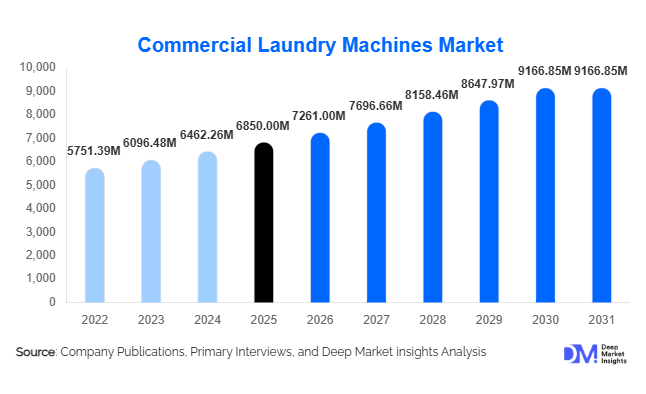
According to Deep Market Insights, the global commercial laundry machines market size was valued at USD 6,850 million in 2025 and is projected to grow from USD 7261.00 million in 2026 to reach USD 9,166.85 million by 2031, expanding at a CAGR of 6.0% during the forecast period (2026–2031). The market growth is primarily driven by the expansion of hospitality and healthcare infrastructure, increasing urbanization, and the rising adoption of automated and energy-efficient laundry systems across institutional settings.
Key Market Insights
- Automation and IoT-enabled laundry systems are gaining traction, enabling real-time monitoring, predictive maintenance, and operational efficiency.
- Hospitality and healthcare sectors dominate demand, driven by high-volume laundry requirements and strict hygiene standards.
- North America leads the market, supported by established laundromat infrastructure and strong replacement demand.
- Asia-Pacific is the fastest-growing region, fueled by urbanization, rising disposable incomes, and expanding service sectors.
- Energy-efficient machines are witnessing strong adoption, driven by environmental regulations and cost-saving initiatives.
- Direct institutional sales dominate distribution, as large buyers prefer customized solutions and long-term service contracts.
What are the latest trends in the commercial laundry machines market?
Shift Toward Smart and Connected Laundry Systems
The integration of IoT and smart technologies is transforming commercial laundry operations. Modern machines are equipped with sensors, cloud connectivity, and analytics tools that enable remote monitoring, predictive maintenance, and performance optimization. Operators can track energy and water usage, detect faults in real time, and reduce downtime through proactive servicing. Mobile-based interfaces and digital payment systems are also being integrated into laundromats, enhancing customer convenience. This trend is particularly strong in developed markets where digital infrastructure is well established, and labor costs are high.
Growing Adoption of Energy-Efficient and Sustainable Machines
Sustainability is becoming a central focus in the commercial laundry machines market. Manufacturers are developing machines that consume less water, electricity, and detergents while maintaining high performance. Heat pump dryers and water recycling systems are gaining popularity, especially in regions with stringent environmental regulations. Businesses are increasingly adopting green-certified equipment to reduce operational costs and meet sustainability targets. This trend is further supported by government incentives and corporate ESG commitments, making eco-friendly machines a key growth segment.
What are the key drivers in the commercial laundry machines market?
Expansion of Hospitality and Healthcare Infrastructure
The rapid growth of hotels, resorts, and healthcare facilities globally is a major driver for commercial laundry machines. These sectors require continuous, large-scale laundry operations to maintain hygiene standards and operational efficiency. Increasing tourism, medical tourism, and healthcare investments are significantly boosting demand for high-capacity and automated machines.
Urbanization and Rise of Organized Laundry Services
Urbanization has led to smaller living spaces and changing lifestyles, increasing reliance on outsourced laundry services. Organized laundromats and centralized laundry facilities are expanding rapidly, particularly in emerging economies. This trend is driving demand for commercial-grade machines that offer efficiency, durability, and scalability.
What are the restraints for the global market?
High Initial Capital Investment
The cost of acquiring commercial laundry machines, especially advanced and high-capacity systems, remains a significant barrier for small businesses. Installation, infrastructure setup, and financing challenges can limit adoption, particularly in price-sensitive markets.
Operational and Maintenance Costs
Commercial laundry machines involve ongoing costs related to energy consumption, water usage, and maintenance. Fluctuating utility prices and the need for regular servicing can impact profitability, especially for small and medium enterprises.
What are the key opportunities in the commercial laundry machines industry?
Growth of Laundromat Chains and Franchise Models
The emergence of organized laundromat chains presents a significant growth opportunity. Franchise-based models are expanding in urban areas, offering standardized services and scalable business operations. This trend is particularly prominent in Asia-Pacific and North America, where demand for convenient laundry services is increasing.
Integration of Smart Technologies and Digital Platforms
The adoption of IoT, AI, and digital payment systems is creating new revenue streams and enhancing operational efficiency. Smart laundry solutions enable remote diagnostics, usage tracking, and automated billing, improving customer experience and reducing operational costs. Companies investing in digital ecosystems can gain a competitive edge in this evolving market.
Report Scope
| Report Metric | Details |
|---|---|
| Market Size in 2025 | USD 6850 Million |
| Market Size in 2026 | USD 7261 Million |
| Market Size in 2031 | USD 9166.85 Million |
| CAGR | 6.0% (2026-2031) |
| Base Year for Estimation | 2025 |
| Historical Data | 2022-2024 |
| Forecast Period | 2026-2031 |
| Report Coverage | Revenue Forecast, Competitive Landscape, Supply Chain Disruption, Growth Factors, Environment & Regulatory Landscape and Trends |
| Geographies Covered | North America, Europe, APAC, Middle East and Africa, LATAM |
| Countries Covered | U.S., Canada, U.K., Germany, France, Spain, Italy, Russia, Nordic, Benelux, Rest of Europe, China, Korea, Japan, India, Australia, Singapore, Taiwan, South East Asia, Rest of Asia-Pacific, UAE, Turky, Saudi Arabia, South Africa, Egypt, Nigeria, Rest of MEA, Brazil, Mexico, Argentina, Chile, Colombia, Rest of LATAM |
Explore more data points, trends and opportunities Download Free Sample Report
Product Type Insights
Washers dominate the commercial laundry machines market, accounting for approximately 35% of the total market share in 2025. Their leadership is primarily driven by their indispensable role as the first and most critical stage in all laundry cycles, across hospitality, healthcare, and industrial applications. The growing adoption of high-efficiency front-load washers, which offer lower water consumption, reduced energy usage, and superior cleaning performance, is further strengthening this segment. Additionally, regulatory pressure on water conservation and sustainability is pushing end users toward advanced washer technologies with optimized load sensing and detergent dosing systems.
Dryers represent the second-largest segment and are witnessing strong growth, particularly with the rising adoption of heat pump and energy-efficient variants. These machines significantly reduce operational costs by lowering electricity consumption, making them highly attractive in regions with high energy tariffs. Washer-dryer combinations are gaining traction in urban and space-constrained environments, especially in small commercial setups and compact laundromats. Meanwhile, specialized equipment such as ironers, presses, and dry-cleaning machines continue to cater to niche industrial and hospitality requirements, particularly in premium hotel chains and textile-intensive industries.
Application Insights
The hospitality sector remains the largest application segment, contributing nearly 30% of total market demand in 2025. This dominance is driven by the continuous need for high-volume laundry operations to manage linens, towels, and guest services in hotels and resorts. The rapid expansion of global tourism and the increasing number of hotel chains, especially in emerging economies, are key growth drivers for this segment. Healthcare is the fastest-growing segment, expanding at an estimated ~7% CAGR, driven by stringent hygiene regulations, infection control requirements, and the expansion of hospital infrastructure globally. Hospitals require specialized laundry systems capable of handling contaminated linens and ensuring sterilization, which is boosting demand for advanced and automated machines.
Laundromats are emerging as a high-growth segment due to urbanization, rising disposable incomes, and changing consumer lifestyles. The shift toward outsourced laundry services and the proliferation of organized laundromat chains are accelerating demand. Industrial applications, including uniform cleaning in manufacturing, oil & gas, and food processing industries, are also contributing to steady growth due to increasing compliance with workplace hygiene standards.
Distribution Channel Insights
Direct sales dominate the market, accounting for around 60% of total revenue, primarily due to the preference of institutional buyers such as hotels, hospitals, and industrial facilities for customized solutions and bulk procurement. These buyers often engage in long-term contracts that include installation, maintenance, and after-sales services, making direct sales the most efficient channel. Distributors and dealers play a crucial role in expanding market penetration, particularly in emerging economies where localized networks are essential for reaching small and medium-sized businesses. These channels also provide technical support and financing options, making them vital for market expansion.
Online sales channels are gradually gaining traction, driven by increasing digitalization and the growing preference for convenient purchasing options among smaller businesses and laundromat operators. E-commerce platforms and direct-to-customer digital models are expected to gain further momentum as manufacturers enhance their online presence.
Capacity Insights
Medium-capacity machines (15–50 kg) lead the market with approximately 45% share, as they provide an optimal balance between cost, efficiency, and throughput. These machines are widely used in hotels, mid-sized laundromats, and healthcare facilities, where consistent performance and moderate volume handling are required. Their versatility and affordability make them the preferred choice across a wide range of end users.
Large-capacity machines are primarily utilized in industrial and centralized laundry operations, where high throughput and continuous operation are critical. These machines are gaining traction in large-scale facilities such as hospitals, industrial plants, and commercial laundry service providers. Small-capacity machines cater to niche applications and low-volume requirements, including small businesses and specialized service providers.
Explore more data points, trends and opportunities Download Free Sample Report
Commercial Laundry Machines Market Segmentations
By Product Type
- Washers
- Dryers
- Washer-Dryer Combos
- Ironers & Presses
- Dry Cleaning Machines
By Application
- Hospitality
- Healthcare
- Laundromats / Self-Service
- Industrial
- Educational Institutions
- Others
By Distribution Channel
- Direct Sales
- Distributors & Dealers
- Online Sales
By Capacity
- Small Capacity
- Medium Capacity
- Large Capacity
By Technology
- Conventional Machines
- Energy-Efficient Machines
- Smart/IoT-Enabled Machines
Regional Insights
North America
North America holds the largest market share of approximately 30% in 2025, led by the United States. The region’s dominance is supported by a well-established laundromat culture, high penetration of commercial laundry services, and advanced healthcare infrastructure. A key growth driver is the strong replacement demand, as businesses upgrade to energy-efficient and smart machines to reduce operational costs and comply with environmental regulations. Additionally, rising labor costs are accelerating the adoption of automated and IoT-enabled systems. The presence of major market players and strong after-sales service networks further strengthens regional growth.
Europe
Europe accounts for around 25% of the market, with major contributions from Germany, the UK, and France. The region’s growth is primarily driven by stringent environmental regulations focused on water and energy efficiency, which are encouraging the adoption of advanced and sustainable laundry solutions. Increasing awareness of carbon footprint reduction and the implementation of green building standards are further supporting demand. Additionally, the region’s mature hospitality industry and growing healthcare infrastructure are contributing to steady market expansion. Technological innovation, particularly in smart and connected laundry systems, is also a key driver in Europe.
Asia-Pacific
Asia-Pacific holds approximately 28% market share and is the fastest-growing region, with a CAGR of around 8%. China and India are the primary growth engines, driven by rapid urbanization, rising disposable incomes, and the expansion of the hospitality and healthcare sectors. The increasing adoption of organized laundry services and laundromat chains is significantly boosting demand. Government initiatives supporting infrastructure development and industrialization are also contributing to market growth. In India, the rise of the middle class and changing consumer lifestyles are accelerating the shift toward outsourced laundry services, while in China, large-scale manufacturing and export-oriented industries are driving industrial laundry demand.
Latin America
Latin America is led by Brazil and Mexico, where urbanization and the gradual expansion of organized laundry services are key growth drivers. The region is experiencing increasing demand due to improving economic conditions and rising awareness of commercial laundry solutions among small and medium enterprises. Growth in the hospitality and tourism sectors is also contributing to market expansion. However, price sensitivity and limited access to advanced technologies remain challenges, prompting demand for cost-effective and durable machines.
Middle East & Africa
The Middle East, particularly the UAE and Saudi Arabia, is witnessing strong demand driven by rapid expansion in luxury hospitality and tourism infrastructure. Large-scale investments in hotels, resorts, and healthcare facilities are creating significant demand for high-capacity and premium laundry machines. Government initiatives to diversify economies and boost tourism are further supporting growth.
In Africa, the market is gradually expanding, supported by increasing investments in healthcare infrastructure and urban development. The growing presence of international hotel chains and rising demand for professional laundry services are key drivers. However, limited infrastructure and cost constraints continue to influence market adoption, leading to a preference for durable and cost-efficient equipment.
Key Players in the Commercial Laundry Machines Market
- Alliance Laundry Systems
- Whirlpool Corporation
- Electrolux Professional
- LG Electronics
- Samsung Electronics
- Girbau Group
- Miele Group
- Dexter Laundry
- Fagor Professional
- Pellerin Milnor Corporation
- Jensen Group
- Kannegiesser
- Shanghai Flying Fish Machinery
- Sea-Lion Machinery
- EDRO Corporation