Commercial Coffee Machine Market Size
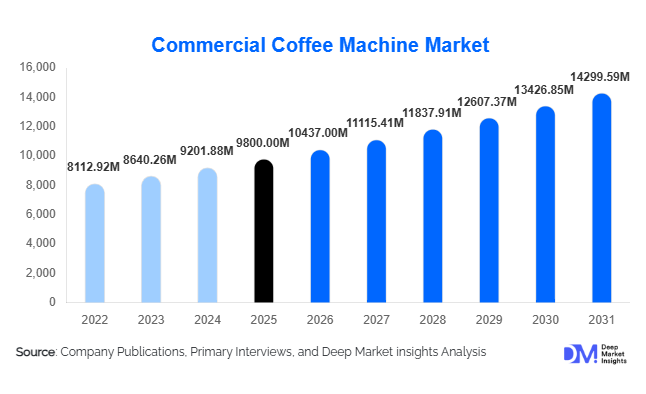
According to Deep Market Insights, the global commercial coffee machine market size was valued at USD 9,800 million in 2025 and is projected to grow from USD 10,437.00 million in 2026 to reach USD 14,299.59 million by 2031, expanding at a CAGR of 6.5% during the forecast period (2026–2031). The commercial coffee machine market is experiencing growth primarily driven by the rapid expansion of specialty coffee chains, increasing coffee consumption across emerging economies, and the growing adoption of automated beverage preparation equipment in hospitality, retail, and corporate environments.
Commercial coffee machines are essential equipment in cafés, restaurants, hotels, offices, and institutional settings where high-volume brewing and consistent beverage quality are critical. Rising consumer demand for premium coffee beverages, such as espresso, cappuccino, latte, and specialty cold brews, has prompted foodservice operators to invest in advanced brewing systems capable of delivering barista-level quality at scale.
The market is also undergoing a significant technological transformation with the introduction of fully automated bean-to-cup machines, touchscreen interfaces, and IoT-enabled monitoring systems, which enhance operational efficiency and reduce downtime. Additionally, the expansion of global café chains and the increasing presence of premium coffee offerings in convenience stores and workplaces are creating sustained demand for professional coffee equipment worldwide.
Key Market Insights
- Espresso machines dominate the market, accounting for over 40% of total revenue due to their widespread use in specialty cafés and restaurants.
- Fully automatic and bean-to-cup machines are gaining traction, driven by the need for consistent beverage quality and reduced labor dependency.
- Europe holds the largest market share, supported by a strong coffee culture and the presence of major equipment manufacturers.
- The Asia-Pacific region is the fastest-growing market, driven by the expansion of café chains and increasing coffee consumption in China, India, and Southeast Asia.
- Corporate office coffee solutions are emerging as a major demand driver, with companies investing in premium workplace amenities.
- IoT-enabled and smart coffee machines are transforming the industry, enabling predictive maintenance, remote monitoring, and automated beverage customization.
What are the latest trends in the commercial coffee machine market?
Rise of Smart and IoT-Enabled Coffee Machines
One of the most significant trends in the commercial coffee machine market is the rapid adoption of smart and connected coffee machines. Modern commercial brewing systems are increasingly equipped with IoT capabilities, allowing operators to remotely monitor machine performance, maintenance cycles, and beverage output. These features are particularly valuable for café chains and large hospitality operators that manage hundreds of machines across multiple locations.
Connected coffee machines also support predictive maintenance, reducing downtime and operational disruptions. Advanced analytics allow operators to track consumption patterns, optimize beverage menus, and manage ingredient inventory more efficiently. Integration with digital payment systems and mobile ordering platforms is further enhancing the consumer experience in quick-service restaurants and self-service coffee kiosks.
Expansion of Specialty Coffee Culture Worldwide
The global rise of specialty coffee culture is another major trend shaping the commercial coffee machine market. Consumers increasingly prefer premium beverages made with freshly ground beans, artisanal brewing methods, and specialty milk textures. As a result, cafés and restaurants are investing in high-end espresso machines capable of producing a wide variety of beverages with precision and consistency.
Emerging markets such as China, India, Indonesia, and Vietnam are experiencing a surge in café openings, driven by urbanization and rising disposable incomes. International coffee chains and boutique cafés are expanding aggressively in these regions, creating significant demand for professional coffee equipment. Additionally, new beverage formats such as cold brew, nitro coffee, and plant-based milk drinks are encouraging operators to upgrade to multi-functional commercial machines.
What are the key drivers in the commercial coffee machine market?
Growth of Global Coffee Consumption
Coffee remains one of the most widely consumed beverages worldwide, and global demand continues to rise steadily. The increasing popularity of espresso-based beverages and specialty coffee drinks has led to significant expansion in café chains and independent coffee shops. Each café typically operates multiple commercial coffee machines to meet peak demand, creating a consistent equipment replacement and upgrade cycle.
In addition to cafés, restaurants and hospitality establishments are expanding their coffee offerings to capture higher beverage margins. This shift toward premium beverage programs is driving investment in advanced commercial brewing equipment capable of delivering consistent flavor profiles and high productivity.
Automation in Foodservice Operations
Automation has become a key priority for foodservice operators seeking to improve efficiency and reduce labor costs. Fully automatic coffee machines simplify the brewing process by integrating grinding, extraction, milk frothing, and cleaning functions into a single system. These machines allow staff with minimal training to prepare complex coffee beverages quickly and consistently.
Automation is particularly valuable in high-traffic environments such as airports, convenience stores, and quick-service restaurants, where speed and consistency are essential. The growing popularity of self-service coffee stations and vending machines is further boosting demand for automated commercial brewing systems.
What are the restraints for the global market?
High Equipment Acquisition Costs
One of the major restraints affecting the commercial coffee machine market is the high cost associated with professional brewing equipment. Advanced espresso machines with multiple boilers, automated milk systems, and digital interfaces can cost several thousand dollars per unit. For small cafés and independent restaurants, this represents a significant upfront investment.
Although leasing and financing options are becoming more common, equipment costs can still limit adoption among smaller businesses and new market entrants. Maintenance expenses and replacement parts also contribute to the total cost of ownership, making cost management an important consideration for foodservice operators.
Volatility in Coffee Supply Chains
Fluctuations in global coffee bean prices and supply chain disruptions can indirectly affect the commercial coffee machine market. Rising raw material costs may force cafés and restaurants to reduce capital expenditures on equipment upgrades or delay expansion plans. In addition, supply chain challenges affecting electronic components and stainless steel materials can increase production costs for machine manufacturers.
What are the key opportunities in the commercial coffee machine industry?
Rapid Expansion of Café Chains in Emerging Markets
The rapid expansion of café chains in emerging economies presents significant opportunities for commercial coffee machine manufacturers. Countries such as China, India, Indonesia, and Brazil are witnessing a surge in specialty coffee outlets as urban consumers adopt café culture and premium beverage experiences.
International coffee chains are opening thousands of new stores across these regions, and each outlet requires high-capacity commercial machines capable of producing hundreds of beverages per day. Equipment suppliers that establish strong distribution networks and after-sales service capabilities in emerging markets are well positioned to benefit from this expansion.
Workplace Coffee Solutions and Office Automation
The corporate workplace segment is emerging as a major growth opportunity in the commercial coffee machine market. Companies increasingly view high-quality coffee as an essential workplace amenity that improves employee satisfaction and productivity. As a result, organizations are installing bean-to-cup coffee machines in office kitchens and collaborative spaces.
Coffee service providers are also offering subscription-based workplace coffee solutions that include machine installation, maintenance, and coffee supply. This recurring service model is creating new revenue streams for manufacturers and service providers while expanding the adoption of commercial coffee machines in corporate environments.
Report Scope
| Report Metric | Details |
|---|---|
| Market Size in 2025 | USD 9800 Million |
| Market Size in 2026 | USD 10437 Million |
| Market Size in 2031 | USD 14299.59 Million |
| CAGR | 6.5% (2026-2031) |
| Base Year for Estimation | 2025 |
| Historical Data | 2022-2024 |
| Forecast Period | 2026-2031 |
| Report Coverage | Revenue Forecast, Competitive Landscape, Supply Chain Disruption, Growth Factors, Environment & Regulatory Landscape and Trends |
| Geographies Covered | North America, Europe, APAC, Middle East and Africa, LATAM |
| Countries Covered | U.S., Canada, U.K., Germany, France, Spain, Italy, Russia, Nordic, Benelux, Rest of Europe, China, Korea, Japan, India, Australia, Singapore, Taiwan, South East Asia, Rest of Asia-Pacific, UAE, Turky, Saudi Arabia, South Africa, Egypt, Nigeria, Rest of MEA, Brazil, Mexico, Argentina, Chile, Colombia, Rest of LATAM |
Explore more data points, trends and opportunities Download Free Sample Report
Product Type Insights
Espresso machines dominate the commercial coffee machine market, accounting for approximately 42% of total revenue in 2025. These machines are widely used in cafés, restaurants, and specialty coffee shops due to their versatility in producing a wide range of beverages, including cappuccinos, lattes, macchiatos, and Americanos. Drip and filter coffee machines remain popular in institutional environments such as offices and hotels, where large batches of coffee are required for breakfast service or meetings. Capsule and pod-based machines are gaining traction in convenience stores and self-service environments because they offer consistent beverage quality and simplified operations. Specialty beverage machines, including cold brew and nitro coffee systems, represent a growing niche segment as operators diversify beverage menus to attract younger consumers seeking innovative coffee experiences.
Application Insights
Cafés and coffee chains represent the largest application segment for commercial coffee machines, accounting for roughly 45% of global installations. These establishments rely heavily on professional espresso machines to maintain beverage quality and operational efficiency during peak hours. Hotels and hospitality venues also represent a significant market segment, with coffee machines installed in restaurants, breakfast buffets, lounges, and conference facilities. Corporate offices are emerging as one of the fastest-growing application areas as companies increasingly provide premium coffee amenities to employees. Convenience stores, airports, hospitals, and universities are also adopting self-service coffee machines, enabling customers to access freshly brewed beverages quickly and conveniently.
Distribution Channel Insights
Equipment distributors and specialized dealers dominate the distribution landscape for commercial coffee machines, accounting for more than half of global sales. Foodservice operators often rely on experienced distributors for machine selection, installation, training, and maintenance services. Direct sales from manufacturers to large enterprise clients such as hotel chains and global café brands are also common. Online B2B platforms are gradually gaining importance as digital procurement channels expand across the hospitality and retail sectors. Coffee service providers offering leasing and subscription-based equipment models are emerging as a key distribution channel, particularly for corporate offices and small cafés that prefer lower upfront investment.
End-Use Industry Insights
The commercial coffee machine market is heavily influenced by trends in the global foodservice and hospitality industries. Cafés and coffee chains represent the largest end-use segment, supported by the rapid expansion of specialty coffee outlets worldwide. The global café industry generates over USD 250 billion in annual revenue, creating a significant demand for high-capacity brewing equipment.
Hotels and restaurants also represent key demand drivers as hospitality operators increasingly invest in premium beverage offerings to enhance guest experiences. Corporate offices represent the fastest-growing end-use segment, driven by rising demand for workplace amenities and automated coffee solutions. Institutional facilities such as hospitals, universities, and airports are also adopting commercial coffee machines to support self-service beverage stations.
Explore more data points, trends and opportunities Download Free Sample Report
Commercial Coffee Machine Market Segmentations
By Machine Type
- Espresso Machines
- Drip / Filter Coffee Machines
- Capsule / Pod Coffee Machines
- Instant Coffee Machines
- Specialty Beverage Coffee Machines
By Technology
- Manual Coffee Machines
- Semi-Automatic Coffee Machines
- Fully Automatic Coffee Machines
- Super-Automatic / Bean-to-Cup Machines
- Smart / Connected Coffee Machines
By Output Capacity
- Low Capacity Machines
- Medium Capacity Machines
- High Capacity Machines
- Ultra-High Capacity Machines
By End-Use Industry
- Cafés & Coffee Chains
- Hotels & Hospitality
- Restaurants & Foodservice Outlets
- Corporate Offices & Workspaces
- Convenience Stores & Retail
- Institutional Facilities
By Distribution Channel
- Direct Manufacturer Sales
- Equipment Distributors & Dealers
- Online B2B Platforms
- Coffee Service Providers / Leasing Models
Regional Insights
North America
North America accounts for approximately 32% of the global commercial coffee machine market. The United States represents the largest market in the region due to high coffee consumption levels and the presence of numerous coffee chains and specialty cafés. Convenience stores and quick-service restaurants are also significant buyers of commercial coffee equipment as they expand beverage offerings. Canada contributes steadily to regional demand through its strong café culture and well-established coffee retail sector.
Europe
Europe holds the largest regional share, accounting for approximately 35% of the global market. Countries such as Italy, Germany, France, and the United Kingdom have long-standing coffee traditions and extensive café networks. The region is also home to several leading coffee machine manufacturers, making it a major production and export hub for commercial coffee equipment. Increasing demand for automated coffee machines in workplaces and convenience stores is further strengthening market growth across Europe.
Asia-Pacific
Asia-Pacific is the fastest-growing regional market for commercial coffee machines, driven by the rapid expansion of café chains and rising coffee consumption among urban populations. China, Japan, South Korea, and India represent the largest markets in the region. China in particular, is experiencing explosive growth in specialty coffee outlets, while India’s emerging café culture is creating new opportunities for equipment manufacturers.
Latin America
Latin America accounts for a smaller but steadily growing share of the global market. Brazil and Mexico represent the largest markets in the region, supported by strong coffee production industries and growing café culture. Increasing urbanization and rising disposable incomes are encouraging greater adoption of premium coffee beverages across major cities.
Middle East & Africa
The Middle East and Africa region is experiencing steady growth in demand for commercial coffee machines, particularly in countries such as the UAE, Saudi Arabia, and South Africa. Luxury hotels, high-end cafés, and premium retail outlets are major buyers of advanced espresso machines. In addition, large hospitality development projects and tourism expansion across the Gulf region are contributing to increased equipment installations.
Key Players in the Commercial Coffee Machine Market
- De'Longhi
- Franke Coffee Systems
- WMF Group
- Melitta Group
- Electrolux Professional
- Jura Elektroapparate
- Philips
- Hamilton Beach Brands
- Nestlé Nespresso
- Lavazza
- Panasonic
- Bosch
- Keurig Dr Pepper
- Illy
- Schaerer