Commercial & Corporate Card Market Size
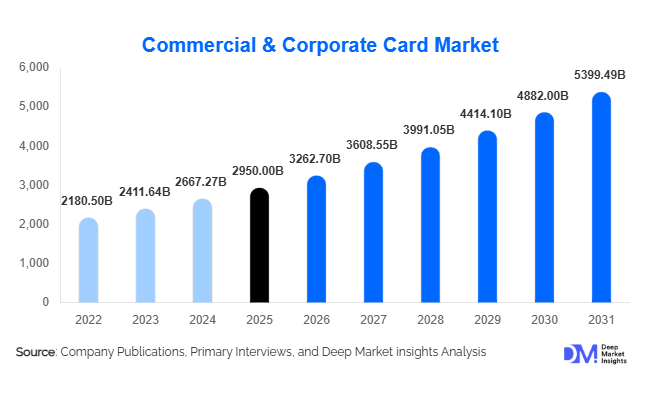
According to Deep Market Insights, the global commercial & corporate card market size was valued at USD 2,950 billion in 2025 and is projected to grow from USD 3,262.70 billion in 2026 to reach USD 5,399.49 billion by 2031, expanding at a CAGR of 10.6% during the forecast period (2026–2031). The market growth is primarily driven by increasing adoption of digital payment solutions, rising demand for real-time expense management, and the growing need for transparent and controlled corporate spending systems. The expansion of fintech ecosystems and integration of AI-powered analytics are further accelerating enterprise adoption across global markets.
Key Market Insights
- Virtual and digital corporate cards are gaining rapid adoption, driven by SaaS payments, remote work environments, and enhanced security features.
- Banking institutions dominate the market, supported by strong infrastructure, trust, and global acceptance networks.
- North America leads the global market, accounting for the largest share due to high enterprise digitization and corporate spending.
- Asia-Pacific is the fastest-growing region, fueled by SME expansion, government initiatives, and digital payment penetration.
- SMEs are emerging as a key growth segment, enabled by fintech-driven flexible credit and onboarding solutions.
- Integration with AI and expense management platforms is transforming corporate cards into strategic financial tools.
What are the latest trends in the commercial & corporate card market?
Rise of Virtual and Embedded Payment Solutions
Virtual cards are becoming a dominant trend as businesses prioritize security, automation, and scalability. These cards enable real-time issuance, usage controls, and seamless integration with enterprise resource planning (ERP) systems. Organizations are increasingly using virtual cards for vendor payments, subscription services, and employee reimbursements. Embedded finance solutions are also gaining traction, where corporate card functionalities are integrated directly into business platforms, simplifying financial operations and improving user experience.
AI-Driven Expense Analytics and Automation
Artificial intelligence is transforming how enterprises manage expenses. AI-powered platforms integrated with corporate cards provide automated expense categorization, fraud detection, and predictive analytics. Businesses are leveraging these tools to gain actionable insights into spending patterns, optimize budgets, and enhance compliance. Automation reduces manual intervention, minimizes errors, and improves operational efficiency, making AI integration a key differentiator among providers.
What are the key drivers in the commercial & corporate card market?
Increasing Digital Payment Adoption
The global shift toward cashless transactions is significantly driving the adoption of corporate cards. Governments and financial institutions are promoting digital payment ecosystems, encouraging enterprises to transition from traditional payment methods to card-based systems. This shift enhances transaction efficiency, traceability, and security.
Growing Demand for Expense Transparency
Organizations are focusing on financial control and governance. Corporate cards offer real-time tracking, spending limits, and detailed reporting features, enabling better expense management. This demand is particularly strong among large enterprises with complex financial operations.
Expansion of Global Business Operations
As companies expand internationally, the need for efficient cross-border payment solutions increases. Corporate cards simplify international transactions, currency conversions, and compliance requirements, supporting global business growth.
What are the restraints for the global market?
Security and Fraud Risks
Despite advancements in cybersecurity, corporate cards remain vulnerable to fraud and data breaches. Organizations must invest in robust security measures, which can increase operational costs and complexity.
High Transaction Costs and Fees
Interchange fees, interest rates, and service charges can be significant, particularly for SMEs. These costs may limit adoption among smaller businesses and price-sensitive markets.
What are the key opportunities in the commercial & corporate card industry?
SME Market Expansion in Emerging Economies
Small and medium enterprises represent a significant untapped opportunity, especially in Asia-Pacific, Latin America, and Africa. Government initiatives promoting digital payments and financial inclusion are encouraging SMEs to adopt corporate cards. Fintech companies are offering tailored solutions with flexible credit and simplified onboarding, making this segment highly attractive for market expansion.
Integration with Digital Ecosystems
The integration of corporate cards with accounting software, ERP systems, and expense management platforms is creating new growth avenues. These integrations enhance operational efficiency, improve data visibility, and enable seamless financial workflows, making corporate cards an essential component of enterprise financial systems.
Report Scope
| Report Metric | Details |
|---|---|
| Market Size in 2025 | USD 2950 Billion |
| Market Size in 2026 | USD 3262.70 Billion |
| Market Size in 2031 | USD 5399.49 Billion |
| CAGR | 10.6% (2026-2031) |
| Base Year for Estimation | 2025 |
| Historical Data | 2022-2024 |
| Forecast Period | 2026-2031 |
| Report Coverage | Revenue Forecast, Competitive Landscape, Supply Chain Disruption, Growth Factors, Environment & Regulatory Landscape and Trends |
| Geographies Covered | North America, Europe, APAC, Middle East and Africa, LATAM |
| Countries Covered | U.S., Canada, U.K., Germany, France, Spain, Italy, Russia, Nordic, Benelux, Rest of Europe, China, Korea, Japan, India, Australia, Singapore, Taiwan, South East Asia, Rest of Asia-Pacific, UAE, Turky, Saudi Arabia, South Africa, Egypt, Nigeria, Rest of MEA, Brazil, Mexico, Argentina, Chile, Colombia, Rest of LATAM |
Explore more data points, trends and opportunities Download Free Sample Report
Card Type Insights
Corporate credit cards continue to dominate the commercial & corporate card market, accounting for approximately 32% of the total market share in 2025. This leadership is primarily driven by their revolving credit capabilities, which provide enterprises with enhanced cash flow flexibility and short-term financing advantages. Large organizations, in particular, rely heavily on corporate credit cards for managing high-volume operational expenses, supplier payments, and employee reimbursements. Their global acceptance across merchants and compatibility with expense management platforms further strengthens their position. In addition, built-in controls such as spending limits, real-time tracking, and reporting tools make them a preferred solution for financial governance and compliance. While purchasing cards (P-cards) are gaining traction in procurement processes due to automation benefits, and travel & entertainment cards remain essential for business travel, virtual cards are emerging as the fastest-growing segment. Their rapid adoption is fueled by the rise of digital transactions, subscription-based business models, and the need for secure, single-use payment mechanisms in vendor and SaaS ecosystems.
Application Insights
Travel and expense (T&E) management remains the leading application segment, contributing nearly 30% of the total market share in 2025. The dominance of this segment is largely attributed to the resurgence of corporate travel, globalization of business operations, and the growing need for efficient expense tracking and reimbursement systems. Enterprises increasingly depend on corporate cards to streamline travel bookings, manage employee expenses, and ensure policy compliance through automated reporting systems. The integration of T&E solutions with ERP and accounting platforms further enhances operational efficiency and reduces administrative burden. Procurement and vendor payments also represent a significant share, driven by the adoption of P-cards and automation in supply chain transactions. Meanwhile, emerging applications such as SaaS subscription payments, digital advertising spend, and cross-border transactions are witnessing rapid growth. These applications reflect the evolving nature of enterprise spending, where digital-first operations and recurring payment models are becoming increasingly prevalent.
Technology Insights
From a technology perspective, traditional chip and PIN cards continue to hold a substantial share due to their widespread acceptance and established security standards. However, the market is undergoing a significant shift toward advanced payment technologies. Contactless cards are witnessing strong adoption, particularly in regions with mature digital payment ecosystems, due to their convenience and faster transaction processing. Notably, virtual cards account for approximately 22% of the market and are the fastest-growing technology segment. Their growth is driven by enhanced security features such as tokenization, single-use credentials, and real-time issuance, which significantly reduce fraud risks. Additionally, the increasing integration of corporate cards with mobile wallets and digital platforms is transforming user experience by enabling seamless, on-the-go transactions. Businesses are also leveraging API-driven card issuance and embedded finance solutions to integrate payment functionalities directly into their operational workflows, further accelerating the adoption of digital card technologies.
Enterprise Size Insights
Large enterprises dominate the commercial & corporate card market, accounting for approximately 65% of the total market share in 2025. This dominance is primarily driven by their extensive operational scale, higher transaction volumes, and the need for structured financial management systems. Large organizations typically have complex expense structures, global operations, and strict compliance requirements, making corporate card solutions indispensable for efficient financial control. These enterprises also benefit from customized card programs, advanced analytics, and integration with enterprise software systems. However, small and medium enterprises (SMEs) represent the fastest-growing segment in the market. The growth of SMEs is fueled by increasing access to digital financial services, simplified onboarding processes offered by fintech companies, and flexible credit options tailored to smaller businesses. As SMEs continue to expand globally and adopt digital tools, their reliance on corporate card solutions is expected to increase significantly.
Explore more data points, trends and opportunities Download Free Sample Report
Commercial & Corporate Card Market Segmentations
By Card Type
- Corporate Credit Cards
- Corporate Charge Cards
- Purchasing Cards (P-Cards)
- Travel & Entertainment Cards
- Fleet Cards
- Virtual Cards
By Application
- Travel & Expense Management
- Procurement & Vendor Payments
- Fleet & Fuel Management
- Subscription & SaaS Payments
- Cross-border Payments
By Enterprise Size
- Large Enterprises
- Small & Medium Enterprises (SMEs)
By Technology
- Chip & PIN Cards
- Contactless Cards
- Virtual/Digital Cards
- Mobile Wallet Integrated Cards
Regional Insights
North America
North America remains the largest market, accounting for approximately 38% of the global share in 2025, with the United States leading the region. The dominance of North America is driven by a highly developed financial ecosystem, widespread adoption of digital payment technologies, and the strong presence of major card issuers and networks. Enterprises in the region have been early adopters of corporate card programs, leveraging them for expense management, procurement, and cross-border transactions. Additionally, the rapid adoption of AI-driven expense management tools and embedded finance solutions is further accelerating market growth. Canada also contributes significantly, supported by increasing enterprise digitization and government initiatives promoting cashless economies.
Europe
Europe holds around 25% of the global market share, with key countries including the United Kingdom, Germany, and France driving demand. The region’s growth is supported by strong regulatory frameworks such as PSD2, which promote secure and transparent digital payments. Increasing adoption of fintech solutions and open banking initiatives are enabling seamless integration of corporate card systems with enterprise financial platforms. Additionally, the growing emphasis on compliance, expense transparency, and sustainability in business operations is encouraging organizations to adopt corporate card solutions. The presence of multinational corporations and cross-border trade activities further strengthens demand across the region.
Asia-Pacific
Asia-Pacific accounts for approximately 22% of the global market share and is the fastest-growing region, with a CAGR exceeding 13% during the forecast period. Major economies such as China, India, and Japan are driving growth through rapid digitalization, expansion of SMEs, and increasing adoption of cashless payment systems. Government initiatives promoting digital economies, such as financial inclusion programs and real-time payment infrastructures, are significantly boosting corporate card adoption. Additionally, the rise of fintech companies offering innovative and cost-effective solutions is accelerating market penetration, particularly among SMEs. The region’s strong economic growth, increasing cross-border trade, and expanding e-commerce ecosystem further contribute to its rapid market expansion.
Latin America
Latin America is witnessing steady growth, with Brazil and Mexico emerging as key markets. The region’s expansion is primarily driven by increasing fintech penetration, improving digital payment infrastructure, and growing SME adoption of corporate financial solutions. Governments and financial institutions are actively promoting financial inclusion and digital transformation, creating favorable conditions for market growth. Additionally, the rising need for efficient expense management and cross-border payment solutions among businesses is supporting the adoption of corporate cards. Despite challenges such as economic volatility, the region presents significant long-term growth potential.
Middle East & Africa
The Middle East & Africa region is experiencing gradual but consistent growth, with the United Arab Emirates and Saudi Arabia leading adoption. The market is driven by government-led digital transformation initiatives, increasing corporate digitization, and the expansion of non-cash payment ecosystems. In the Middle East, high-income economies and a strong preference for digital financial solutions are accelerating adoption, particularly among large enterprises. In Africa, the growth is supported by improving financial infrastructure, rising fintech innovation, and increasing participation of SMEs in formal financial systems. The region’s growing focus on economic diversification and digital economy development is expected to further drive demand for corporate card solutions.
Key Players in the Commercial & Corporate Card Market
- Visa Inc.
- Mastercard Incorporated
- American Express Company
- JPMorgan Chase & Co.
- Citigroup Inc.
- Bank of America Corporation
- HSBC Holdings plc
- Barclays plc
- BNP Paribas
- Wells Fargo & Company
- Capital One Financial Corporation
- U.S. Bancorp
- Discover Financial Services
- Stripe Inc.
- Brex Inc.