Color Cosmetics Market Size
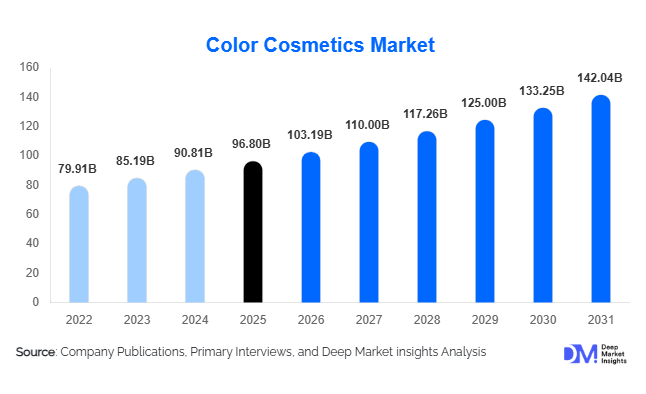
According to Deep Market Insights, the global color cosmetics market size was valued at USD 96.8 billion in 2025 and is projected to grow from USD 103.19 billion in 2026 to reach USD 142.04 billion by 2031, expanding at a CAGR of 6.6% during the forecast period (2026–2031). The market growth is driven by rising beauty consciousness, increasing influence of social media and beauty influencers, growing demand for premium and clean-label cosmetics, and rapid expansion of e-commerce and direct-to-consumer beauty channels globally.
Key Market Insights
- Facial makeup dominates global demand, driven by foundation, concealers, and hybrid skincare-makeup products.
- Asia-Pacific leads global consumption, supported by rising disposable income, urbanization, and a strong beauty culture in China, India, and South Korea.
- Digital commerce is reshaping the industry, with social media, influencer marketing, and virtual try-on tools accelerating product discovery and sales.
- Clean beauty and sustainability are becoming core purchase drivers, especially among Gen Z and millennial consumers.
- Premium cosmetics are expanding faster than mass-market products due to increasing preference for high-performance and dermatologically tested formulations.
- Men’s and gender-neutral cosmetics are emerging as high-growth segments, reflecting changing global beauty standards.
What are the latest trends in the color cosmetics market?
Clean Beauty and Sustainable Formulations
The shift toward clean beauty is one of the most significant transformations in the color cosmetics market. Consumers are increasingly demanding vegan, cruelty-free, organic, and non-toxic formulations. Brands are responding by reformulating products to eliminate harmful chemicals and adopting transparent ingredient labeling. Sustainable packaging, including refillable compacts and biodegradable materials, is also gaining strong traction. Companies investing in carbon-neutral production and eco-certified supply chains are gaining competitive advantage, particularly in Europe and North America.
AI, AR, and Digital Beauty Personalization
Technology integration is revolutionizing how consumers interact with cosmetics. Artificial intelligence is being used for personalized shade matching, skin analysis, and product recommendations, while augmented reality enables virtual try-on experiences through mobile apps and e-commerce platforms. Social commerce and livestream shopping are also reshaping buying behavior, especially in Asia-Pacific markets. These innovations are significantly reducing return rates and improving customer satisfaction in online beauty retail.
What are the key drivers in the color cosmetics market?
Rising Social Media and Influencer Impact
The widespread influence of platforms such as Instagram, TikTok, and YouTube has transformed cosmetic consumption patterns. Beauty influencers and celebrity collaborations drive rapid product adoption and trend cycles. Viral makeup trends, tutorials, and product reviews have shortened product life cycles and increased experimentation among consumers, especially younger demographics.
Growing Demand for Premium and Hybrid Products
Consumers are increasingly preferring multifunctional cosmetics that combine skincare benefits with makeup properties. Products infused with SPF, anti-aging ingredients, hydration agents, and skin-repair compounds are witnessing strong demand. This premiumization trend is particularly strong in developed markets, where consumers prioritize quality, safety, and long-term skin benefits.
Expansion of E-Commerce and Direct-to-Consumer Channels
The rapid growth of online beauty retail has significantly expanded market access. Brand-owned websites, marketplaces, and social commerce platforms allow consumers to explore wider product ranges with personalized recommendations. Improved logistics, digital payment systems, and influencer-driven marketing strategies are further accelerating online sales growth globally.
What are the restraints for the global market?
Stringent Regulatory Requirements
The cosmetics industry faces strict regulatory frameworks across regions such as Europe and North America. Compliance with ingredient safety standards, product testing, and labeling regulations increases operational costs and limits the speed of product launches. Smaller players often face challenges in meeting these regulatory requirements.
Raw Material Price Volatility
Fluctuations in the prices of pigments, oils, waxes, and specialty chemicals impact production costs and profit margins. Global supply chain disruptions, geopolitical uncertainties, and transportation cost increases further add pressure on manufacturers, particularly those operating in price-sensitive mass-market segments.
What are the key opportunities in the color cosmetics industry?
Expansion in Emerging Markets
Rapid urbanization, rising disposable income, and increasing beauty awareness in countries such as India, Indonesia, Brazil, and the UAE present significant growth opportunities. These regions are witnessing strong adoption of international beauty trends, supported by growing e-commerce penetration and influencer-driven marketing.
Innovation in Inclusive and Personalized Beauty
Brands are increasingly focusing on inclusive shade ranges and personalized product offerings tailored to diverse skin tones and consumer preferences. AI-driven customization and data analytics are enabling companies to develop hyper-personalized cosmetics, improving customer engagement and brand loyalty.
Sustainability-Led Product Development
Sustainability presents a major long-term opportunity, with consumers actively preferring environmentally responsible brands. Companies investing in biodegradable packaging, clean formulations, and ethical sourcing are expected to gain stronger market positioning and premium pricing power.
Report Scope
| Report Metric | Details |
|---|---|
| Market Size in 2025 | USD 96.8 Billion |
| Market Size in 2026 | USD 103.19 Billion |
| Market Size in 2031 | USD 142.04 Billion |
| CAGR | 6.6% (2026-2031) |
| Base Year for Estimation | 2025 |
| Historical Data | 2022-2024 |
| Forecast Period | 2026-2031 |
| Report Coverage | Revenue Forecast, Competitive Landscape, Supply Chain Disruption, Growth Factors, Environment & Regulatory Landscape and Trends |
| Geographies Covered | North America, Europe, APAC, Middle East and Africa, LATAM |
| Countries Covered | U.S., Canada, U.K., Germany, France, Spain, Italy, Russia, Nordic, Benelux, Rest of Europe, China, Korea, Japan, India, Australia, Singapore, Taiwan, South East Asia, Rest of Asia-Pacific, UAE, Turky, Saudi Arabia, South Africa, Egypt, Nigeria, Rest of MEA, Brazil, Mexico, Argentina, Chile, Colombia, Rest of LATAM |
Explore more data points, trends and opportunities Download Free Sample Report
Product Type Insights
Facial makeup remains the leading product category in the global color cosmetics market, accounting for approximately 31% of total market revenue in 2025. The segment’s dominance is primarily driven by growing consumer preference for complexion-enhancing products such as foundations, concealers, primers, blushes, and contour products. Increasing demand for flawless skin appearance, rising adoption of HD makeup products, and the popularity of hybrid skincare-infused cosmetics are major growth drivers supporting this segment globally. Consumers are increasingly seeking multifunctional facial cosmetics containing SPF protection, anti-aging ingredients, hydration compounds, and skin-repair actives, which has accelerated premiumization across the category. In addition, social media beauty trends and the influence of professional makeup tutorials have significantly increased consumer spending on facial cosmetics, especially among Gen Z and millennial demographics. Eye makeup represents nearly 24% of the global market and continues to witness strong growth due to increasing experimentation with eye-focused beauty looks across digital platforms. Products such as mascaras, eyeliners, eyebrow enhancers, and eye shadow palettes are experiencing rising demand due to beauty influencer campaigns, celebrity collaborations, and short-form video content. The segment is further supported by innovation in waterproof, smudge-resistant, and long-lasting formulations, particularly in Asia-Pacific and North America, where trend-driven cosmetic consumption remains strong.
Lip products account for approximately 22% of market share globally, supported by strong demand for long-wear matte lipsticks, liquid lip colors, lip stains, and hydrating lip tints. The normalization of social gatherings, workplace attendance, and fashion-focused beauty trends has accelerated post-pandemic recovery in this segment. Premium lip products featuring clean-label ingredients, vegan formulations, and moisturizing compounds are increasingly gaining traction among consumers. Nail cosmetics and specialty hybrid cosmetics collectively account for the remaining market share, with rising demand for vegan nail products, breathable nail coatings, and sustainable beauty formulations. Specialty cosmetics such as halal-certified makeup, dermatologically tested products, and organic cosmetics are witnessing particularly strong growth among health-conscious consumers seeking safer and ethically produced alternatives.
Application Insights
Daily wear cosmetics remain the largest application segment within the global color cosmetics market, supported by the growing integration of makeup products into routine personal grooming and self-care practices. Consumers increasingly prefer lightweight, long-lasting, and multifunctional cosmetics suitable for professional, social, and casual everyday use. The segment is further driven by rising workforce participation among women, increasing urbanization, and higher disposable income across emerging economies. Professional and salon makeup applications are witnessing steady expansion due to growing demand from bridal services, fashion events, entertainment production, and influencer-led content creation industries. Makeup artists and beauty professionals continue to drive demand for premium, HD-compatible, and long-lasting cosmetics capable of delivering camera-ready finishes. Bridal makeup remains a particularly important growth driver in countries such as India, the UAE, and Southeast Asian nations, where wedding-related beauty spending continues to rise significantly.
Occasion-based and event-focused makeup applications are also expanding steadily as consumers increasingly purchase cosmetics for festivals, parties, fashion events, concerts, and destination weddings. The growing popularity of social media photography and video-driven beauty presentation has increased consumer willingness to experiment with bold colors, specialty products, and premium formulations. Emerging niche applications such as photography-driven makeup, entertainment makeup, and influencer cosmetics are gaining traction among younger consumers. Demand for professional-grade makeup products suitable for high-definition photography, digital content creation, and livestreaming continues to increase globally, particularly across Asia-Pacific and North America.
Distribution Channel Insights
Offline retail continues to account for a significant share of the global color cosmetics market due to strong consumer preference for physical product testing, shade matching, and in-store beauty consultations. Specialty beauty retailers, department stores, hypermarkets, pharmacies, and salon-based retail outlets remain critical distribution channels globally. Consumers often prefer offline purchases for premium cosmetics due to the ability to test textures, colors, and formulations before purchase. In-store promotional campaigns, exclusive launches, and personalized beauty advisory services also continue to support offline retail dominance.
However, online distribution channels are witnessing the fastest growth across the market due to rapid e-commerce penetration and increasing digital engagement among beauty consumers. Brand-owned websites, online marketplaces, social commerce platforms, and subscription beauty services are significantly reshaping purchasing behavior. The rapid adoption of AI-powered shade matching, virtual try-on technologies, and augmented reality beauty tools has improved consumer confidence in online cosmetic purchases.
Social media-driven commerce continues to emerge as a major industry growth driver, particularly in China, South Korea, India, and Southeast Asia. Livestream shopping, influencer-led tutorials, and short-video product demonstrations have substantially accelerated online conversion rates. Subscription-based beauty boxes and direct-to-consumer business models are also enabling brands to build stronger customer retention and recurring revenue streams. In addition, omnichannel retail strategies are becoming increasingly important as leading cosmetic brands integrate physical retail experiences with digital platforms to create seamless consumer engagement across multiple touchpoints.
Consumer Group Insights
Women remain the dominant consumer group within the global color cosmetics market, accounting for the majority of overall demand due to routine cosmetic usage, rising beauty awareness, and strong participation across both premium and mass-market categories. Female consumers continue to drive demand for facial makeup, lip products, and eye cosmetics across all major regional markets. However, male grooming and gender-neutral cosmetics are emerging as some of the fastest-growing consumer segments globally. Changing social perceptions regarding male beauty and self-care, combined with celebrity influence and expanding skincare awareness, are encouraging higher cosmetic adoption among male consumers. Products such as tinted moisturizers, concealers, eyebrow products, and lightweight complexion cosmetics are increasingly being marketed toward men.
Teenagers and Gen Z consumers are playing a transformative role in shaping market trends. Younger consumers actively experiment with bold colors, artistic makeup styles, and trend-driven cosmetic products influenced heavily by social media platforms such as TikTok, Instagram, and YouTube. This demographic also demonstrates a strong preference for vegan, cruelty-free, inclusive, and environmentally sustainable beauty products. Professional makeup artists represent another important high-value consumer segment supporting premium product demand globally. This segment drives sales of high-performance cosmetics designed for long wear, HD photography compatibility, and advanced skin-finish capabilities. The growth of the entertainment industry, digital content creation, fashion photography, and influencer marketing continues to strengthen demand from professional cosmetic users.
Explore more data points, trends and opportunities Download Free Sample Report
Color Cosmetics Market Segmentations
By Product Type
- Facial Makeup
- Eye Makeup
- Lip Products
- Nail Cosmetics
- Specialty & Hybrid Cosmetics
By Application
- Daily Wear Cosmetics
- Professional & Salon Makeup
- Fashion & Entertainment Makeup
- Bridal & Occasion Makeup
- Photography & Content Creator Makeup
By Distribution Channel
- Online Retail
- Specialty Beauty Stores
- Hypermarkets & Supermarkets
- Department Stores
- Pharmacy & Drug Stores
- Salon & Spa Retail
By Consumer Group
- Women
- Men
- Gender-Neutral Consumers
- Teenagers & Gen Z Consumers
- Professional Makeup Artists
By Price Range
- Mass Market
- Mid-Premium
- Premium
- Luxury Prestige Cosmetics
Regional Insights
Asia-Pacific
Asia-Pacific remains the largest regional market for color cosmetics, accounting for approximately 39% of global market revenue in 2025. The region’s dominance is driven by rapid urbanization, increasing disposable income, strong beauty consciousness, and expanding digital commerce ecosystems. China continues to lead regional demand due to its highly developed e-commerce infrastructure, livestream shopping culture, and rapid adoption of trend-driven beauty products. Domestic Chinese beauty brands are increasingly competing with global players through digital-first marketing strategies and affordable premium offerings.
India represents one of the fastest-growing markets globally, supported by rising middle-class income, increasing participation of women in the workforce, rapid expansion of organized beauty retail, and growing social media influence. Tier-2 and tier-3 cities are emerging as key consumption hubs due to improving internet penetration and the affordability of beauty products. South Korea continues to influence global cosmetic innovation through K-beauty trends, advanced formulations, and skincare-integrated makeup products. Japan remains a mature premium cosmetics market characterized by high demand for technologically advanced, lightweight, and skin-sensitive formulations. The regional market is further supported by strong manufacturing capabilities, export-oriented cosmetic production, and increasing adoption of clean beauty and sustainable packaging trends across Asia-Pacific economies.
North America
North America accounts for nearly 26% of the global color cosmetics market, with the United States representing the largest contributor to regional revenue. The market is primarily driven by high consumer spending on premium beauty products, rapid adoption of inclusive cosmetics, and strong digital retail penetration. Celebrity-backed cosmetic launches, influencer marketing, and social media engagement continue to significantly shape purchasing behavior across the region.
The United States remains a global innovation hub for premium beauty products, AI-powered cosmetic personalization, and direct-to-consumer beauty brands. Rising consumer demand for clean-label, vegan, cruelty-free, and dermatologically tested products is driving product innovation among both established and emerging brands. Canada continues to experience stable market growth supported by premium beauty consumption and increasing sustainability awareness among consumers. The region also benefits from advanced retail infrastructure, high e-commerce adoption rates, and strong investments in beauty technology, including augmented reality virtual try-on tools and AI-driven customer analytics platforms.
Europe
Europe represents approximately 24% of the global market and remains a major hub for luxury and premium cosmetics consumption. France, Germany, the United Kingdom, and Italy are among the leading regional markets driving demand for high-end beauty products and sustainable formulations. France continues to serve as a global center for prestige beauty brands, cosmetic innovation, and export-oriented luxury cosmetic manufacturing.
European consumers demonstrate a particularly strong preference for clean-label cosmetics, organic formulations, and environmentally sustainable packaging. Stringent regulatory standards regarding cosmetic ingredients and product safety have encouraged innovation in safer and dermatologically tested products. Germany and the United Kingdom are witnessing increasing demand for vegan cosmetics, refillable packaging, and cruelty-free beauty products. The growth of online beauty retail, combined with increasing consumer awareness regarding ingredient transparency and ethical sourcing, continues to support long-term market expansion across Europe.
Latin America
Latin America remains an important emerging market for color cosmetics, with Brazil accounting for the largest regional share due to its highly beauty-conscious consumer base and strong domestic cosmetic manufacturing sector. Brazilian consumers demonstrate high per-capita spending on beauty and personal care products, particularly in facial makeup, lip products, and nail cosmetics. Mexico and Argentina are also witnessing steady growth due to rising urbanization, expanding middle-class populations, and increasing adoption of international beauty trends. The growing popularity of influencer marketing and social commerce is accelerating digital cosmetic sales across the region.
Regional growth is additionally supported by improving retail infrastructure, expanding the availability of affordable premium cosmetics, and increasing demand for multifunctional and long-lasting beauty products suitable for tropical climates.
Middle East & Africa
The Middle East & Africa region is witnessing strong growth in premium and luxury color cosmetics demand. The UAE and Saudi Arabia represent key regional luxury beauty markets supported by high disposable income, increasing beauty awareness, and strong consumer preference for premium international brands. Luxury shopping culture, tourism-driven retail activity, and high social media engagement continue to support strong cosmetic consumption across Gulf countries.
Halal-certified cosmetics and long-lasting makeup formulations designed for hot climatic conditions are particularly popular across the Middle East. Beauty influencers and celebrity endorsements also play a major role in shaping regional purchasing behavior. In Africa, countries such as South Africa and Nigeria are emerging as important growth markets due to increasing urbanization, rising youth population, and improving retail accessibility. Growing awareness regarding skincare-integrated cosmetics, inclusive shade ranges, and affordable premium beauty products is supporting market expansion across the African region.
Key Players in the Color Cosmetics Market
- L’Oréal Group
- Estée Lauder Companies
- Coty Inc.
- Shiseido Company
- Chanel Beauty
- Dior Beauty
- Revlon Inc.
- Amorepacific Corporation
- Kao Corporation
- Unilever Beauty & Wellbeing
- Procter & Gamble Beauty
- e.l.f. Beauty
- Natura & Co.
- Oriflame Cosmetics
- Mary Kay Inc.