Coffee Pod Market Size
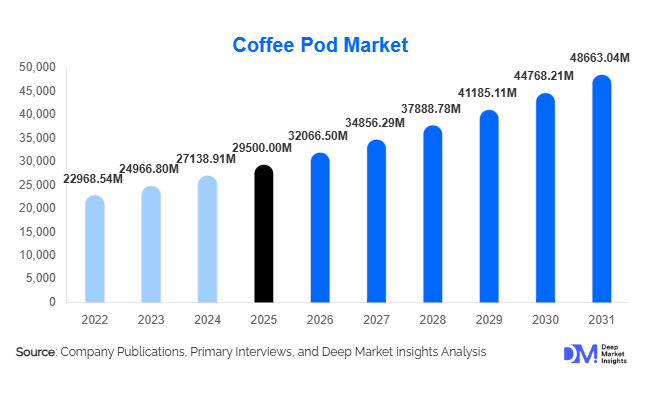
According to Deep Market Insights, the global coffee pod market size was valued at USD 29,500 million in 2025 and is projected to grow from USD 32,066.50 million in 2026 to reach USD 48,663.04 million by 2031, expanding at a CAGR of 8.7% during the forecast period (2026–2031). The coffee pod market growth is primarily driven by the increasing demand for convenience-oriented coffee consumption, rapid adoption of single-serve brewing systems, and the growing preference for premium and specialty coffee experiences across both residential and commercial segments.
Key Market Insights
- Single-serve coffee consumption continues to expand globally, driven by urban lifestyles and time-saving preferences.
- Premium and specialty coffee pods are gaining traction, supported by rising consumer willingness to pay for quality and origin-specific blends.
- North America dominates the global market, supported by high coffee machine penetration and established brand ecosystems.
- Asia-Pacific is the fastest-growing region, fueled by urbanization and the shift toward Western-style coffee consumption.
- Sustainable and biodegradable pods are emerging as a key trend, influenced by regulatory pressure and environmental awareness.
- Subscription-based and direct-to-consumer models are transforming distribution, ensuring recurring revenue streams for manufacturers.
What are the latest trends in the coffee pod market?
Sustainability-Driven Product Innovation
The coffee pod market is undergoing a significant transformation toward environmentally friendly solutions. Traditional plastic and aluminum pods have faced criticism due to their environmental impact, prompting manufacturers to invest in compostable and biodegradable alternatives. Companies are increasingly adopting plant-based materials and recyclable designs to align with regulatory requirements, particularly in Europe and North America. This shift is also influencing consumer purchasing decisions, as eco-conscious buyers prefer brands that demonstrate sustainability commitments. Circular economy initiatives, including pod recycling programs and reusable capsule systems, are gaining traction, reinforcing sustainability as a central trend shaping the market’s future.
Growth of Premium and Specialty Coffee Pods
Consumers are increasingly seeking high-quality coffee experiences at home, driving demand for premium and specialty coffee pods. Single-origin, organic, and ethically sourced coffee varieties are becoming more widely available in pod formats, allowing consumers to replicate café-style beverages. This trend is particularly strong among millennials and urban professionals who prioritize quality and authenticity. Coffee brands are responding by expanding their product portfolios with limited-edition blends, artisanal roasting techniques, and collaborations with specialty coffee producers. The premiumization trend is also contributing to higher profit margins and differentiation in an increasingly competitive market.
What are the key drivers in the coffee pod market?
Rising Demand for Convenience and Time Efficiency
The growing need for quick and hassle-free coffee preparation is a major driver of the coffee pod market. Single-serve pods eliminate the complexities associated with traditional brewing methods, offering consistent taste and minimal cleanup. This convenience is particularly appealing in urban households and workplaces where time constraints are significant. The increasing adoption of coffee machines in residential settings further amplifies this trend, making coffee pods an integral part of daily consumption habits.
Expansion of Coffee Machine Ecosystem
The widespread availability of affordable coffee machines has played a crucial role in driving coffee pod consumption. Manufacturers are adopting strategies such as bundling machines with starter pod kits and offering subscription-based replenishment services. This ecosystem approach ensures customer retention and repeat purchases. Emerging markets are witnessing rapid growth in machine penetration, which is expected to significantly boost pod demand over the forecast period.
What are the restraints for the global market?
Environmental Concerns and Waste Management Issues
The environmental impact of single-use coffee pods remains a major challenge for the industry. Non-biodegradable materials contribute to landfill waste, leading to increased regulatory scrutiny and negative consumer perception. Although sustainable alternatives are gaining popularity, their higher production costs and limited compatibility pose challenges for widespread adoption.
Higher Cost Compared to Traditional Coffee Formats
Coffee pods are generally more expensive on a per-serving basis compared to ground or instant coffee. This cost factor can limit adoption in price-sensitive markets, particularly in developing regions. Despite the convenience and quality benefits, affordability remains a key barrier that manufacturers must address to expand their consumer base.
What are the key opportunities in the coffee pod market?
Expansion in Emerging Markets
Emerging economies such as China, India, and Brazil present significant growth opportunities for coffee pod manufacturers. Rising disposable incomes, urbanization, and the growing influence of Western coffee culture are driving demand for premium coffee experiences. Companies can capitalize on this trend by offering affordable machines and localized flavor profiles tailored to regional preferences.
Smart Coffee Machines and Personalization
The integration of smart technologies into coffee machines is creating new growth avenues for the coffee pod market. Connected devices allow users to customize brewing parameters, track consumption, and reorder pods automatically. Subscription-based models and data-driven personalization are enhancing customer engagement and loyalty, providing a competitive edge to technologically advanced players.
Report Scope
| Report Metric | Details |
|---|---|
| Market Size in 2025 | USD 29500 Million |
| Market Size in 2026 | USD 32066.50 Million |
| Market Size in 2031 | USD 48663.04 Million |
| CAGR | 8.7% (2026-2031) |
| Base Year for Estimation | 2025 |
| Historical Data | 2022-2024 |
| Forecast Period | 2026-2031 |
| Report Coverage | Revenue Forecast, Competitive Landscape, Supply Chain Disruption, Growth Factors, Environment & Regulatory Landscape and Trends |
| Geographies Covered | North America, Europe, APAC, Middle East and Africa, LATAM |
| Countries Covered | U.S., Canada, U.K., Germany, France, Spain, Italy, Russia, Nordic, Benelux, Rest of Europe, China, Korea, Japan, India, Australia, Singapore, Taiwan, South East Asia, Rest of Asia-Pacific, UAE, Turky, Saudi Arabia, South Africa, Egypt, Nigeria, Rest of MEA, Brazil, Mexico, Argentina, Chile, Colombia, Rest of LATAM |
Explore more data points, trends and opportunities Download Free Sample Report
Product Type Insights
Capsule-based systems dominate the coffee pod market, accounting for approximately 52% of the global share in 2025. This leadership is primarily driven by their closed-loop ecosystem, where proprietary machine compatibility ensures strong customer retention and repeat purchases. Leading brands have built highly integrated platforms combining machines, capsules, and subscription services, creating a lock-in effect that sustains long-term revenue streams. Additionally, consistent brewing quality, precise portion control, and wide availability of flavor variants further strengthen consumer preference for capsule systems globally.
Single-serve pods represent a significant secondary segment, particularly in price-sensitive and mass-market applications. Their relatively lower cost and compatibility with a broader range of machines make them attractive in emerging markets. Meanwhile, refillable and reusable pods are gaining traction as a sustainability-driven alternative. Although still niche in market share, this segment is growing rapidly due to increasing environmental awareness and the rising cost sensitivity among consumers seeking long-term savings. The shift toward eco-friendly consumption is expected to gradually rebalance the product mix over the forecast period.
Application Insights
Regular coffee remains the dominant application segment, contributing nearly 46% of the total market share in 2025. Its leadership is attributed to its universal appeal, affordability, and widespread consumption across both residential and commercial settings. Regular coffee pods cater to daily consumption needs, making them the backbone of volume demand in the market.
However, specialty coffee pods are the fastest-growing segment, driven by premiumization trends and increasing consumer preference for high-quality, artisanal coffee experiences. Demand for single-origin, organic, and ethically sourced coffee is rising, particularly in urban and developed markets. Flavored coffee pods are also expanding, especially among younger demographics who seek variety and customization in their beverage choices. Meanwhile, decaffeinated coffee pods are steadily growing, supported by health-conscious consumers and increasing awareness of caffeine-related concerns. The diversification of applications is enabling manufacturers to target multiple consumer segments simultaneously, enhancing overall market growth.
Distribution Channel Insights
Offline retail channels, including supermarkets, hypermarkets, and specialty stores, continue to dominate the coffee pod market, accounting for approximately 55% of total sales in 2025. The leading position of offline channels is driven by immediate product availability, strong brand visibility, and the ability for consumers to physically evaluate products before purchase. In-store promotions and bundled offerings with coffee machines further support sales through this channel.
However, online distribution channels are witnessing the fastest growth, fueled by the rapid expansion of e-commerce platforms and direct-to-consumer (D2C) strategies. Subscription-based services are emerging as a key growth driver, enabling automated replenishment and enhancing customer convenience. Digital platforms also allow companies to leverage data analytics for personalized recommendations, improving customer engagement and retention. The growing penetration of smartphones and digital payment systems, particularly in emerging markets, is expected to accelerate the shift toward online channels in the coming years.
End-Use Insights
The residential segment dominates the coffee pod market, contributing around 68% of total demand in 2025. This dominance is primarily driven by the increasing adoption of home coffee machines and the growing trend of at-home coffee consumption. Consumers are increasingly seeking café-style experiences within their homes, supported by rising disposable incomes and changing lifestyle patterns. The convenience, consistency, and variety offered by coffee pods make them highly suitable for household use.
The commercial segment, including offices, hotels, restaurants, and institutional settings, is the fastest-growing segment. Growth in this segment is driven by the need for operational efficiency, consistent beverage quality, and reduced preparation time. The hospitality industry, in particular, is increasingly adopting coffee pods to enhance customer experience while minimizing labor and training requirements. Additionally, the rise of hybrid work models is encouraging offices to upgrade workplace amenities, further boosting demand for premium coffee solutions.
Explore more data points, trends and opportunities Download Free Sample Report
Coffee Pod Market Segmentations
By Product Type
- Capsule-Based Systems
- Single-Serve Coffee Pods
- Refillable/Reusable Pods
By Application
- Regular Coffee
- Specialty Coffee
- Flavored Coffee
- Decaffeinated Coffee
By Distribution Channel
- Online Retail
- Supermarkets/Hypermarkets
- Convenience Stores
- Specialty Stores
By End-Use
- Residential
- Commercial
Regional Insights
North America
North America holds the largest share of the coffee pod market, accounting for approximately 34% in 2025, with the United States leading regional demand. The region’s dominance is driven by high per capita coffee consumption, widespread penetration of single-serve coffee machines, and strong brand loyalty toward established players. The presence of advanced retail infrastructure and well-developed e-commerce ecosystems further supports market growth. Additionally, increasing demand for premium and specialty coffee, along with the growing adoption of subscription-based models, is reinforcing North America’s leadership position. Canada also contributes significantly, supported by similar consumption patterns and a strong preference for convenient brewing solutions.
Europe
Europe represents around 31% of the global market, with key countries including Germany, France, Italy, and the UK driving demand. The region’s growth is strongly influenced by its deep-rooted coffee culture and high acceptance of premium coffee products. Sustainability is a major driver in Europe, with stringent regulations promoting recyclable and biodegradable packaging. Consumers in this region are highly environmentally conscious, leading to increased demand for eco-friendly coffee pods. Additionally, the presence of leading coffee brands and strong distribution networks further supports market expansion across the region.
Asia-Pacific
Asia-Pacific is the fastest-growing region, with a CAGR exceeding 10%. Countries such as China, Japan, South Korea, and India are experiencing rapid growth due to urbanization, rising disposable incomes, and changing consumer lifestyles. The increasing influence of Western coffee culture, particularly among younger populations, is driving demand for coffee pods. The expansion of café chains and the growing availability of affordable coffee machines are further accelerating adoption. In addition, the rapid growth of e-commerce platforms and digital payment systems is enabling easier access to coffee pod products, making the region a key growth engine for the global market.
Latin America
Latin America is experiencing steady growth, led by Brazil and Mexico. The region benefits from a strong coffee production base, which supports both domestic consumption and export opportunities. Increasing urbanization and rising middle-class incomes are driving demand for convenient coffee solutions such as pods. Additionally, the growing popularity of premium coffee products and the expansion of modern retail channels are contributing to market growth. Latin America is also emerging as a key exporter of coffee pods, leveraging its established coffee supply chain to cater to international demand.
Middle East & Africa
The Middle East & Africa region is witnessing growing demand, particularly in countries such as the UAE and Saudi Arabia. The expansion of the hospitality and tourism sectors is a major driver, as hotels and restaurants increasingly adopt coffee pods to enhance service quality. High disposable incomes and a strong preference for premium products in the Middle East are further supporting market growth. In Africa, the presence of major coffee-producing countries provides a strong supply base, while increasing urbanization and rising consumer awareness are gradually boosting domestic consumption. Government initiatives to promote tourism and hospitality infrastructure are also contributing to the region’s growth trajectory.
Key Players in the Coffee Pod Market
- Nestlé
- JDE Peet’s
- Keurig Dr Pepper
- Starbucks Corporation
- Lavazza Group
- Tchibo
- Illycaffè
- Jacobs Douwe Egberts
- Kraft Heinz
- Dualit
- Dunkin’ Brands
- Gloria Jean’s Coffees
- Tim Hortons
- Luigi Lavazza S.p.A.
- Peet’s Coffee