Coffee Machine Market Size
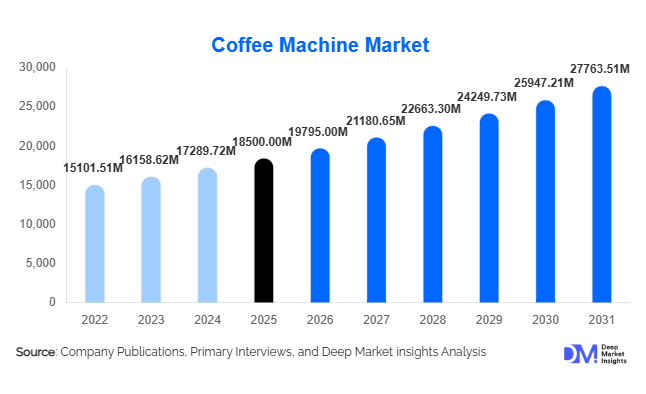
According to Deep Market Insights, the global coffee machine market size was valued at USD 18,500 million in 2025 and is projected to grow from USD 19,795.00 million in 2026 to reach USD 27,763.51 million by 2031, expanding at a CAGR of 7.0% during the forecast period (2026–2031). The market growth is primarily driven by increasing global coffee consumption, rising demand for premium and specialty coffee experiences, and rapid technological advancements in automated and smart coffee machines. The growing popularity of café culture, the expansion of commercial establishments, and the rising adoption of at-home coffee solutions are further supporting market expansion across both developed and emerging economies.
Key Market Insights
- Espresso and bean-to-cup machines are driving premiumization, as consumers increasingly seek café-quality coffee at home and in workplaces.
- Smart and connected coffee machines are gaining traction, offering app-based control, personalization, and maintenance tracking.
- North America dominates the market, supported by high coffee consumption and widespread adoption of single-serve machines.
- Asia-Pacific is the fastest-growing region, driven by rising disposable income and expanding café culture in countries like China and India.
- Commercial demand remains strong, fueled by the rapid expansion of cafés, restaurants, and office coffee solutions.
- Sustainability is becoming a key differentiator, with increasing demand for recyclable pods and energy-efficient machines.
What are the latest trends in the coffee machine market?
Smart and Connected Coffee Machines
The integration of IoT and smart technologies is transforming the coffee machine market. Modern machines now offer features such as mobile app control, programmable brewing schedules, and AI-based customization of coffee strength and temperature. These innovations enhance user convenience and create a personalized coffee experience. Smart machines are particularly popular in urban households and premium office environments, where automation and efficiency are highly valued. Additionally, connectivity enables predictive maintenance and remote diagnostics, reducing downtime and improving product lifecycle management. This trend is expected to significantly drive demand in the premium segment.
Shift Toward Sustainable and Eco-Friendly Solutions
Sustainability is emerging as a critical trend in the coffee machine market. Consumers are increasingly concerned about environmental impact, particularly related to single-use coffee pods and energy consumption. Manufacturers are responding by introducing biodegradable capsules, recyclable materials, and energy-efficient machines. Regulatory pressure in regions such as Europe is also encouraging the adoption of eco-friendly solutions. Companies are investing in sustainable product design and circular economy initiatives, including recycling programs and reduced packaging waste. This shift is not only enhancing brand value but also influencing purchasing decisions among environmentally conscious consumers.
What are the key drivers in the coffee machine market?
Rising Global Coffee Consumption
The increasing popularity of coffee as a daily beverage is a major driver of market growth. Younger demographics, particularly millennials and Gen Z, are fueling demand for specialty coffee and premium brewing experiences. The expansion of global coffee chains and independent cafés has further reinforced coffee culture, leading to higher demand for both commercial and residential coffee machines.
Technological Advancements and Automation
Advancements in automation and digital technologies are significantly influencing the market. Fully automatic and super-automatic machines are gaining popularity due to their ease of use and consistent output. Features such as touchscreens, voice control, and programmable settings are enhancing user experience and driving adoption in both residential and commercial segments.
Expansion of Commercial Establishments
The rapid growth of cafés, restaurants, hotels, and co-working spaces is boosting demand for commercial coffee machines. The global hospitality sector continues to expand, with coffee becoming an essential offering in customer experience strategies. Office coffee solutions are also gaining importance as companies focus on employee satisfaction and workplace amenities.
What are the restraints for the global market?
High Initial Cost of Advanced Machines
Premium coffee machines, particularly those with advanced features and automation, are relatively expensive. This limits adoption in price-sensitive markets and among budget-conscious consumers. High upfront costs can act as a barrier, especially in developing economies.
Maintenance and Operational Complexity
Coffee machines require regular maintenance, including cleaning, descaling, and servicing. Advanced machines may also require technical expertise for operation and troubleshooting. These factors can increase operational costs and deter potential buyers, particularly in small businesses and households.
What are the key opportunities in the coffee machine industry?
Growth in Emerging Markets
Emerging economies such as India, China, and Brazil present significant growth opportunities due to rising disposable incomes and changing consumer lifestyles. The expansion of café culture and increasing awareness of premium coffee experiences are driving demand for both commercial and residential machines. Companies can leverage localized manufacturing and competitive pricing strategies to capture these markets.
Integration of Smart Technologies and Subscription Models
The adoption of smart technologies and subscription-based business models is creating new revenue streams. Manufacturers can offer bundled services, including coffee supplies and maintenance, along with machines. This approach enhances customer retention and provides recurring revenue opportunities.
Focus on Sustainability and Green Innovation
Environmental concerns are opening new avenues for innovation. Companies that develop eco-friendly products, such as biodegradable pods and energy-efficient machines, can gain a competitive advantage. Sustainability-focused branding is also helping companies attract environmentally conscious consumers and comply with regulatory requirements.
Report Scope
| Report Metric | Details |
|---|---|
| Market Size in 2025 | USD 18500 Million |
| Market Size in 2026 | USD 19795.00 Million |
| Market Size in 2031 | USD 27763.51 Million |
| CAGR | 7% (2026-2031) |
| Base Year for Estimation | 2025 |
| Historical Data | 2022-2024 |
| Forecast Period | 2026-2031 |
| Report Coverage | Revenue Forecast, Competitive Landscape, Supply Chain Disruption, Growth Factors, Environment & Regulatory Landscape and Trends |
| Geographies Covered | North America, Europe, APAC, Middle East and Africa, LATAM |
| Countries Covered | U.S., Canada, U.K., Germany, France, Spain, Italy, Russia, Nordic, Benelux, Rest of Europe, China, Korea, Japan, India, Australia, Singapore, Taiwan, South East Asia, Rest of Asia-Pacific, UAE, Turky, Saudi Arabia, South Africa, Egypt, Nigeria, Rest of MEA, Brazil, Mexico, Argentina, Chile, Colombia, Rest of LATAM |
Explore more data points, trends and opportunities Download Free Sample Report
Product Type Insights
Espresso machines dominate the coffee machine market, accounting for approximately 32% of the global market share in 2025, and continue to lead due to their strong alignment with evolving consumer preferences for premium, café-style beverages. The primary driver behind this dominance is the global shift toward specialty coffee consumption, where consumers increasingly value customization, taste precision, and barista-quality output at home and in commercial settings. The rapid expansion of global café chains and independent specialty coffee shops has also reinforced the demand for espresso-based beverages such as cappuccinos and lattes, further strengthening this segment’s leadership. Additionally, technological improvements in semi-automatic and super-automatic espresso machines have made them more accessible to residential users, expanding their addressable market.
Single-serve and capsule machines are gaining significant traction, particularly in North America and Europe, driven by convenience, speed, and minimal cleanup requirements. Their growth is further supported by subscription-based coffee pod ecosystems and brand partnerships. Meanwhile, bean-to-cup machines are emerging as one of the fastest-growing sub-segments, especially in offices and premium households, as they offer a balance between automation and freshly ground coffee quality. This segment is benefiting from increasing consumer willingness to invest in high-end appliances that replicate café experiences at home.
Technology Insights
Fully automatic coffee machines hold the largest share, contributing nearly 35% of the market in 2025, primarily due to their ability to deliver consistent, high-quality coffee with minimal user effort. The key driver for this segment is the growing demand for convenience and time efficiency, particularly among urban consumers and commercial establishments. Fully automatic machines integrate grinding, brewing, and milk frothing into a single system, making them highly attractive for both households and workplaces.
The increasing penetration of smart and connected coffee machines is further accelerating growth within this segment. IoT-enabled machines allow users to control brewing parameters remotely, personalize coffee profiles, and receive maintenance alerts, enhancing user experience and operational efficiency. This trend is particularly prominent in premium segments, where consumers are willing to pay a premium for advanced features. Additionally, commercial operators are adopting automated systems to reduce labor dependency and improve service consistency, further reinforcing the dominance of fully automatic technology.
End-Use Insights
The commercial segment leads the market with around 58% share in 2025, driven by the rapid expansion of cafés, restaurants, hotels, and corporate offices. The primary growth driver for this segment is the global proliferation of coffee chains and specialty cafés, which continue to expand aggressively across both developed and emerging markets. The hospitality industry’s focus on enhancing customer experience through premium beverage offerings has also contributed to increased adoption of high-capacity and advanced coffee machines.
Office coffee solutions represent another key driver, as organizations increasingly invest in workplace amenities to improve employee satisfaction and productivity. Meanwhile, the residential segment is growing steadily, supported by the rising trend of home brewing and the “home barista” movement. Consumers are increasingly investing in premium machines to replicate café-quality coffee at home, particularly following behavioral shifts observed during and after the pandemic. The global café industry, growing at over 6–7% annually, continues to be a major contributor to sustained commercial demand.
Distribution Channel Insights
Offline retail channels dominate the market, accounting for approximately 65% of total sales, primarily due to the high-value nature of coffee machines and the need for physical evaluation before purchase. Consumers prefer in-store experiences where they can assess product features, build quality, and performance through demonstrations. Specialty appliance stores and electronics retailers play a crucial role in influencing purchasing decisions, particularly in the premium segment.
However, online channels are witnessing rapid growth, driven by increasing digital adoption, competitive pricing, and the availability of a wide range of products. E-commerce platforms are leveraging customer reviews, product comparisons, and promotional discounts to attract buyers. The growth of direct-to-consumer (D2C) channels is also enabling manufacturers to strengthen brand engagement and offer customized solutions. Subscription-based models for coffee pods and maintenance services are further enhancing the role of online platforms in the distribution ecosystem.
Explore more data points, trends and opportunities Download Free Sample Report
Coffee Machine Market Segmentations
By Product Type
- Drip Coffee Machines
- Espresso Machines
- Single-Serve / Pod Coffee Machines
- Capsule Coffee Machines
- Bean-to-Cup Machines
- French Press & Manual Coffee Makers
- Percolators
- Cold Brew Coffee Makers
- Specialty Coffee Machines
By Technology
- Manual Machines
- Semi-Automatic Machines
- Fully Automatic Machines
- Smart / Connected Coffee Machines
By End-Use
- Residential
- Commercial
By Distribution Channel
- Online Retail
- Specialty Stores
- Supermarkets/Hypermarkets
- Electronics Retail Stores
Regional Insights
North America
North America holds around 30% of the global market share in 2025, with the United States being the dominant contributor. The region’s leadership is primarily driven by exceptionally high per capita coffee consumption and a deeply ingrained coffee culture. The widespread adoption of single-serve and capsule machines, particularly in households and offices, is a key growth driver. Additionally, the strong presence of global coffee chains and quick-service restaurants has significantly boosted commercial demand. Technological adoption is also high, with consumers showing a strong preference for smart and premium coffee machines. Canada complements regional growth with increasing demand for energy-efficient and high-end appliances, supported by rising disposable incomes and urbanization.
Europe
Europe accounts for approximately 28% of the market, led by Germany, Italy, France, and the UK. The region’s growth is driven by its long-standing coffee culture and strong preference for high-quality espresso-based beverages. Italy plays a critical role as a manufacturing hub for espresso machines, driving both domestic consumption and exports. Germany and the UK are key demand centers, supported by high disposable incomes and increasing adoption of premium and fully automatic machines. Sustainability is also a major driver in Europe, with consumers favoring eco-friendly products and recyclable coffee pods. Regulatory frameworks promoting energy efficiency and environmental responsibility further support market growth.
Asia-Pacific
Asia-Pacific is the fastest-growing region, with a CAGR exceeding 9%, driven by rapid urbanization, rising middle-class income, and changing consumer lifestyles. China and India are the primary growth engines, where expanding café culture and westernization of consumption patterns are fueling demand for coffee machines. The increasing number of international and domestic café chains is significantly boosting commercial demand. Japan and South Korea contribute through strong demand for technologically advanced and compact machines, reflecting consumer preference for innovation and convenience. Additionally, increasing awareness of specialty coffee and growing e-commerce penetration are accelerating market expansion across the region.
Latin America
Latin America is experiencing steady growth, led by Brazil and Mexico. The region benefits from its strong position as a global coffee producer, which supports both domestic consumption and export-driven demand. Brazil, being one of the largest coffee producers globally, has a well-established coffee culture that is driving demand for both residential and commercial machines. Increasing urbanization and rising disposable incomes are further supporting the adoption of advanced coffee machines. In Mexico, the growth of café chains and quick-service restaurants is acting as a key driver. Additionally, growing awareness of specialty coffee is encouraging consumers to invest in higher-quality brewing equipment.
Middle East & Africa
The Middle East and Africa region is emerging as a promising market, driven by increasing investments in hospitality and tourism infrastructure. Countries such as the UAE and Saudi Arabia are witnessing strong demand due to the expansion of luxury hotels, cafés, and premium dining establishments. High disposable incomes and a preference for premium lifestyle products are key growth drivers in the Middle East. In Africa, the market is supported by its status as a major coffee-producing region, with countries such as Ethiopia and Kenya contributing to both production and consumption. Tourism-driven demand, particularly in hospitality and resorts, is also boosting the adoption of commercial coffee machines. Additionally, improving urban infrastructure and rising middle-class populations are expected to further accelerate growth in this region.
Key Players in the Coffee Machine Market
- De’Longhi Group
- Nestlé (Nespresso)
- Keurig Dr Pepper
- Philips
- Jura Elektroapparate
- Breville Group
- Electrolux
- Panasonic
- Melitta Group
- Illycaffè
- Krups
- Hamilton Beach Brands
- Morphy Richards
- La Marzocco
- Rancilio Group