Coffee Cart Market Size
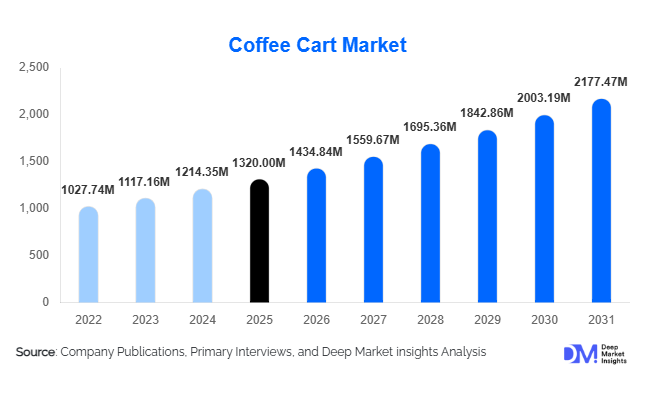
According to Deep Market Insights, the global coffee cart market size was valued at USD 1,320 million in 2025 and is projected to grow from USD 1,434.84 million in 2026 to reach USD 2,177.47 million by 2031, expanding at a CAGR of 8.7% during the forecast period (2026–2031). The coffee cart market growth is primarily driven by rising demand for on-the-go specialty beverages, increasing urban entrepreneurship, and the growing popularity of flexible, low-capex foodservice models. The expansion of mobile coffee formats across high-footfall urban areas, corporate campuses, and events is further accelerating adoption globally.
Key Market Insights
- Coffee carts are increasingly becoming a preferred entry point for micro-entrepreneurs, driven by low startup costs and flexible operations.
- Specialty coffee consumption is driving premiumization, with increasing demand for artisanal brews and high-quality beans.
- North America dominates the global market, supported by a strong coffee culture and high consumer spending.
- Asia-Pacific is the fastest-growing region, fueled by urbanization and rising middle-class demand in countries like India and China.
- Sustainability trends are reshaping product offerings, including solar-powered carts and biodegradable packaging.
- Digital payments and mobile ordering technologies are enhancing operational efficiency and customer experience.
What are the latest trends in the coffee cart market?
Rise of Specialty and Third-Wave Coffee Culture
The global shift toward specialty coffee is significantly influencing the coffee cart market. Consumers are increasingly seeking premium, ethically sourced, and artisanal coffee experiences, which coffee carts are well-positioned to deliver. Single-origin beans, cold brews, and nitro coffee offerings are becoming standard across urban markets. This trend is particularly strong among younger demographics who value quality, transparency, and unique flavor profiles. Coffee cart operators are leveraging this trend by offering curated menus and engaging storytelling around coffee sourcing, roasting techniques, and brewing methods.
Mobile and Pop-Up Retail Expansion
Pop-up coffee carts are gaining traction as flexible retail solutions in high-traffic areas such as business districts, tourist locations, and events. Brands are increasingly using coffee carts as marketing tools to test new markets, launch products, and engage directly with customers. This model reduces risk compared to permanent retail spaces while allowing operators to adapt quickly to demand fluctuations. Seasonal and event-based deployments are becoming common, especially in festivals, exhibitions, and corporate gatherings.
What are the key drivers in the coffee cart market?
Low Capital Investment and High ROI Potential
Coffee carts require significantly lower investment compared to traditional cafés, making them highly attractive to entrepreneurs and small business owners. With setup costs ranging from USD 3,000 to USD 10,000 for mid-range carts, operators can achieve faster breakeven and higher return on investment. This affordability is driving widespread adoption, particularly in emerging economies where access to capital may be limited.
Urbanization and On-the-Go Consumption
Rapid urbanization and busy lifestyles are increasing the demand for convenient, quick-service beverage options. Coffee carts positioned in transit hubs, office districts, and educational institutions benefit from consistent foot traffic. The growing workforce population and time-constrained consumers are key contributors to this demand, making coffee carts an essential part of urban food ecosystems.
What are the restraints for the global market?
Regulatory and Licensing Challenges
Strict regulations governing street vending, food safety, and zoning can pose significant challenges for coffee cart operators. Obtaining permits and complying with local laws can be time-consuming and costly, particularly in developed markets with stringent standards. These barriers can limit market entry and expansion.
Weather Dependency and Operational Limitations
Coffee carts are highly dependent on outdoor conditions, making them vulnerable to seasonal fluctuations and adverse weather. Rain, extreme temperatures, and low foot traffic during off-peak seasons can impact revenue stability. Unlike fixed cafés, carts lack the infrastructure to operate consistently under all conditions.
What are the key opportunities in the coffee cart industry?
Expansion into Corporate and Event Catering
Coffee carts are increasingly being deployed in corporate offices, trade shows, and private events, offering customized beverage services. This segment provides high-margin opportunities through premium pricing and recurring contracts. Corporate partnerships for daily or weekly services are emerging as stable revenue streams, particularly in developed markets.
Adoption of Sustainable and Eco-Friendly Solutions
Growing environmental awareness is creating opportunities for operators to differentiate through sustainability. Solar-powered carts, reusable cups, and biodegradable packaging are gaining traction, especially in Europe and North America. Businesses adopting green practices can attract environmentally conscious consumers and command premium pricing.
Report Scope
| Report Metric | Details |
|---|---|
| Market Size in 2025 | USD 1320 Million |
| Market Size in 2026 | USD 1434.84 Million |
| Market Size in 2031 | USD 2177.47 Million |
| CAGR | 8.7% (2026-2031) |
| Base Year for Estimation | 2025 |
| Historical Data | 2022-2024 |
| Forecast Period | 2026-2031 |
| Report Coverage | Revenue Forecast, Competitive Landscape, Supply Chain Disruption, Growth Factors, Environment & Regulatory Landscape and Trends |
| Geographies Covered | North America, Europe, APAC, Middle East and Africa, LATAM |
| Countries Covered | U.S., Canada, U.K., Germany, France, Spain, Italy, Russia, Nordic, Benelux, Rest of Europe, China, Korea, Japan, India, Australia, Singapore, Taiwan, South East Asia, Rest of Asia-Pacific, UAE, Turky, Saudi Arabia, South Africa, Egypt, Nigeria, Rest of MEA, Brazil, Mexico, Argentina, Chile, Colombia, Rest of LATAM |
Explore more data points, trends and opportunities Download Free Sample Report
Product Type Insights
Mobile push carts continue to dominate the coffee cart market, accounting for approximately 38% of the total market share in 2025. The primary driver behind this leadership is their low capital investment requirement combined with high operational flexibility, making them the most accessible option for first-time entrepreneurs and small-scale operators. These carts are easy to relocate, allowing vendors to optimize sales by targeting high-footfall areas such as office districts, transit hubs, and tourist locations. Additionally, minimal infrastructure dependency reduces regulatory and operational complexity, further supporting widespread adoption across both developed and emerging markets.
Bike-mounted coffee carts are witnessing steady growth, particularly in environmentally conscious urban centers across Europe and North America. Their appeal lies in zero-emission mobility and the ability to navigate congested urban areas, aligning with sustainability regulations and green mobility initiatives. Meanwhile, trailer-based coffee carts are gaining traction in premium and high-volume settings, such as festivals and large public events, where higher output capacity and advanced equipment integration are required. Modular and pop-up coffee carts are also expanding rapidly, driven by their scalability and adaptability for short-term deployments, especially in event-based and seasonal applications. This diversification in product types reflects a market increasingly driven by flexibility, sustainability, and targeted consumer engagement strategies.
Application Insights
Urban streets and business districts remain the leading application segment, contributing approximately 44% of the global market share in 2025. The key growth driver for this segment is the consistent demand generated by working professionals and commuters seeking convenient, high-quality beverages. High population density and predictable foot traffic patterns make these locations highly profitable for operators, enabling steady daily revenue streams and rapid customer turnover.
Events and exhibitions are emerging as one of the fastest-growing application areas, fueled by the rising demand for customized and experiential food and beverage services. Coffee carts are increasingly being integrated into weddings, corporate events, trade shows, and festivals, where operators can command premium pricing through tailored menus and branding opportunities. Corporate campuses are also gaining importance as a key application segment, driven by organizations investing in employee experience and workplace amenities. The presence of on-site coffee carts enhances employee satisfaction and productivity, creating recurring demand. Additionally, tourist locations and educational institutions contribute significantly to market growth due to high daily footfall and impulse consumption behavior, further diversifying revenue streams for operators.
Distribution Channel Insights
The coffee cart market is predominantly driven by direct-to-consumer (D2C) sales, as transactions occur at the point of service, accounting for the majority of revenue generation. This dominance is supported by the immediacy and convenience of on-site purchasing, which aligns with the core value proposition of coffee carts—quick service and accessibility. However, the distribution landscape is evolving with the integration of digital technologies.
Mobile ordering systems, QR-based payments, and app-driven loyalty programs are transforming how operators engage with customers. These technologies enable faster transaction processing, reduced wait times, and improved customer retention. Social media platforms such as Instagram and location-based apps are becoming critical tools for customer acquisition, allowing operators to communicate real-time locations, promotions, and menu updates. Additionally, partnerships with food delivery and aggregator platforms are emerging in select urban markets, further expanding reach. The growing role of digital ecosystems is enhancing operational efficiency while enabling coffee cart businesses to compete more effectively with traditional cafés.
End-Use Insights
Independent entrepreneurs dominate the coffee cart market, accounting for over 50% of the total market share in 2025. The leading driver for this segment is the low barrier to entry, combined with high flexibility in operations, allowing individuals to start and scale businesses with minimal investment. This segment benefits significantly from the global rise in gig economy participation and micro-entrepreneurship, particularly in emerging markets where self-employment opportunities are expanding.
Corporate catering services represent the fastest-growing end-use segment, driven by increasing demand for premium workplace amenities and event-based services. Companies are increasingly outsourcing beverage services to coffee cart operators to enhance employee engagement and brand image. Educational institutions also contribute significantly to demand, supported by high student population density and consistent daily consumption patterns. Tourist locations are another important segment, benefiting from seasonal demand spikes and high visitor footfall. Collectively, these end-use segments highlight the versatility of coffee carts in serving diverse customer bases while maintaining strong growth momentum.
Explore more data points, trends and opportunities Download Free Sample Report
Coffee Cart Market Segmentations
By Product Type
- Mobile Push Carts
- Bike-mounted Coffee Carts
- Trailer/Truck-based Coffee Carts
- Modular/Pop-up Coffee Stations
By Application
- Urban Streets & Business Districts
- Events & Exhibitions
- Corporate Campuses
- Tourist Locations
- Educational Institutions
By Distribution Channel
- Direct-to-Consumer (On-site Sales)
- Online & Mobile Ordering Platforms
- Social Media & Digital Channels
- Event & Corporate Contracts
By End-Use
- Independent Entrepreneurs
- Franchise Operators
- Corporate Catering Services
- Event Service Providers
Regional Insights
North America
North America holds approximately 32% of the global coffee cart market share in 2025, making it the largest regional market. The primary growth drivers include a well-established coffee culture, high disposable income levels, and strong consumer preference for specialty beverages. The widespread adoption of mobile food service models, supported by favorable urban infrastructure and regulatory frameworks in many cities, further accelerates market expansion. Major urban centers such as New York, Los Angeles, and Toronto exhibit high penetration of premium coffee carts, driven by dense populations and significant commuter traffic. Additionally, the region’s rapid adoption of digital payment systems and mobile ordering technologies enhances operational efficiency and customer convenience, reinforcing market growth.
Europe
Europe accounts for approximately 28% of the global market, with key contributions from countries such as Italy, the United Kingdom, Germany, and France. The region’s growth is primarily driven by a strong cultural affinity for high-quality coffee and an increasing emphasis on sustainability. European consumers are highly receptive to specialty coffee and eco-friendly solutions, encouraging operators to adopt biodegradable materials and energy-efficient cart designs. Government regulations promoting low-emission urban mobility are also supporting the adoption of bike-mounted and electric coffee carts. Furthermore, the popularity of outdoor cafés and street vending culture in cities like Paris and Milan provides a favorable environment for coffee cart businesses to thrive.
Asia-Pacific
Asia-Pacific holds around 24% of the global market share and is the fastest-growing region, with a CAGR exceeding 10%. Growth in this region is driven by rapid urbanization, an expanding middle-class population, and increasing westernization of consumer lifestyles. Countries such as China, India, Japan, and Australia are प्रमुख contributors to market expansion. In India and Southeast Asia, government initiatives supporting small businesses and startups are encouraging entrepreneurship in the coffee cart segment. Additionally, rising coffee consumption among younger demographics and the proliferation of business districts and IT hubs are creating strong demand. The relatively low cost of entry and high scalability make coffee carts particularly attractive in this region, further accelerating growth.
Latin America
Latin America contributes approximately 8% of the global market, with Brazil and Mexico as the leading countries. The region’s growth is supported by its strong coffee production base and increasing domestic consumption. Coffee carts are gaining popularity as a means of adding value to locally produced coffee, enabling direct-to-consumer sales. Urbanization and tourism are also key drivers, particularly in cities with high visitor traffic. Additionally, the affordability of coffee cart setups makes them accessible to local entrepreneurs, supporting market expansion across both urban and semi-urban areas.
Middle East & Africa
The Middle East & Africa region holds around 8% of the global market share, with key markets including the UAE, Saudi Arabia, and South Africa. Growth in this region is driven by expanding tourism, an increasing number of luxury events, and rising adoption of premium foodservice concepts. The Middle East, in particular, benefits from high disposable income and a strong preference for specialty beverages, supporting demand for high-end coffee carts. In Africa, urbanization and the growth of informal retail sectors are facilitating the adoption of mobile coffee solutions. Additionally, the region’s role as a major coffee producer supports local sourcing and supply chain efficiency, further contributing to market development.
Key Players in the Coffee Cart Market
- Starbucks Corporation
- Nestlé S.A.
- JDE Peet’s
- Lavazza Group
- Illycaffè S.p.A.
- Costa Coffee
- Tim Hortons
- Blue Bottle Coffee
- Peet’s Coffee
- Dunkin’
- Luckin Coffee
- Caribou Coffee
- Gloria Jean’s Coffees
- The Coffee Bean & Tea Leaf
- Tchibo