Cocktail Shakers Market Size
According to Deep Market Insights, the global cocktail shakers market size was valued at USD 780 million in 2025 and is projected to grow from USD 823.68 million in 2026 to reach USD 1,081.63 million by 2031, expanding at a CAGR of 5.6% during the forecast period (2026–2031). The cocktail shakers market growth is primarily driven by the rising global cocktail culture, increasing popularity of home mixology, and expanding hospitality infrastructure worldwide. Cocktail shakers remain essential tools in beverage preparation, enabling bartenders and consumers to mix ingredients efficiently while enhancing drink flavor and presentation.
The market has evolved from a purely professional bartending tool to a lifestyle product widely used in households, bars, restaurants, and luxury hotels. Growing consumer interest in premium spirits, craft cocktails, and home entertainment has significantly expanded demand for cocktail preparation tools. Additionally, the influence of social media and online cocktail tutorials has encouraged amateur mixologists to experiment with drink recipes, increasing purchases of barware products such as cocktail shakers, strainers, and jiggers.
Manufacturers are increasingly focusing on design innovation and premium materials such as copper, brass, and insulated stainless steel to differentiate their products in a competitive market. Hospitality industry growth, particularly in tourism-driven economies, is also generating significant demand for commercial-grade cocktail shakers. As global nightlife and beverage culture continue to expand, the cocktail shakers market is expected to maintain steady growth through the end of the decade.
Key Market Insights
- Home bartending and DIY mixology culture are expanding globally, driving demand for beginner-friendly cocktail shaker kits and barware sets.
- Stainless steel cocktail shakers dominate the market due to durability, corrosion resistance, and professional-grade performance.
- North America remains the largest regional market, supported by a strong cocktail culture and a large hospitality industry.
- Asia-Pacific is the fastest-growing region, driven by urbanization, expanding nightlife infrastructure, and rising disposable incomes.
- Premium and designer barware products are gaining traction, particularly among consumers creating luxury home bar setups.
- E-commerce platforms are transforming distribution channels, enabling global access to cocktail shaker brands and customized products.
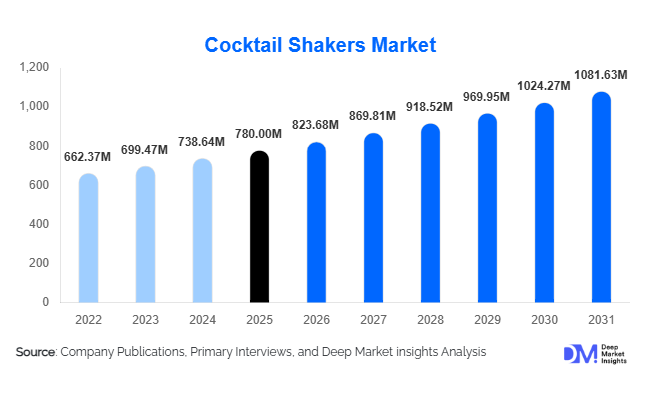
What are the latest trends in the cocktail shakers market?
Premiumization of Barware Products
Premium cocktail shakers are increasingly positioned as lifestyle and luxury accessories rather than basic bar tools. Manufacturers are introducing products made from copper, brass, gold-plated stainless steel, and designer alloys to attract consumers seeking aesthetically appealing barware. These products often feature elegant finishes, ergonomic designs, and luxury packaging, making them suitable for gifting and home bar displays. Premium cocktail shakers are particularly popular among consumers who purchase high-end spirits and wish to replicate professional bar experiences at home. Hospitality establishments are also investing in premium bar tools to enhance visual presentation during cocktail preparation, which contributes to a more engaging customer experience.
Growth of Home Mixology Culture
The global rise in home mixology is one of the most transformative trends shaping the cocktail shakers market. Online cocktail tutorials, recipe-sharing platforms, and social media content have encouraged consumers to experiment with beverage preparation at home. As a result, beginner-friendly cocktail shaker sets that include strainers, jiggers, and mixing spoons are becoming widely popular. Retailers and e-commerce platforms are capitalizing on this trend by offering bundled barware kits and instructional guides. The increasing popularity of home entertaining and themed gatherings has further strengthened demand for cocktail preparation tools among household consumers.
What are the key drivers in the cocktail shakers market?
Rising Global Cocktail Culture
The growing popularity of craft cocktails and premium beverage experiences is a major driver of cocktail shaker demand. Bars and restaurants worldwide are expanding cocktail menus to include artisanal ingredients, innovative flavor combinations, and visually appealing drinks. Professional bartenders rely heavily on cocktail shakers to achieve consistent flavor blending and optimal drink presentation. Urban nightlife expansion and the increasing presence of specialty cocktail bars are further supporting the adoption of professional bar tools across hospitality establishments.
Expansion of the Global Hospitality Industry
The hospitality sector, including bars, restaurants, hotels, and catering services, plays a critical role in driving cocktail shakers market growth. Tourism recovery and large-scale hospitality infrastructure investments are increasing the number of establishments that require professional bartending equipment. Luxury hotels, cruise ships, rooftop bars, and entertainment venues frequently procure cocktail shakers in bulk as part of their bar setup. As global tourism continues to grow, particularly in emerging markets, demand for professional cocktail preparation tools is expected to rise significantly.
What are the restraints for the global market?
Low Product Differentiation
Cocktail shakers are relatively simple products, which makes them easy to manufacture and replicate. This has resulted in a highly competitive market with numerous small manufacturers and private-label brands offering similar products. Limited product differentiation often leads to price competition, particularly within the economy and mid-range segments. Manufacturers must therefore focus on design innovation, premium materials, and brand positioning to maintain a competitive advantage.
Volatility in Raw Material Prices
Fluctuations in the prices of raw materials such as stainless steel, aluminum, and copper can significantly impact production costs for cocktail shaker manufacturers. Since many companies operate in price-sensitive retail markets, passing these cost increases to consumers can be challenging. This volatility may reduce profit margins for manufacturers and create uncertainties in long-term pricing strategies.
What are the key opportunities in the cocktail shakers industry?
Designer and Customizable Barware
The growing consumer preference for personalized products presents strong opportunities for cocktail shaker manufacturers. Custom engraving, branded logos, and limited-edition designs are becoming popular among both individual consumers and hospitality businesses. Personalized barware products are frequently purchased as gifts, corporate promotional items, or wedding accessories. Companies that offer customization services through online platforms can capture higher-value segments and strengthen brand loyalty.
Expansion of Hospitality Infrastructure in Emerging Markets
Emerging economies across Asia-Pacific, the Middle East, and Latin America are witnessing significant investments in tourism and hospitality infrastructure. New hotels, resorts, nightlife venues, and luxury restaurants are expanding rapidly in cities such as Dubai, Bangkok, Shanghai, and Mexico City. These establishments require professional bartending equipment, including cocktail shakers, which creates consistent demand for commercial-grade products. Suppliers that establish strong distribution networks in these regions can benefit from long-term procurement contracts with hospitality operators.
Report Scope
| Report Metric | Details |
|---|---|
| Market Size in 2025 | USD 780 Million |
| Market Size in 2026 | USD 823.68 Million |
| Market Size in 2031 | USD 1081.63 Million |
| CAGR | 5.6% (2026-2031) |
| Base Year for Estimation | 2025 |
| Historical Data | 2022-2024 |
| Forecast Period | 2026-2031 |
| Report Coverage | Revenue Forecast, Competitive Landscape, Supply Chain Disruption, Growth Factors, Environment & Regulatory Landscape and Trends |
| Geographies Covered | North America, Europe, APAC, Middle East and Africa, LATAM |
| Countries Covered | U.S., Canada, U.K., Germany, France, Spain, Italy, Russia, Nordic, Benelux, Rest of Europe, China, Korea, Japan, India, Australia, Singapore, Taiwan, South East Asia, Rest of Asia-Pacific, UAE, Turky, Saudi Arabia, South Africa, Egypt, Nigeria, Rest of MEA, Brazil, Mexico, Argentina, Chile, Colombia, Rest of LATAM |
Explore more data points, trends and opportunities Download Free Sample Report
Product Type Insights
Cobbler cocktail shakers dominate the global market due to their user-friendly three-piece design that includes a built-in strainer and cap. These shakers are widely preferred by beginner bartenders and household users because they eliminate the need for additional bar tools. Boston shakers, consisting of two metal tins or a glass-and-metal combination, are commonly used by professional bartenders due to their larger capacity and efficient mixing performance. Parisian or French shakers represent a premium niche segment characterized by sleek design and high-end materials. Professional-grade tin-on-tin shakers are also gaining traction in commercial establishments due to their durability and speed during high-volume cocktail preparation.
Application Insights
The household consumer segment represents the largest application for cocktail shakers, accounting for nearly 69% of global demand. Increasing interest in home entertaining and DIY cocktail preparation has significantly expanded this segment. Commercial applications within bars, restaurants, and hotels are also growing rapidly as hospitality establishments expand their beverage offerings. Catering companies and event organizers represent another important application area, using cocktail shakers to prepare beverages at weddings, corporate events, and private gatherings. Additionally, mixology schools and bartender training institutes are emerging as niche application segments, purchasing professional-grade equipment for educational purposes.
Distribution Channel Insights
Hypermarkets and supermarkets remain significant distribution channels for cocktail shakers, offering consumers the opportunity to compare product quality and design before purchasing. Specialty kitchenware stores also play a crucial role by offering premium barware collections and curated bartender tool sets. However, online retail platforms are rapidly gaining market share as consumers increasingly prefer the convenience of e-commerce. Digital platforms allow customers to access a wider variety of products, read reviews, and compare pricing across brands. Hospitality equipment suppliers represent another key distribution channel, providing bulk orders directly to bars, hotels, and restaurants.
End-User Insights
Household consumers represent the dominant end-user segment, driven by the increasing popularity of home bartending and social gatherings. Many consumers are investing in home bar setups that include cocktail shakers, mixing glasses, and premium spirits. Bars and nightclubs represent the fastest-growing commercial segment due to rising global nightlife activities. Hotels and resorts also contribute significantly to demand, particularly in tourism-driven destinations where cocktail bars are integral to the guest experience. Restaurants and catering services further expand market demand by incorporating specialty cocktails into their beverage menus.
Explore more data points, trends and opportunities Download Free Sample Report
Cocktail Shakers Market Segmentations
By Product Type
- Cobbler Shakers
- Boston Shakers
- Parisian (French) Shakers
- Tin-on-Tin Professional Shakers
By Material Type
- Stainless Steel
- Copper
- Glass
- Plastic and Acrylic
- Aluminum
By Application
- Household / Home Bartending
- Bars and Nightclubs
- Hotels and Resorts
- Restaurants
- Catering and Event Services
- Bartending Schools and Training Institutes
By Distribution Channel
- Online Retail / E-commerce
- Hypermarkets and Supermarkets
- Specialty Kitchenware Stores
- Hospitality Equipment Suppliers
- Department Stores
By Price Range
- Economy / Budget Segment
- Mid-Range Segment
- Premium and Luxury Segment
Regional Insights
North America
North America holds the largest share of the global cocktail shakers market, accounting for approximately 38% of total revenue. The United States represents the dominant country within the region due to its vibrant cocktail culture and extensive hospitality sector. Craft cocktail bars, mixology competitions, and premium spirits consumption have contributed to strong demand for professional bartending equipment. Canada also shows steady growth as urban consumers increasingly adopt home mixology practices.
Europe
Europe accounts for nearly 29% of the global cocktail shakers market, supported by well-established bar cultures in countries such as the United Kingdom, Germany, France, Spain, and Italy. The UK remains a leading market due to its extensive pub and cocktail bar industry, while Southern European tourism hubs generate strong seasonal demand from hospitality establishments. European consumers also show a strong preference for premium and designer barware products.
Asia-Pacific
Asia-Pacific is the fastest-growing regional market, driven by rapid urbanization, rising disposable income, and expanding nightlife infrastructure. Countries such as China, Japan, South Korea, India, and Australia are experiencing increasing demand for cocktail preparation tools. Japan is known for its sophisticated bartending traditions, while China and India are witnessing a growing middle-class population interested in home mixology and premium beverages.
Latin America
Latin America represents a developing market for cocktail shakers, supported by strong cocktail traditions in countries such as Brazil and Mexico. Urban nightlife expansion and tourism growth are encouraging bars and restaurants to invest in professional bartending equipment. The region’s rich beverage culture, including tequila- and cachaça-based cocktails, continues to sustain steady demand for cocktail preparation tools.
Middle East & Africa
The Middle East and Africa region is witnessing growing demand due to tourism development and expanding luxury hospitality infrastructure. Cities such as Dubai and Abu Dhabi have become major nightlife hubs with numerous rooftop bars and high-end hotels requiring professional bartending equipment. South Africa also represents a key market due to its established hospitality sector and growing craft cocktail culture.
Key Players in the Cocktail Shakers Market
- OXO
- Cocktail Kingdom
- Viski
- A Bar Above
- Mercer Culinary
- American Metalcraft
- Blomus
- Barfly Mixology Gear
- Zwiesel Glas
- True Fabrications
- Final Touch
- Urban Bar
- Crafthouse by Fortessa
- Vin Bouquet
- Libbey