Cocktail Maker Market Size
According to Deep Market Insights, the global cocktail maker market size was valued at USD 1,150 million in 2025 and is projected to grow from USD 1,266.15 million in 2026 to reach USD 2,048.43 million by 2031, expanding at a CAGR of 10.1% during the forecast period (2026–2031). The cocktail maker market growth is primarily driven by the increasing adoption of automated beverage solutions, rising demand for premium home entertainment appliances, and growing automation within the hospitality sector. The convergence of smart technology, IoT-enabled customization, and changing consumer lifestyles is accelerating the transition of cocktail makers from niche luxury devices to mainstream kitchen and commercial appliances.
Key Market Insights
- Automation and smart integration are transforming beverage preparation, with IoT-enabled cocktail machines gaining traction among both residential and commercial users.
- Commercial establishments dominate demand, particularly bars, hotels, and restaurants seeking consistency and operational efficiency.
- North America leads the market, driven by strong cocktail culture, high disposable income, and early adoption of smart appliances.
- Asia-Pacific is the fastest-growing region, fueled by urbanization, rising middle-class income, and expanding hospitality infrastructure.
- Online distribution channels are gaining dominance, enabling direct-to-consumer sales and global accessibility.
- Mid-range products are the most popular segment, offering a balance between affordability and advanced features.
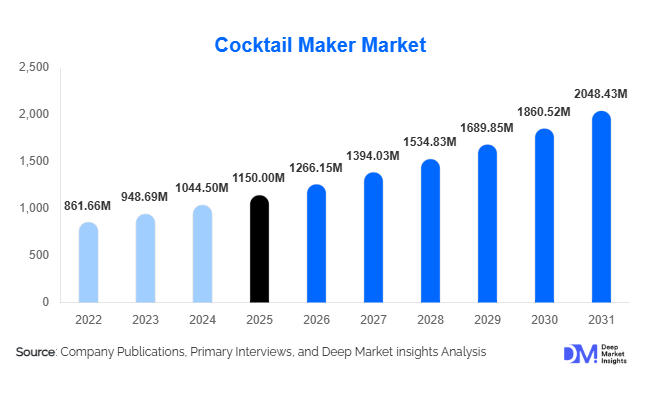
What are the latest trends in the cocktail maker market?
Smart and Connected Cocktail Systems
The integration of smart technology is a defining trend in the cocktail maker market. IoT-enabled devices allow users to customize drinks, control machines via mobile applications, and access cloud-based recipe libraries. This trend is particularly appealing to tech-savvy consumers who value personalization and convenience. Manufacturers are also integrating AI-driven recommendations, enabling machines to suggest cocktails based on user preferences and consumption patterns. Subscription-based ingredient systems are emerging alongside these devices, creating recurring revenue models and strengthening brand ecosystems.
Premiumization and Home Mixology Culture
The growing interest in home entertainment has led to increased demand for premium cocktail-making experiences. Consumers are investing in high-quality machines that replicate bar-level drinks at home. This trend is supported by social media influence, rising disposable incomes, and the desire for experiential consumption. Premium cocktail makers with sleek designs, touchscreen interfaces, and advanced mixing capabilities are gaining popularity, particularly in urban households. The trend is also driving innovation in compact and aesthetically appealing devices tailored for modern kitchens.
What are the key drivers in the cocktail maker market?
Expansion of Hospitality Automation
The hospitality industry is increasingly adopting automation to enhance efficiency and reduce labor dependency. Cocktail makers enable consistent drink preparation, faster service, and reduced wastage, making them highly attractive for bars, restaurants, and hotels. As labor costs rise globally, automated solutions are becoming essential for maintaining profitability and service quality.
Rising Demand for Convenience and Personalization
Modern consumers prioritize convenience without compromising on quality. Cocktail makers address this demand by offering quick, consistent, and customizable drink preparation. The ability to create personalized cocktails at the touch of a button is driving adoption across residential and commercial segments.
What are the restraints for the global market?
High Initial Cost of Advanced Systems
Premium cocktail makers, particularly fully automated and IoT-enabled systems, involve significant upfront costs. This limits adoption among price-sensitive consumers and small-scale businesses, particularly in developing markets.
Limited Awareness in Emerging Economies
Despite growing urbanization, awareness and adoption of cocktail makers remain relatively low in several developing regions. Traditional beverage preparation methods continue to dominate, slowing market penetration.
What are the key opportunities in the cocktail maker industry?
Expansion into Emerging Markets
Emerging economies such as India, China, and Brazil present significant growth opportunities due to rising disposable incomes and expanding hospitality sectors. Companies that localize pricing strategies and product offerings can tap into these high-growth markets effectively.
Commercial Automation in Travel and Events
The adoption of cocktail makers in airlines, cruise lines, and event catering services is creating new growth avenues. These sectors require compact, efficient systems capable of delivering high-quality beverages at scale, making automation a valuable solution.
Report Scope
| Report Metric | Details |
|---|---|
| Market Size in 2025 | USD 1150 Million |
| Market Size in 2026 | USD 1266.15 Million |
| Market Size in 2031 | USD 2048.43 Million |
| CAGR | 10.1% (2026-2031) |
| Base Year for Estimation | 2025 |
| Historical Data | 2022-2024 |
| Forecast Period | 2026-2031 |
| Report Coverage | Revenue Forecast, Competitive Landscape, Supply Chain Disruption, Growth Factors, Environment & Regulatory Landscape and Trends |
| Geographies Covered | North America, Europe, APAC, Middle East and Africa, LATAM |
| Countries Covered | U.S., Canada, U.K., Germany, France, Spain, Italy, Russia, Nordic, Benelux, Rest of Europe, China, Korea, Japan, India, Australia, Singapore, Taiwan, South East Asia, Rest of Asia-Pacific, UAE, Turky, Saudi Arabia, South Africa, Egypt, Nigeria, Rest of MEA, Brazil, Mexico, Argentina, Chile, Colombia, Rest of LATAM |
Explore more data points, trends and opportunities Download Free Sample Report
Product Type Insights
Automated cocktail machines dominate the cocktail maker market, accounting for approximately 42% of the total market share in 2025. The leadership of this segment is primarily driven by the increasing need for operational efficiency, consistency in beverage preparation, and reduced dependency on skilled labor in commercial settings. Bars, hotels, and high-volume restaurants are increasingly adopting fully automated systems to standardize drink quality and improve turnaround times during peak hours. Additionally, the integration of IoT capabilities, touchscreen interfaces, and pre-programmed recipes enhances usability and attracts both commercial and premium residential users. The shift toward automation is further reinforced by rising labor costs globally and the need for scalable solutions in hospitality. Semi-automated machines continue to serve niche users who prefer a blend of manual control and automation, while manual cocktail tools remain relevant in traditional and low-cost settings. However, the long-term growth trajectory clearly favors automated solutions due to their ability to deliver precision, efficiency, and a superior user experience.
Application Insights
The commercial segment leads the market, contributing around 61% of total demand in 2025, making it the most significant revenue-generating segment. The dominance of this segment is driven by the rapid adoption of automation across bars, pubs, hotels, and restaurants, where consistency, speed, and cost optimization are critical. Cocktail makers help reduce ingredient wastage, improve service efficiency, and maintain uniform quality, which is essential for brand reputation in hospitality. Additionally, the increasing number of premium dining establishments and nightlife venues globally is supporting sustained demand. The residential segment, while smaller in share, is the fastest-growing segment, fueled by rising disposable incomes, urban lifestyles, and the growing popularity of home entertainment and mixology. Consumers are increasingly investing in smart kitchen appliances that offer convenience and premium experiences. Emerging applications in airlines, cruise lines, and large-scale catering services are further expanding the market, as these sectors seek compact, automated solutions to deliver consistent beverage experiences at scale.
Distribution Channel Insights
Online retail dominates the distribution landscape, accounting for approximately 58% of total sales in 2025. The leading position of this segment is driven by the rapid growth of e-commerce platforms, increasing digital penetration, and the shift toward direct-to-consumer (D2C) sales models. Online channels offer consumers the ability to compare products, access detailed specifications, read user reviews, and benefit from competitive pricing, making them highly attractive for both residential and small commercial buyers. Manufacturers are also leveraging online platforms to expand their global reach and reduce dependency on intermediaries. Additionally, digital marketing and influencer-driven promotions are playing a key role in boosting online sales. Offline channels, including specialty appliance stores and HoReCa distributors, continue to play a critical role in catering to large commercial buyers who require product demonstrations, bulk purchasing options, and after-sales service support. However, the long-term trend indicates continued dominance of online channels due to convenience and accessibility.
Price Range Insights
Mid-range cocktail makers (USD 200–800) hold the largest share, representing around 49% of the market in 2025. The leadership of this segment is driven by its ability to offer an optimal balance between affordability and advanced functionality. These products typically include essential automation features, multiple recipe options, and user-friendly interfaces, making them suitable for both residential users and small-to-medium commercial establishments. The growing middle-class population globally and increasing demand for value-for-money products are key factors supporting this segment’s dominance. Premium products, priced above USD 800, cater to high-end consumers and luxury hospitality establishments, offering advanced features such as AI integration, app connectivity, and high-capacity dispensing systems. Meanwhile, economy products are gaining traction in emerging markets, where price sensitivity remains high, and adoption is driven by affordability rather than advanced features.
Explore more data points, trends and opportunities Download Free Sample Report
Cocktail Maker Market Segmentations
By Product Type
- Automated Cocktail Machines
- Semi-Automated Cocktail Makers
- Manual Cocktail Tools & Kits
By Application
- Residential Consumers
- Bars & Pubs
- Hotels & Resorts
- Restaurants
- Airlines & Cruise Lines
- Event & Catering Services
By Distribution Channel
- Online Retail
- Specialty Appliance Stores
- Electronics Retail Chains
- HoReCa Distributors
Regional Insights
North America
North America holds the largest share of the cocktail maker market at approximately 38% in 2025, with the United States accounting for the majority of regional demand. The region’s dominance is driven by a well-established cocktail culture, high disposable incomes, and strong consumer inclination toward premium and smart home appliances. The presence of leading manufacturers and early adoption of automation technologies further strengthen market growth. Additionally, the highly developed hospitality sector, characterized by a large number of bars, restaurants, and hotels, is a key driver of demand. The increasing trend of home entertainment and the popularity of DIY mixology are also contributing to residential adoption. Strong e-commerce infrastructure and widespread digital penetration further accelerate market expansion in the region.
Europe
Europe accounts for around 27% of the global market share, with major contributions from the UK, Germany, and France. The region’s growth is driven by its mature hospitality industry, strong café and bar culture, and increasing preference for premium consumer appliances. European consumers are highly receptive to technologically advanced and aesthetically designed products, which supports the adoption of smart cocktail makers. Additionally, the region’s focus on sustainability and energy-efficient appliances is encouraging manufacturers to develop eco-friendly solutions. The growth of tourism and nightlife industries across major European cities further drives demand from commercial establishments. Regulatory standards ensuring product quality and safety also enhance consumer confidence, supporting steady market expansion.
Asia-Pacific
Asia-Pacific is the fastest-growing region in the cocktail maker market, with a CAGR exceeding 12%. Key markets include China, Japan, South Korea, and India. The region’s rapid growth is driven by increasing urbanization, rising disposable incomes, and the expansion of organized retail and hospitality sectors. The growing middle-class population and exposure to Western lifestyles are encouraging the adoption of premium appliances, including cocktail makers. In countries like China and India, the rapid growth of nightlife culture, luxury hotels, and fine dining establishments is significantly boosting commercial demand. Additionally, the increasing penetration of e-commerce platforms is making these products more accessible to consumers. Government initiatives supporting manufacturing and smart appliance adoption, along with rising consumer interest in home automation, are further accelerating market growth in the region.
Latin America
Latin America holds approximately 6% of the global market share, with Brazil and Mexico leading demand. The region’s growth is primarily driven by expanding tourism, a vibrant nightlife culture, and increasing urbanization. The rising number of bars, clubs, and restaurants is creating steady demand for cocktail makers in commercial settings. Additionally, improving economic conditions and growing middle-class populations are supporting residential adoption. However, price sensitivity remains a key factor, leading to higher demand for mid-range and economy products. The increasing penetration of online retail platforms is also enhancing product accessibility across the region.
Middle East & Africa
The Middle East & Africa region accounts for around 5% of the global market, led by the UAE and South Africa. Growth in this region is driven by the expansion of luxury hospitality and tourism sectors, particularly in the Gulf countries. High-end hotels, resorts, and premium dining establishments are increasingly adopting automated cocktail solutions to enhance customer experience and operational efficiency. The presence of a high-income consumer base in the UAE and Saudi Arabia is also supporting demand for premium cocktail makers. In Africa, South Africa leads the market due to its well-developed hospitality industry and growing urban consumer base. While regulatory restrictions on alcohol consumption in certain countries may limit growth, the overall market is supported by tourism-driven demand and increasing investment in hospitality infrastructure.
Key Players in the Cocktail Maker Market
- Bartesian
- Keurig Dr Pepper
- Drinkworks
- Hamilton Beach Brands
- Whirlpool Corporation
- LG Electronics
- Samsung Electronics
- Panasonic Corporation
- Breville Group
- SharkNinja
- Electrolux AB
- iGulu
- Somabar
- Alchema
- Makr Shakr