Children’s Food Supplements Market Size
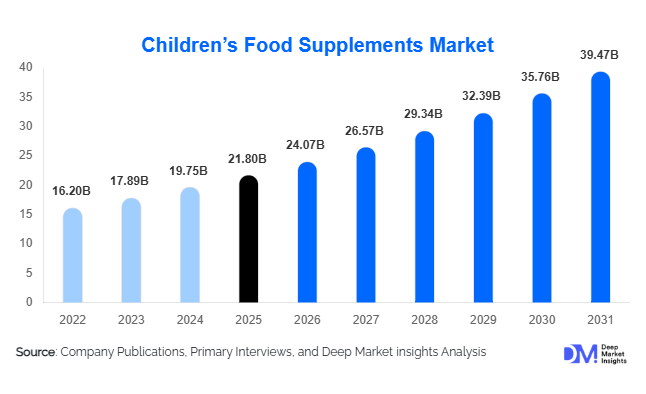
According to Deep Market Insights, the global children’s food supplements market size was valued at USD 21.8 billion in 2025 and is projected to grow from USD 24.07 billion in 2026 to reach USD 39.47 billion by 2031, expanding at a CAGR of 10.4% during the forecast period (2026–2031). The children’s food supplements market growth is primarily driven by increasing parental awareness regarding preventive healthcare, rising prevalence of micronutrient deficiencies among children, and growing demand for immunity-enhancing nutritional products. The market is also benefiting from the expansion of pediatric wellness trends, increasing adoption of gummy and chewable supplement formats, and rapid growth in digital health and e-commerce channels.
Key Market Insights
- Immunity-focused supplements are dominating market demand, particularly products containing vitamin C, vitamin D, zinc, probiotics, and omega fatty acids.
- Gummy and chewable supplement formats are rapidly replacing traditional syrups and capsules, improving product acceptance among children and driving repeat purchases.
- Asia-Pacific dominates the global children’s food supplements market, supported by large pediatric populations, urbanization, and increasing healthcare spending in China and India.
- North America remains the leading premium market, driven by high consumer awareness, strong preventive healthcare spending, and widespread clean-label product adoption.
- Plant-based, organic, and allergen-free pediatric supplements are emerging as major growth categories, particularly among millennial parents seeking clean-label nutrition products.
- Technological innovation and personalized pediatric nutrition platforms are reshaping the industry through AI-driven supplement recommendations, subscription models, and microbiome-focused formulations.
Children’s Food Supplements Market Trends
Clean-Label and Organic Pediatric Supplements Gaining Strong Momentum
Parents are increasingly prioritizing transparency, safety, and ingredient quality in children’s nutritional products. This has accelerated demand for clean-label supplements free from artificial colors, preservatives, allergens, and excessive sugar content. Organic gummies, plant-based omega supplements, vegan chewables, and naturally flavored syrups are becoming mainstream offerings across developed markets. Manufacturers are reformulating products with naturally sourced ingredients and investing heavily in sustainable packaging solutions to align with environmentally conscious consumer preferences. Pediatric supplements with non-GMO certifications, organic labels, and clinically tested natural ingredients are witnessing particularly strong adoption in North America and Europe. The trend is also expanding into emerging markets where premium pediatric wellness products are gaining popularity among urban middle-income consumers.
Microbiome and Personalized Nutrition Innovation Expanding
Advancements in microbiome science are significantly influencing the children’s food supplements market. Pediatric probiotic and synbiotic products designed to improve immunity, digestive health, and cognitive development are becoming one of the fastest-growing supplement categories globally. Companies are increasingly investing in personalized nutrition technologies that assess children’s dietary patterns, nutritional gaps, and age-specific health requirements to recommend tailored supplement combinations. AI-enabled nutrition apps and subscription-based vitamin packs are becoming more common, particularly in developed economies. Digital health integration is improving consumer engagement while helping manufacturers build long-term customer retention. Companies are also leveraging pediatric clinical studies to support product efficacy claims, strengthening trust among health-conscious parents seeking evidence-based nutrition solutions.
Children’s Food Supplements Market Drivers
Growing Focus on Preventive Pediatric Healthcare
Increasing parental awareness regarding preventive healthcare is one of the primary drivers accelerating demand for children’s food supplements globally. Modern dietary habits among children often lack adequate micronutrient intake due to growing consumption of processed and convenience foods. This has contributed to rising deficiencies in vitamin D, calcium, iron, and omega fatty acids, prompting pediatricians and healthcare providers to recommend supplementation. Parents are increasingly adopting daily nutritional supplements to support immunity, bone health, cognitive development, and overall wellness from an early age. Growing healthcare education campaigns and expanding pediatric nutrition awareness are further strengthening long-term market demand.
Rapid Growth of Immunity-Support Supplementation
Consumer behavior has shifted significantly toward immunity-focused wellness products following increased global health awareness. Pediatric supplements containing probiotics, zinc, elderberry, vitamin C, and multivitamin combinations are witnessing exceptionally strong demand growth. School-going children remain a major target demographic as parents seek solutions to reduce susceptibility to seasonal illnesses and infections. Manufacturers are launching child-friendly flavored gummies, chewables, and powders specifically designed for immunity support, further improving product adoption. Immunity remains the largest application segment within the global children’s food supplements market due to rising focus on proactive wellness management.
Children’s Food Supplements Market Restraints
Regulatory Scrutiny and Product Compliance Challenges
The children’s food supplements market faces increasing regulatory oversight related to labeling standards, dosage accuracy, ingredient safety, and marketing claims. Regulatory authorities in the United States, Europe, and Asia-Pacific are imposing stricter controls on pediatric supplement formulations, especially regarding sugar content, artificial additives, and health benefit claims. Compliance with varying international standards significantly increases operational complexity and costs for manufacturers. Companies entering multiple regional markets must invest heavily in clinical testing, certification, and regulatory approvals to maintain market access and consumer confidence.
Concerns Regarding Excessive Sugar and Misleading Claims
Parents are becoming increasingly cautious regarding the nutritional quality of children’s supplements, particularly gummies containing high sugar content or artificial flavoring agents. Misleading health claims and inconsistent nutrient labeling across certain brands have also created skepticism among consumers. Excessive supplementation concerns, especially regarding vitamins and minerals, are prompting healthcare professionals to advocate more responsible usage. These factors create reputational risks for manufacturers and require greater transparency, evidence-based marketing, and cleaner formulations to sustain long-term consumer trust within the market.
Children’s Food Supplements Market Opportunities
Expansion of Plant-Based and Allergen-Free Nutrition Products
The growing popularity of plant-based nutrition presents a significant opportunity for children’s food supplement manufacturers. Parents increasingly prefer vegan, dairy-free, gluten-free, and allergen-free formulations that align with evolving dietary preferences and food sensitivities. Manufacturers developing pediatric supplements using algae-based omega oils, plant-derived proteins, and naturally sourced vitamins are expected to benefit from strong premiumization trends. Demand for organic and allergen-free products is particularly high among urban consumers in North America, Europe, Japan, and Australia. Companies focusing on sustainability, transparent ingredient sourcing, and clean-label certifications are likely to strengthen brand loyalty and pricing power.
Digital Commerce and Personalized Pediatric Wellness Platforms
The rapid expansion of digital healthcare and e-commerce infrastructure is creating substantial growth opportunities within the children’s food supplements market. Subscription-based supplement services, AI-powered nutritional assessments, and direct-to-consumer pediatric wellness platforms are transforming how parents purchase nutritional products. Personalized supplement packs based on age, immunity requirements, and dietary habits are gaining traction in developed markets. E-commerce penetration is also enabling international brands to expand rapidly into emerging economies where physical retail distribution remains underdeveloped. Integration of telehealth consultations, digital pediatric wellness tracking, and customized nutrition recommendations is expected to create long-term growth opportunities for both established manufacturers and emerging wellness startups.
Report Scope
| Report Metric | Details |
|---|---|
| Market Size in 2025 | USD 21.8 Billion |
| Market Size in 2026 | USD 24.07 Billion |
| Market Size in 2031 | USD 39.47 Billion |
| CAGR | 10.4% (2026-2031) |
| Base Year for Estimation | 2025 |
| Historical Data | 2022-2024 |
| Forecast Period | 2026-2031 |
| Report Coverage | Revenue Forecast, Competitive Landscape, Supply Chain Disruption, Growth Factors, Environment & Regulatory Landscape and Trends |
| Geographies Covered | North America, Europe, APAC, Middle East and Africa, LATAM |
| Countries Covered | U.S., Canada, U.K., Germany, France, Spain, Italy, Russia, Nordic, Benelux, Rest of Europe, China, Korea, Japan, India, Australia, Singapore, Taiwan, South East Asia, Rest of Asia-Pacific, UAE, Turky, Saudi Arabia, South Africa, Egypt, Nigeria, Rest of MEA, Brazil, Mexico, Argentina, Chile, Colombia, Rest of LATAM |
Explore more data points, trends and opportunities Download Free Sample Report
Product Type Insights
Vitamin supplements dominate the children’s food supplements market, accounting for approximately 41% of total global revenue in 2025. Multivitamins and vitamin D formulations remain particularly popular due to rising concerns regarding immunity, bone development, and nutritional deficiencies among children. Mineral supplements such as calcium, iron, and zinc are also witnessing strong demand growth, especially in emerging markets addressing pediatric anemia and developmental deficiencies. Probiotic and prebiotic supplements represent one of the fastest-growing product categories as awareness regarding digestive health and microbiome wellness expands globally. Omega fatty acid supplements, particularly DHA-focused products, are increasingly consumed to support cognitive development and vision health. Herbal and botanical supplements, including elderberry and turmeric formulations, are gradually gaining acceptance among health-conscious parents seeking natural immunity solutions.
Application Insights
Immunity support remains the leading application segment in the children’s food supplements market, accounting for nearly 30% of total revenue in 2025. Rising parental concerns regarding seasonal illnesses, infections, and long-term wellness continue to support strong demand for immunity-focused formulations. Bone and teeth development supplements also maintain substantial demand due to increasing awareness regarding vitamin D and calcium deficiencies among growing children. Cognitive development supplements containing omega fatty acids, probiotics, and brain-health nutrients are witnessing rapid adoption, particularly among school-age children. Digestive health applications are expanding significantly as probiotic supplementation becomes more mainstream. Sleep support, stress management, and sports nutrition supplements are also emerging as niche yet rapidly growing categories, particularly among adolescents and active children participating in sports and academic activities.
Distribution Channel Insights
Pharmacies and drug stores continue to dominate the global children’s food supplements market due to strong consumer trust in pharmacist and pediatrician recommendations. Parents often prefer purchasing pediatric supplements through regulated healthcare channels to ensure product quality and safety. Supermarkets and hypermarkets remain important retail channels, particularly for mainstream multivitamin and gummy products. Online retail and e-commerce platforms represent the fastest-growing distribution segment globally, driven by subscription services, product variety, convenience, and increasing digital health awareness. Direct-to-consumer pediatric nutrition brands are leveraging social media marketing, parenting influencers, and personalized supplement recommendations to expand customer reach. Specialty nutrition stores and pediatric clinics are also strengthening their market presence by offering clinically positioned and premium nutritional products.
Age Group Insights
Children aged 6–12 years account for the largest share of the children’s food supplements market, representing approximately 38% of total revenue in 2025. This segment experiences high supplement consumption due to increased exposure to school environments, active lifestyles, and greater nutritional requirements during developmental years. Toddlers aged 2–5 years represent another important segment, particularly for immunity-support and digestive health formulations. Infant-focused supplementation remains highly regulated but continues to grow steadily through pediatric healthcare recommendations. Teenagers and adolescents are emerging as a rapidly expanding consumer group due to rising demand for sports nutrition, energy support, cognitive wellness, and protein supplementation. Increasing awareness regarding teenage nutrition and physical performance is expected to support long-term growth in this age category.
Explore more data points, trends and opportunities Download Free Sample Report
Children’s Food Supplements Market Segmentations
By Product Type
- Vitamins
- Minerals
- Probiotics & Prebiotics
- Omega & Essential Fatty Acids
- Herbal & Botanical Supplements
- Specialty Supplements
By Form
- Gummies
- Chewable Tablets
- Syrups/Liquids
- Powders
- Capsules & Softgels
- Oral Strips & Sachets
By Age Group
- Infants (0–2 years)
- Toddlers (2–5 years)
- Children (6–12 years)
- Adolescents (13–18 years)
By Application
- Immunity Support
- Bone & Teeth Development
- Cognitive Development
- Digestive Health
- Energy & Metabolism
- Sleep & Stress Management
- Sports Nutrition
By Distribution Channel
- Pharmacies & Drug Stores
- Supermarkets & Hypermarkets
- Online Retail/E-commerce
- Specialty Nutrition Stores
- Pediatric Clinics & Hospitals
- Direct Selling/Subscription Models
Regional Insights
North America
North America accounted for nearly 32% of the global children’s food supplements market in 2025, led primarily by the United States. Strong preventive healthcare spending, high consumer awareness regarding nutritional supplementation, and widespread adoption of premium pediatric wellness products continue to support regional market dominance. Consumers in the U.S. increasingly prefer clean-label, sugar-free, and clinically validated supplements, particularly gummy and probiotic formulations. Canada is also witnessing rising demand for organic and allergen-free pediatric supplements due to growing health-conscious consumer behavior and favorable retail penetration.
Europe
Europe remains a highly mature and quality-focused market for children’s food supplements, driven by strong demand from Germany, the United Kingdom, France, and Italy. European consumers increasingly prioritize organic, vegan, and sustainably produced pediatric supplements. Regulatory standards within the region remain among the strictest globally, encouraging manufacturers to invest in evidence-based formulations and cleaner ingredient profiles. Demand for probiotics, immunity-support supplements, and plant-based pediatric nutrition products continues to expand steadily across Western Europe. Eastern European markets are also witnessing gradual growth due to improving healthcare awareness and rising disposable income levels.
Asia-Pacific
Asia-Pacific dominates the global children’s food supplements market with approximately 36% market share in 2025 and is projected to remain the fastest-growing regional market throughout the forecast period. China represents one of the largest markets globally due to increasing urbanization, rising healthcare expenditure, and strong demand for premium imported pediatric nutrition products. India is emerging as the fastest-growing national market owing to its large pediatric population, increasing awareness regarding micronutrient deficiencies, and expansion of e-commerce-driven supplement accessibility. Japan and South Korea continue to witness high demand for probiotic and functional pediatric nutrition products, while Southeast Asian markets such as Indonesia and Vietnam are experiencing rapid adoption of affordable multivitamin and immunity supplements.
Latin America
Latin America is experiencing rising demand for children’s food supplements, particularly in Brazil and Mexico. Expanding middle-class populations, improving healthcare awareness, and increasing focus on preventive wellness are supporting regional market growth. Brazilian consumers are increasingly adopting immunity-support and multivitamin products, while Mexico is witnessing growing demand for affordable pediatric nutrition supplements through pharmacy and retail distribution channels. E-commerce growth is also improving accessibility to international pediatric supplement brands throughout the region.
Middle East & Africa
The Middle East & Africa region is gradually emerging as an important growth market for children’s food supplements. Saudi Arabia and the UAE are leading regional demand due to rising healthcare spending, premium wellness adoption, and increasing awareness regarding pediatric nutrition. Government initiatives targeting childhood malnutrition and vitamin deficiencies are also supporting supplement demand across several African countries. South Africa represents one of the most developed pediatric supplement markets within Africa, benefiting from expanding retail infrastructure and increasing preventive healthcare awareness among urban consumers.