Child Safety Seat Market Size
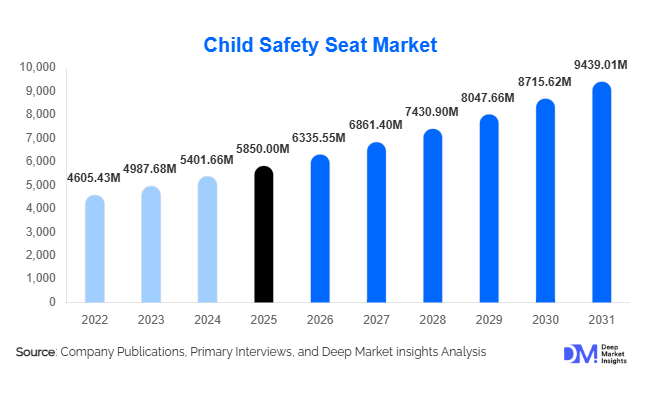
According to Deep Market Insights, the global child safety seat market size was valued at USD 5,850 million in 2025 and is projected to grow from USD 6,335.55 million in 2026 to reach USD 9439.01 million by 2031, expanding at a CAGR of 8.3% during the forecast period (2026–2031). The child safety seat market growth is primarily driven by increasing enforcement of child passenger safety regulations, rising awareness among parents regarding road safety, and the growing adoption of advanced safety technologies such as ISOFIX systems and impact-absorbing materials.
Key Market Insights
- Regulatory compliance is a major growth driver, with governments mandating child restraint systems across developed and emerging economies.
- Convertible and all-in-one seats are gaining traction, offering long-term usability and better value for consumers.
- North America dominates the market, supported by strict enforcement laws and high awareness levels.
- Asia-Pacific is the fastest-growing region, driven by increasing vehicle ownership and rising middle-class income.
- Mid-range products lead demand, balancing affordability with safety and advanced features.
- Technological advancements, including smart sensors and improved installation mechanisms, are reshaping product innovation.
What are the latest trends in the child safety seat market?
Shift Toward Multi-Functional and Long-Use Seats
Consumers are increasingly preferring convertible and all-in-one child safety seats that accommodate multiple growth stages, reducing the need for frequent replacements. This trend is driven by cost efficiency and convenience, especially in price-sensitive markets. Manufacturers are focusing on modular designs, adjustable harness systems, and extendable features to cater to children from infancy to pre-teen years. This not only enhances product lifecycle value but also aligns with sustainability concerns by reducing product waste.
Integration of Smart and Connected Technologies
Smart child safety seats equipped with sensors, temperature alerts, and app-based monitoring systems are gaining traction, particularly in premium segments. These features address critical parental concerns such as accidental child lock-ins and improper seat installation. IoT-enabled seats that provide real-time alerts and safety diagnostics are becoming key differentiators. As technology costs decline, these innovations are expected to penetrate mid-range segments, expanding their market reach.
What are the key drivers in the child safety seat market?
Stringent Government Regulations and Safety Standards
Governments across North America, Europe, and the Asia-Pacific are enforcing stringent safety standards such as FMVSS 213 and ECE R129. These regulations mandate the use of child restraint systems, directly boosting market demand. Increasing penalties for non-compliance and awareness campaigns are further strengthening adoption rates globally.
Rising Awareness of Child Road Safety
Growing awareness among parents regarding the importance of child safety during travel is a significant growth driver. Campaigns by healthcare organizations and NGOs have increased knowledge about accident prevention, encouraging higher adoption of certified safety seats. Social media and digital platforms have also played a role in educating consumers.
Growth in Automobile Ownership
Increasing passenger vehicle sales, particularly in emerging markets such as India and China, are driving demand for child safety seats. Urbanization, rising disposable incomes, and changing lifestyles are contributing to higher vehicle ownership, which directly correlates with increased adoption of child restraint systems.
What are the restraints for the global market?
High Cost of Premium Safety Seats
The relatively high cost of advanced child safety seats remains a major barrier, particularly in developing regions. Premium products with advanced safety features are often priced beyond the reach of middle-income consumers, limiting widespread adoption.
Low Awareness in Emerging Economies
Despite regulatory progress, awareness regarding the importance and correct usage of child safety seats remains low in several developing countries. This leads to underutilization and slower market penetration, especially in rural and semi-urban areas.
What are the key opportunities in the child safety seat industry?
Expansion in Emerging Markets
Emerging economies such as India, Brazil, and Southeast Asian countries offer significant growth opportunities due to low penetration rates and increasing regulatory enforcement. Companies can tap into these markets by offering affordable product variants and investing in awareness campaigns. Localization of manufacturing can further reduce costs and improve accessibility.
Growth of Institutional Demand
The rise of ride-hailing services, car rental platforms, and shared mobility is creating new demand for child safety seats. Governments are increasingly mandating safety compliance in these services, opening opportunities for bulk procurement and subscription-based business models.
Report Scope
| Report Metric | Details |
|---|---|
| Market Size in 2025 | USD 5850 Million |
| Market Size in 2026 | USD 6335.55 Million |
| Market Size in 2031 | USD 9439.01 Million |
| CAGR | 8.3% (2026-2031) |
| Base Year for Estimation | 2025 |
| Historical Data | 2022-2024 |
| Forecast Period | 2026-2031 |
| Report Coverage | Revenue Forecast, Competitive Landscape, Supply Chain Disruption, Growth Factors, Environment & Regulatory Landscape and Trends |
| Geographies Covered | North America, Europe, APAC, Middle East and Africa, LATAM |
| Countries Covered | U.S., Canada, U.K., Germany, France, Spain, Italy, Russia, Nordic, Benelux, Rest of Europe, China, Korea, Japan, India, Australia, Singapore, Taiwan, South East Asia, Rest of Asia-Pacific, UAE, Turky, Saudi Arabia, South Africa, Egypt, Nigeria, Rest of MEA, Brazil, Mexico, Argentina, Chile, Colombia, Rest of LATAM |
Explore more data points, trends and opportunities Download Free Sample Report
Product Type Insights
Convertible car seats dominate the global child safety seat market, accounting for approximately 32% of the total market share in 2025. Their leadership is primarily driven by their multi-stage usability, allowing transition from rear-facing infant mode to forward-facing toddler configurations, thereby offering long-term cost efficiency to consumers. This value proposition is particularly attractive in both developed and emerging markets, where parents increasingly seek durable, high-utility products. Additionally, regulatory recommendations in regions such as North America and Europe encouraging extended rear-facing usage further support demand for convertible seats.
Infant car seats continue to maintain steady demand, especially in developed economies with high birth rates and strict hospital discharge safety requirements, where newborn transportation mandates drive adoption. Booster seats also hold a significant share, particularly in mature markets where children graduate from early-stage seats but must still comply with safety laws. Meanwhile, all-in-one seats are emerging as a high-growth sub-segment, driven by urban consumers seeking convenience, space optimization, and long-term investment products. The trend toward premiumization, along with increasing awareness of lifecycle cost benefits, is further strengthening the position of multi-functional seating solutions globally.
Installation Type Insights
ISOFIX/LATCH-installed child safety seats lead the market with approximately 58% share in 2025, primarily due to their superior safety performance, standardized installation mechanism, and reduced risk of incorrect fitting. Unlike traditional seatbelt-installed systems, ISOFIX solutions provide fixed anchor points that ensure stability and minimize installation errors, which is a key concern among parents.
The growth of this segment is strongly driven by regulatory mandates across Europe (ECE R129) and increasing adoption in North America and Asia-Pacific markets. Automakers are also integrating ISOFIX anchor points as standard features in passenger vehicles, further accelerating adoption. In emerging economies, awareness campaigns and OEM partnerships are helping drive penetration, although cost sensitivity still limits full-scale adoption. Over time, declining costs and regulatory enforcement are expected to push ISOFIX systems toward near-universal adoption, particularly in mid-range and premium vehicles.
Distribution Channel Insights
Offline retail channels continue to dominate the market, accounting for approximately 62% of total market share in 2025. This dominance is attributed to the highly experiential nature of the purchase process, where consumers prefer physical inspection, in-store demonstrations, and expert consultations before making a decision. Specialty baby stores and large-format retail chains play a critical role in educating consumers on product features, installation techniques, and compliance standards, thereby influencing purchase decisions.
However, online channels are witnessing rapid growth, fueled by increasing digital penetration, the availability of detailed product comparisons, and competitive pricing strategies. E-commerce platforms and brand-owned direct-to-consumer (D2C) websites are expanding their presence by offering installation guides, customer reviews, and bundled deals. The COVID-19 pandemic further accelerated online adoption, a trend that continues to persist. Going forward, omnichannel strategies integrating online convenience with offline support services are expected to reshape distribution dynamics.
End-Use Insights
Individual consumers account for nearly 88% of total demand in the child safety seat market, driven by increasing parental awareness, rising disposable incomes, and regulatory compliance requirements. Household demand is further supported by urbanization, nuclear family structures, and growing emphasis on child safety standards, particularly in developed markets. Parents are increasingly prioritizing certified safety products, leading to higher penetration rates in urban centers.
Institutional buyers, including ride-hailing services, car rental companies, and corporate fleet operators, represent a smaller yet rapidly expanding segment. This segment is growing at a faster pace due to evolving safety regulations mandating child restraint systems in commercial passenger vehicles. Additionally, the rise of shared mobility platforms is creating new demand channels, with operators investing in durable, easy-to-install safety seats suitable for high-frequency usage. This shift is expected to significantly expand institutional demand over the forecast period.
Explore more data points, trends and opportunities Download Free Sample Report
Child Safety Seat Market Segmentations
By Product Type
- Infant Car Seats
- Convertible Car Seats
- Booster Seats
- Combination Seats
- All-in-One Seats
By Installation Type
- Seatbelt-Installed Seats
- ISOFIX / LATCH Installed Seats
By Distribution Channel
- Offline Retail
- Online Retail
By End-Use
- Individual Consumers
- Institutional Buyers
By Price Range
- Economy
- Mid-Range
- Premium
Regional Insights
North America
North America holds the largest share of approximately 35% in 2025, led by the United States, which represents the majority of regional demand. The market is driven by stringent federal and state-level regulations mandating child safety seat usage, along with high awareness among consumers regarding road safety. Strong purchasing power and a well-established retail ecosystem further support market growth. Additionally, the presence of leading manufacturers and continuous product innovation, including smart safety features, contribute to sustained demand. Canada also plays a significant role, with similar regulatory frameworks and high compliance rates reinforcing regional growth.
Europe
Europe accounts for around 28% of the global market, with key countries such as Germany, the United Kingdom, and France driving demand. The region’s growth is primarily fueled by strict regulatory standards such as ECE R44 and R129, which mandate advanced safety requirements and encourage the adoption of ISOFIX systems. High consumer awareness, strong enforcement mechanisms, and a preference for premium and technologically advanced products further support market expansion. Additionally, sustainability trends and demand for eco-friendly materials are influencing product innovation across European markets.
Asia-Pacific
Asia-Pacific holds approximately 22% market share and is the fastest-growing region globally. Countries such as China and India are leading demand due to rapid urbanization, increasing vehicle ownership, and rising middle-class income levels. Government initiatives promoting road safety and gradual implementation of child restraint regulations are key growth drivers. In China, growing awareness and premiumization trends are boosting adoption, while India is emerging as a high-growth market with an expected CAGR exceeding 12%, supported by regulatory developments and increasing consumer education. Expanding e-commerce penetration and local manufacturing capabilities are further accelerating market growth across the region.
Latin America
Latin America accounts for approximately 8% of the global market, with Brazil and Mexico as the primary contributors. Market growth is driven by improving regulatory frameworks, increasing awareness of child safety, and rising urbanization. Economic development and expanding middle-class populations are gradually improving affordability and access to safety products. However, price sensitivity remains a challenge, prompting manufacturers to introduce cost-effective product variants tailored to regional demand. Government campaigns promoting road safety are expected to further enhance adoption rates in the coming years.
Middle East & Africa
The Middle East & Africa region holds nearly 7% market share, with demand concentrated in countries such as the United Arab Emirates and South Africa. Growth in this region is driven by increasing urbanization, rising disposable incomes, and growing awareness of child safety standards. In the Middle East, high-income populations and strong demand for premium automotive accessories support market expansion, while in Africa, gradual regulatory developments and improving infrastructure are contributing to steady growth. Additionally, increasing vehicle ownership and the expansion of modern retail channels are expected to create new opportunities for market players in this region.