Child Potty Seats Market Size
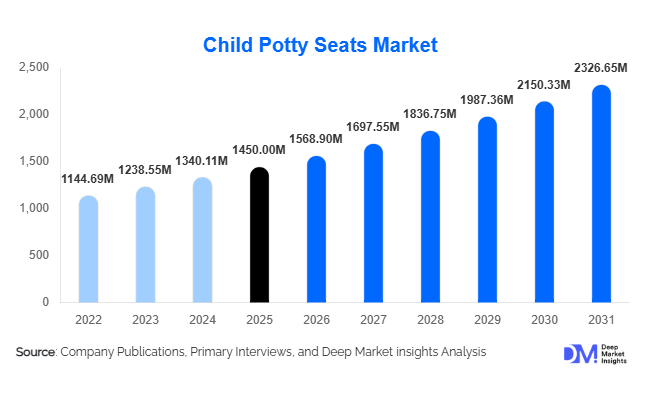
According to Deep Market Insights, the global child potty seats market size was valued at USD 1,450 million in 2025 and is projected to grow from USD 1,568.90 million in 2026 to reach USD 2,326.65 million by 2031, expanding at a CAGR of 8.2% during the forecast period (2026–2031). The market growth is primarily driven by increasing awareness of early childhood hygiene, rising disposable incomes, and the growing adoption of ergonomic and child-friendly potty training solutions. The transition from traditional potty training methods to modern, safe, and innovative products is significantly contributing to market expansion.
Key Market Insights
- Growing emphasis on child hygiene and early toilet training is driving demand for safe and ergonomic potty seats globally.
- Online retail channels are expanding rapidly, enabling wider product accessibility and boosting sales across emerging markets.
- Asia-Pacific dominates the market, supported by high birth rates and increasing middle-class spending on baby care products.
- Premium and smart potty seats are gaining traction, particularly in North America and Europe, driven by product innovation.
- Eco-friendly and sustainable materials are emerging as a key trend, reflecting growing environmental awareness among consumers.
- Institutional demand from daycare centers and early education facilities is rising, supporting overall market growth.
What are the latest trends in the child potty seats market?
Premiumization and Smart Product Innovation
The market is witnessing a shift toward premium and technologically advanced potty seats. Manufacturers are introducing features such as music-enabled seats, sensor-based feedback systems, and ergonomic designs to enhance the potty training experience for children. These innovations are particularly popular in developed regions, where parents prioritize comfort, safety, and engagement. Smart potty seats that reward children through sound or visual cues are gaining popularity as they help reinforce positive training behavior. Additionally, aesthetic designs and customizable features are increasingly influencing purchasing decisions, contributing to higher average selling prices.
Rise of Eco-Friendly and Sustainable Materials
Environmental sustainability is becoming a major trend in the child potty seats market. Consumers are increasingly opting for products made from biodegradable or eco-friendly materials, such as bamboo composites or recyclable plastics. Manufacturers are responding by incorporating sustainable production practices and obtaining safety certifications. This trend is particularly prominent in Europe and North America, where regulatory frameworks and consumer awareness around environmental impact are strong. Brands focusing on sustainability are gaining a competitive advantage by aligning with environmentally conscious parenting trends.
What are the key drivers in the child potty seats market?
Increasing Awareness of Child Hygiene
Rising awareness among parents regarding hygiene and early toilet training is a key growth driver. Pediatric recommendations and parenting communities are encouraging early adoption of potty training products, boosting demand globally. Educational campaigns and healthcare initiatives further support the adoption of hygienic practices, particularly in emerging markets.
Rising Disposable Income and Baby Care Spending
Higher disposable income levels, especially in urban areas, are enabling parents to invest in premium baby care products. This trend is driving demand for high-quality potty seats with advanced features, particularly in North America and Europe. The willingness to spend on child safety and comfort is significantly influencing market growth.
Expansion of E-commerce Channels
The rapid growth of e-commerce platforms is transforming the distribution landscape. Online retail offers convenience, competitive pricing, and access to a wide range of products, making it a preferred channel for consumers. The ability to compare features and read reviews has further accelerated online adoption, especially in Asia-Pacific and Latin America.
What are the restraints for the global market?
Availability of Low-Cost Alternatives
In many developing regions, traditional potty training methods and low-cost, unbranded products remain prevalent. These alternatives limit the penetration of branded and premium potty seats, posing a challenge for market expansion.
Price Sensitivity in Emerging Markets
Despite growing demand, affordability remains a key concern in price-sensitive markets. Premium products may face slower adoption, requiring manufacturers to balance innovation with cost-effectiveness to capture a broader consumer base.
What are the key opportunities in the child potty seats industry?
Expansion in Emerging Markets
Emerging economies such as India, China, and parts of Africa present significant growth opportunities due to rising birth rates and improving healthcare awareness. Increasing urbanization and government initiatives promoting sanitation are further driving demand. Companies that adapt pricing strategies and distribution networks to local markets can unlock substantial growth potential.
Growth in Direct-to-Consumer and E-commerce Models
The expansion of direct-to-consumer sales channels offers opportunities for brands to enhance customer engagement and improve margins. Subscription-based baby care kits, bundled product offerings, and personalized recommendations are emerging trends that can drive repeat purchases and brand loyalty.
Report Scope
| Report Metric | Details |
|---|---|
| Market Size in 2025 | USD 1450 Million |
| Market Size in 2026 | USD 1568.90 Million |
| Market Size in 2031 | USD 2326.65 Million |
| CAGR | 8.2% (2026-2031) |
| Base Year for Estimation | 2025 |
| Historical Data | 2022-2024 |
| Forecast Period | 2026-2031 |
| Report Coverage | Revenue Forecast, Competitive Landscape, Supply Chain Disruption, Growth Factors, Environment & Regulatory Landscape and Trends |
| Geographies Covered | North America, Europe, APAC, Middle East and Africa, LATAM |
| Countries Covered | U.S., Canada, U.K., Germany, France, Spain, Italy, Russia, Nordic, Benelux, Rest of Europe, China, Korea, Japan, India, Australia, Singapore, Taiwan, South East Asia, Rest of Asia-Pacific, UAE, Turky, Saudi Arabia, South Africa, Egypt, Nigeria, Rest of MEA, Brazil, Mexico, Argentina, Chile, Colombia, Rest of LATAM |
Explore more data points, trends and opportunities Download Free Sample Report
Product Type Insights
Potty training seats dominate the child potty seats market, accounting for approximately 34% of the global share in 2025. The leadership of this segment is primarily driven by its compatibility with standard household toilets, eliminating the need for additional space or standalone setups. This makes it particularly attractive in urban households where space optimization is critical. Additionally, the affordability and ease of installation of these seats contribute to their widespread adoption across both developed and developing regions. The trend toward early toilet training, supported by pediatric recommendations, further strengthens demand for this segment.
Standalone potty chairs continue to hold a significant share, especially among first-time users and younger toddlers, as they offer psychological comfort and independence during initial training stages. Meanwhile, portable and foldable potty seats are emerging as high-growth sub-segments, driven by increasing travel frequency among families and demand for on-the-go hygiene solutions. The smart potty seats segment, though still niche, is expanding rapidly due to premiumization trends, incorporating features such as music, sensors, and reward-based systems that enhance child engagement and training efficiency.
Material Insights
Plastic-based potty seats dominate the market with approximately 62% share in 2025, primarily due to their cost-effectiveness, durability, and lightweight properties. The ability of plastic materials such as polypropylene and ABS to withstand repeated use while maintaining hygiene standards makes them the preferred choice for mass-market products. Additionally, plastic allows for versatile design and color customization, which appeals to both children and parents.
Silicone and cushioned potty seats are gaining traction, particularly in premium segments, as they provide enhanced comfort, anti-slip functionality, and ergonomic support. These features are increasingly valued by parents seeking safer and more comfortable solutions for toddlers. Furthermore, the eco-friendly materials segment, including biodegradable plastics and bamboo composites, is expected to witness the fastest growth. This is driven by rising environmental awareness, stricter regulatory frameworks in developed regions, and increasing consumer preference for sustainable baby care products.
Distribution Channel Insights
Online retail channels account for approximately 38% of the global market share and represent the fastest-growing distribution segment. The growth of this channel is driven by increasing internet penetration, smartphone usage, and the convenience of home delivery. E-commerce platforms enable consumers to compare product features, read reviews, and access a wider range of options, making them highly attractive, especially for urban and tech-savvy parents. Promotional discounts and bundled baby care offerings further boost online sales.
Offline channels, including supermarkets, hypermarkets, specialty baby stores, and pharmacies, continue to play a crucial role, particularly in regions with lower digital penetration and a strong preference for physical product evaluation. These channels provide immediate product availability and tactile assurance, which remains important for first-time buyers. The coexistence of online and offline channels is creating an omnichannel retail environment, enhancing overall market accessibility.
End-Use Insights
Residential households dominate the market with over 70% share in 2025, as potty training is primarily conducted at home under parental supervision. The dominance of this segment is driven by rising awareness of early childhood hygiene, increasing birth rates in emerging markets, and growing parental investment in baby care products. The shift toward nuclear families and dual-income households is also encouraging the adoption of convenient and easy-to-use potty training solutions.
Daycare centers and early education institutions represent the fastest-growing end-use segment, driven by increasing enrollment in organized childcare facilities and the need for standardized hygiene practices across institutions. These facilities require durable and easy-to-clean potty seats to maintain sanitation standards. Hospitals and pediatric clinics also contribute to demand, particularly for demonstration, early training guidance, and postnatal care programs, supporting product awareness and adoption among new parents.
Explore more data points, trends and opportunities Download Free Sample Report
Child Potty Seats Market Segmentations
By Product Type
- Standalone Potty Chairs
- Potty Training Seats
- Potty Seats with Ladder/Steps
- Travel/Foldable Potty Seats
- Smart/Interactive Potty Seats
By Material Type
- Plastic
- Silicone/Soft Cushioned Seats
- Wooden Potty Seats
- Eco-friendly/Biodegradable Materials
By Distribution Channel
- Online Retail
- Supermarkets/Hypermarkets
- Specialty Baby Stores
- Pharmacies/Drug Stores
By End-Use
- Residential Households
- Daycare Centers
- Hospitals & Pediatric Clinics
- Early Education Institutions
Regional Insights
Asia-Pacific
Asia-Pacific holds the largest share of approximately 32% in 2025, making it the dominant regional market. The growth in this region is primarily driven by high birth rates, expanding middle-class population, and increasing urbanization. Countries such as China and India are key contributors, supported by rising disposable incomes and growing awareness of child hygiene practices. Additionally, government-led sanitation initiatives, improving healthcare infrastructure, and rapid expansion of e-commerce platforms are significantly boosting product penetration. The availability of cost-effective manufacturing in the region also supports large-scale supply, further strengthening market growth.
North America
North America accounts for around 28% of the global market, led by the United States. The region’s growth is driven by high disposable income, strong consumer spending on premium baby care products, and advanced retail infrastructure. Parents in this region show a strong preference for ergonomic, safe, and technologically advanced potty seats, contributing to the growth of premium and smart product segments. Additionally, the presence of leading market players and high awareness of early child development practices further support regional demand.
Europe
Europe represents approximately 24% of the market, with Germany, the UK, and France as major contributors. The region is characterized by a strong preference for eco-friendly, high-quality, and safety-certified products. Growth is driven by strict regulatory standards, increasing environmental awareness, and rising adoption of sustainable materials. Additionally, well-established childcare systems and high participation in daycare facilities are supporting demand for institutional use of potty seats.
Latin America
Latin America holds about 8% market share, with Brazil and Mexico leading regional demand. Growth in this region is driven by increasing urbanization, improving retail infrastructure, and rising awareness of modern childcare practices. The expansion of organized retail and e-commerce platforms is enhancing product accessibility. Additionally, a growing middle-class population and improving economic conditions are encouraging higher spending on baby care products.
Middle East & Africa
The Middle East & Africa region accounts for approximately 8% of the market and is the fastest-growing region, with a CAGR exceeding 9.5%. Growth is driven by increasing healthcare awareness, improving maternal and child health programs, and rising adoption of modern childcare solutions. Countries such as the UAE and South Africa are leading adoption due to higher disposable incomes and better retail infrastructure. Additionally, government initiatives promoting sanitation and hygiene, coupled with expanding urban populations, are creating strong growth opportunities across the region.