Ceramic Flower Pots and Planter Market Size
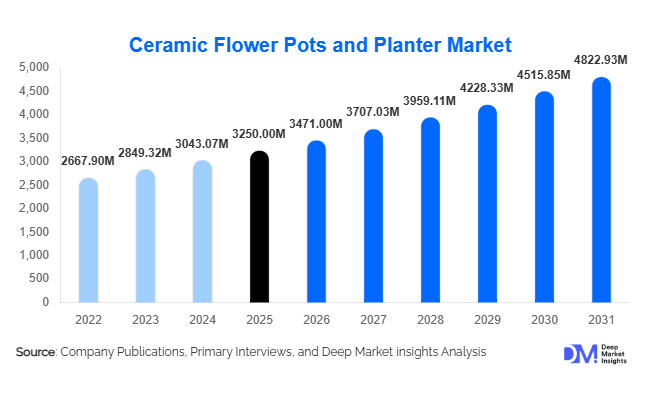
According to Deep Market Insights, the global ceramic flower pots and planter market size was valued at USD 3,250 million in 2025 and is projected to grow from USD 3,471.00 million in 2026 to reach USD 4,822.93 million by 2031, expanding at a CAGR of 6.8% during the forecast period (2026–2031). The market growth is primarily driven by increasing consumer inclination toward home décor, rising indoor gardening trends, and growing adoption of sustainable and aesthetically appealing planting solutions across residential and commercial sectors.
Key Market Insights
- Indoor gardening and home décor trends are significantly boosting demand, with ceramic planters becoming a staple in modern interior design.
- Asia-Pacific dominates the market, supported by strong manufacturing capabilities and rising domestic consumption in China and India.
- Residential end-use accounts for the majority share, driven by increasing urbanization and lifestyle upgrades.
- The mid-range pricing segment leads globally, offering a balance between affordability and design aesthetics.
- Offline retail remains dominant, though online channels are growing rapidly with over 10% annual growth.
- Sustainability and eco-friendly materials are influencing purchasing decisions, favoring ceramic over plastic alternatives.
What are the latest trends in the ceramic flower pots and planter market?
Premium and Artisanal Design Adoption
The market is witnessing a strong shift toward premium and handcrafted ceramic planters. Consumers are increasingly drawn to unique, artistic designs, including hand-painted finishes, textured glazes, and culturally inspired motifs. This trend is particularly strong in North America and Europe, where customers are willing to pay higher prices for differentiated and sustainable home décor products. Artisanal ceramics are also benefiting from the rise of social media platforms, where aesthetic appeal plays a major role in consumer purchasing behavior.
Integration of Smart and Self-Watering Features
Technological integration is emerging as a key trend, with manufacturers introducing self-watering ceramic planters that reduce maintenance for urban consumers. Some premium products are incorporating moisture sensors and IoT-based plant monitoring systems, catering to tech-savvy customers. This trend aligns with the growing demand for convenience in urban lifestyles and is expected to gain traction in developed markets where smart home ecosystems are expanding rapidly.
What are the key drivers in the ceramic flower pots and planter market?
Growth in Indoor Gardening and Urban Living
The increasing adoption of indoor plants as part of home décor and wellness practices is a major driver. Urban consumers, particularly in apartments and compact housing, prefer ceramic planters due to their aesthetic appeal and durability. The rise of biophilic design concepts, which integrate nature into indoor spaces, has further accelerated demand.
Rising Environmental Awareness
Consumers are shifting toward eco-friendly and sustainable products, positioning ceramic planters as a preferred alternative to plastic. Ceramic materials are biodegradable and environmentally safer, aligning with global sustainability goals. This shift is particularly evident in developed regions where environmental consciousness is high.
Expansion of Real Estate and Commercial Infrastructure
Growth in residential construction, hospitality, and commercial real estate is driving demand for landscaping and decorative elements. Hotels, office spaces, and public infrastructure projects increasingly incorporate greenery, boosting the use of ceramic planters for both functional and aesthetic purposes.
What are the restraints for the global market?
Fragility and High Logistics Costs
Ceramic planters are prone to breakage during transportation, leading to higher packaging costs and logistical challenges. This is particularly problematic for e-commerce channels, where returns and damages can impact profitability and customer satisfaction.
Competition from Low-Cost Alternatives
Plastic and fiber planters offer advantages such as lightweight handling, durability, and lower prices. These substitutes pose a significant challenge, especially in price-sensitive markets, limiting the penetration of ceramic products in certain regions.
What are the key opportunities in the ceramic flower pots and planter industry?
Urban Landscaping and Government Greening Initiatives
Governments across the globe are investing in urban beautification and green infrastructure projects, creating demand for durable and visually appealing planters. Ceramic planters are widely used in parks, public spaces, and smart city projects, presenting large-scale procurement opportunities for manufacturers.
Expansion of E-commerce and Direct-to-Consumer Channels
The rapid growth of online retail platforms allows manufacturers to reach global audiences without relying on traditional distribution networks. Direct-to-consumer models enable customization, better margins, and enhanced brand visibility, making this a key growth avenue for both new entrants and established players.
Report Scope
| Report Metric | Details |
|---|---|
| Market Size in 2025 | USD 3250 Million |
| Market Size in 2026 | USD 3471 Million |
| Market Size in 2031 | USD 4822.93 Million |
| CAGR | 6.8% (2026-2031) |
| Base Year for Estimation | 2025 |
| Historical Data | 2022-2024 |
| Forecast Period | 2026-2031 |
| Report Coverage | Revenue Forecast, Competitive Landscape, Supply Chain Disruption, Growth Factors, Environment & Regulatory Landscape and Trends |
| Geographies Covered | North America, Europe, APAC, Middle East and Africa, LATAM |
| Countries Covered | U.S., Canada, U.K., Germany, France, Spain, Italy, Russia, Nordic, Benelux, Rest of Europe, China, Korea, Japan, India, Australia, Singapore, Taiwan, South East Asia, Rest of Asia-Pacific, UAE, Turky, Saudi Arabia, South Africa, Egypt, Nigeria, Rest of MEA, Brazil, Mexico, Argentina, Chile, Colombia, Rest of LATAM |
Explore more data points, trends and opportunities Download Free Sample Report
Product Type Insights
Decorative planters continue to dominate the global ceramic flower pots and planter market, accounting for approximately 32% of the market share in 2025. Their leadership is driven by the growing consumer preference for home décor products that combine functionality with aesthetics. The increasing focus on premiumization and design innovation has strengthened the decorative segment, with features such as hand-painted finishes, textured glazes, and culturally inspired motifs appealing to both residential and commercial buyers. Standard flower pots remain widely used for functional purposes, while self-watering planters are emerging rapidly due to their convenience, especially among urban consumers with limited time for plant care. Large outdoor planters are primarily adopted for commercial landscaping in offices, hotels, and public spaces, whereas bonsai pots cater to niche enthusiasts who value ornamental horticulture and artisanal craftsmanship. The decorative planters segment’s growth is also supported by rising digital exposure, as social media platforms inspire consumers to integrate visually appealing plants into interior spaces, further reinforcing its market dominance.
Application Insights
Indoor planters hold the largest application share, contributing around 57% of the market in 2025. This segment’s dominance is largely fueled by urban living trends, smaller residential spaces, and the growing popularity of indoor plants for both aesthetic appeal and wellness benefits, including air purification and mental health enhancement. Commercial applications such as hotels, corporate offices, and public spaces are increasingly adopting indoor planters to create attractive and healthy environments, supporting steady growth in this segment. Outdoor planters are witnessing consistent expansion, particularly in commercial landscaping and luxury residential projects, where aesthetic design, durability, and environmental compatibility are crucial. The combined effect of rising awareness of biophilic design, health-conscious interior trends, and urbanization is reinforcing the global preference for indoor planters, while outdoor planters continue to grow in areas with strong residential landscaping and hospitality investments.
Distribution Channel Insights
Offline retail channels continue to dominate with an estimated 62% market share in 2025, as consumers prefer physically examining ceramic products due to concerns over fragility, texture, and finish quality. Key offline channels include garden centers, specialty décor stores, and home improvement outlets, which remain essential for buyers seeking immediate product availability and personalized assistance. However, online retail is emerging as the fastest-growing distribution segment, driven by convenience, product variety, competitive pricing, and access to niche artisanal and designer planters. E-commerce platforms, brand websites, and direct-to-consumer channels allow manufacturers to showcase premium and customizable offerings to a global audience, complementing offline sales. Digital marketing and social media exposure further support online growth by influencing purchase decisions and promoting innovative product designs.
End-Use Insights
The residential segment continues to lead the market, representing approximately 65% share in 2025, supported by increasing consumer expenditure on home décor, indoor gardening, and wellness-focused living spaces. Rising urbanization, apartment living, and growing interest in sustainable and aesthetic interior design are major growth drivers. The commercial segment, including hospitality, corporate offices, and real estate, is the fastest-growing segment with an estimated CAGR of 7.5%. Growth in this segment is fueled by demand for plant-based office wellness programs, landscaping for luxury residential and hospitality projects, and aesthetic enhancement of public spaces. Corporations and developers are increasingly leveraging decorative and large outdoor planters as part of branding, wellness initiatives, and client engagement strategies, making the commercial segment a high-potential growth driver globally.
Explore more data points, trends and opportunities Download Free Sample Report
Ceramic Flower Pots and Planter Market Segmentations
By Product Type
- Decorative Planters
- Standard Flower Pots
- Self-Watering Planters
- Large Outdoor Planters
- Bonsai Pots
By Application
- Indoor Planters
- Outdoor Planters
By Distribution Channel
- Offline Retail
- Online Retail
By End-Use
- Residential
- Commercial
Regional Insights
Asia-Pacific
Asia-Pacific dominates the global market with approximately 42% share in 2025, led by China and India. China serves as the largest manufacturing and export hub for ceramic planters, supported by well-established production infrastructure, cost-efficient labor, and strong domestic consumption. India is witnessing rapid demand growth due to rising disposable incomes, urbanization, and an emerging middle-class interest in home décor and wellness-oriented indoor gardening. Government initiatives promoting infrastructure development, smart cities, and residential housing projects are further supporting market expansion. The rise of e-commerce platforms and digital marketing in the region has also accelerated adoption, especially for premium, decorative, and self-watering planters. Additionally, cultural trends favoring ornamental gardening, balcony plant décor, and lifestyle-oriented indoor greenery are significant growth drivers in the region.
North America
North America accounts for approximately 24% of the global market, with the United States leading demand. High disposable income, strong consumer spending on home décor, and growing interest in indoor gardening and wellness are key drivers. Consumers in the region increasingly prefer premium and designer ceramic planters that combine aesthetics with functionality. Growth is also fueled by office wellness trends, corporate landscaping programs, and residential urban gardening projects. The popularity of self-watering and smart planters, along with eco-friendly and sustainable product preferences, further enhances market expansion. Online retail adoption and digital exposure to global design trends are supporting rapid sales growth, especially in urban and suburban regions.
Europe
Europe holds around 22% market share, with Germany, France, and the UK as key markets. Demand is driven by high consumer awareness of sustainability, eco-friendly products, and premium design aesthetics. Urbanization, small apartment living, and health-conscious interior trends further support indoor planter growth. Decorative and artisanal ceramic planters are particularly popular due to a strong cultural appreciation for craftsmanship and design. Regulatory standards related to material safety and environmental compliance also influence product adoption, as consumers favor eco-friendly and long-lasting materials. Growth is additionally propelled by hospitality and luxury real estate sectors, incorporating decorative planters into landscape and interior design.
Middle East & Africa
The Middle East & Africa are emerging markets for ceramic planters, driven by investments in luxury real estate, tourism, and urban landscaping projects. Countries such as the UAE, Saudi Arabia, and Qatar are adopting high-end decorative and large outdoor planters to enhance hotel, corporate, and public spaces. Rising disposable incomes, modern residential development, and urban beautification initiatives are key growth drivers. Decorative and indoor planters are increasingly used in commercial applications such as hotels, resorts, and corporate offices to align with wellness and aesthetic trends.
Latin America
Latin America shows steady growth, led by Brazil and Mexico, driven by expanding urban housing developments, increased disposable incomes, and rising awareness of interior décor trends. Residential adoption is supported by urban apartment living, while commercial demand is emerging in hospitality and office landscaping. Decorative planters are leading the segment, driven by a growing preference for aesthetically appealing and sustainable products. Growth is further facilitated by the adoption of international design trends and increasing e-commerce penetration in key countries.
Key Players in the Ceramic Flower Pots and Planter Market
- The HC Companies
- Fiskars Group
- Scheurich GmbH
- Deroma Group
- Lechuza
- Elho
- Pacific Home & Garden
- Bergs Potter
- Yorkshire Flowerpots
- Teraplast
- Garden Pots International
- Florentaise Group
- Keter Group
- Asian Pottery
- Jamali Garden