Cell Phone Charging Station Market Size
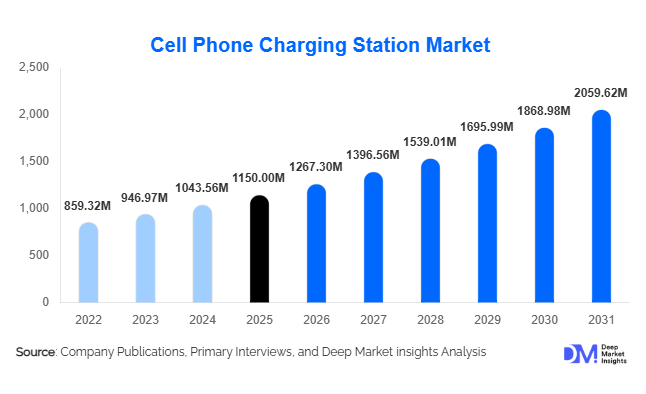
According to Deep Market Insights, the global cell phone charging station market size was valued at USD 1,150 million in 2025 and is projected to grow from USD 1,267.30 million in 2026 to reach USD 2,059.62 million by 2031, expanding at a CAGR of 10.2% during the forecast period (2026–2031). The market growth is primarily driven by the exponential rise in smartphone usage, increasing dependence on mobile connectivity, and the growing deployment of charging infrastructure across public and commercial spaces. The integration of smart technologies, such as IoT-enabled monitoring systems and digital advertising displays, is further transforming charging stations into multifunctional assets. Additionally, rapid urbanization and infrastructure expansion in emerging economies are accelerating adoption, while developed markets are focusing on advanced solutions such as wireless and fast-charging systems.
Key Market Insights
- Smart charging stations with IoT and digital advertising capabilities are gaining traction, transforming infrastructure into revenue-generating platforms.
- Transportation hubs such as airports and railway stations dominate demand, driven by high footfall and long dwell times.
- Asia-Pacific leads the global market, supported by rapid urbanization and increasing smartphone penetration.
- North America remains a mature but innovation-driven market, focusing on wireless and fast-charging technologies.
- Advertisement-supported charging stations are expanding rapidly, offering sustainable monetization models.
- Solar-powered and eco-friendly charging solutions are emerging, aligning with global sustainability goals.
What are the latest trends in the cell phone charging station market?
Integration of Smart and IoT-Enabled Charging Stations
The market is witnessing a strong shift toward smart charging stations equipped with IoT capabilities. These systems allow real-time monitoring, predictive maintenance, and remote management, significantly improving operational efficiency. Businesses are increasingly adopting these solutions to gather user data, analyze usage patterns, and optimize performance. Additionally, app-based integrations enable users to locate nearby stations, reserve charging slots, and make digital payments. This trend is particularly prominent in developed markets, where digital infrastructure supports advanced connectivity solutions.
Growth of Advertisement-Driven Charging Infrastructure
Charging stations integrated with digital displays are becoming powerful advertising platforms. Deployed in high-footfall areas such as malls, airports, and stadiums, these stations generate recurring revenue through targeted advertisements. This model allows businesses to offset installation and operational costs while enhancing customer engagement. Programmatic advertising and data analytics are further improving the effectiveness of these platforms, making them highly attractive for both advertisers and infrastructure providers.
What are the key drivers in the cell phone charging station market?
Rising Smartphone Dependency and Battery Usage
The increasing use of smartphones for activities such as streaming, gaming, digital payments, and navigation is driving demand for charging infrastructure. Battery-intensive applications are leading to frequent power depletion, making public charging stations a necessity in high-traffic environments. This trend is expected to continue as mobile devices become central to both personal and professional activities.
Expansion of Public Infrastructure and Commercial Spaces
The growth of airports, shopping malls, transportation hubs, and entertainment venues is significantly boosting the deployment of charging stations. Businesses are installing these systems to enhance customer experience, increase dwell time, and improve brand perception. In many cases, charging stations are becoming a standard amenity, similar to Wi-Fi services in public spaces.
What are the restraints for the global market?
High Installation and Maintenance Costs
Advanced charging stations, particularly those with smart features and outdoor capabilities, require significant capital investment. Costs associated with installation, weatherproofing, and maintenance can be high, limiting adoption among small and medium enterprises. This remains a key challenge for market expansion, especially in price-sensitive regions.
Security and Compatibility Concerns
Users often express concerns about data security when using public charging stations, including risks of malware and data theft. Additionally, compatibility issues across different device types and charging standards can limit usability. Addressing these concerns through standardized technologies and enhanced security protocols is essential for wider adoption.
What are the key opportunities in the cell phone charging station industry?
Smart City Infrastructure Development
Governments worldwide are investing in smart city projects, creating significant opportunities for charging station providers. These stations are being integrated into urban infrastructure as essential connectivity points, offering long-term growth potential through public-private partnerships. The ability to combine charging services with data analytics and urban management systems further enhances their value proposition.
Expansion in Emerging Markets
Rapid urbanization and increasing smartphone penetration in regions such as Asia-Pacific, Latin America, and Africa are creating strong demand for charging infrastructure. Many of these markets have limited existing infrastructure, offering first-mover advantages for new entrants. Solar-powered solutions are particularly attractive in areas with unreliable electricity supply, providing cost-effective and sustainable alternatives.
Report Scope
| Report Metric | Details |
|---|---|
| Market Size in 2025 | USD 1150 Million |
| Market Size in 2026 | USD 1267.30 Million |
| Market Size in 2031 | USD 2059.62 Million |
| CAGR | 10.2% (2026-2031) |
| Base Year for Estimation | 2025 |
| Historical Data | 2022-2024 |
| Forecast Period | 2026-2031 |
| Report Coverage | Revenue Forecast, Competitive Landscape, Supply Chain Disruption, Growth Factors, Environment & Regulatory Landscape and Trends |
| Geographies Covered | North America, Europe, APAC, Middle East and Africa, LATAM |
| Countries Covered | U.S., Canada, U.K., Germany, France, Spain, Italy, Russia, Nordic, Benelux, Rest of Europe, China, Korea, Japan, India, Australia, Singapore, Taiwan, South East Asia, Rest of Asia-Pacific, UAE, Turky, Saudi Arabia, South Africa, Egypt, Nigeria, Rest of MEA, Brazil, Mexico, Argentina, Chile, Colombia, Rest of LATAM |
Explore more data points, trends and opportunities Download Free Sample Report
Product Type Insights
Fixed charging stations continue to dominate the global market, accounting for approximately 48% of the total market share in 2025. Their leadership is primarily driven by their permanent installation in high-traffic environments such as airports, shopping malls, corporate offices, and transportation hubs, where reliability, durability, and the ability to serve multiple users simultaneously are critical. These stations are often integrated into infrastructure planning, making them a long-term utility rather than a temporary convenience. Additionally, businesses prefer fixed installations due to their potential for branding and advertisement integration, which enhances monetization opportunities.
Portable charging stations are witnessing steady growth, particularly in event-based environments such as exhibitions, concerts, and outdoor gatherings. Their flexibility, ease of deployment, and lower upfront costs make them attractive for temporary or seasonal use cases. Meanwhile, smart charging stations represent the fastest-growing segment, driven by the increasing adoption of IoT-enabled systems, real-time analytics, and digital advertising displays. These stations are transforming into multifunctional digital hubs, enabling operators to generate additional revenue streams while improving user experience. The convergence of charging infrastructure with smart city ecosystems is expected to further accelerate innovation and adoption across all product categories.
Application Insights
Wired charging remains the dominant technology segment, holding approximately 55% of the global market share in 2025. Its continued leadership is attributed to universal compatibility across devices, cost efficiency, and reliability in high-usage environments. Public and commercial installations favor wired solutions due to their ability to support multiple device types without requiring specialized hardware. Wireless charging is rapidly gaining traction, particularly in premium environments such as hotels, corporate offices, and high-end retail spaces. The convenience of cable-free charging and advancements in Qi-standard technology are driving adoption. However, its growth is currently limited by relatively slower charging speeds and higher installation costs compared to wired alternatives.
Fast-charging technologies are emerging as a critical growth driver within the application segment. With increasing demand for quick power top-ups in transit locations and busy commercial areas, fast-charging solutions are becoming essential. The integration of technologies such as Power Delivery (PD) and Quick Charge is significantly reducing charging times, enhancing user convenience, and improving station utilization rates. As consumer expectations shift toward speed and efficiency, the adoption of advanced charging technologies is expected to reshape the competitive landscape.
End-Use Industry Insights
The transportation sector leads the market, accounting for approximately 30% of the global share in 2025. This dominance is driven by high passenger volumes, extended waiting times, and the increasing need for continuous connectivity in airports, railway stations, and bus terminals. Charging stations in these environments are considered essential infrastructure, contributing to passenger satisfaction and operational efficiency. Retail and commercial spaces represent another significant segment, as businesses increasingly deploy charging stations to enhance customer experience and increase dwell time. Shopping malls, supermarkets, and large-format stores are leveraging charging infrastructure as a competitive differentiator, encouraging longer visits and higher consumer spending.
The hospitality sector is also experiencing strong growth, with hotels, restaurants, and cafes integrating charging solutions as value-added services. This trend is particularly prominent in premium and business-oriented establishments. Emerging applications in healthcare and education are further expanding the market, as mobile devices become integral to communication, diagnostics, learning, and administrative processes. The growing reliance on mobile technology across these sectors is expected to drive sustained demand for charging infrastructure.
Explore more data points, trends and opportunities Download Free Sample Report
Cell Phone Charging Station Market Segmentations
By Product Type
- Fixed Charging Stations
- Portable Charging Stations
- Smart Charging Stations
By Charging Technology
- Wired Charging
- Wireless Charging
- Fast Charging
By End-Use Industry
- Transportation & Mobility
- Retail & Commercial Spaces
- Hospitality
- Corporate & Offices
- Healthcare
- Education
By Power Source
- Grid-Powered
- Solar-Powered
- Hybrid-Powered
By Revenue Model
- Free-to-Use (Sponsored)
- Pay-Per-Use
- Subscription-Based
- Advertisement-Supported
Regional Insights
North America
North America accounts for approximately 32% of the global market share, with the United States being the primary contributor. The region’s growth is driven by high smartphone penetration, widespread adoption of advanced technologies, and a well-established public infrastructure network. The presence of major airports, large retail chains, and corporate offices has accelerated the deployment of charging stations. Additionally, the strong emphasis on customer experience and digital engagement is encouraging businesses to invest in smart charging solutions with integrated advertising capabilities. Canada is also witnessing steady growth, supported by smart city initiatives, government investments in public amenities, and increasing adoption of sustainable infrastructure solutions.
Asia-Pacific
Asia-Pacific is the largest and fastest-growing regional market, holding approximately 35% of the global share in 2025. China and India are the key contributors, driven by large populations, rapid urbanization, and rising smartphone penetration. The region benefits from extensive infrastructure development, including new airports, metro systems, and commercial complexes, which are creating strong demand for charging stations. Government-led digital transformation initiatives and the expansion of smart city projects are further accelerating market growth. India, in particular, is emerging as the fastest-growing country, with a CAGR exceeding 12%, supported by increasing investments in public infrastructure and growing consumer reliance on mobile devices for digital services.
Europe
Europe accounts for approximately 20% of the global market, with Germany, the United Kingdom, and France leading adoption. The region’s growth is strongly influenced by sustainability initiatives and regulatory frameworks promoting energy-efficient infrastructure. The increasing deployment of solar-powered and eco-friendly charging stations aligns with Europe’s broader environmental goals. Additionally, the presence of mature retail and transportation networks supports widespread adoption. Consumer preference for premium and wireless charging solutions is also driving innovation in this region, particularly in high-end commercial and hospitality environments.
Middle East & Africa
The Middle East & Africa region is experiencing robust growth, particularly in countries such as the UAE and Saudi Arabia. The market is driven by large-scale smart city projects, tourism infrastructure development, and increasing investments in public amenities. High disposable income levels and a strong focus on luxury experiences are encouraging the adoption of advanced charging solutions in the hospitality and retail sectors. In Africa, growth is supported by rising smartphone penetration and the need for reliable charging infrastructure in areas with inconsistent power supply. Solar-powered charging stations are gaining traction in this region, offering sustainable and cost-effective solutions.
Latin America
Latin America is an emerging market, with Brazil and Mexico leading demand. The region’s growth is driven by rapid urbanization, expansion of retail infrastructure, and increasing smartphone usage. Governments and private players are investing in improving public infrastructure, which is creating opportunities for charging station deployment. Additionally, the growing middle-class population and rising consumer expectations for convenience are supporting market adoption. While the market is still in its early stages compared to developed regions, it is expected to witness steady growth as infrastructure development continues and awareness of charging solutions increases.
Key Players in the Cell Phone Charging Station Market
- ChargeItSpot
- KwikBoost
- Brightbox
- Veloxity One
- ChargeTech
- ChargeBox
- InCharged
- Lux Charging Solutions
- PowerPod
- GoCharge
- FuelRod
- MobileQubes
- Zappy
- ChargePoint Services
- Envision Solar