CBD Infused Cosmetics Market Size
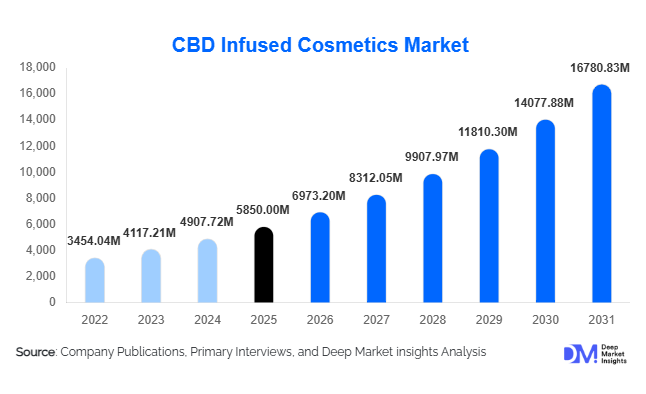
According to Deep Market Insights, the global CBD-infused cosmetics market size was valued at USD 5,850 million in 2025 and is projected to grow from USD 6,973.20 million in 2026 to reach USD 16,780.83 million by 2031, expanding at a CAGR of 19.2% during the forecast period (2026–2031). The market growth is primarily driven by increasing consumer preference for natural and plant-based ingredients, rising awareness of CBD’s therapeutic benefits in skincare, and the rapid expansion of premium and clean beauty segments globally.
Key Market Insights
- CBD-infused skincare dominates the market, driven by demand for anti-inflammatory and anti-aging benefits.
- Premium and luxury segments are expanding rapidly, supported by high consumer willingness to pay for functional beauty products.
- North America leads the global market, benefiting from regulatory support and high consumer awareness.
- Asia-Pacific is the fastest-growing region, fueled by rising disposable incomes and evolving beauty preferences.
- E-commerce platforms are the primary sales channel, enabling global reach for niche and emerging brands.
- Technological advancements in formulation, such as nano-emulsification, are improving product efficacy and differentiation.
What are the latest trends in the CBD-infused cosmetics market?
Shift Toward Clean and Functional Beauty
The CBD-infused cosmetics market is increasingly aligned with the global clean beauty movement, where consumers prioritize transparency, sustainability, and natural ingredients. CBD is being positioned as a multifunctional ingredient offering anti-inflammatory, antioxidant, and calming properties. Brands are emphasizing organic sourcing, cruelty-free formulations, and eco-friendly packaging to appeal to environmentally conscious consumers. This trend is particularly strong among millennials and Gen Z consumers who seek both efficacy and ethical product attributes. As a result, companies are reformulating existing products and launching CBD-specific product lines to cater to this growing demand.
Advanced Formulation and Delivery Technologies
Technological innovation is playing a crucial role in enhancing the effectiveness of CBD cosmetics. Techniques such as nano-emulsification and encapsulation are improving the absorption and stability of CBD in topical applications. These advancements enable manufacturers to create high-performance products with consistent quality and longer shelf life. Additionally, the integration of AI-driven personalization tools is allowing brands to offer customized skincare solutions based on individual skin types and conditions, further strengthening consumer engagement and loyalty.
What are the key drivers in the CBD-infused cosmetics market?
Rising Demand for Natural and Organic Products
Consumers are increasingly shifting away from synthetic chemicals toward plant-based alternatives, driving demand for CBD-infused cosmetics. The perception of CBD as a safe and natural ingredient with multiple skin benefits has accelerated its adoption across skincare, haircare, and body care segments. This trend is further supported by growing awareness of clean beauty and wellness-focused lifestyles.
Increasing Prevalence of Skin Disorders
The rising incidence of skin conditions such as acne, eczema, and inflammation is boosting demand for functional skincare products. CBD’s anti-inflammatory and soothing properties make it a preferred ingredient in formulations targeting these issues. Dermatology-backed endorsements and clinical studies are further enhancing consumer confidence and driving market growth.
Expansion of Digital and Direct-to-Consumer Channels
The rapid growth of e-commerce and social media marketing has significantly increased product accessibility and consumer awareness. Brands are leveraging influencer marketing, online reviews, and targeted advertising to reach a wider audience. Direct-to-consumer models allow companies to maintain higher margins while building strong brand identity and customer relationships.
What are the restraints for the global market?
Regulatory Uncertainty Across Regions
The lack of uniform regulations governing CBD usage in cosmetics remains a major challenge. While some countries permit hemp-derived CBD, others impose restrictions or lack clear guidelines, creating operational complexities for global brands and limiting market expansion.
Quality Standardization and Consumer Trust Issues
Variations in CBD sourcing, concentration, and formulation can impact product quality and efficacy. The absence of standardized testing and certification frameworks may lead to consumer skepticism, particularly in emerging markets where awareness is still developing.
What are the key opportunities in the CBD-infused cosmetics industry?
Expansion into Emerging Markets
Regulatory relaxation in regions such as the Asia-Pacific and Latin America is opening new growth avenues for CBD cosmetic products. Rising middle-class populations, increasing disposable incomes, and growing awareness of premium skincare are creating significant demand potential. Companies entering these markets early can establish a strong brand presence and capture long-term growth opportunities.
Integration with Wellness and Professional Beauty Segments
The convergence of cosmetics and wellness is creating opportunities in professional settings such as spas, dermatology clinics, and wellness centers. CBD-based treatments for relaxation, stress relief, and skin repair are gaining popularity, offering higher-margin revenue streams and recurring demand for businesses operating in these segments.
Report Scope
| Report Metric | Details |
|---|---|
| Market Size in 2025 | USD 5850 Million |
| Market Size in 2026 | USD 6973.20 Million |
| Market Size in 2031 | USD 16780.83 Million |
| CAGR | 19.2% (2026-2031) |
| Base Year for Estimation | 2025 |
| Historical Data | 2022-2024 |
| Forecast Period | 2026-2031 |
| Report Coverage | Revenue Forecast, Competitive Landscape, Supply Chain Disruption, Growth Factors, Environment & Regulatory Landscape and Trends |
| Geographies Covered | North America, Europe, APAC, Middle East and Africa, LATAM |
| Countries Covered | U.S., Canada, U.K., Germany, France, Spain, Italy, Russia, Nordic, Benelux, Rest of Europe, China, Korea, Japan, India, Australia, Singapore, Taiwan, South East Asia, Rest of Asia-Pacific, UAE, Turky, Saudi Arabia, South Africa, Egypt, Nigeria, Rest of MEA, Brazil, Mexico, Argentina, Chile, Colombia, Rest of LATAM |
Explore more data points, trends and opportunities Download Free Sample Report
Product Type Insights
Skin care products dominate the CBD-infused cosmetics market, accounting for approximately 48% of the total market share in 2025. This segment continues to lead due to strong consumer demand for multifunctional skincare solutions, particularly those addressing anti-aging, acne management, inflammation, and hydration. The inherent anti-inflammatory and antioxidant properties of CBD make it highly effective in topical skincare formulations, which has driven its widespread adoption among both premium and mass-market brands. Additionally, increasing dermatological endorsements and clinical backing have further strengthened consumer confidence in CBD-based skincare products.
Hair care and body care segments are also gaining significant traction, particularly with the introduction of CBD-infused shampoos, conditioners, lotions, and massage oils that promote scalp health, hydration, and relaxation. These segments are benefiting from the growing overlap between personal care and wellness. Meanwhile, makeup products, although still in a relatively nascent stage, are expected to witness steady growth as brands innovate with CBD-based foundations, lip balms, and hybrid cosmetic-skincare products. The expansion of “cosmeceutical” offerings, where beauty meets therapeutic benefits, is further reinforcing the dominance of skincare within this segment.
Application Insights
Therapeutic skincare applications represent the largest segment within the CBD-infused cosmetics market, driven by increasing demand for products that address inflammation, irritation, acne, and signs of aging. Consumers are increasingly viewing CBD as a functional ingredient rather than just a cosmetic additive, which has elevated its use in targeted treatment-based formulations. This segment benefits from rising awareness of skin health and the growing prevalence of dermatological concerns globally.
Relaxation and wellness-focused applications, including massage oils, aromatherapy products, and spa-based treatments, are the fastest-growing category. This growth is closely linked to the rapid expansion of the global wellness industry and increasing consumer inclination toward stress-relief and holistic self-care routines. Cosmetic enhancement applications, such as makeup and fragrances, are gradually gaining acceptance as CBD becomes more mainstream. As consumer education improves and regulatory clarity increases, these applications are expected to evolve into a significant secondary growth driver for the market.
Distribution Channel Insights
Online retail dominates the CBD-infused cosmetics market, contributing approximately 52% of total sales in 2025. This dominance is driven by the rapid growth of e-commerce platforms, direct-to-consumer (D2C) business models, and digital marketing strategies. Online channels provide brands with global reach, lower operational costs, and the ability to directly engage with consumers through personalized marketing and subscription-based offerings. The availability of detailed product information, customer reviews, and influencer endorsements further enhances consumer confidence and purchasing decisions.
Offline channels, including specialty stores, pharmacies, and salons, continue to play a critical role, particularly in premium product positioning and experiential marketing. These channels allow consumers to physically test products and receive expert recommendations, which is especially important for new and emerging product categories like CBD cosmetics. The integration of omnichannel strategies is becoming increasingly important, enabling brands to deliver a seamless and consistent customer experience across both online and offline touchpoints.
End-User Insights
Individual consumers account for the majority of demand in the CBD-infused cosmetics market, representing approximately 78% of the total market share. This dominance is driven by increasing awareness of CBD benefits, rising disposable incomes, and the growing popularity of self-care and wellness routines. Consumers are increasingly incorporating CBD-based products into their daily skincare and personal care regimens, particularly in urban and developed markets.
However, professional users such as spas, wellness centers, and dermatology clinics represent the fastest-growing segment. This growth is fueled by the rising adoption of CBD-based treatments in therapeutic and relaxation-focused applications, including facials, massages, and post-treatment skincare. The professional segment also benefits from higher product margins and repeat usage, making it an attractive growth avenue for manufacturers. As the wellness and medical aesthetics industries continue to expand, this segment is expected to play a crucial role in driving overall market growth.
Explore more data points, trends and opportunities Download Free Sample Report
CBD Infused Cosmetics Market Segmentations
By Product Type
- Skin Care Products
- Hair Care Products
- Makeup Products
- Body Care Products
- Fragrances
By Application
- Therapeutic Skincare
- Relaxation & Wellness
- Cosmetic Enhancement
By Distribution Channel
- Online Retail
- Specialty Stores
- Pharmacies/Drugstores
- Supermarkets/Hypermarkets
- Salons & Spas
By End-User
- Individual Consumers
- Professional Use
By Price Range
- Mass Market
- Premium
- Luxury
Regional Insights
North America
North America remains the largest market for CBD-infused cosmetics, accounting for approximately 42% of the global market share in 2025. The United States leads regional demand due to well-established regulatory frameworks for hemp-derived CBD, high consumer awareness, and a strong presence of leading cosmetic and CBD-focused brands. The region also benefits from a mature e-commerce ecosystem and widespread acceptance of wellness-oriented products. Additionally, increasing investments in product innovation and marketing, coupled with strong demand for premium skincare, continue to drive growth. Canada further supports regional expansion through legalized cannabis policies and a well-regulated CBD supply chain, enabling consistent product quality and availability.
Europe
Europe holds approximately 28% of the global CBD cosmetics market, with key demand centers in the UK, Germany, and France. The region’s strong emphasis on clean beauty, sustainability, and organic formulations is a major driver for CBD product adoption. Regulatory clarity surrounding hemp-derived CBD in cosmetics has improved market confidence and encouraged new product launches. Additionally, European consumers are highly inclined toward ethically sourced and environmentally friendly products, which aligns well with CBD-based offerings. The presence of established cosmetic industries and increasing investment in R&D are further accelerating market growth across the region.
Asia-Pacific
Asia-Pacific is the fastest-growing region, with a projected CAGR exceeding 21% during the forecast period. Rapid urbanization, rising disposable incomes, and increasing awareness of advanced skincare solutions are key growth drivers. Countries such as China, Japan, South Korea, and India are witnessing significant demand growth. South Korea, in particular, is leveraging its advanced skincare innovation capabilities to integrate CBD into high-performance formulations. In China, expanding e-commerce platforms and growing interest in premium imported cosmetics are driving adoption. India is emerging as a promising market due to increasing consumer awareness, a growing middle-class population, and the rapid expansion of digital retail channels. Favorable government initiatives supporting herbal and plant-based products are also contributing to regional growth.
Latin America
Latin America is an emerging market for CBD-infused cosmetics, with Brazil and Mexico leading regional demand. Growth in this region is driven by gradual regulatory relaxation, increasing consumer awareness, and expanding access to international brands through online platforms. Rising urbanization and a growing middle-class population are also contributing to higher spending on personal care and premium beauty products. Additionally, the region’s strong cultural emphasis on beauty and grooming is creating a favorable environment for the adoption of innovative cosmetic products such as CBD-based formulations.
Middle East & Africa
The Middle East & Africa region is gradually adopting CBD-infused cosmetics, with demand primarily concentrated in countries such as the UAE and South Africa. Growth in this region is driven by the expansion of luxury retail sectors, increasing tourism, and rising interest in wellness and premium beauty products. The UAE, in particular, serves as a regional hub for high-end cosmetics, supported by a strong presence of international brands and affluent consumers. In Africa, improving economic conditions and increasing urbanization are contributing to the gradual adoption of advanced personal care products. Although regulatory constraints remain a challenge, growing consumer awareness and the influence of global beauty trends are expected to support steady market growth in the coming years.
Key Players in the CBD-Infused Cosmetics Market
- Estée Lauder Companies Inc.
- L’Oréal Group
- Unilever PLC
- Cannuka LLC
- Kiehl’s
- Lord Jones
- CBD for Life
- Elixinol Global Ltd.
- Medical Marijuana Inc.
- Isodiol International Inc.
- Josie Maran Cosmetics
- Endoca BV
- Herbivore Botanicals
- Vertly
- Kapu Maku LLC