Casual Shoes Market Size
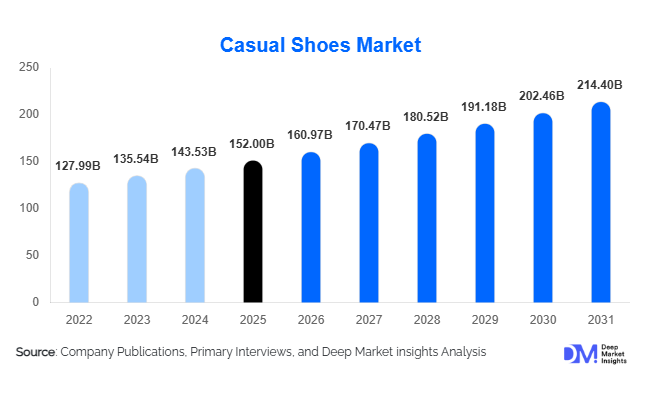
According to Deep Market Insights, the global casual shoes market size was valued at USD 152 billion in 2025 and is projected to grow from USD 160.97 billion in 2026 to reach USD 214.40 billion by 2031, expanding at a CAGR of 5.9% during the forecast period (2026–2031). The casual shoes market growth is primarily driven by increasing adoption of comfort-oriented footwear, rising influence of athleisure trends, and strong expansion of e-commerce platforms globally. Growing urbanization, rising disposable incomes, and evolving fashion preferences are further accelerating demand across both developed and emerging economies.
Key Market Insights
- Sneakers dominate the product segment, driven by the global rise of athleisure and multifunctional footwear demand.
- Online retail channels are rapidly expanding, supported by increasing smartphone penetration and digital shopping trends.
- Asia-Pacific leads the global market, fueled by a large consumer base and strong manufacturing capabilities.
- The mid-range pricing segment holds the largest share, appealing to the expanding middle-class population worldwide.
- Sustainability is becoming a key purchase driver, with growing demand for eco-friendly and recycled materials.
- Technological innovations, such as 3D knitting and lightweight materials, are transforming product design and performance.
What are the latest trends in the casual shoes market?
Sustainable Footwear Innovation
The casual shoes market is increasingly shifting toward sustainability, with manufacturers adopting eco-friendly materials such as recycled plastics, organic textiles, and bio-based leather alternatives. Consumers, particularly in Europe and North America, are showing a strong preference for environmentally responsible products. Brands are integrating circular economy practices, including take-back programs and recyclable designs, to reduce environmental impact. This trend is also supported by regulatory pressures encouraging sustainable production processes and transparency in sourcing.
Rise of Athleisure and Hybrid Fashion
Athleisure continues to redefine casual footwear, blending sports functionality with everyday fashion. Sneakers and slip-ons are increasingly used across multiple occasions, including work, travel, and leisure. Hybrid work culture has further accelerated this trend, as consumers prioritize comfort without compromising style. Brands are responding with versatile designs that combine aesthetics with ergonomic features, appealing to a broad demographic range.
What are the key drivers in the casual shoes market?
Growth of E-commerce and Digital Retail
The rapid expansion of e-commerce platforms has significantly boosted the casual shoes market. Consumers now have access to a wide range of products, competitive pricing, and personalized recommendations. Direct-to-consumer (DTC) strategies adopted by leading brands are enhancing customer engagement and improving profit margins. Digital channels also enable brands to reach untapped markets, particularly in emerging economies.
Rising Urbanization and Disposable Income
Increasing urbanization, particularly in the Asia-Pacific and Latin America, is driving demand for lifestyle products such as casual shoes. Growing middle-class populations with higher disposable incomes are spending more on fashion and comfort-oriented footwear. This trend is further supported by changing work cultures and increased social mobility.
What are the restraints for the global market?
Raw Material Price Volatility
Fluctuations in the prices of key raw materials such as leather, rubber, and synthetic fabrics pose a significant challenge for manufacturers. These variations impact production costs and profit margins, making pricing strategies more complex in a highly competitive market.
Intense Market Competition
The casual shoes market is highly fragmented, with numerous global and regional players competing for market share. Price competition, brand differentiation challenges, and the presence of counterfeit products can limit profitability and hinder growth for smaller players.
What are the key opportunities in the casual shoes industry?
Expansion in Emerging Markets
Emerging economies such as India, Indonesia, and Brazil present significant growth opportunities due to rising incomes, urbanization, and increasing fashion awareness. Local manufacturing initiatives and favorable government policies are further supporting market expansion in these regions.
Digital Customization and Personalization
Advancements in digital technologies are enabling brands to offer customized footwear solutions. Consumers can personalize designs, colors, and fit, enhancing customer satisfaction and brand loyalty. This trend is particularly popular among younger, tech-savvy consumers.
Report Scope
| Report Metric | Details |
|---|---|
| Market Size in 2025 | USD 152 Billion |
| Market Size in 2026 | USD 160.97 Billion |
| Market Size in 2031 | USD 214.40 Billion |
| CAGR | 5.9% (2026-2031) |
| Base Year for Estimation | 2025 |
| Historical Data | 2022-2024 |
| Forecast Period | 2026-2031 |
| Report Coverage | Revenue Forecast, Competitive Landscape, Supply Chain Disruption, Growth Factors, Environment & Regulatory Landscape and Trends |
| Geographies Covered | North America, Europe, APAC, Middle East and Africa, LATAM |
| Countries Covered | U.S., Canada, U.K., Germany, France, Spain, Italy, Russia, Nordic, Benelux, Rest of Europe, China, Korea, Japan, India, Australia, Singapore, Taiwan, South East Asia, Rest of Asia-Pacific, UAE, Turky, Saudi Arabia, South Africa, Egypt, Nigeria, Rest of MEA, Brazil, Mexico, Argentina, Chile, Colombia, Rest of LATAM |
Explore more data points, trends and opportunities Download Free Sample Report
Product Type Insights
Sneakers dominate the casual shoes market, accounting for approximately 42% of the total market share in 2025. This leadership is primarily driven by the global rise of athleisure, where consumers increasingly prefer footwear that seamlessly blends comfort, performance, and style. Sneakers benefit from strong adoption across all demographics, from youth to working professionals, due to their versatility for daily wear, travel, and even semi-formal settings. Continuous product innovation, including lightweight cushioning, breathable fabrics, and ergonomic designs, further strengthens demand. Additionally, collaborations between footwear brands and fashion influencers or celebrities have elevated sneakers into a lifestyle and fashion statement, reinforcing their dominant position. Slip-ons and loafers follow as popular alternatives, particularly driven by convenience, ease of wear, and increasing demand for minimalist fashion. Sandals and flip-flops maintain steady demand in tropical and emerging markets due to climatic suitability and affordability, while casual boots and moccasins cater to premium and seasonal demand, particularly in North America and Europe, where colder climates support their usage.
Material Type Insights
Textile-based footwear leads the market with around 35% share, driven by its lightweight structure, breathability, and cost-effectiveness, making it highly suitable for mass-market consumption. The increasing adoption of knit and mesh fabrics, especially in sneakers, has further accelerated this segment’s growth. Additionally, textile materials support design flexibility and color variations, aligning with fast-changing fashion trends. Leather continues to hold a strong position in the premium segment due to its durability, aesthetic appeal, and association with high-quality craftsmanship. However, synthetic materials such as rubber and EVA are witnessing strong growth due to their affordability, durability, and adaptability in high-volume manufacturing. A key emerging driver in this segment is the rapid adoption of sustainable materials, including recycled plastics and bio-based alternatives, as brands respond to regulatory pressures and growing consumer demand for environmentally responsible products.
Distribution Channel Insights
Online retail channels account for approximately 38% of the market, reflecting the rapid digital transformation of the retail landscape. The growth of e-commerce is driven by increasing smartphone penetration, improved logistics infrastructure, and the availability of multiple payment options. Consumers are increasingly attracted to online platforms due to convenience, wider product selection, competitive pricing, and personalized recommendations enabled by AI and data analytics. Direct-to-consumer (DTC) strategies adopted by major brands have further strengthened online sales by improving margins and customer engagement. Despite this shift, offline channels—including specialty stores, brand outlets, and multi-brand retailers—continue to play a crucial role, particularly in emerging markets where consumers prefer physical product trials. Offline retail also supports brand building and experiential marketing, especially for premium footwear segments.
End-Use Insights
The men’s segment leads the market with nearly 48% share, driven by higher purchase frequency, broader product availability, and strong demand for versatile footwear suitable for both casual and semi-formal settings. Men's footwear also benefits from higher average selling prices in premium categories such as leather-based casual shoes and branded sneakers. However, the women’s segment is witnessing the fastest growth, fueled by rising fashion consciousness, increasing workforce participation, and expanding product innovation tailored to women-specific designs and comfort features. The kids’ segment remains stable, supported by consistent replacement demand due to growth cycles and the need for durable, comfortable footwear. Increasing focus on ergonomic design and safety features in kids’ footwear is also contributing to steady growth in this segment.
Explore more data points, trends and opportunities Download Free Sample Report
Casual Shoes Market Segmentations
By Product Type
- Sneakers
- Slip-ons & Loafers
- Sandals & Flip-Flops
- Casual Boots
- Moccasins & Driving Shoes
- Espadrilles
By Material Type
- Leather
- Textile
- Rubber & EVA-based Materials
- Suede & Nubuck
- Sustainable Materials
By End User
- Men
- Women
- Kids
By Price Range
- Economy
- Mid-range
- Premium
By Distribution Channel
- Online Retail
- Specialty Stores
- Supermarkets & Hypermarkets
- Brand Outlets
Regional Insights
Asia-Pacific
Asia-Pacific dominates the global casual shoes market with approximately 38% share in 2025, driven by a combination of a large population base, rising disposable incomes, and strong manufacturing ecosystems. China remains the largest producer and consumer, benefiting from established supply chains and export capabilities. India is one of the fastest-growing markets, supported by rapid urbanization, an expanding middle-class population, and increasing adoption of branded footwear. Additionally, Southeast Asian countries such as Vietnam and Indonesia are emerging as key manufacturing hubs due to low labor costs and favorable government policies. The region’s growth is further accelerated by increasing e-commerce penetration and a rising youth population with a strong fashion orientation.
North America
North America accounts for around 24% of the market share, with the United States being the dominant contributor. Growth in this region is driven by high consumer purchasing power, strong brand loyalty, and continuous innovation by leading global players. The popularity of athleisure and casual workplace attire has significantly increased demand for sneakers and slip-ons. Additionally, the region benefits from a well-established retail infrastructure and an advanced e-commerce ecosystem. The growing trend of premiumization and sustainability, with consumers willing to pay higher prices for eco-friendly and high-quality products, further supports market expansion.
Europe
Europe holds approximately 20% share, led by key markets such as Germany, the UK, and France. The region is characterized by strong demand for premium and sustainable footwear, driven by environmentally conscious consumers and stringent regulatory standards. Growth is supported by increasing adoption of eco-friendly materials, circular fashion initiatives, and a high preference for quality craftsmanship. Additionally, fashion-forward consumers and the strong presence of luxury and heritage footwear brands contribute to sustained demand. Seasonal demand variations, particularly for boots and leather footwear, also play a significant role in shaping the regional market.
Latin America
Latin America contributes about 10% of the market, with Brazil and Mexico leading regional demand. Growth in this region is primarily driven by expanding urban populations, improving economic conditions, and increasing penetration of organized retail. The rising influence of global fashion trends and growing middle-class income levels are boosting demand for branded casual footwear. Additionally, the expansion of e-commerce platforms and international brand presence is enhancing product accessibility across the region.
Middle East & Africa
The Middle East & Africa region accounts for nearly 8% share, with key markets including the UAE and South Africa. Growth is driven by rising disposable incomes, increasing urbanization, and growing fashion awareness among younger populations. The Middle East benefits from a strong preference for premium and luxury footwear, supported by high-income consumers and expanding retail infrastructure. In Africa, improving economic conditions and increasing penetration of affordable footwear are driving market growth. Additionally, the expansion of international retail chains and e-commerce platforms is enhancing market accessibility across the region.