Carpet and Rugs Market Size
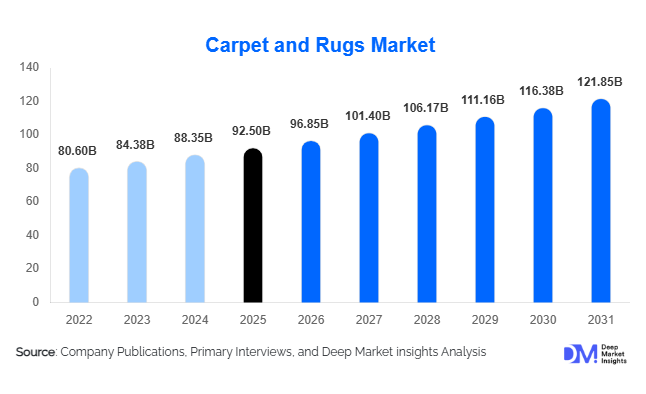
According to Deep Market Insights, the global carpet and rugs market was valued at USD 92.5 billion in 2025 and is expected to grow from USD 96.85 billion in 2026 to USD 121.85 billion by 2031, registering a CAGR of 4.7% during the forecast period (2026–2031). The carpet and rugs market growth is primarily driven by rising residential construction, increasing demand for interior décor solutions, and the expansion of commercial infrastructure, such as hospitality and office spaces. Additionally, the growing influence of e-commerce platforms and the shift toward sustainable materials are reshaping product offerings and consumer preferences globally.
Key Market Insights
- Synthetic fiber carpets dominate the market, accounting for over 60% share due to durability, affordability, and ease of maintenance.
- Residential applications lead demand, contributing more than 55% of the global market, supported by urban housing growth and home décor trends.
- Asia-Pacific dominates the global market, driven by strong production and export capabilities in China and India.
- Online retail channels are rapidly expanding, offering customization, convenience, and competitive pricing to consumers.
- Tufted carpets hold the largest product share, accounting for nearly 48% due to scalability and cost efficiency.
- Sustainability trends are accelerating, with increasing demand for natural fibers such as wool, jute, and recycled materials.
What are the latest trends in the carpet and rugs market?
Shift Toward Sustainable and Eco-Friendly Carpets
Environmental awareness is driving significant changes in the carpet and rugs industry, with manufacturers increasingly adopting sustainable materials such as recycled polyester, organic cotton, and natural fibers like wool and jute. Consumers are prioritizing low-emission and biodegradable products, prompting companies to invest in green certifications and eco-friendly production processes. This trend is particularly strong in Europe and North America, where regulatory frameworks and consumer preferences favor sustainability. Additionally, circular economy practices such as recycling old carpets into new products are gaining traction, reducing environmental impact and enhancing brand value.
Digitalization and Customization in Product Offerings
Technological advancements are transforming the way carpets and rugs are designed, manufactured, and sold. Digital printing and automated tufting technologies enable intricate designs and mass customization, allowing consumers to personalize products based on size, color, and patterns. E-commerce platforms are integrating augmented reality (AR) tools that allow customers to visualize carpets in their homes before purchase. This digital shift is expanding market reach, improving customer engagement, and enabling manufacturers to cater to niche demands efficiently.
What are the key drivers in the carpet and rugs market?
Growth in Residential Construction and Renovation
The expansion of urban housing and increasing home renovation activities are major drivers of the carpet and rugs market. Rising disposable incomes and changing lifestyles are encouraging consumers to invest in aesthetically appealing and functional interior products. In developed markets, remodeling trends are particularly strong, with homeowners upgrading flooring solutions to enhance comfort and visual appeal.
Expansion of Commercial and Hospitality Sectors
The recovery and growth of hospitality, office spaces, and retail environments are significantly boosting demand for carpets and rugs. Hotels, resorts, and corporate offices rely on carpets for their aesthetic value, comfort, and acoustic properties. The increasing number of commercial construction projects globally is expected to sustain demand in this segment.
What are the restraints for the global market?
Volatility in Raw Material Prices
Fluctuating prices of raw materials, particularly synthetic fibers derived from petrochemicals, pose a significant challenge to manufacturers. Variations in crude oil prices directly impact production costs, affecting profit margins and pricing strategies.
Competition from Alternative Flooring Solutions
The growing popularity of alternatives such as vinyl, hardwood, and laminate flooring presents a restraint for the carpet and rugs market. These materials offer durability, low maintenance, and modern aesthetics, making them attractive substitutes, especially in commercial applications.
What are the key opportunities in the carpet and rugs industry?
Emerging Market Expansion
Rapid urbanization and infrastructure development in emerging economies such as India, China, and Southeast Asia present significant growth opportunities. Increasing middle-class populations and rising disposable incomes are driving demand for affordable and mid-range carpet products, making these regions attractive for market expansion.
Growth of E-Commerce and Direct-to-Consumer Channels
The rise of online retail platforms is transforming the carpet and rugs market by enabling manufacturers to reach a global customer base. Digital platforms offer convenience, competitive pricing, and access to a wide range of designs, enhancing consumer adoption. Companies leveraging digital marketing and online customization tools are gaining a competitive edge.
Report Scope
| Report Metric | Details |
|---|---|
| Market Size in 2025 | USD 92.5 Billion |
| Market Size in 2026 | USD 96.85 Billion |
| Market Size in 2031 | USD 121.85 Billion |
| CAGR | 4.7% (2026-2031) |
| Base Year for Estimation | 2025 |
| Historical Data | 2022-2024 |
| Forecast Period | 2026-2031 |
| Report Coverage | Revenue Forecast, Competitive Landscape, Supply Chain Disruption, Growth Factors, Environment & Regulatory Landscape and Trends |
| Geographies Covered | North America, Europe, APAC, Middle East and Africa, LATAM |
| Countries Covered | U.S., Canada, U.K., Germany, France, Spain, Italy, Russia, Nordic, Benelux, Rest of Europe, China, Korea, Japan, India, Australia, Singapore, Taiwan, South East Asia, Rest of Asia-Pacific, UAE, Turky, Saudi Arabia, South Africa, Egypt, Nigeria, Rest of MEA, Brazil, Mexico, Argentina, Chile, Colombia, Rest of LATAM |
Explore more data points, trends and opportunities Download Free Sample Report
Product Type Insights
Tufted carpets continue to dominate the global carpet and rugs market, accounting for approximately 48% of the total market share in 2025. This leadership position is primarily driven by their cost efficiency, high production scalability, and design versatility. Manufacturers favor tufting technology due to its ability to produce large volumes at relatively low cost while offering a wide range of textures, patterns, and finishes. The growing demand for affordable yet aesthetically appealing flooring solutions in both residential and commercial sectors has further strengthened the dominance of tufted carpets. Additionally, advancements in automated tufting and digital patterning technologies have enhanced product customization, enabling manufacturers to meet diverse consumer preferences across regions.
Woven carpets, including Axminster and Wilton types, cater to the premium and luxury segments due to their superior durability, intricate craftsmanship, and long lifecycle. These carpets are widely used in high-end hospitality and commercial spaces where design sophistication and longevity are critical. Knotted carpets, particularly handmade variants, are valued for their artisanal appeal and cultural significance, with strong demand in export markets such as North America and Europe. Meanwhile, needle-punched carpets and hooked rugs serve niche segments, particularly in commercial and industrial applications where durability and cost-effectiveness are prioritized. Overall, the diversity in product types enables manufacturers to address a broad spectrum of price points, functional needs, and design preferences globally.
Application Insights
Floor covering remains the dominant application, accounting for over 80% of the global market share in 2025, driven by its essential role in residential and commercial interiors. Carpets are widely used for their ability to provide thermal insulation, comfort underfoot, and noise reduction, making them a preferred choice in homes, offices, and hospitality environments. The increasing focus on interior aesthetics, coupled with rising disposable incomes, has further amplified demand for carpets as a key design element in modern living spaces.
Decorative applications, including wall hangings and designer rugs, are gaining traction in premium and luxury segments, where consumers seek unique and artistic interior solutions. Acoustic insulation applications are also expanding rapidly, particularly in commercial environments such as offices, conference rooms, and auditoriums, where noise management is critical. The growing trend toward multifunctional interior solutions is encouraging manufacturers to develop carpets with enhanced properties such as stain resistance, antimicrobial coatings, and sound absorption capabilities, thereby broadening their application scope.
Distribution Channel Insights
Offline retail channels continue to dominate the market, accounting for approximately 65% of global sales in 2025. This dominance is driven by the consumer preference for physical inspection of texture, quality, and color accuracy before purchase. Specialty stores, home improvement centers, and large-format retail outlets play a crucial role in influencing buying decisions, particularly for high-value and customized products. Additionally, professional guidance from in-store experts enhances consumer confidence, especially in premium segments.
However, online retail is emerging as the fastest-growing distribution channel, supported by increasing digital adoption and changing consumer behavior. E-commerce platforms offer greater product variety, competitive pricing, and convenience, making them attractive to younger and tech-savvy consumers. The integration of advanced technologies such as augmented reality (AR) for virtual product visualization and AI-driven recommendations is further accelerating online sales. Direct-to-consumer (D2C) channels through brand-owned websites are also gaining traction, enabling manufacturers to improve margins, build brand loyalty, and offer personalized shopping experiences.
End-Use Insights
The residential segment remains the largest end-use category, contributing approximately 55% of the global market demand in 2025. This dominance is driven by rapid urbanization, increasing housing construction, and growing consumer spending on home décor. Rising middle-class populations, particularly in emerging economies, are fueling demand for affordable and mid-range carpet products, while premium segments are benefiting from renovation and interior design trends in developed markets.
The commercial segment, including hospitality, offices, and retail spaces, is the fastest-growing segment, supported by global economic recovery and expanding infrastructure development. Hotels and resorts require high-quality carpets for aesthetics and durability, while office spaces increasingly use carpets for acoustic and ergonomic benefits. Institutional applications in healthcare and education are also witnessing steady growth, as carpets contribute to comfort, safety, and noise reduction. Additionally, export-driven demand from key manufacturing hubs such as India, Turkey, and China continues to play a vital role in supporting global supply chains and market expansion.
Explore more data points, trends and opportunities Download Free Sample Report
Carpet and Rugs Market Segmentations
By Product Type
- Tufted Carpets & Rugs
- Woven Carpets (Axminster, Wilton, Flat Weave)
- Knotted Carpets (Handmade & Machine-made)
- Needle-punched Carpets
- Hooked & Braided Rugs
By Application
- Floor Covering
- Wall Décor & Decorative Use
- Acoustic Insulation
- Commercial Interior Solutions
By Distribution Channel
- Online Retail
- Specialty Stores
- Home Improvement Stores
- Hypermarkets & Supermarkets
- Direct-to-Consumer (D2C) Channels
Regional Insights
Asia-Pacific
Asia-Pacific dominates the global carpet and rugs market, accounting for approximately 38% of the market share in 2025. The region’s leadership is driven by large-scale manufacturing capabilities, strong export orientation, and rapid urbanization. China leads in machine-made carpet production due to its advanced manufacturing infrastructure and cost competitiveness, while India is a global hub for handmade carpets, benefiting from skilled labor and strong export demand. Rising disposable incomes, expanding middle-class populations, and increasing residential construction across countries such as China, India, Indonesia, and Vietnam are key growth drivers. Additionally, government initiatives promoting domestic manufacturing and exports are further strengthening the region’s position. Asia-Pacific is also the fastest-growing region, supported by a CAGR exceeding 5.5%.
North America
North America holds approximately 25% of the global market share, with the United States accounting for the majority of demand. Growth in this region is primarily driven by high consumer spending on home improvement, strong renovation trends, and demand for premium flooring solutions. The presence of leading global manufacturers and well-established distribution networks further supports market expansion. Additionally, increasing adoption of eco-friendly carpets and sustainable materials is influencing purchasing decisions. The commercial sector, particularly hospitality and corporate offices, is also contributing to demand, supported by economic recovery and infrastructure investments.
Europe
Europe accounts for around 22% of the global market, with key countries including Germany, the United Kingdom, France, and Italy. The region is characterized by strong demand for high-quality, sustainable, and design-oriented carpet products. Stringent environmental regulations and increasing consumer awareness are driving the adoption of eco-friendly materials such as wool and recycled fibers. The presence of established luxury brands and a strong focus on interior aesthetics further support market growth. Additionally, renovation activities in residential and commercial sectors are contributing to steady demand across the region.
Latin America
Latin America represents approximately 7% of the global market, led by Brazil and Mexico. Market growth in this region is driven by urbanization, expanding retail infrastructure, and increasing middle-class income levels. The demand for affordable and mid-range carpet products is particularly strong, as consumers prioritize cost-effective home improvement solutions. However, economic volatility and limited local manufacturing capabilities may moderate growth compared to other regions.
Middle East & Africa
The Middle East & Africa region accounts for approximately 8% of the global market, with key demand centers in the UAE, Saudi Arabia, and South Africa. Growth in this region is driven by large-scale infrastructure projects, luxury real estate developments, and a strong hospitality sector. Cultural preferences for carpets and rugs, particularly in Middle Eastern countries, further support demand. Additionally, increasing tourism and investments in high-end hotels and commercial spaces are boosting the adoption of premium carpet products. Africa is also witnessing gradual growth due to improving economic conditions and urban development initiatives.
Key Players in the Carpet and Rugs Market
- Mohawk Industries
- Shaw Industries Group
- Interface Inc.
- Tarkett
- Beaulieu International Group
- Oriental Weavers
- Balta Group
- Milliken & Company
- Tai Ping Carpets
- Dixie Group
- Victoria PLC
- Jaipur Rugs
- Welspun Flooring
- Brintons Carpets
- Ege Carpets