Car Air Freshener Market Size
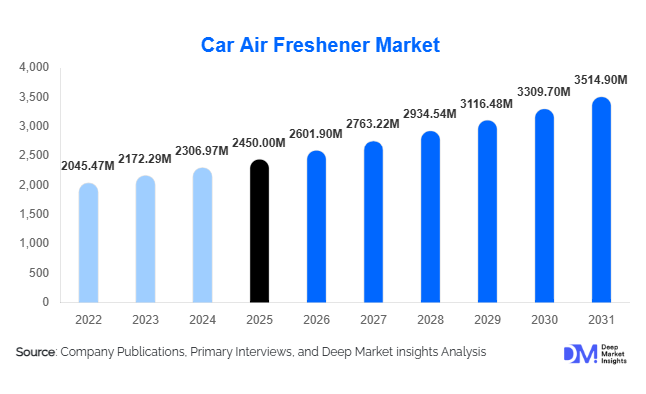
According to Deep Market Insights, the global car air freshener market size was valued at USD 2,450 million in 2025 and is projected to grow from USD 2,601.90 million in 2026 to reach USD 3,514.90 million by 2031, expanding at a CAGR of 6.2% during the forecast period (2026–2031). The car air freshener market growth is primarily driven by rising global vehicle ownership, increasing consumer awareness regarding in-car hygiene and air quality, and the growing preference for personalized driving experiences.
Key Market Insights
- Consumer preference is shifting toward natural and eco-friendly air fresheners, driven by concerns over chemical exposure and environmental sustainability.
- Mid-range and premium product segments are expanding rapidly, supported by demand for long-lasting fragrances and aesthetically appealing designs.
- Asia-Pacific dominates the global market, led by strong vehicle sales and rising disposable incomes in China and India.
- Online distribution channels are the fastest-growing segment, driven by convenience, product variety, and subscription-based purchasing models.
- Ride-sharing and fleet operators are emerging as key demand drivers, emphasizing consistent in-car fragrance for customer satisfaction.
- Technological advancements, including electric diffusers and smart fragrance systems, are reshaping product innovation.
What are the latest trends in the car air freshener market?
Shift Toward Natural and Sustainable Products
The market is experiencing a significant transition toward natural and bio-based air fresheners. Consumers are increasingly avoiding synthetic chemical-based products due to concerns over volatile organic compounds (VOCs) and potential health risks. Manufacturers are responding by introducing essential oil-based formulations, biodegradable packaging, and refillable systems. This trend is particularly strong in Europe and North America, where regulatory frameworks are becoming stricter. Sustainable branding and eco-certifications are also playing a crucial role in influencing purchasing decisions, especially among environmentally conscious consumers.
Rise of Smart and Electric Diffusers
Technological integration is transforming traditional air fresheners into smart devices. Electric and USB-powered diffusers with adjustable intensity, automated release mechanisms, and app-based controls are gaining traction. These products offer enhanced convenience and customization, appealing to tech-savvy consumers and premium vehicle owners. Integration with vehicle HVAC systems and connected car ecosystems is emerging as a future trend, enabling seamless fragrance control and improved user experience.
What are the key drivers in the car air freshener market?
Increasing Vehicle Ownership and Usage
The steady rise in global vehicle ownership, particularly in emerging economies, is a primary driver of market growth. Passenger vehicles account for the majority of demand, with increased commuting times and urban congestion further boosting the need for in-car comfort solutions. As more consumers spend extended periods in their vehicles, the demand for air fresheners continues to rise.
Growing Awareness of In-Car Hygiene
Post-pandemic consumer behavior has emphasized hygiene and cleanliness, including in-car environments. Air fresheners that offer odor elimination, antibacterial properties, and air purification benefits are gaining popularity. This shift has expanded the market beyond fragrance products to include functional air care solutions.
What are the restraints for the global market?
Health Concerns Related to Synthetic Chemicals
The presence of synthetic chemicals in many air fresheners has raised concerns regarding allergies and respiratory issues. Increasing consumer skepticism and regulatory scrutiny are challenging traditional product formulations, requiring manufacturers to invest in safer alternatives.
High Replacement Frequency and Price Sensitivity
Car air fresheners often require frequent replacement, leading to recurring costs for consumers. This creates price sensitivity, particularly in developing markets, where consumers may prefer lower-cost options or reduce usage frequency.
What are the key opportunities in the car air freshener industry?
Expansion in Emerging Markets
Emerging economies such as India, Indonesia, and Brazil present significant growth opportunities due to rising vehicle ownership and increasing disposable incomes. These markets remain underpenetrated, offering substantial potential for both local and global players. Localization of fragrance preferences and pricing strategies can enhance market penetration.
Integration with Automotive OEMs
Collaborations with automotive manufacturers to integrate air freshening systems directly into vehicles present a high-value opportunity. As in-car experience becomes a differentiator, especially in premium and electric vehicles, embedded fragrance systems can drive long-term demand and brand loyalty.
Report Scope
| Report Metric | Details |
|---|---|
| Market Size in 2025 | USD 2450 Million |
| Market Size in 2026 | USD 2601.90 Million |
| Market Size in 2031 | USD 3514.90 Million |
| CAGR | 6.2% (2026-2031) |
| Base Year for Estimation | 2025 |
| Historical Data | 2022-2024 |
| Forecast Period | 2026-2031 |
| Report Coverage | Revenue Forecast, Competitive Landscape, Supply Chain Disruption, Growth Factors, Environment & Regulatory Landscape and Trends |
| Geographies Covered | North America, Europe, APAC, Middle East and Africa, LATAM |
| Countries Covered | U.S., Canada, U.K., Germany, France, Spain, Italy, Russia, Nordic, Benelux, Rest of Europe, China, Korea, Japan, India, Australia, Singapore, Taiwan, South East Asia, Rest of Asia-Pacific, UAE, Turky, Saudi Arabia, South Africa, Egypt, Nigeria, Rest of MEA, Brazil, Mexico, Argentina, Chile, Colombia, Rest of LATAM |
Explore more data points, trends and opportunities Download Free Sample Report
Product Type Insights
Vent clip air fresheners dominate the global market, accounting for approximately 28% of the total share in 2025. Their leadership is primarily driven by superior functionality, as they utilize vehicle HVAC systems to ensure uniform fragrance distribution across the cabin. This results in higher consumer satisfaction compared to passive formats. Additionally, increasing adoption of modern vehicles with advanced air circulation systems has further supported demand for vent clips. Their compact design, ease of installation, and minimal interference with interior aesthetics make them the preferred choice among urban consumers and premium car owners.
Hanging cardboard fresheners continue to hold a significant position within the economy segment due to their low cost, high accessibility, and strong brand recall, particularly in developing markets. Gel-based and can-style fresheners are favored for their long-lasting fragrance release, making them suitable for consumers seeking low-maintenance solutions. Meanwhile, electric and USB-powered diffusers are rapidly gaining traction in the premium segment, supported by rising demand for customizable, long-duration, and technology-integrated fragrance systems. This segment is expected to witness the fastest growth due to the increasing penetration of connected and luxury vehicles.
Fragrance Type Insights
Fresh and clean fragrances lead the market with approximately 32% share in 2025, primarily due to their universal acceptance and neutral scent profiles that appeal across geographies and demographics. These fragrances are particularly preferred in shared mobility environments such as taxis and ride-sharing vehicles, where mild and non-offensive scents are critical for broad customer acceptance. The increasing emphasis on hygiene and odor elimination has further strengthened demand for this category.
Citrus and floral fragrances follow closely, driven by their refreshing, energizing, and mood-enhancing properties. These variants are particularly popular among younger consumers and in warmer climates where light fragrances are preferred. Woody and gourmet fragrances are gaining traction in premium segments, especially among consumers seeking luxury and personalized in-car experiences. Custom-blended and seasonal fragrances are emerging as a niche but high-value segment, supported by brand differentiation strategies and growing consumer inclination toward personalization.
Distribution Channel Insights
Offline retail channels dominate the market, accounting for around 60% of total sales in 2025. This dominance is driven by strong product visibility, impulse purchasing behavior, and extensive distribution networks across supermarkets, automotive accessory stores, and convenience outlets. Consumers often prefer offline channels for immediate product availability and the ability to evaluate fragrance options physically before purchase.
However, online channels are witnessing the fastest growth, supported by increasing e-commerce penetration, digital payments adoption, and the availability of a wider product range. E-commerce platforms enable consumers to access premium, imported, and niche products that may not be available in physical stores. Direct-to-consumer (D2C) channels are also gaining momentum, allowing brands to establish stronger customer relationships and improve margins. Subscription-based models for periodic replacement are emerging as a key trend, particularly in developed markets, creating recurring revenue streams and enhancing customer retention.
End-User Insights
Individual consumers dominate the market, contributing approximately 68% of total demand in 2025. This segment’s growth is closely linked to rising global passenger vehicle ownership and increasing consumer preference for enhanced in-car comfort. Frequent replacement cycles and brand loyalty further contribute to sustained demand from this segment. Ride-sharing and taxi services represent the fastest-growing end-user segment, driven by the need to maintain a pleasant in-car environment and improve customer ratings. Drivers increasingly view air fresheners as essential tools for enhancing passenger experience, directly influencing their earnings and service quality perception.
Fleet operators, including logistics and corporate transport providers, are also contributing to market expansion through bulk procurement and standardized fragrance solutions. This segment is benefiting from the growth of organized fleet services and increasing focus on vehicle maintenance and brand image.
Explore more data points, trends and opportunities Download Free Sample Report
Car Air Freshener Market Segmentations
By Product Type
- Hanging Cardboard Fresheners
- Vent Clip Fresheners
- Gel-Based Fresheners
- Spray/Aerosol Fresheners
- Electric/USB Diffusers
- Can/Container Solid Fresheners
- Passive Essential Oil Diffusers
By Fragrance Type
- Fresh/Clean
- Citrus
- Floral
- Fruity
- Woody
- Gourmet
- Custom/Seasonal Blends
By Distribution Channel
- Online Retail
- Supermarkets/Hypermarkets
- Automotive Specialty Stores
- Convenience Stores
- Direct-to-Consumer (D2C)
By End-User
- Individual Consumers
- Fleet Operators
- Ride-sharing & Taxi Services
- Corporate/Institutional Buyers
By Vehicle Type
- Passenger Vehicles
- Light Commercial Vehicles (LCVs)
- Heavy Commercial Vehicles (HCVs)
Regional Insights
Asia-Pacific
Asia-Pacific leads the global car air freshener market with approximately 38% share in 2025, driven by strong automotive production and sales across key countries such as China, India, Japan, and Southeast Asian nations. China alone contributes nearly 18% of global demand, supported by its large vehicle parc and expanding middle-class population. The region’s growth is fueled by rapid urbanization, rising disposable incomes, increasing vehicle ownership, and expanding aftermarket automotive sales. In India, the market is witnessing the fastest growth, driven by rising awareness of in-car hygiene, increasing penetration of passenger vehicles, and growing adoption of affordable air freshener products. Additionally, the presence of low-cost manufacturing hubs and strong export capabilities further strengthens the region’s market position.
North America
North America accounts for approximately 25% of the global market share, with the United States being the largest contributor. The region’s growth is driven by high consumer spending power, strong aftermarket automotive culture, and high product penetration rates. Consumers in this region demonstrate a strong preference for premium and long-lasting air fresheners, supporting higher average selling prices. Additionally, increasing awareness of health and environmental concerns is driving demand for natural and eco-friendly products. Technological adoption, including smart and electric diffusers, is also more advanced in this region, further supporting market expansion.
Europe
Europe holds approximately 22% of the global market share, led by Germany, the UK, France, and Italy. The market is characterized by strict environmental regulations and strong consumer preference for sustainable products. This has accelerated the shift toward bio-based and low-VOC air fresheners. Growth in the region is supported by high vehicle density, increasing demand for premium automotive accessories, and a strong regulatory push toward environmentally compliant products. Innovation in fragrance technology and sustainable packaging is a key differentiator for companies operating in this market.
Latin America
Latin America represents around 8% of the global market, with Brazil and Mexico as the primary contributors. Market growth is driven by rising vehicle ownership, improving economic conditions, and expanding retail distribution networks. Increasing consumer awareness regarding in-car hygiene and comfort is also supporting demand. The region shows strong potential for growth in the mid-range and economy segments due to price sensitivity, while gradual adoption of premium products is being observed in urban centers.
Middle East & Africa
The Middle East and Africa account for approximately 7% of the global market share. The UAE and Saudi Arabia lead demand in the Middle East, driven by high disposable incomes, strong luxury vehicle sales, and a preference for premium automotive accessories. In Africa, countries such as South Africa are witnessing steady growth due to urbanization, expanding automotive markets, and increasing awareness of vehicle maintenance and hygiene. The region’s growth is further supported by rising demand for luxury vehicles in the Middle East and increasing penetration of affordable air fresheners in African markets.