Calendar Stand Market Size
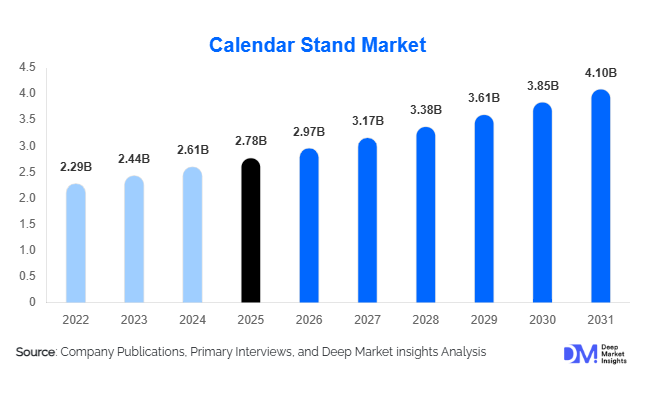
According to Deep Market Insights, the global calendar stand market size was valued at USD 2.78 billion in 2025 and is projected to grow from USD 2.97 billion in 2026 to reach USD 4.10 billion by 2031, expanding at a CAGR of 6.7% during the forecast period (2026–2031). The calendar stand market growth is primarily driven by rising corporate promotional activities, increasing demand for personalized office stationery, and the continued relevance of physical planning tools across corporate, educational, and household environments.
Calendar stands, particularly desk or tent-style calendars, remain widely used due to their convenience, visibility, and ability to combine scheduling functionality with branding opportunities. Businesses frequently distribute branded calendar stands as part of annual marketing campaigns, ensuring year-round brand exposure. The market also benefits from increasing adoption of customized and print-on-demand calendar products, which allow companies and consumers to create personalized designs with logos, photographs, or promotional messaging.
Despite the rise of digital scheduling tools, physical desk calendars continue to hold value in hybrid work environments where quick visual reference tools improve productivity. Additionally, the growing popularity of eco-friendly materials such as recycled paperboard and bamboo stands is reshaping product development. Manufacturers are also introducing designer and premium calendar stands targeted at modern home offices and luxury corporate gifting segments. These evolving consumer preferences and expanding corporate promotional budgets are expected to sustain steady growth in the calendar stand market over the next decade.
Key Market Insights
- Corporate promotional calendars remain a major demand driver, with businesses using branded calendar stands as year-round marketing tools.
- Asia-Pacific dominates global production, particularly China and India, due to large-scale printing infrastructure and cost-efficient manufacturing.
- Paperboard and cardboard materials account for the majority of production, supported by recyclability and low manufacturing costs.
- E-commerce and print-on-demand platforms are transforming the industry, enabling small businesses and consumers to create customized calendar stands.
- Eco-friendly materials are gaining traction, with growing use of recycled paper, biodegradable inks, and sustainable packaging.
- Smart and hybrid calendar stands are emerging, integrating QR codes, NFC tags, and digital scheduling connectivity.
What are the latest trends in the calendar stand market?
Rise of Personalized and Print-on-Demand Calendar Stands
Personalization has become one of the strongest trends in the calendar stand market. Businesses and consumers increasingly prefer customized calendar products that incorporate company branding, personal photographs, or creative layouts. Print-on-demand technologies have made small-batch production economically viable, enabling customers to design calendar stands through online platforms with real-time previews and template libraries. This trend is particularly strong among small businesses, marketing agencies, and individuals seeking unique desk accessories. As personalization tools become more advanced and accessible, manufacturers are investing in digital printing technologies and automated design platforms to meet rising demand for custom calendar products.
Growing Demand for Eco-Friendly and Sustainable Materials
Sustainability considerations are reshaping the calendar stand industry. Corporations and consumers are increasingly seeking products made from recycled paper, biodegradable inks, and FSC-certified materials. Eco-friendly calendar stands made from bamboo, recycled cardboard, and compostable packaging are gaining popularity, particularly in North America and Europe. Many manufacturers are redesigning production processes to reduce waste and minimize plastic usage. Sustainability certifications and carbon-neutral printing practices are also becoming important differentiators for suppliers competing in corporate procurement markets.
What are the key drivers in the calendar stand market?
Expansion of Corporate Promotional Merchandise
Corporate promotional spending is a key driver of the calendar stand market. Companies frequently distribute branded calendars to employees, partners, and customers as part of marketing campaigns. Unlike many promotional items that are used briefly, desk calendars remain visible throughout the year, providing continuous brand exposure. Industries such as banking, real estate, healthcare, and manufacturing regularly purchase calendar stands in bulk, creating a recurring annual demand cycle. This promotional utility ensures stable demand even as digital marketing channels expand.
Growth of Hybrid Work and Home Office Culture
The rise of hybrid and remote work models has increased demand for productivity tools used in home offices. Many professionals prefer physical desk calendars for quick reference and task organization without relying on digital devices. Stylish designer calendar stands have also become part of modern desk décor, blending functionality with aesthetics. As home offices continue to evolve into permanent workspaces, demand for premium and visually appealing desk accessories is expected to support long-term market growth.
What are the restraints for the global market?
Increasing Adoption of Digital Scheduling Tools
The widespread use of smartphones, cloud calendars, and productivity apps presents a challenge to the traditional calendar stand market. Digital scheduling tools offer features such as reminders, automatic synchronization, and remote accessibility that physical calendars cannot replicate. Younger professionals in particular often rely heavily on digital platforms for scheduling tasks and meetings, potentially reducing demand for physical desk calendars in some segments.
Seasonal Demand and Inventory Risks
Calendar stands are inherently seasonal products, with the majority of sales occurring during the final quarter of the year. This concentrated demand cycle creates inventory management challenges for manufacturers and retailers. Unsold calendars quickly become obsolete once the new year begins, leading to potential losses and supply chain inefficiencies. Companies must carefully balance production volumes with market demand to minimize excess inventory.
What are the key opportunities in the calendar stand industry?
Expansion of Corporate Branding and Promotional Products
The global promotional merchandise industry continues to expand, creating significant opportunities for calendar stand manufacturers. Businesses across sectors rely on promotional items that deliver long-term brand visibility. Calendar stands are particularly effective because they remain visible on desks for an entire year. Companies offering fast customization, corporate design services, and bulk production capabilities can capture a substantial share of this growing promotional products market.
Integration of Smart and Hybrid Calendar Solutions
Technological innovation is opening new possibilities in the calendar stand market. Smart calendar stands incorporating QR codes, NFC chips, or small digital displays allow users to link physical calendars with digital scheduling systems. These hybrid solutions combine the convenience of physical planning with the connectivity of modern productivity tools. Such innovations are particularly attractive to technology-driven workplaces and younger professionals seeking integrated planning solutions.
Report Scope
| Report Metric | Details |
|---|---|
| Market Size in 2025 | USD 2.78 Billion |
| Market Size in 2026 | USD 2.97 Billion |
| Market Size in 2031 | USD 4.10 Billion |
| CAGR | 6.7% (2026-2031) |
| Base Year for Estimation | 2025 |
| Historical Data | 2022-2024 |
| Forecast Period | 2026-2031 |
| Report Coverage | Revenue Forecast, Competitive Landscape, Supply Chain Disruption, Growth Factors, Environment & Regulatory Landscape and Trends |
| Geographies Covered | North America, Europe, APAC, Middle East and Africa, LATAM |
| Countries Covered | U.S., Canada, U.K., Germany, France, Spain, Italy, Russia, Nordic, Benelux, Rest of Europe, China, Korea, Japan, India, Australia, Singapore, Taiwan, South East Asia, Rest of Asia-Pacific, UAE, Turky, Saudi Arabia, South Africa, Egypt, Nigeria, Rest of MEA, Brazil, Mexico, Argentina, Chile, Colombia, Rest of LATAM |
Explore more data points, trends and opportunities Download Free Sample Report
Product Type Insights
The calendar stand market is segmented by product type into tent or flip desk calendar stands, desk pad calendar stands, perpetual calendar stands, designer calendar stands, and smart or electronic calendar stands. Tent or flip desk calendar stands currently dominate the market, accounting for nearly 46% of global calendar stand revenue. The leading position of this segment is primarily driven by its cost efficiency, compact design, and strong suitability for mass corporate distribution. These calendar stands are widely adopted by companies for promotional campaigns, employee desk use, and brand visibility programs because they provide continuous year-round exposure at a relatively low production cost. In addition, their lightweight structure and ease of customization enable printing companies and promotional product suppliers to efficiently produce high-volume orders with company branding, logos, and marketing messages. Seasonal corporate gifting and marketing campaigns conducted during the year-end period further reinforce the demand for tent or flip calendar stands across both developed and emerging markets.Desk pad calendar stands represent another important segment within the market, particularly in professional office environments where users prefer larger formats that allow for detailed daily planning, note-taking, and schedule management. These products are commonly used in administrative offices, financial institutions, and corporate workspaces where desk organization tools remain essential for productivity. The segment is also supported by increasing demand for multifunctional desk accessories that combine planning space with visual date tracking.
Perpetual calendar stands form a niche but stable category, typically manufactured using durable materials such as metal, acrylic, or wood. These products are positioned as decorative desk accessories rather than disposable calendars and are favored by premium consumers who prefer long-lasting items that do not require annual replacement. Corporate gifting programs and executive desk accessories contribute to steady demand in this segment, particularly in developed markets where aesthetic office decor is valued.Designer calendar stands are gaining popularity among home office users, creative professionals, and companies seeking visually distinctive promotional items. These products often incorporate artistic layouts, premium materials, or innovative stand designs that enhance desk aesthetics while maintaining functionality. The rapid growth of remote work and home office setups in recent years has further increased demand for visually appealing workspace accessories, benefiting this segment.Smart or electronic calendar stands represent an emerging niche within the market. These products integrate digital display technology, connectivity features, and synchronization with online calendars, allowing users to manage schedules dynamically. While still a relatively small share of the market, this segment is expected to experience gradual growth as smart desk accessories and connected office devices become more prevalent in technologically advanced workplaces.
Application Insights
The application landscape of the calendar stand market includes corporate offices, household and personal use, educational institutions, hospitality businesses, and marketing or promotional campaigns. Corporate offices remain the largest application segment, accounting for nearly 40% of global demand. The dominance of this segment is driven by the widespread use of desk calendars as both functional planning tools and promotional marketing materials. Many companies distribute branded calendar stands to employees, clients, and business partners as part of annual marketing strategies. These products provide continuous brand visibility throughout the year while also serving a practical workplace function. Bulk purchasing by corporate organizations significantly contributes to the scale of demand in this segment.Household and personal use accounts for approximately 28% of market demand, supported by consumers who rely on desk calendars for daily scheduling, task planning, and home organization. Even as digital calendar applications become more common, many individuals continue to prefer physical desk calendars because they provide quick visual access to dates and reminders without requiring electronic devices. The growth of home office environments and remote work arrangements has further reinforced the use of desk accessories such as calendar stands in personal workspaces.
Educational institutions represent another important application segment. Schools, colleges, and universities frequently distribute academic calendars, event schedules, and branded desk calendars to students, faculty members, and administrative staff. These calendars help coordinate academic timelines, examinations, and institutional events while also serving as promotional materials that reinforce institutional identity.The hospitality sector, including hotels, travel agencies, and tourism service providers, also utilizes customized calendar stands as promotional tools. These organizations often distribute branded calendars to customers as part of loyalty programs or marketing initiatives, helping maintain brand visibility throughout the year. Similarly, marketing agencies and corporate gifting programs are expanding the use of premium designer calendar stands for client engagement, employee recognition, and seasonal promotional campaigns. The growing emphasis on relationship marketing and branded merchandise continues to support the expansion of these applications.
Distribution Channel Insights
The distribution of calendar stands occurs through a combination of offline retail channels, online platforms, and corporate direct sales networks. Offline retail channels currently dominate the market, accounting for roughly 44% of global distribution. Traditional stationery stores, bookstores, office supply retailers, and printing shops remain key sales outlets, particularly during the final quarter of the year when seasonal calendar purchases peak. Many consumers and businesses prefer purchasing calendars through physical retail outlets because it allows them to evaluate design quality, paper texture, and print clarity before making a purchase.Online distribution channels are experiencing rapid growth as digital commerce expands across both developed and emerging markets. E-commerce marketplaces, specialized stationery websites, and print-on-demand platforms allow customers to easily order customized calendar stands with personalized graphics, branding elements, or photographs. Online channels also provide broader product variety and convenience, particularly for individual consumers and small businesses seeking limited-volume customized orders.Corporate direct sales represent another critical distribution channel within the market. Printing companies, promotional merchandise suppliers, and advertising agencies frequently work directly with corporate clients to produce large-volume customized calendar stands. These direct business-to-business transactions often involve tailored design services, bulk manufacturing, and integrated branding solutions. As a result, direct sales channels play a vital role in fulfilling high-volume orders associated with corporate promotional campaigns and employee gifting programs.
Explore more data points, trends and opportunities Download Free Sample Report
Calendar Stand Market Segmentations
By Product Type
- Tent / Flip Desk Calendar Stands
- Desk Pad Calendar Stands
- Perpetual Calendar Stands
- Premium Designer Calendar Stands
- Smart / Electronic Calendar Stands
By Material
- Paperboard / Cardboard
- Plastic
- Metal
- Wood / Bamboo
- Hybrid or Composite Materials
By Distribution Channel
- Offline Retail
- Corporate Direct Sales
- Online Retail / E-commerce
- Print-on-Demand Platforms
By End-Use
- Corporate Offices & Businesses
- Household / Personal Use
- Educational Institutions
- Hospitality & Commercial Establishments
- Promotional Marketing & Corporate Gifting
Regional Insights
North America
North America accounts for approximately 27% of the global calendar stand market. The United States represents the largest market in the region due to its strong corporate promotional spending, established office supply industry, and well-developed retail distribution networks. Businesses across sectors frequently distribute branded desk calendars to employees, clients, and partners as part of annual marketing and relationship-building initiatives. This consistent corporate purchasing cycle represents a key driver of regional demand. Additionally, the presence of large printing companies, promotional merchandise suppliers, and office supply chains supports efficient distribution and customization services throughout the region. Canada also contributes significantly to market demand, particularly through small and medium-sized businesses that utilize branded desk calendars for local marketing campaigns and client engagement programs. The continued popularity of physical desk accessories in professional workspaces further supports stable market demand across North America.
Europe
Europe holds nearly 23% of the global calendar stand market share, with Germany, the United Kingdom, and France representing the largest national markets. The region demonstrates strong consumer appreciation for artistic and designer stationery products, which contributes to demand for aesthetically distinctive calendar stands featuring photography, artwork, and premium design elements. A major driver of regional market growth is the increasing emphasis on sustainability and environmentally responsible product manufacturing. European consumers and businesses often prefer calendars produced using recycled paper, biodegradable materials, and eco-friendly printing processes. Additionally, strong corporate gifting traditions in several European countries support annual demand for branded desk calendars distributed during the holiday season. The presence of established publishing and printing industries across Western Europe further strengthens regional production capabilities and product innovation.
Asia-Pacific
Asia-Pacific represents the largest production hub for calendar stands and accounts for roughly 38% of the global market. China and India dominate manufacturing within the region due to their extensive printing infrastructure, large labor force, and competitive production costs. These countries export significant volumes of calendar products to markets in North America and Europe, making the region a critical component of global supply chains. In addition to manufacturing strength, the region is experiencing rapid demand growth driven by expanding corporate sectors, rising small business marketing activities, and increasing adoption of promotional merchandise. Japan and South Korea represent high-value markets within Asia-Pacific where consumers show strong demand for premium designer calendar stands and innovative desk accessories. The growing number of startups and corporate offices across emerging economies in Southeast Asia and India is further contributing to market expansion. As a result of these factors, Asia-Pacific is the fastest-growing regional market and is projected to expand at a CAGR of nearly 7.8% through 2031.
Latin America
Latin America accounts for approximately 6% of global calendar stand demand, led primarily by Brazil and Mexico. Corporate promotional campaigns remain a key driver of demand across the region as businesses increasingly utilize branded desk calendars as cost-effective marketing tools. The steady expansion of small and medium-sized enterprises is also contributing to market growth, as these organizations adopt promotional merchandise to strengthen customer relationships and brand recognition. Additionally, the growing retail stationery sector in major urban centers is improving product accessibility for both individual consumers and businesses. Seasonal promotional campaigns and year-end marketing activities continue to stimulate sales across the region.
Middle East & Africa
The Middle East and Africa collectively represent about 6% of the global calendar stand market. Demand within the Middle East is primarily concentrated in countries such as the United Arab Emirates and Saudi Arabia, where strong corporate marketing expenditure and expanding hospitality industries create demand for customized promotional materials. Hotels, travel agencies, and corporate service providers frequently distribute branded desk calendars to clients as part of marketing and relationship management strategies. In Africa, market demand is supported by educational institutions, government organizations, and local businesses that distribute printed calendars annually for administrative coordination and promotional purposes. Increasing business activity, urbanization, and improvements in local printing infrastructure are gradually strengthening market growth across several African economies.
Key Players in the Calendar Stand Market
- Cimpress (Vistaprint)
- Hallmark Cards
- American Calendar Company
- House of Doolittle
- IG Design Group
- Navitor Inc.
- Warwick Publishing
- Goslen Printing Company
- New England Calendar Company
- Cavallini Papers & Co.
- BrownTrout Publishers
- Andrews McMeel Publishing
- Turner Licensing
- Calendar Company LLC
- Blueline (Rediform)