Cake Mold Market Size
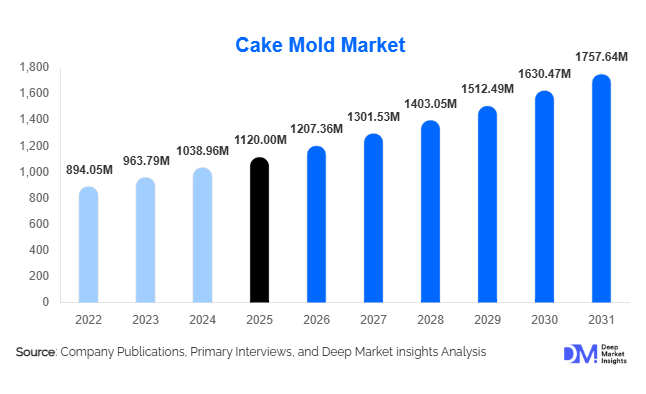
According to Deep Market Insights, the global cake mold market size was valued at USD 1,120 million in 2025 and is projected to grow from USD 1,207.36 million in 2026 to reach USD 1,757.64 million by 2031, expanding at a CAGR of 7.8% during the forecast period (2026–2031). The cake mold market growth is primarily driven by the rising popularity of home baking, expansion of the global bakery industry, and increasing demand for aesthetically appealing baked products across both household and commercial segments.
Key Market Insights
- Home baking trends continue to surge globally, supported by social media influence and growing interest in DIY food preparation.
- Commercial bakeries dominate demand, accounting for nearly 60% of total consumption due to bulk procurement needs.
- Non-stick coated molds lead the market, capturing over 55% share owing to ease of use and improved baking outcomes.
- Asia-Pacific is the fastest-growing region, driven by urbanization and expansion of bakery chains in India and China.
- Online retail channels are expanding rapidly, enabling wider product accessibility and customization options.
- Product innovation in silicone and eco-friendly materials is reshaping consumer preferences and driving premiumization.
What are the latest trends in the cake mold market?
Shift Toward Silicone and Flexible Bakeware
Silicone cake molds are gaining strong traction due to their flexibility, non-stick properties, and ease of cleaning. These molds eliminate the need for greasing and enable effortless removal of baked products, making them highly popular among home bakers. Manufacturers are increasingly introducing BPA-free, food-grade silicone products that can withstand extreme temperatures, catering to both amateur and professional users. The rising preference for lightweight and space-saving kitchen tools is further accelerating the adoption of silicone molds globally.
Rising Demand for Specialty and Novelty Molds
The growing influence of social media platforms has significantly increased demand for uniquely shaped and decorative cakes. Consumers are seeking molds that enable intricate designs, including bundt shapes, themed molds, and multi-tier configurations. This trend is particularly prominent among younger consumers and home-based baking entrepreneurs who prioritize visual appeal for content creation and business differentiation. Manufacturers are responding by expanding product portfolios with innovative and customizable designs.
What are the key drivers in the cake mold market?
Expansion of the Global Bakery Industry
The steady growth of the global bakery sector, valued at over USD 500 billion, is a major driver for cake mold demand. Increasing consumption of cakes, pastries, and desserts across urban populations is driving bulk demand from commercial bakeries and foodservice providers. Industrial bakeries require durable and high-performance molds to ensure consistency and efficiency, further boosting market growth.
Growing Popularity of Home Baking
The rise of home baking as a hobby and side business has significantly expanded the consumer base for cake molds. Factors such as increased time spent at home, availability of online tutorials, and growing interest in personalized food experiences have contributed to this trend. The demand for user-friendly, affordable, and versatile baking tools continues to rise, particularly in emerging markets.
What are the restraints for the global market?
Fluctuating Raw Material Prices
Volatility in the prices of raw materials such as aluminum, steel, and silicone impacts manufacturing costs and pricing strategies. These fluctuations can lead to higher product prices, affecting demand in price-sensitive markets and reducing profit margins for manufacturers.
Presence of Low-Cost Unorganized Players
The availability of low-cost, unbranded, and counterfeit products poses a significant challenge to established manufacturers. These products often compromise on quality and durability, creating pricing pressure and impacting brand reputation in emerging markets.
What are the key opportunities in the cake mold industry?
Adoption of Sustainable and Eco-Friendly Materials
The increasing focus on sustainability presents a major opportunity for manufacturers to develop eco-friendly cake molds. Products made from recyclable metals, biodegradable materials, and non-toxic coatings are gaining popularity, especially in environmentally conscious markets such as Europe and North America. Companies investing in sustainable production practices can enhance brand value and meet regulatory requirements.
Growth of E-commerce and Direct-to-Consumer Channels
The rapid expansion of online retail platforms is enabling manufacturers to reach a broader customer base. E-commerce allows for greater product visibility, competitive pricing, and access to niche markets. Direct-to-consumer strategies, supported by digital marketing and influencer collaborations, are helping brands engage with younger demographics and increase sales.
Report Scope
| Report Metric | Details |
|---|---|
| Market Size in 2025 | USD 1120 Million |
| Market Size in 2026 | USD 1207.36 Million |
| Market Size in 2031 | USD 1757.64 Million |
| CAGR | 7.8% (2026-2031) |
| Base Year for Estimation | 2025 |
| Historical Data | 2022-2024 |
| Forecast Period | 2026-2031 |
| Report Coverage | Revenue Forecast, Competitive Landscape, Supply Chain Disruption, Growth Factors, Environment & Regulatory Landscape and Trends |
| Geographies Covered | North America, Europe, APAC, Middle East and Africa, LATAM |
| Countries Covered | U.S., Canada, U.K., Germany, France, Spain, Italy, Russia, Nordic, Benelux, Rest of Europe, China, Korea, Japan, India, Australia, Singapore, Taiwan, South East Asia, Rest of Asia-Pacific, UAE, Turky, Saudi Arabia, South Africa, Egypt, Nigeria, Rest of MEA, Brazil, Mexico, Argentina, Chile, Colombia, Rest of LATAM |
Explore more data points, trends and opportunities Download Free Sample Report
Product Type Insights
Standard cake pans continue to dominate the global market, accounting for approximately 38% of the total share, primarily driven by their extensive usage across both household and commercial baking applications. The consistent demand for round, square, and rectangular pans stems from their versatility, ease of use, and suitability for a wide range of baked products including sponge cakes, layered cakes, and everyday desserts. The leading segment driver for standard cake pans is their universal applicability and frequent replacement demand, particularly in commercial kitchens where wear and tear is high. Meanwhile, specialty molds such as bundt pans, springform pans, and novelty-shaped molds are witnessing accelerated growth as consumers increasingly seek aesthetically appealing and customized baked goods. This trend is further fueled by the rising influence of social media baking trends and home-based cake businesses. Additionally, cupcake and muffin trays represent a strong and steadily growing segment, supported by the increasing popularity of portion-controlled desserts, on-the-go snacking, and the expansion of café chains and quick-service bakeries.
Material Type Insights
Metal cake molds lead the market with an estimated 42% share, driven by their superior durability, excellent heat conductivity, and suitability for high-volume baking operations. Aluminum and carbon steel remain the most preferred materials due to their ability to ensure uniform baking and consistent product quality, making them indispensable in commercial settings. The leading segment driver for metal molds is their efficiency in delivering precise baking results, which is critical for professional bakers and large-scale foodservice providers. In contrast, silicone molds are rapidly gaining traction, particularly among home bakers, due to their flexibility, non-stick properties, and ease of cleaning. These molds also support intricate designs, aligning with the growing trend of decorative baking. Glass and ceramic molds cater to niche but stable segments, where consumers prioritize aesthetic presentation, oven-to-table convenience, and multi-functional usage. These materials are especially popular in premium households and boutique bakeries.
Coating Type Insights
Non-stick coated molds dominate the market with over 55% share, largely due to their ability to enhance baking efficiency and simplify product release. The leading segment driver for this category is the convenience factor, as non-stick coatings significantly reduce the need for greasing agents such as oil or butter, aligning with the preferences of health-conscious consumers. These coatings also contribute to better product appearance and reduced cleaning time, making them highly desirable in both household and commercial applications. Emerging alternatives such as ceramic-coated and silicone-coated molds are gaining attention for their improved durability, scratch resistance, and environmentally friendly attributes. As sustainability becomes a key consideration, manufacturers are increasingly focusing on developing coatings that are free from harmful chemicals, further boosting adoption of advanced coating technologies.
End-Use Insights
The commercial segment accounts for the largest share of approximately 60%, driven by robust demand from bakeries, hotels, restaurants, and large-scale foodservice providers. The leading segment driver for commercial usage is the need for high-capacity, durable, and performance-oriented bakeware that can withstand continuous usage while maintaining consistent quality. The rapid expansion of bakery chains, café culture, and food delivery platforms has further amplified demand within this segment. On the other hand, the household segment is emerging as the fastest-growing category, supported by the rising popularity of baking as a recreational activity and a viable source of income. The growth of home-based baking businesses, particularly in urban areas, along with the influence of digital content and baking tutorials, has significantly increased product adoption. Additionally, the emergence of cloud kitchens and small-scale entrepreneurs is creating new growth avenues, bridging the gap between household and commercial usage.
Distribution Channel Insights
Offline retail channels dominate the market with approximately 65% share, encompassing supermarkets, hypermarkets, specialty kitchen stores, and departmental outlets. The leading segment driver for offline distribution is the ability for consumers to physically evaluate product quality, size, and material before purchase, which remains a critical factor for bakeware products. Strong retail networks and in-store promotions further support sales through this channel. However, online distribution channels are experiencing rapid growth, driven by increasing internet penetration, convenience, and access to a wider variety of products and brands. E-commerce platforms offer competitive pricing, detailed product descriptions, and customer reviews, which significantly influence purchasing decisions. The growing preference for online shopping among younger demographics and urban consumers is expected to further accelerate the shift toward digital retail channels.
Explore more data points, trends and opportunities Download Free Sample Report
Cake Mold Market Segmentations
By Material Type
- Metal Cake Molds
- Silicone Cake Molds
- Glass Cake Molds
- Ceramic Cake Molds
- Plastic Cake Molds
By Product Type
- Standard Cake Pans
- Specialty Cake Molds
- Cupcake & Muffin Trays
- Multi-Cavity Baking Molds
By Coating Type
- Non-stick Coated
- Uncoated
- Ceramic-Coated
- Silicone-Coated
By End-User
- Household/Residential
- Commercial
By Distribution Channel
- Online Retail
- Supermarkets/Hypermarkets
- Specialty Kitchen Stores
- Brand-Owned Stores/Websites
Regional Insights
North America
North America holds approximately 32% of the global market share, with the United States leading regional demand. Market growth in this region is driven by a well-established baking culture, high consumer spending capacity, and strong demand for premium and innovative bakeware products. Additionally, the increasing trend of home baking, particularly post-pandemic, continues to support market expansion. The presence of leading manufacturers, continuous product innovation, and a highly developed retail infrastructure further enhance market penetration. Regional growth is also supported by the rising popularity of specialty baking, including gluten-free and organic products, which drives demand for high-quality and non-toxic bakeware solutions.
Europe
Europe accounts for approximately 28% of the global market, with key contributions from countries such as Germany, France, and the United Kingdom. The region is characterized by a strong emphasis on quality, sustainability, and craftsmanship, which significantly influences consumer purchasing behavior. Growth in Europe is driven by increasing demand for eco-friendly and durable bakeware, along with a rising interest in artisanal and homemade baked goods. Regulatory support for sustainable manufacturing practices and the growing popularity of premium kitchenware products further contribute to market expansion. Additionally, cultural traditions associated with baking and confectionery play a vital role in maintaining steady demand across the region.
Asia-Pacific
Asia-Pacific is the fastest-growing regional market, with countries such as India and China serving as key growth engines. Rapid urbanization, rising disposable incomes, and changing lifestyle patterns are significantly driving demand for baking products and equipment. One of the primary regional growth drivers is the increasing adoption of Western food habits, including cakes and pastries, particularly among younger populations. The expansion of organized retail and bakery chains, coupled with the surge in home baking activities, further accelerates market growth. In India, the market is expected to grow at a CAGR exceeding 9%, supported by the rise of home-based baking businesses, social media influence, and increasing entrepreneurial activities in the food sector. Government initiatives supporting small businesses and the rapid growth of e-commerce platforms also contribute to regional expansion.
Latin America
Latin America is experiencing moderate growth, with Brazil and Mexico leading regional demand. The market is driven by increasing consumption of baked goods, urbanization, and the gradual expansion of modern retail infrastructure. Regional growth is further supported by the rising number of local bakeries and small-scale food businesses, which are adopting cost-effective and durable bakeware solutions. Cultural preferences for sweet baked products and desserts also play a significant role in sustaining demand. Additionally, improving economic conditions and growing middle-class populations are expected to enhance market potential in the coming years.
Middle East & Africa
The Middle East & Africa region is emerging as a promising growth market, driven by the rapid expansion of the hospitality and tourism sectors. Countries such as the UAE and South Africa are at the forefront of regional demand, supported by increasing investments in hotels, restaurants, and catering services. A key regional growth driver is the rising demand for premium and customized baked products, particularly in urban centers. Changing consumer lifestyles, increasing expatriate populations, and growing exposure to international cuisines are further boosting market growth. Additionally, the gradual development of retail infrastructure and increasing adoption of modern kitchen appliances are expected to create new opportunities for market expansion across the region.
Key Players in the Cake Mold Market
- Wilton Brands
- Nordic Ware
- Groupe SEB
- Meyer Corporation
- Tupperware Brands
- Silikomart
- Fat Daddio’s
- Chicago Metallic
- Paderno World Cuisine
- Tramontina
- Cuisinart
- Calphalon
- Pyrex
- Kaiser Bakeware
- Le Creuset