Built-In Home Appliances Market Size
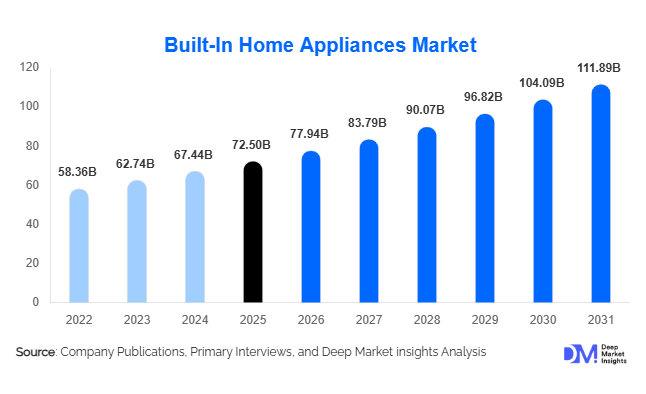
According to Deep Market Insights, the global built-in home appliances market size was valued at USD 72.5 billion in 2025 and is projected to grow from USD 77.94 billion in 2026 to reach USD 111.89 billion by 2031, expanding at a CAGR of 7.5% during the forecast period (2026–2031). The market growth is primarily driven by increasing adoption of modular kitchens, rising urbanization, and growing consumer preference for premium, space-efficient, and aesthetically integrated appliances. Additionally, advancements in smart and connected appliances, coupled with increasing disposable incomes across emerging economies, are accelerating demand globally.
Key Market Insights
- Built-in appliances are increasingly becoming a standard in modular kitchens, particularly in urban residential developments worldwide.
- Smart and IoT-enabled appliances are gaining rapid traction, accounting for a growing share of premium product demand.
- Europe dominates the global market, driven by strong adoption of integrated kitchen designs and high consumer purchasing power.
- Asia-Pacific is the fastest-growing region, fueled by rapid urbanization and expanding middle-class populations.
- Residential applications account for the majority share, supported by new housing and renovation activities.
- Premiumization trends are reshaping product offerings, with increasing demand for luxury appliances such as built-in coffee machines and wine coolers.
What are the latest trends in the built-in home appliances market?
Smart and Connected Kitchen Ecosystems
The integration of smart technologies into built-in appliances is transforming modern kitchens into connected ecosystems. Consumers are increasingly adopting appliances that can be controlled through smartphones, voice assistants, and home automation systems. Features such as remote monitoring, predictive maintenance, and energy optimization are enhancing convenience and efficiency. Manufacturers are focusing on interoperability across devices, enabling seamless communication between ovens, refrigerators, and dishwashers. This trend is particularly strong in developed markets, where smart home adoption is accelerating.
Premiumization and Custom Kitchen Designs
There is a growing shift toward premium and customized kitchen solutions, particularly in high-income households. Consumers are investing in luxury built-in appliances that offer both functionality and aesthetic appeal. Products such as steam ovens, wine coolers, and integrated coffee machines are gaining popularity. Real estate developers are increasingly partnering with appliance manufacturers to offer fully equipped modular kitchens as part of premium housing projects. This trend is contributing to higher average selling prices and improved profit margins for manufacturers.
What are the key drivers in the built-in home appliances market?
Expansion of Modular Kitchen Installations
The rapid adoption of modular kitchens globally is a major driver of demand for built-in appliances. These appliances are designed to integrate seamlessly with cabinetry, offering space optimization and a clean aesthetic. Urban housing projects and modern residential developments are increasingly incorporating modular kitchens as a standard feature, boosting market growth.
Rising Disposable Income and Lifestyle Upgrades
Increasing income levels, particularly in emerging economies, are enabling consumers to invest in premium home appliances. Built-in appliances are increasingly viewed as lifestyle upgrades that enhance convenience, efficiency, and home value. This shift in consumer perception is driving higher adoption rates.
Technological Advancements in Appliances
Continuous innovation in appliance technology, including AI integration, energy-efficient systems, and smart connectivity, is driving replacement demand. Consumers are upgrading older appliances to benefit from advanced features, contributing to sustained market growth.
What are the restraints for the global market?
High Initial Costs and Installation Complexity
Built-in appliances require a higher upfront investment compared to freestanding alternatives. Additionally, installation involves customization and professional services, increasing overall costs. This acts as a barrier, particularly in price-sensitive markets.
Limited Flexibility in Existing Infrastructure
Retrofitting built-in appliances in traditional kitchens can be challenging due to structural limitations. This restricts adoption in older residential properties and slows market penetration in certain regions.
What are the key opportunities in the built-in home appliances industry?
Growth in Emerging Urban Markets
Rapid urbanization in countries such as India, China, and Southeast Asian nations presents significant growth opportunities. Rising middle-class populations and increasing housing developments are driving demand for modular kitchens and built-in appliances.
Integration with Smart Home Technologies
The increasing adoption of smart homes offers a major opportunity for manufacturers to develop connected appliances. Integration with IoT ecosystems can enhance user experience and create new revenue streams through software and services.
Expansion of Premium and Luxury Segments
Demand for high-end appliances is growing globally, particularly in developed markets and among affluent consumers in emerging economies. Manufacturers can capitalize on this trend by offering customized, design-focused, and technologically advanced products.
Report Scope
| Report Metric | Details |
|---|---|
| Market Size in 2025 | USD 72.5 Billion |
| Market Size in 2026 | USD 77.94 Billion |
| Market Size in 2031 | USD 111.89 Billion |
| CAGR | 7.5% (2026-2031) |
| Base Year for Estimation | 2025 |
| Historical Data | 2022-2024 |
| Forecast Period | 2026-2031 |
| Report Coverage | Revenue Forecast, Competitive Landscape, Supply Chain Disruption, Growth Factors, Environment & Regulatory Landscape and Trends |
| Geographies Covered | North America, Europe, APAC, Middle East and Africa, LATAM |
| Countries Covered | U.S., Canada, U.K., Germany, France, Spain, Italy, Russia, Nordic, Benelux, Rest of Europe, China, Korea, Japan, India, Australia, Singapore, Taiwan, South East Asia, Rest of Asia-Pacific, UAE, Turky, Saudi Arabia, South Africa, Egypt, Nigeria, Rest of MEA, Brazil, Mexico, Argentina, Chile, Colombia, Rest of LATAM |
Explore more data points, trends and opportunities Download Free Sample Report
Product Type Insights
Built-in ovens continue to dominate the product segment, accounting for approximately 22% of the global market share in 2025. Their leadership position is primarily driven by their universal application across both residential and commercial kitchens, making them a core component of modern modular kitchen setups. The growing popularity of home cooking, baking, and multifunctional cooking appliances, particularly post-pandemic, has significantly boosted demand. Additionally, technological advancements such as steam cooking, convection features, and smart controls are enhancing product appeal. Built-in cooktops and hobs represent the next largest category, driven by the global shift toward energy-efficient and induction-based cooking solutions, particularly in urban households. Meanwhile, built-in refrigeration appliances, including premium refrigerators and wine coolers, are gaining traction in luxury housing segments due to increasing consumer preference for high-end, aesthetically integrated kitchen solutions and lifestyle-oriented appliances.
Technology Insights
Smart and connected appliances lead the technology segment, accounting for nearly 35% of the market share in 2025, and are also the fastest-growing category. This dominance is driven by rising consumer demand for convenience, automation, and energy efficiency. Features such as remote operation via mobile apps, voice assistant compatibility, predictive maintenance alerts, and energy consumption tracking are becoming key purchase drivers. The rapid proliferation of smart homes, particularly in North America, Europe, and parts of the Asia-Pacific, is accelerating this trend. Conventional appliances still hold a considerable share, especially in developing regions where price sensitivity remains high. However, their share is gradually declining as consumers increasingly upgrade to smart alternatives, supported by falling prices of connected technologies and improved accessibility.
Price Range Insights
The mid-range segment dominates the built-in home appliances market with approximately 45% share, driven by its ability to balance affordability and functionality. This segment benefits significantly from the expanding middle-class population in emerging economies such as China, India, and Southeast Asia, where consumers are upgrading from traditional appliances to built-in solutions. The premium and luxury segments, although smaller in volume, are witnessing faster growth rates due to increasing demand for high-end, design-focused, and technologically advanced appliances. In developed markets such as Europe and North America, premium appliances are becoming a standard feature in new housing projects, further boosting this segment. The economy segment remains relevant in price-sensitive regions but is gradually losing share as consumers shift toward higher-value offerings.
Installation Type Insights
Fully integrated appliances dominate the installation type segment, accounting for around 60% of the market. Their leadership is driven by the growing emphasis on seamless kitchen aesthetics, particularly in modern modular and luxury kitchen designs. Consumers increasingly prefer appliances that blend completely with cabinetry, offering a clean and uniform appearance. This trend is especially prominent in Europe and North America, where design and space optimization are key considerations. Semi-integrated appliances continue to hold a notable share in developing markets, as they provide a cost-effective alternative while still offering partial integration benefits. However, as disposable incomes rise and design preferences evolve, the shift toward fully integrated solutions is expected to accelerate globally.
Distribution Channel Insights
Offline retail channels dominate the market with nearly 65% market share, primarily due to the high-value nature of built-in appliances and the need for physical inspection, demonstration, and expert consultation before purchase. Specialty appliance stores and large-format retail outlets play a critical role in influencing consumer decisions by offering personalized services and installation guidance. However, online channels are witnessing rapid growth, driven by increasing digital penetration, competitive pricing, and convenience. E-commerce platforms and brand-owned websites are enhancing customer experience through virtual product demonstrations, augmented reality tools, and flexible financing options, gradually narrowing the gap with offline sales.
End-Use Insights
The residential segment dominates the market with approximately 70% share, driven by strong demand from new housing construction and renovation activities. The increasing adoption of modular kitchens in urban households is a key growth driver, particularly in emerging economies. Additionally, rising consumer awareness regarding energy-efficient and space-saving appliances is further boosting residential demand. The commercial segment, including hospitality, food service, and real estate projects, is growing at a faster pace due to expansion in hotels, restaurants, cloud kitchens, and serviced apartments. The growth of the global hospitality industry and increasing investments in commercial infrastructure are expected to significantly contribute to this segment’s expansion.
Explore more data points, trends and opportunities Download Free Sample Report
Built-In Home Appliances Market Segmentations
By Product Type
- Built-in Ovens
- Built-in Cooktops & Hobs
- Built-in Refrigeration
- Built-in Dishwashers
- Built-in Kitchen Ventilation
- Built-in Coffee Machines
- Built-in Washing Machines & Dryers
By Technology
- Conventional Appliances
- Smart/Connected Appliances
By Price Range
- Economy
- Mid-Range
- Premium/Luxury
By Distribution Channel
- Offline Retail
- Online Retail
By End-Use
- Residential
- Commercial
Regional Insights
Europe
Europe holds the largest share of the built-in home appliances market at approximately 35% in 2025, driven by strong cultural preferences for modular kitchens and integrated home designs. Countries such as Germany, Italy, France, and the UK lead demand due to high consumer purchasing power and early adoption of premium appliances. Germany alone contributes nearly 10% of global demand, supported by its advanced manufacturing base and strong presence of leading appliance brands. Additionally, stringent energy efficiency regulations and sustainability standards across the European Union are driving the adoption of technologically advanced and energy-efficient built-in appliances, further strengthening regional growth.
North America
North America accounts for around 25% of the global market, with the United States being the dominant contributor. The region’s growth is primarily driven by a strong culture of kitchen remodeling and renovation, particularly in the U.S., where homeowners frequently upgrade to premium built-in appliances. The increasing penetration of smart home technologies and high consumer awareness regarding energy efficiency are also key growth drivers. Furthermore, the presence of leading global manufacturers and strong distribution networks enhances market accessibility. Canada is also witnessing steady growth, supported by rising residential construction and increasing demand for modern kitchen solutions.
Asia-Pacific
Asia-Pacific is the fastest-growing region, expanding at a CAGR of approximately 9%, driven by rapid urbanization, rising disposable incomes, and expanding middle-class populations. China and India are the primary growth engines, with China contributing around 12% of global demand. The region’s growth is fueled by large-scale residential construction projects, government housing initiatives, and increasing adoption of modular kitchens. In India, initiatives such as urban housing schemes and rising consumer aspirations are accelerating demand. Additionally, increasing penetration of international brands and growing awareness of smart appliances are further supporting regional expansion.
Latin America
Latin America is experiencing moderate growth, with Brazil and Mexico leading the market. Urbanization, improving economic conditions, and rising middle-class income levels are key drivers of demand. The growing real estate sector and increasing adoption of modern kitchen designs are contributing to market expansion. However, price sensitivity remains a challenge, which is why mid-range and semi-integrated appliances dominate in this region. Increasing availability of financing options and expanding retail networks are expected to support future growth.
Middle East & Africa
The Middle East and Africa region is driven by luxury real estate developments, particularly in countries such as the UAE and Saudi Arabia. High-income consumers and a strong preference for premium and luxury housing are fueling demand for built-in appliances. The region’s growth is also supported by increasing investments in hospitality and tourism infrastructure, including hotels and serviced apartments. In Africa, market growth is comparatively slower but is gradually improving due to urbanization and rising disposable incomes in key economies such as South Africa. Overall, the demand in this region is largely concentrated in premium and high-end segments, supported by affluent consumer bases and large-scale development projects.
Key Players in the Built-In Home Appliances Market
- Whirlpool Corporation
- BSH Hausgeräte GmbH
- Electrolux AB
- Samsung Electronics
- LG Electronics
- Haier Group
- Miele
- Panasonic Corporation
- GE Appliances
- Arçelik A.Ş.
- SMEG S.p.A.
- Viking Range
- Sub-Zero Group
- Fisher & Paykel Appliances
- Sharp Corporation