Brows, Microblading & Lash Extensions Market Size
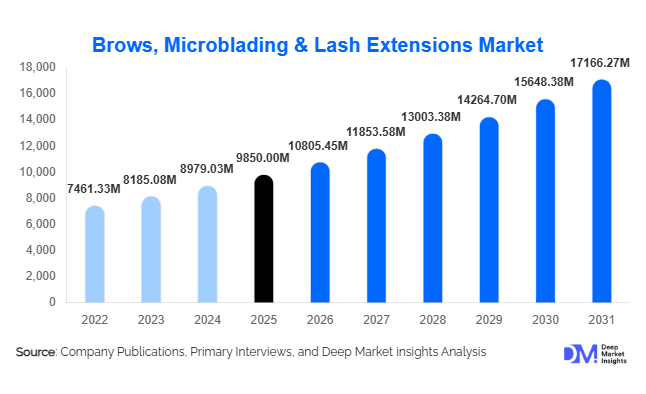
According to Deep Market Insights, the global brows, microblading & lash extensions market size was valued at USD 9,850 million in 2025 and is projected to grow from USD 10,805.45 million in 2026 to reach USD 17,166.27 million by 2031, expanding at a CAGR of 9.7% during the forecast period (2026–2031). The market growth is primarily driven by rising consumer emphasis on facial aesthetics, increasing adoption of semi-permanent beauty solutions, and the rapid expansion of organized salon chains and certified professionals globally.
Key Market Insights
- Semi-permanent beauty solutions are gaining mainstream acceptance, driven by convenience and long-lasting results compared to daily makeup routines.
- Beauty salons and chains dominate service delivery, accounting for over half of the global demand due to trust, quality assurance, and standardized services.
- North America leads the global market, supported by high disposable incomes and a mature beauty service infrastructure.
- Asia-Pacific is the fastest-growing region, fueled by rising middle-class income and increasing beauty consciousness in countries like China and India.
- Technological advancements in pigments, adhesives, and tools are improving safety, durability, and customization of services.
- Professional training and certification ecosystems are expanding, enabling market scalability and improving service quality globally.
What are the latest trends in the brows, microblading & lash extensions market?
Shift Toward Natural-Looking and Customizable Aesthetics
Consumers are increasingly demanding natural-looking enhancements rather than dramatic transformations. Techniques such as ombre brows, hybrid lash extensions, and customized brow mapping are gaining popularity. This trend is driven by social media influence and the desire for subtle, everyday beauty solutions. Professionals are adopting advanced consultation techniques and digital design tools to create personalized looks tailored to individual facial features, skin tones, and lifestyle preferences. This shift is expanding repeat service demand, as consumers seek maintenance and refinements rather than one-time treatments.
Integration of Advanced Tools and Safer Formulations
The market is witnessing significant technological innovation in tools and materials. Improved adhesives with hypoallergenic properties, longer-lasting pigments, and precision microblading devices are enhancing service quality and safety. Digital tools such as AI-based facial mapping and virtual previews are being introduced to improve customer experience and reduce procedural errors. Additionally, manufacturers are focusing on eco-friendly and cruelty-free materials, aligning with global sustainability trends and increasing consumer awareness.
What are the key drivers in the brows, microblading & lash extensions market?
Growing Influence of Social Media and Beauty Trends
Social media platforms have significantly shaped global beauty standards, promoting fuller brows and enhanced lashes as essential elements of modern grooming. Influencers and beauty professionals continuously showcase results, driving consumer awareness and adoption. This has transformed these services from niche luxury treatments into routine beauty practices, especially among younger demographics.
Convenience and Time-Saving Benefits
Microblading and lash extensions offer long-lasting results, reducing the need for daily makeup application. This convenience appeals strongly to working professionals and busy consumers. With results lasting weeks to months, these services provide a practical alternative to traditional cosmetics, driving repeat demand and customer retention.
What are the restraints for the global market?
High Cost of Premium Services
Advanced services such as volume lash extensions and microblading procedures are relatively expensive, limiting accessibility among price-sensitive consumers. In emerging markets, this cost barrier restricts adoption to urban and affluent populations, slowing broader market penetration.
Regulatory and Safety Concerns
Inconsistent regulations across regions pose challenges for market growth. Lack of standardized training and certification can lead to safety issues such as infections or allergic reactions, impacting consumer trust. Strengthening regulatory frameworks and standardizing certifications remain critical for long-term growth.
What are the key opportunities in the brows, microblading & lash extensions industry?
Expansion in Emerging Markets
Rapid urbanization and rising disposable incomes in Asia-Pacific, Latin America, and the Middle East are creating strong growth opportunities. Countries such as India, Brazil, and the UAE are witnessing increased demand for organized beauty services. Companies that localize pricing and service offerings can tap into these high-growth markets and significantly expand their customer base.
Growth of Professional Training and Certification
The increasing demand for skilled professionals is driving the expansion of training academies and certification programs. This creates opportunities for companies to integrate vertically by offering both services and training. Standardized certifications enhance consumer confidence and improve service quality, supporting long-term market growth.
Service Type Insights
Microblading continues to lead the global service type segment, accounting for approximately 28% of the total market in 2025. This dominance is primarily driven by its ability to deliver natural-looking, semi-permanent eyebrow enhancements that align with current beauty trends emphasizing fuller and well-defined brows. The long-lasting nature of microblading (typically 12–18 months) significantly reduces daily grooming time, making it highly attractive to working professionals and urban consumers. Additionally, increasing awareness through social media and influencer marketing has accelerated adoption across both developed and emerging markets.
Lash extension services, particularly volume and hybrid lash extensions, are witnessing strong growth due to their customizable nature and ability to cater to diverse aesthetic preferences. These services appeal to younger demographics seeking dramatic yet personalized looks. Meanwhile, ancillary services such as touch-ups, lash refills, and aftercare treatments are becoming critical revenue contributors, ensuring recurring income streams for service providers. The rising frequency of maintenance sessions is further strengthening customer retention and lifetime value, making the service segment highly resilient and scalable.
Report Scope
| Report Metric | Details |
|---|---|
| Market Size in 2025 | USD 9850 Million |
| Market Size in 2026 | USD 10805.45 Million |
| Market Size in 2031 | USD 17166.27 Million |
| CAGR | 9.7% (2026-2031) |
| Base Year for Estimation | 2025 |
| Historical Data | 2022-2024 |
| Forecast Period | 2026-2031 |
| Report Coverage | Revenue Forecast, Competitive Landscape, Supply Chain Disruption, Growth Factors, Environment & Regulatory Landscape and Trends |
| Geographies Covered | North America, Europe, APAC, Middle East and Africa, LATAM |
| Countries Covered | U.S., Canada, U.K., Germany, France, Spain, Italy, Russia, Nordic, Benelux, Rest of Europe, China, Korea, Japan, India, Australia, Singapore, Taiwan, South East Asia, Rest of Asia-Pacific, UAE, Turky, Saudi Arabia, South Africa, Egypt, Nigeria, Rest of MEA, Brazil, Mexico, Argentina, Chile, Colombia, Rest of LATAM |
Explore more data points, trends and opportunities Download Free Sample Report
Product Type Insights
Synthetic lash fibers dominate the product segment, capturing approximately 35% of the global market share in 2025. Their leadership is driven by a combination of affordability, consistent quality, and ethical advantages over natural alternatives such as mink lashes. Increasing consumer preference for cruelty-free and vegan beauty products has further accelerated the shift toward synthetic materials, especially in North America and Europe.
Adhesives and pigments form the backbone of service quality, with ongoing innovation focused on improving retention, safety, and hypoallergenic properties. Advanced formulations are enabling longer-lasting applications while minimizing the risk of irritation, thereby enhancing consumer confidence. Additionally, tools and equipment such as precision tweezers, microblading pens, and magnification devices are experiencing steady demand, supported by the growing number of trained professionals and salon establishments globally. The expansion of professional training institutes is also driving product standardization and boosting demand for high-quality equipment.
End-Use Insights
Beauty salons and chains remain the dominant end-use segment, accounting for nearly 52% of the global market in 2025. Their leadership is driven by consumer preference for professional expertise, hygiene standards, and consistent service quality. Organized salon chains, in particular, are benefiting from brand trust, standardized procedures, and the ability to invest in advanced tools and training programs.
Dermatology clinics and medical spas represent the fastest-growing segment, driven by increasing demand for medically supervised aesthetic procedures. Consumers are becoming more cautious about safety and are opting for clinically certified environments, especially for procedures involving skin penetration such as microblading. Independent technicians and freelancers are also gaining traction, particularly in urban areas, due to their flexible pricing models and personalized services. This segment is expanding rapidly through social media-driven client acquisition and home-based service offerings, contributing to market decentralization.
Distribution Channel Insights
Direct B2B sales dominate the distribution landscape, contributing approximately 40% of total product sales. This is primarily due to salons and clinics preferring direct procurement from manufacturers to ensure product authenticity, bulk pricing advantages, and consistent supply. Long-term supplier relationships and customized product offerings further strengthen this channel’s dominance.
Online retail channels are the fastest-growing distribution segment, driven by the rapid expansion of e-commerce platforms and increasing digital adoption among professionals and DIY users. Online channels provide access to a wide range of products, competitive pricing, and convenience, making them particularly attractive in emerging markets. Specialty beauty stores and professional training institutes also play a crucial role in distribution by offering curated product selections and hands-on product demonstrations, thereby influencing purchasing decisions and brand loyalty.
Explore more data points, trends and opportunities Download Free Sample Report
Brows, Microblading & Lash Extensions Market Segmentations
By Service Type
- Eyebrow Services
- Eyelash Services
- Ancillary Services
By Product Type
- Synthetic Lash Fibers
- Pigments & Dyes
- Adhesives & Bonding Agents
- Tools & Equipment
- Hygiene & Sterilization Products
By End-Use
- Beauty Salons & Chains
- Independent Technicians/Freelancers
- Dermatology Clinics & Medical Spas
- Home-based Consumers (DIY Kits)
By Distribution Channel
- Direct B2B Sales
- Online Retail
- Specialty Beauty Stores
- Professional Training Institutes
Regional Insights
North America
North America holds the largest share of the global market at approximately 32% in 2025, with the United States accounting for nearly 75% of regional demand. The region’s dominance is driven by high disposable incomes, strong consumer awareness, and a well-established beauty services ecosystem. The widespread availability of certified professionals and stringent regulatory standards enhances consumer trust and adoption. Additionally, the strong influence of social media trends and celebrity endorsements continues to drive demand for advanced brow and lash services. Canada is also witnessing steady growth, supported by increasing urbanization, rising beauty consciousness, and expansion of organized salon chains.
Europe
Europe accounts for around 25% of the global market, with key contributors including the UK, Germany, and France. The UK alone represents nearly 30% of the regional market, driven by a mature beauty industry and high adoption of lash extension services. Growth in Europe is strongly supported by increasing emphasis on safety regulations, standardized certifications, and high-quality products. Additionally, the region’s strong inclination toward sustainable and cruelty-free beauty solutions is boosting demand for synthetic lash fibers and organic pigments. Rising consumer preference for premium and personalized services is further driving market expansion across Western Europe.
Asia-Pacific
Asia-Pacific is the fastest-growing region, with a CAGR of approximately 11%. China leads the region with around 35% market share, driven by a large urban population, strong beauty trends, and the rapid expansion of salon chains. India is emerging as the fastest-growing country, with a CAGR exceeding 13%, supported by rising disposable incomes, increasing penetration of organized beauty services, and government-backed skill development initiatives. South Korea and Japan also play a significant role due to their advanced beauty industries and innovation in cosmetic technologies. The growing influence of K-beauty trends and social media platforms is further accelerating adoption across the region.
Latin America
Latin America is led by Brazil and Mexico, with Brazil accounting for nearly 40% of regional demand. The region’s growth is driven by a strong cultural emphasis on personal grooming and beauty, particularly in urban centers. Increasing availability of trained professionals and the expansion of international beauty brands are enhancing service accessibility. Additionally, rising middle-class income and growing adoption of semi-permanent cosmetic treatments are contributing to market expansion. Social media influence and celebrity-driven beauty trends are also playing a significant role in shaping consumer preferences in the region.
Middle East & Africa
The Middle East represents a high-value market, particularly in countries such as the UAE and Saudi Arabia, where high disposable incomes and a strong preference for luxury beauty services drive demand. The region benefits from a growing number of premium salons and increasing adoption of advanced aesthetic treatments. Government initiatives to promote tourism and the luxury retail sectors are also indirectly supporting market growth.
Africa shows moderate but promising growth, with South Africa leading regional demand. Increasing urbanization, rising awareness of beauty services, and the gradual expansion of organized salon networks are key growth drivers. Additionally, the growing youth population and increasing exposure to global beauty trends are expected to drive long-term demand across the region.
Key Players in the Brows, Microblading & Lash Extensions Market
- NovaLash
- Xtreme Lashes
- PhiBrows
- Anastasia Beverly Hills
- Lash Perfect
- Blink Lash Store
- Sugarlash PRO
- Borboleta Beauty
- London Lash
- Lash Affair
- Elleebana
- Nouveau Lashes
- Bella Lash
- Microbeau International
- Everlasting Brow