Bottle Drying Racks Market Size
According to Deep Market Insights, the global bottle drying racks market size was valued at USD 1,280.00 million in 2025 and is projected to grow from USD 1,356.80 million in 2026 to reach USD 1,815.70 million by 2031, expanding at a CAGR of 6% during the forecast period (2026–2031). The bottle drying racks market growth is primarily driven by rising hygiene awareness, increasing adoption of reusable bottles, expanding baby care product consumption, and growing demand for space-efficient kitchen organization solutions across both developed and emerging economies.
Key Market Insights
- Baby bottle drying racks remain the single largest application segment, supported by sustained birth rates in emerging markets and increasing per-child spending globally.
- Reusable water bottles and sports bottle drying applications are the fastest-growing segment, driven by sustainability regulations and consumer shift away from single-use plastics.
- E-commerce dominates distribution channels, accounting for over 40% of global sales due to ease of comparison, design variety, and direct-to-consumer pricing advantages.
- Asia-Pacific leads manufacturing and incremental demand growth, while North America and Europe dominate premium and innovation-led consumption.
- Plastic-based drying racks continue to hold volume leadership, though stainless steel and bamboo racks are gaining traction due to durability and eco-friendly positioning.
- Product differentiation through modularity, foldability, and antimicrobial materials is becoming a critical competitive strategy.
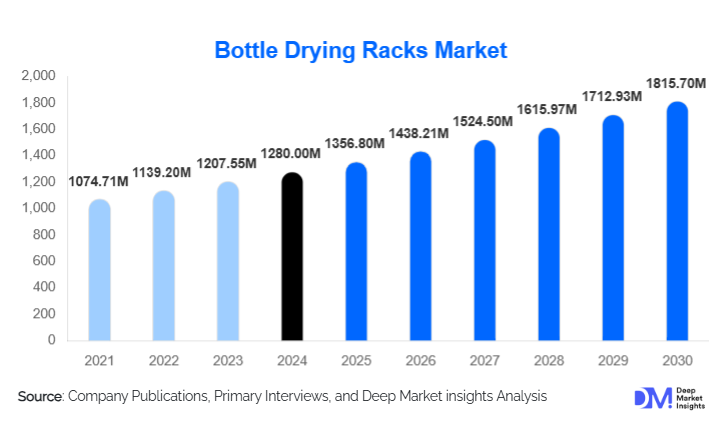
What are the latest trends in the bottle drying racks market?
Expansion Beyond Baby-Care Applications
Bottle drying racks are increasingly being positioned as multi-purpose household and commercial hygiene tools rather than niche baby-care accessories. Rising consumption of reusable water bottles, protein shakers, insulated tumblers, and coffee accessories is expanding everyday usage across households, offices, gyms, and educational institutions. Manufacturers are launching larger-capacity, modular racks capable of handling different bottle sizes, lids, straws, and accessories, making them suitable for broader lifestyle needs. This trend is significantly increasing replacement cycles and repeat purchases.
Premium, Foldable, and Space-Saving Designs
Urbanization and shrinking kitchen spaces are driving demand for foldable, collapsible, and vertical bottle drying racks. Premium designs that combine stainless steel frames, silicone pegs, and drip trays with modern aesthetics are gaining popularity in North America and Europe. Consumers increasingly value durability, visual appeal, and ease of storage, supporting premium pricing and margin expansion. Electric and heated drying racks, while still niche, are gaining early traction in high-income households and healthcare settings.
What are the key drivers in the bottle drying racks market?
Rising Adoption of Reusable Bottles
Global initiatives to reduce plastic waste and regulatory bans on single-use plastics are accelerating the adoption of reusable bottles across residential, institutional, and commercial settings. Proper air-drying of bottles is essential to prevent bacterial growth and odor formation, directly supporting demand for dedicated drying racks. This driver is particularly strong in North America and Europe, where sustainability-conscious consumers are driving consistent demand growth.
Growth in Baby Care and Infant Hygiene Spending
Despite declining birth rates in some developed countries, global baby care spending continues to rise due to higher per-child expenditure, especially in urban households. Parents increasingly prioritize hygiene, safety, and BPA-free materials, making dedicated bottle drying racks a standard purchase alongside feeding accessories. Emerging economies in the Asia-Pacific and Africa are contributing significantly to volume growth in this segment.
What are the restraints for the global market?
Price Sensitivity in Developing Markets
In low- and middle-income regions, bottle drying racks often compete with traditional substitutes such as towels or general dish racks. Price sensitivity limits premium product adoption and forces manufacturers to maintain low-cost offerings, impacting margin expansion. Without localized pricing and design strategies, market penetration in these regions can remain constrained.
Low Product Differentiation and Commoditization Risk
The market faces relatively low technological entry barriers, resulting in the presence of unbranded and low-cost manufacturers. This intensifies price competition and creates commoditization risk, particularly in plastic-based racks. Sustained differentiation through design, branding, and functional innovation is required to protect long-term profitability.
What are the key opportunities in the bottle drying racks industry?
Eco-Friendly and Sustainable Product Development
Demand for bamboo-based racks, recycled plastics, and long-life stainless steel designs is increasing rapidly, especially in Europe and North America. Sustainability-focused branding, recyclable packaging, and low-carbon manufacturing processes provide strong differentiation opportunities. As reusable containers become mandatory in more regions, eco-friendly drying solutions are expected to see accelerated adoption.
Smart and Electric Drying Solutions
Electric and heated bottle drying racks integrated with energy-efficient systems and antimicrobial features represent a high-margin opportunity. While currently accounting for less than 10% of market value, this segment is expected to grow at a double-digit rate as consumers seek faster and more hygienic drying solutions, particularly in healthcare and daycare environments.
Report Scope
| Report Metric | Details |
|---|---|
| Market Size in 2025 | USD 1280 Million |
| Market Size in 2026 | USD 1356.80 Million |
| Market Size in 2031 | USD 1815.70 Million |
| CAGR | 6% (2026-2031) |
| Base Year for Estimation | 2025 |
| Historical Data | 2022-2024 |
| Forecast Period | 2026-2031 |
| Report Coverage | Revenue Forecast, Competitive Landscape, Supply Chain Disruption, Growth Factors, Environment & Regulatory Landscape and Trends |
| Geographies Covered | North America, Europe, APAC, Middle East and Africa, LATAM |
| Countries Covered | U.S., Canada, U.K., Germany, France, Spain, Italy, Russia, Nordic, Benelux, Rest of Europe, China, Korea, Japan, India, Australia, Singapore, Taiwan, South East Asia, Rest of Asia-Pacific, UAE, Turky, Saudi Arabia, South Africa, Egypt, Nigeria, Rest of MEA, Brazil, Mexico, Argentina, Chile, Colombia, Rest of LATAM |
Explore more data points, trends and opportunities Download Free Sample Report
Product Type Insights
Countertop bottle drying racks dominate the market, accounting for approximately 44% of total revenue in 2025, due to their affordability, ease of use, and compatibility with most kitchen layouts. Foldable and collapsible racks are gaining market share rapidly as urban households seek space-saving solutions. Wall-mounted and over-sink racks appeal to compact living spaces but remain niche. Electric bottle drying racks represent a premium sub-segment with strong growth potential, driven by hygiene-conscious consumers and institutional buyers.
Material Insights
Plastic-based bottle drying racks lead the market with nearly 48% share in 2025, supported by low cost, lightweight construction, and widespread availability of BPA-free materials. Stainless steel racks are gaining traction due to durability, corrosion resistance, and premium aesthetics. Bamboo and wooden racks are emerging as eco-friendly alternatives, particularly in Europe, while hybrid designs combining plastic, metal, and silicone are increasingly popular for performance and design flexibility.
Distribution Channel Insights
E-commerce platforms dominate distribution, accounting for around 42% of global sales in 2025. Online channels enable product comparison, design-driven purchasing, and direct-to-consumer strategies that improve margins. Offline retail, including supermarkets and specialty baby-care stores, remains important for first-time buyers. Direct B2B and institutional sales are growing steadily, particularly in healthcare, daycare, and foodservice applications.
End-Use Insights
Residential consumers represent the largest end-use segment, contributing approximately 62% of total market demand. Healthcare facilities, daycare centers, and foodservice establishments are the fastest-growing end-use segments, driven by stricter hygiene protocols and operational efficiency needs. Emerging applications in laboratories and beverage preparation settings are creating incremental demand and diversifying revenue streams.
Explore more data points, trends and opportunities Download Free Sample Report
Bottle Drying Racks Market Segmentations
By Product Type
- Countertop Bottle Drying Racks
- Foldable & Collapsible Bottle Drying Racks
- Wall-Mounted / Over-Sink Bottle Drying Racks
- Electric & Heated Bottle Drying Racks
- Modular & Expandable Drying Systems
By Material
- Plastic (PP, ABS, BPA-Free Polymers)
- Stainless Steel & Aluminum
- Silicone-Based Racks
- Wood & Bamboo-Based Racks
- Hybrid Material Racks
By Application
- Baby Feeding Bottles & Accessories
- Reusable Water Bottles & Sports Bottles
- Kitchenware & Drinkware
- Medical & Laboratory Bottles
- Commercial Beverage Containers
By Distribution Channel
- Offline Retail (Supermarkets & Specialty Stores)
- E-commerce Platforms
- Direct-to-Consumer (Brand Websites)
- B2B & Institutional Sales
By End User
- Residential Consumers
- Hospitals & Healthcare Facilities
- Daycare Centers & Schools
- Foodservice & Hospitality
- Pharmaceutical & Laboratory Users
Regional Insights
North America
North America accounted for approximately 28% of the global market share in 2025, led by the United States and Canada. High adoption of reusable bottles, strong baby-care spending, and demand for premium kitchen accessories support steady growth. The region also leads in innovation-driven products, including electric and modular racks.
Europe
Europe held around 24% market share, with Germany, the U.K., and France driving demand. Sustainability regulations, eco-friendly consumer preferences, and high penetration of reusable drinkware are key growth drivers. Bamboo and stainless steel racks are particularly popular in this region.
Asia-Pacific
Asia-Pacific is the largest and fastest-growing region, accounting for nearly 32% of global demand and expanding at an estimated 9.5% CAGR. China, India, Japan, and South Korea lead consumption, supported by population growth, urbanization, and expanding middle-class income. The region also serves as a global manufacturing hub.
Latin America
Latin America represents about 9% of the market, led by Brazil and Mexico. Rising urban households and increasing awareness of hygiene and sustainability are gradually driving adoption.
Middle East & Africa
The Middle East & Africa accounted for approximately 7% of global demand, with growth supported by urbanization, healthcare infrastructure expansion, and rising baby-care spending in the UAE, Saudi Arabia, and South Africa.
Top Players in the Bottle Drying Racks Industry
- Philips
- Munchkin
- Tommee Tippee
- Dr. Brown’s
- OXO
- Chicco
- Boon
- Béaba
- Skip Hop
- Medela
- Evenflo
- Pigeon Corporation
- Avent
- Babymoov
- Comotomo