Bookends Market Size
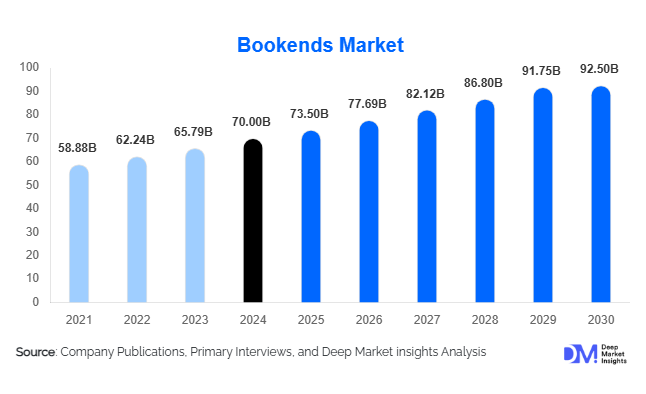
According to Deep Market Insights, the global bookends market size was valued at USD 70 billion in 2025 and is projected to grow from USD 73.5 billion in 2026 to reach USD 92.5 billion by 2031, expanding at a CAGR of 5.7% during the forecast period (2026–2031). The bookends market growth is primarily driven by increasing home décor and organizational trends, rising demand for aesthetic and multifunctional accessories, and the expansion of e-commerce and global distribution channels offering diverse designs and materials.
Key Market Insights
- Consumers increasingly prefer multifunctional and designer bookends, combining utility with aesthetic appeal for residential, commercial, and institutional use.
- Wood and modern/contemporary designs dominate globally, driven by versatility, durability, and alignment with interior décor trends.
- Asia-Pacific is emerging as the largest and fastest-growing market, led by rising middle-class income, urbanization, and increasing investments in education and home furnishings.
- Online retail channels are accelerating market growth, allowing niche and artisanal designs to reach global consumers efficiently.
- Sustainability trends are shaping production, with demand for eco-friendly, recycled, and certified materials gaining traction.
- Technological adoption, including CNC machining, 3D printing, and AR-based visualization for consumer previews, is transforming product customization and manufacturing efficiency.
What are the latest trends in the bookends market?
Sustainability and Eco-Friendly Materials
Bookend manufacturers are increasingly incorporating recycled wood, metal, and plastics, as well as sustainably sourced hardwoods, to appeal to environmentally conscious consumers. Certifications such as FSC for wood and low-VOC finishes for painted products are becoming important purchase considerations. This trend not only enhances brand differentiation but also aligns with government regulations and global sustainability goals. Companies leveraging eco-friendly materials are positioned to capture higher price premiums and foster long-term customer loyalty.
Designer and Customization Trends
Customization is gaining prominence, with consumers seeking limited-edition, themed, and artist-collaborated bookends. Novelty, luxury, and personalized products are driving higher margins, while mass-market players focus on mid-range designs. Online platforms have facilitated this trend, allowing consumers to choose bespoke shapes, engravings, and finishes. This shift is enhancing the role of bookends as decorative and statement pieces, beyond their functional use of supporting books.
What are the key drivers in the bookends market?
Growing Home Décor and Interior Aesthetic Demand
Consumers worldwide are increasingly investing in home decoration, leading to higher demand for stylish and functional accessories such as bookends. Open shelving, home libraries, and display-oriented bookshelves are contributing to sustained market growth. Wood and contemporary designs are particularly popular due to their ability to complement diverse interiors.
Remote Work and Hybrid Education
The rise of remote work and hybrid learning has resulted in an increase in home office setups and personal study spaces, boosting the demand for organizational accessories, including bookends. These products are now being perceived as essential for both functionality and visual appeal in modern homes.
E-Commerce and Global Accessibility
Digital retail channels have expanded market reach, enabling smaller brands and artisans to sell directly to global consumers. Enhanced online visibility and social media marketing are increasing awareness and adoption of diverse bookend designs. E-commerce also facilitates faster product innovation and customer feedback integration, further accelerating growth.
What are the restraints for the global market?
Decline in Physical Book Usage
Increasing adoption of e-books, audiobooks, and tablets in some regions reduces the demand for physical books, potentially limiting growth in the bookends market. Younger demographics are more likely to consume digital content, affecting the volume of traditional bookend purchases.
Price Sensitivity and Competitive Pressure
The bookends market is fragmented, with many small players competing primarily on price. Volatility in raw material costs (wood, metal, stone) and shipping logistics for heavy materials can constrain profitability. Manufacturers in the low- and mid-tier segments face challenges in maintaining margins while offering competitive pricing.
What are the key opportunities in the bookends market?
Integration of Smart and Multifunctional Features
Innovative bookends with integrated features such as LED lighting, USB ports, wireless speakers, or phone holders present new opportunities. Such multifunctional designs appeal to tech-savvy consumers and the home office segment, creating a differentiated product offering with higher perceived value.
Expansion in Emerging Markets
Emerging regions like India, China, and Southeast Asia are witnessing rapid urbanization, rising middle-class income, and growing interest in home décor. This creates strong demand for both mass-market and premium bookends. Online retail penetration in these regions is also expanding, allowing access to global designs and niche segments.
Customization and Luxury Collaborations
Collaboration with designers and artists to produce limited-edition, themed, or bespoke bookends offers higher margins and brand recognition. Consumers increasingly value personalization and aesthetic appeal, making this a profitable niche for both new entrants and established players.
Report Scope
| Report Metric | Details |
|---|---|
| Market Size in 2025 | USD 70 Billion |
| Market Size in 2026 | USD 73.5 Billion |
| Market Size in 2031 | USD 92.5 Billion |
| CAGR | 5.7% (2026-2031) |
| Base Year for Estimation | 2025 |
| Historical Data | 2022-2024 |
| Forecast Period | 2026-2031 |
| Report Coverage | Revenue Forecast, Competitive Landscape, Supply Chain Disruption, Growth Factors, Environment & Regulatory Landscape and Trends |
| Geographies Covered | North America, Europe, APAC, Middle East and Africa, LATAM |
| Countries Covered | U.S., Canada, U.K., Germany, France, Spain, Italy, Russia, Nordic, Benelux, Rest of Europe, China, Korea, Japan, India, Australia, Singapore, Taiwan, South East Asia, Rest of Asia-Pacific, UAE, Turky, Saudi Arabia, South Africa, Egypt, Nigeria, Rest of MEA, Brazil, Mexico, Argentina, Chile, Colombia, Rest of LATAM |
Explore more data points, trends and opportunities Download Free Sample Report
Product Type Insights
Wood-based bookends dominate the market due to their versatility, durability, and aesthetic appeal, accounting for nearly 42% of the 2025 market. Metal and marble-based designs cater to premium segments, while plastic and acrylic designs are popular in mass-market and novelty categories. Modern and contemporary designs hold approximately 32% of the market, reflecting consumer preference for minimalistic and clean aesthetics.
Application Insights
Residential use remains the largest application, representing more than 52% of the 2025 market, driven by home décor and personal office setups. Educational institutions and commercial offices are also growing, reflecting rising investments in libraries, corporate gifting, and décor solutions. Hospitality and leisure applications are emerging as niche segments, particularly for luxury and decorative bookends.
Distribution Channel Insights
Online retail, including e-commerce marketplaces and brand-owned platforms, accounts for roughly 38% of the market, reflecting faster growth compared to offline retail. Specialty stores, furniture outlets, and department stores remain significant, particularly for premium and designer segments. Direct B2B sales to institutions and corporates contribute to steady bulk demand.
Explore more data points, trends and opportunities Download Free Sample Report
Bookends Market Segmentations
By Product Type
- Wood-Based Bookends
- Metal Bookends
- Marble/Stone Bookends
- Plastic/Acrylic Bookends
- Designer & Luxury Bookends
By Application
- Residential/Home Décor
- Educational/Institutional Libraries
- Commercial/Office Use
- Hospitality & Leisure
By Distribution Channel
- Online Retail & E-Commerce
- Specialty Stores
- Department Stores
- Furniture & Home Décor Outlets
- B2B Sales (Corporate & Institutional)
Regional Insights
North America
North America accounts for approximately 28% of the global market, led by the U.S. and Canada. High disposable income, home décor trends, and gifting culture drive demand. Premium and designer bookends are particularly popular, with strong adoption of online retail platforms.
Europe
Europe holds about 27% of the market, with Germany, the UK, France, and Nordic countries leading. Minimalist and designer bookends are in high demand, along with sustainable material preferences. Growth is steady, supported by cultural affinity for decorative home accessories.
Asia-Pacific
Asia-Pacific is the fastest-growing region, accounting for nearly 33% of the market, led by China, India, Japan, and South Korea. Rising urbanization, growing middle-class income, e-commerce expansion, and interest in interior décor fuel growth. Residential and educational applications are primary drivers.
Latin America
Latin America represents 6–8% of the global market, with Brazil, Mexico, and Argentina as key markets. Rising home décor interest and outbound gifting trends support gradual market expansion.
Middle East & Africa
MEA holds approximately 5% of the market. GCC countries like the UAE and Saudi Arabia, along with South Africa, drive premium and decorative bookend demand. Luxury residential and hospitality sectors are key adopters, while local manufacturing and imports influence pricing.
Key Players in the Bookends Market
- The Decor Kart
- Yamazaki Europe GmbH
- Inter IKEA Systems B.V.
- Wayfair LLC
- Knob Creek Metal Arts
- GuangBo Group
- Alessi SpA
- Jonathan Adler Enterprises LLC
- Umbra
- MUJI
- Ferm Living
- Kikkerland Design
- CB2
- West Elm
- Creative Co-Op