Bidets Market Size
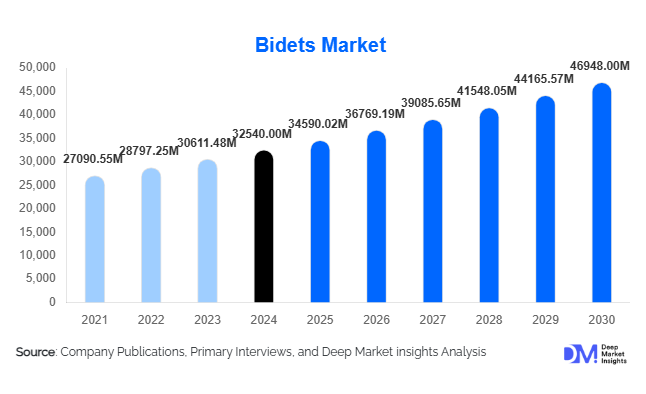
According to Deep Market Insights, the global bidets market size was valued at USD 32,540 million in 2025 and is projected to grow from USD 34,590.02 million in 2026 to reach USD 46,948 million by 2031, expanding at a CAGR of 6.3% during the forecast period (2026–2031). The bidets market growth is primarily driven by increasing global awareness of hygiene and sanitation, rising demand for water-efficient and eco-friendly bathroom fixtures, and widespread adoption of smart/bidet toilet seats as part of modern bathroom and smart-home upgrades.
Key Market Insights
- Add-on bidet seats and retrofit solutions are becoming mainstream in urban households, offering the easiest installation and appealing to consumers upgrading existing bathrooms without major plumbing work.
- Smart and electric bidets are rapidly gaining market share globally, driven by consumer demand for comfort, convenience, and smart-home integration in developed and emerging markets alike.
- Residential demand dominates the market, as rising disposable incomes and modernization of homes encourage homeowners to invest in bidets for hygiene and comfort purposes.
- Water scarcity concerns and sustainability awareness are promoting bidet adoption, since bidets help reduce toilet-paper usage and provide a more water-efficient sanitation solution compared to conventional methods or standalone bidet setups.
- E-commerce and online retail channels are accelerating penetration, especially in younger demographics and emerging markets, by simplifying the purchase and delivery of bidet attachments and seats.
- Emerging markets in Asia-Pacific, the Middle East & Africa, and Latin America are becoming critical growth zones, as urbanization, rising incomes, and upgraded sanitary infrastructure drive increased bidet adoption.
Latest Market Trends
Rise of Smart & Electric Bidets
Manufacturers are increasingly promoting electric bidet seats and smart bidet units equipped with heated seats, warm-water jets, adjustable spray pressure, air-dryers, self-cleaning nozzles, and sensor-based operations. These features appeal strongly to consumers seeking hygiene, comfort, and convenience akin to smart-home living. The trend is especially strong in developed countries and rapidly urbanizing regions, where bathrooms are being upgraded to modern standards and where consumers are open to paying a premium for added comfort and hygiene features.
Growing Retrofit and Add-On Solutions
Rather than replacing existing toilets or reconstructing bathrooms, many households are opting for add-on bidet seats or handheld bidet sprayers, which can be installed with minimal plumbing work. This retrofit-friendly trend opens up a much larger addressable market, especially in apartments, older homes, and regions where standalone bidet installation is impractical. The convenience and cost-efficiency of add-on solutions are making bidets accessible to a wider segment of consumers.
Water-Efficiency and Eco-Friendly Sanitation Gains Appeal
As water scarcity becomes a global concern and environmental awareness rises, bidets are increasingly being marketed as a sustainable alternative to toilet paper and traditional plumbing-heavy standalone bidets. For eco-conscious consumers and regions under water-conservation pressure, bidets offer hygienic solutions while reducing waste and preserving water resources. This environmental positioning is broadening the appeal of bidets beyond luxury markets, toward mainstream adoption.
Bidets Market Drivers
Rising Hygiene and Health Awareness
Increasing public consciousness about personal hygiene, health, and sanitation, especially in light of global health crises and ongoing public-health campaigns, is driving the adoption of bidets worldwide. Many consumers now view bidets as more hygienic than the traditional use of toilet paper. Particularly among elderly users, women, post-surgery patients, and mobility-impaired individuals, bidets offer safer, cleaner, and more comfortable options. This has led to growing demand in both residential spaces and institutional settings such as hospitals, elder-care centers, and clinics.
Smart-Home and Modern Bathroom Upgrades
As smart-home adoption spreads and consumers invest more in home comfort and convenience, bathrooms are no longer viewed simply as functional spaces, but as zones for comfort and wellness. Smart bidet units with features like warm-water wash, heated seats, adjustable spray, air-dryers, and remote controls fit neatly into this trend. Developers of premium apartments, luxury villas, and high-end hotels are also integrating bidets into bathroom designs to meet rising consumer expectations, thereby fueling demand.
Environmental and Water-Efficiency Concerns
With increasing global awareness about sustainability, resource conservation, and waste reduction, bidets are being positioned as eco-friendly alternatives to conventional toilet setups and toilet-paper usage. In regions facing water scarcity or where environmental regulations are tightening, bidets offer a practical, water-efficient solution. This trend is particularly relevant in emerging markets where governments and consumers are turning toward sustainable sanitation solutions.
Market Restraints
Installation Challenges and Plumbing Constraints
Especially for standalone or fully integrated bidet systems, installation often requires changes to existing plumbing, adequate bathroom space, or extensive renovation, which can be costly and impractical in older buildings or apartments. In many regions, inadequate plumbing infrastructure or small bathroom footprints deter consumers from installing standalone bidets, limiting market penetration.
Cultural Resistance and Low Awareness in Some Markets
In many countries, bidets are still considered unfamiliar or unnecessary. Cultural norms around toilet hygiene, lack of awareness about bidets’ benefits, or perceived complexity may cause consumers to resist adoption. For new markets, particularly where toilet-paper hygiene is deeply entrenched, significant education and marketing efforts are needed to overcome skepticism, which can slow down growth.
Bidets Market Opportunities
Large Untapped Potential in Emerging Markets
As urbanization accelerates in developing regions (Asia-Pacific, Latin America, the Middle East, and Africa), new residential and commercial bathrooms are being built, representing a vast untapped base for bidet adoption. Many of these consumers are first-time adopters and may be more open to retrofit add-on bidet seats or handheld bidet spray solutions due to cost-effectiveness and ease of installation. Manufacturers and new entrants who target affordable, locally appropriate bidet products stand to capture a significant share of this growing demand base.
Expansion in Healthcare, Elder-Care, and Institutional Segments
With aging populations in many countries and increasing focus on hygiene in healthcare settings, there is a growing demand for bidets in hospitals, clinics, elder-care homes, rehabilitation centers, and public institutions. For elderly or mobility-challenged users, bidets offer safer, more hygienic sanitation. Institutions upgrading their sanitary infrastructure represent a high-volume business opportunity, especially for bidet models designed for ease of use, safety, and durability.
Integration with Smart-Home Ecosystems and Premium Real-Estate Development
As smart-home adoption grows and real-estate developers market luxury apartments and villas, bidets, especially smart/electric models, can be bundled as part of premium bathroom packages. This creates opportunities for manufacturers to collaborate with real-estate developers, smart-home system integrators, and hospitality chains to standardize bidet installations. Additionally, as consumers associate bidets with hygiene, comfort, and modern living, smart bidet units can become a norm rather than a luxury, allowing new entrants and existing players to expand in mid-range and premium segments.
Report Scope
| Report Metric | Details |
|---|---|
| Market Size in 2025 | USD 32540 Million |
| Market Size in 2026 | USD 34590.02 Million |
| Market Size in 2031 | USD 46948 Million |
| CAGR | 6.3% (2026-2031) |
| Base Year for Estimation | 2025 |
| Historical Data | 2022-2024 |
| Forecast Period | 2026-2031 |
| Report Coverage | Revenue Forecast, Competitive Landscape, Supply Chain Disruption, Growth Factors, Environment & Regulatory Landscape and Trends |
| Geographies Covered | North America, Europe, APAC, Middle East and Africa, LATAM |
| Countries Covered | U.S., Canada, U.K., Germany, France, Spain, Italy, Russia, Nordic, Benelux, Rest of Europe, China, Korea, Japan, India, Australia, Singapore, Taiwan, South East Asia, Rest of Asia-Pacific, UAE, Turky, Saudi Arabia, South Africa, Egypt, Nigeria, Rest of MEA, Brazil, Mexico, Argentina, Chile, Colombia, Rest of LATAM |
Explore more data points, trends and opportunities Download Free Sample Report
Product Type Insights
Add-on bidet seats and retrofit bidet solutions dominate the market globally, owing to their low installation requirements, cost-effectiveness, and compatibility with existing toilets. These options are especially popular in urban apartments or older homes where installing standalone bidets would require major plumbing and space changes. Their retrofit-friendly nature makes them accessible to a broader base of consumers upgrading their bathrooms, which explains their leading share in 2025. Meanwhile, smart and electric bidets within the add-on category are rapidly gaining traction due to comfort and hygiene appeal, positioning this product type as the backbone of the global bidets market. Budget and handheld bidet sprayer solutions also maintain steady demand in emerging markets due to their affordability and minimal installation needs.
Application Insights
The residential sector remains the largest application segment for bidets, driven by homeowners upgrading bathrooms for improved hygiene and comfort. Within residential use, emerging urban middle-class households and newly constructed apartments contribute significantly to adoption. In addition to residential, institutional applications, including healthcare facilities, elder-care homes, hotels, and hospitality establishments are expanding steadily, especially in regions with growing healthcare infrastructure and tourism. The increasing inclusion of bidets in luxury hotels and premium residential complexes reflects rising consumer expectations for hygienic and modern sanitary amenities. This dual application mix supports robust growth across both personal and commercial end-use sectors.
Distribution Channel Insights
While traditional offline retail sanitary-ware stores, plumbing shops, and home-improvement showrooms continue to serve a baseline market, online retail and e-commerce platforms are increasingly driving bidet sales globally. Particularly for add-on bidet seats and handheld sprayers, online marketplaces provide ease of purchase, delivery, and installation support, making them attractive for younger, tech-savvy consumers. In emerging markets, online retail helps bridge gaps in local retail availability and offers access to a wider variety of products. As e-commerce penetration increases, the share of online sales is expected to continue rising, accelerating market growth and reach.
User Segment Insights
Urban homeowners upgrading their bathrooms, especially younger families and middle-income households, represent a growing user segment for bidets, driven by increasing hygiene awareness and disposable income. Elderly individuals, healthcare patients, and mobility-impaired users represent another important user segment, given bidets’ ease of use and sanitary benefits. Additionally, hospitality and real-estate developers targeting premium customers are adopting bidets (especially smart/electric versions) as standard fixtures in luxury apartments, hotels, and resorts. Collectively, these segments create a diversified demand base spanning middle-income homeowners to high-end luxury consumers and institutional buyers.
Explore more data points, trends and opportunities Download Free Sample Report
Bidets Market Segmentations
By Product Type
- Add-On Bidet Seats
- Handheld Bidet Sprayers
- Standalone Bidets
- Smart/Electric Bidets
By Application
- Residential
- Healthcare & Elder-Care Facilities
- Hotels & Hospitality
- Commercial/Institutional Buildings
By Distribution Channel
- Online Retail
- Sanitaryware & Plumbing Showrooms
- Home Improvement Stores
- Specialty Bathroom Retailers
Regional Insights
Asia-Pacific
Asia-Pacific remains the largest and fastest-growing market for bidets, accounting for a substantial share of global demand in 2025. Traditional leaders like Japan and South Korea, where bidet toilet seats and smart toilets are already mainstream, continue to drive robust demand. Meanwhile, rapidly urbanizing economies such as China and India are seeing increasing interest as middle-class households renovate bathrooms or build new homes. The combination of rising disposable income, urban construction growth, and growing hygiene awareness positions Asia-Pacific as a long-term growth engine for the global bidets market.
Europe
Europe maintains a strong demand base for bidets, particularly in countries where standalone bidets have been traditional bathroom fixtures. Retrofit add-on bidet seats and smart bidets are gaining popularity as consumers modernize bathrooms and upgrade sanitary ware. Water-efficiency norms, environmental awareness, and sustainable bathroom renovation trends further support bidet adoption. As a result, Europe continues to hold a significant share of the global market, with steady growth prospects.
North America
Though historically slower in bidet adoption, North America is witnessing rising interest, especially among health-conscious and eco-aware consumers, as well as early adopters of smart-home technologies. The demand for retrofit add-on bidet seats and smart models is growing, driven by awareness of hygiene benefits and convenience. As water-conservation awareness and smart-home adoption increase, North America is poised for accelerating growth, even if overall penetration remains lower than in Asia or Europe currently.
Middle East & Africa
Emerging urban centers, increasing investments in real estate and hospitality, and heightened interest in modern sanitary solutions are fueling bidet adoption in the Middle East and Africa. In water-scarce regions, bidets’ water-efficient and hygienic properties resonate well. Though the current share is modest, this region represents one of the fastest-growing markets, especially in affluent urban zones, luxury hotels, and new residential developments.
Latin America
Latin America shows growing potential as urbanization spreads and disposable incomes rise. In major economies such as Brazil, there is increasing interest among urban households for bathroom upgrades with bidet seats or handheld bidet sprayers. As awareness of hygiene increases and sanitary-ware markets mature, bidet penetration is likely to rise gradually. While the region’s share remains smaller compared to Asia, Europe, or North America, its growth trajectory is upward.
Key Players in the Bidets Market
- TOTO
- LIXIL Corporation
- Kohler Co.
- Geberit
- Roca Sanitario S.A.
- Duravit AG
- Villeroy & Boch
- American Standard
- Bravat
- NEOREST / Inax (subsidiary under global brand umbrella)
- Woodbridge Bath
- BelBagno
- Grohe (for bidet faucets and bidet-compatible fixtures)
- Cera Sanitaryware
- Jaquar & Company (for markets like India and Southeast Asia)