Bed Sheets Market Size
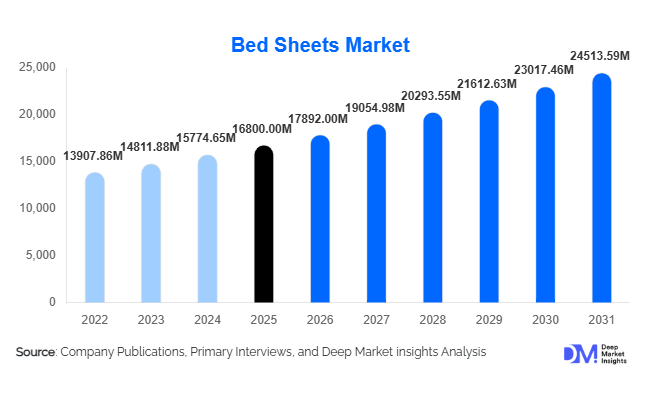
According to Deep Market Insights, the global bed sheets market size was valued at USD 16,800 million in 2025 and is projected to grow from USD 17,892.00 million in 2026 to reach USD 24,513.59 million by 2031, expanding at a CAGR of 6.5% during the forecast period (2026–2031). The bed sheets market growth is primarily driven by rising consumer spending on home furnishings, increasing awareness of sleep quality, and the expansion of the global hospitality and healthcare sectors. Additionally, growing demand for premium and sustainable bedding materials, coupled with the rapid penetration of e-commerce platforms, is further accelerating market expansion.
Key Market Insights
- Cotton-based bed sheets dominate globally, accounting for nearly half of total market demand due to comfort, breathability, and affordability.
- Residential usage remains the primary demand driver, contributing approximately 70% of total consumption.
- Asia-Pacific leads the global market, supported by strong manufacturing capabilities and growing domestic demand.
- Online retail channels are expanding rapidly, capturing an increasing share due to convenience, product variety, and competitive pricing.
- Mid-range products dominate pricing segments, driven by strong demand from emerging economies.
- Sustainability trends are reshaping product innovation, with rising demand for organic cotton, bamboo fabrics, and eco-friendly dyes.
What are the latest trends in the bed sheets market?
Shift Toward Sustainable and Organic Bedding
Consumers are increasingly prioritizing environmentally friendly products, driving demand for organic cotton, bamboo fibers, and sustainably produced textiles. Manufacturers are investing in certifications such as organic textile standards and adopting water-efficient dyeing processes to meet regulatory requirements and consumer expectations. This trend is particularly strong in Europe and North America, where eco-conscious purchasing decisions are influencing product innovation and brand positioning. Companies are also focusing on recyclable packaging and reducing carbon footprints to align with sustainability goals.
Growth of Direct-to-Consumer and E-commerce Channels
The rapid expansion of online retail has transformed the bed sheets market. Direct-to-consumer (D2C) brands are leveraging digital platforms to offer personalized products, competitive pricing, and subscription-based services. E-commerce marketplaces provide consumers with extensive product choices, transparent pricing, and easy comparison features. This shift is particularly appealing to younger consumers who prefer convenience and customization. Additionally, digital marketing strategies, including influencer collaborations and social media campaigns, are significantly influencing purchasing behavior.
What are the key drivers in the bed sheets market?
Rising Disposable Income and Urbanization
Increasing disposable income levels, especially in emerging economies, are driving higher spending on home décor and comfort products. Rapid urbanization has led to increased housing demand, thereby boosting the need for household textiles, including bed sheets. Consumers are increasingly upgrading to higher-quality products, contributing to market growth.
Expansion of Hospitality and Healthcare Sectors
The global hospitality industry is witnessing strong growth, resulting in increased demand for high-quality bed linens. Hotels and resorts require frequent replacement of bed sheets to maintain hygiene standards. Similarly, healthcare institutions such as hospitals and clinics require durable and easy-to-clean bedding products, ensuring consistent demand across these sectors.
Increasing Focus on Sleep Quality and Wellness
Growing awareness of the importance of sleep quality is influencing consumer purchasing decisions. Bed sheets made from breathable, hypoallergenic, and temperature-regulating materials are gaining popularity. This trend is driving demand for premium products with higher thread counts and advanced fabric technologies.
What are the restraints for the global market?
Volatility in Raw Material Prices
The bed sheets market is highly dependent on raw materials such as cotton and synthetic fibers. Fluctuations in raw material prices directly impact manufacturing costs and profit margins. This volatility creates pricing challenges for manufacturers and can hinder market growth.
Intense Market Competition and Price Sensitivity
The presence of numerous local and regional players leads to intense price competition, particularly in the economy and mid-range segments. Consumers in price-sensitive markets often prioritize affordability over brand loyalty, limiting the ability of companies to maintain high margins and differentiate their offerings.
What are the key opportunities in the bed sheets industry?
Expansion in Hospitality and Tourism Infrastructure
The rapid growth of global tourism and the expansion of hotel chains present significant opportunities for bed sheet manufacturers. Large-scale procurement by hospitality players creates demand for high-quality, durable, and customized bedding solutions. Emerging markets in the Asia-Pacific and the Middle East are particularly attractive due to ongoing infrastructure development.
Adoption of Smart and Functional Textiles
Technological advancements in textile manufacturing are enabling the development of smart bed sheets with features such as temperature regulation, antimicrobial properties, and moisture-wicking capabilities. These innovations cater to consumers seeking enhanced comfort and health benefits, creating new revenue streams for manufacturers.
Report Scope
| Report Metric | Details |
|---|---|
| Market Size in 2025 | USD 16800 Million |
| Market Size in 2026 | USD 17892 Million |
| Market Size in 2031 | USD 24513.59 Million |
| CAGR | 6.5% (2026-2031) |
| Base Year for Estimation | 2025 |
| Historical Data | 2022-2024 |
| Forecast Period | 2026-2031 |
| Report Coverage | Revenue Forecast, Competitive Landscape, Supply Chain Disruption, Growth Factors, Environment & Regulatory Landscape and Trends |
| Geographies Covered | North America, Europe, APAC, Middle East and Africa, LATAM |
| Countries Covered | U.S., Canada, U.K., Germany, France, Spain, Italy, Russia, Nordic, Benelux, Rest of Europe, China, Korea, Japan, India, Australia, Singapore, Taiwan, South East Asia, Rest of Asia-Pacific, UAE, Turky, Saudi Arabia, South Africa, Egypt, Nigeria, Rest of MEA, Brazil, Mexico, Argentina, Chile, Colombia, Rest of LATAM |
Explore more data points, trends and opportunities Download Free Sample Report
Product Type Insights
Bed sheet sets continue to dominate the global market, accounting for approximately 55% of total demand in 2025, primarily due to their convenience, bundled pricing advantage, and aesthetic uniformity. Consumers increasingly prefer complete bedding solutions that include fitted sheets, flat sheets, and pillowcases, especially in urban households and hospitality environments where coordinated interiors are prioritized. The growth of organized retail and e-commerce platforms has further accelerated the adoption of bundled offerings by enabling easy comparison and value-driven purchasing decisions.
From a growth driver perspective, the dominance of bed sheet sets is largely attributed to the rising trend of home décor standardization and lifestyle upgrades, particularly among middle-income households. Additionally, hospitality chains prefer standardized bedding sets for operational efficiency and brand consistency. Fitted sheets are witnessing faster growth within this category due to their ease of use, superior mattress grip, and compatibility with modern bedding systems, while flat sheets continue to hold demand in traditional and developing markets where usage habits remain unchanged.
Material Type Insights
Cotton bed sheets lead the global market with an estimated 48% share in 2025, driven by their natural softness, breathability, durability, and widespread consumer acceptance. The segment’s leadership is reinforced by the strong global availability of cotton and its cost-to-comfort advantage, making it suitable for both premium and mass-market applications. Cotton remains the preferred material across residential, hospitality, and healthcare sectors due to its hypoallergenic properties and ease of maintenance.
Within this segment, premium cotton variants such as Egyptian and Pima cotton are gaining traction in developed markets, supported by increasing consumer willingness to pay for luxury and comfort. Meanwhile, blended fabrics and microfiber are gaining popularity in price-sensitive regions due to their affordability and durability. Emerging materials such as bamboo and linen are witnessing accelerated growth, driven by rising sustainability awareness and demand for eco-friendly textiles. These materials are particularly appealing to environmentally conscious consumers in Europe and North America.
Distribution Channel Insights
Offline retail channels continue to dominate the bed sheets market, accounting for nearly 60% of total sales in 2025. This dominance is driven by the consumer preference for physical product evaluation, including fabric texture, color accuracy, and size verification before purchase. Supermarkets, hypermarkets, and specialty home furnishing stores remain key distribution points, especially in emerging economies where digital penetration is still evolving.
However, online retail is the fastest-growing segment, supported by increasing internet penetration, smartphone usage, and digital payment adoption. E-commerce platforms and brand-owned websites are gaining traction due to their ability to offer a wide range of products, competitive pricing, and doorstep delivery. The growth of direct-to-consumer (D2C) brands and the integration of AI-driven personalization tools are further enhancing online sales. Developed markets such as North America and Europe are leading this transition, while Asia-Pacific is witnessing rapid adoption due to expanding digital infrastructure.
End-Use Insights
The residential segment dominates the bed sheets market, contributing approximately 70% of total demand in 2025. This dominance is driven by consistent household consumption, frequent replacement cycles, and growing awareness of home aesthetics and comfort. Rising disposable incomes and increasing home ownership rates, particularly in emerging markets, are further fueling demand in this segment.
The hospitality sector is the fastest-growing end-use segment, supported by global tourism recovery, increasing hotel construction, and rising demand for premium guest experiences. Hotels and resorts require high-quality, durable bed sheets and frequently replace them to maintain hygiene standards, leading to steady bulk demand. The healthcare and institutional segments also play a crucial role, driven by strict hygiene requirements and large-scale procurement in hospitals, hostels, and dormitories. Additionally, emerging applications such as co-living spaces and short-term rental platforms are contributing to incremental demand.
Explore more data points, trends and opportunities Download Free Sample Report
Bed Sheets Market Segmentations
By Product Type
- Flat Bed Sheets
- Fitted Bed Sheets
- Bed Sheet Sets
By Material Type
- Cotton Bed Sheets
- Polyester Bed Sheets
- Blended Fabric Bed Sheets
- Linen Bed Sheets
- Silk Bed Sheets
- Bamboo Bed Sheets
- Microfiber Bed Sheets
By Distribution Channel
- Online Retail
- Supermarkets/Hypermarkets
- Specialty Stores
- Department Stores
By End Use
- Residential
- Hospitality
- Healthcare
- Institutional
Regional Insights
Asia-Pacific
The Asia-Pacific region holds the largest share of the global bed sheet market, at approximately 38% in 2025, driven by its strong manufacturing base and expanding domestic consumption. China and India are the key contributors, with China leading in large-scale production and India emerging as a major exporter due to its abundant cotton supply. The region’s growth is supported by rapid urbanization, a rising middle-class population, increasing disposable incomes, and government support for textile manufacturing. Additionally, export-driven demand from North America and Europe continues to strengthen the region’s market position. The expansion of organized retail and e-commerce platforms is further accelerating regional growth.
North America
North America accounts for approximately 27% of the global market, with the United States being the largest contributor. The region’s growth is primarily driven by high consumer spending power, strong preference for premium and luxury bedding products, and widespread adoption of e-commerce channels. Consumers in this region prioritize comfort, quality, and brand value, leading to increased demand for high thread count and sustainable bed sheets. Additionally, the presence of established hospitality and healthcare sectors ensures consistent institutional demand. The growing trend of home renovation and interior design is also supporting market expansion.
Europe
Europe holds around 22% of the global market share, led by countries such as Germany, the United Kingdom, and France. The region’s growth is strongly influenced by increasing consumer awareness of sustainability, stringent environmental regulations, and a preference for eco-friendly products. Demand for organic cotton, recycled fabrics, and ethically produced bed sheets is particularly high. Additionally, the region benefits from a mature retail infrastructure and a well-established hospitality sector. The trend toward premiumization and minimalist home décor is further supporting market growth in Europe.
Middle East & Africa
The Middle East & Africa region accounts for approximately 7% of the global market, driven primarily by the rapid expansion of the hospitality and tourism sectors. Countries such as the UAE and Saudi Arabia are investing heavily in luxury hotels and tourism infrastructure, leading to increased demand for premium bed linens. The region’s growth is supported by government-led tourism initiatives, a rising expatriate population, and an increasing focus on luxury living standards. Additionally, the hot climate in the region drives demand for breathable and lightweight fabrics such as cotton.
Latin America
Latin America contributes around 6% of the global market, with Brazil and Mexico leading regional demand. The market growth in this region is driven by improving economic conditions, rising urbanization, and increasing consumer spending on home textiles. The expansion of retail infrastructure and growing penetration of e-commerce platforms are further supporting market development. Additionally, the hospitality sector in tourist destinations is contributing to steady demand for bed sheets. However, price sensitivity remains a key factor influencing purchasing decisions in this region.
Key Players in the Bed Sheets Market
- Welspun India Ltd.
- Trident Limited
- Springs Global
- WestPoint Home
- Tempur Sealy International
- Boll & Branch
- Frette
- Serta Simmons Bedding
- Acton & Acton Ltd.
- Beaumont & Brown
- American Textile Company
- Sunvim Group
- Luolai Lifestyle Technology
- Pacific Coast Feather Company
- Shanghai Luolai Home Textile