Beauty Supplements Market Size
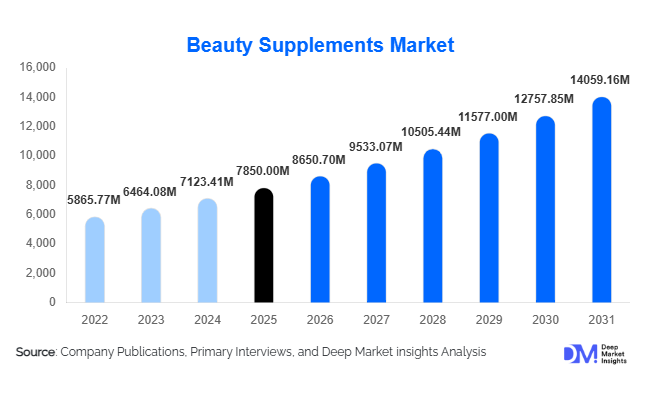
According to Deep Market Insights, the global beauty supplements market size was valued at USD 7,850 million in 2025 and is projected to grow from USD 8,650.70 million in 2026 to reach USD 14,059.16 million by 2031, expanding at a CAGR of 10.2% during the forecast period (2026–2031). The beauty supplements market growth is primarily driven by the increasing consumer shift toward “beauty from within” solutions, rising awareness of preventive healthcare, and the growing convergence of nutraceuticals and personal care industries.
Key Market Insights
- Collagen-based supplements dominate the market, driven by strong demand for anti-aging and skin health benefits.
- Online distribution channels lead sales, supported by direct-to-consumer brands and subscription-based purchasing models.
- North America holds the largest market share, with high consumer awareness and premium product adoption.
- Asia-Pacific is the fastest-growing region, fueled by rising disposable incomes and beauty-conscious populations.
- Gummies and innovative delivery formats are gaining traction, especially among younger consumers.
- Personalized nutrition and clean-label products are reshaping consumer preferences and driving premiumization.
What are the latest trends in the beauty supplements market?
Shift Toward Personalized Beauty Nutrition
Personalization is emerging as a transformative trend in the beauty supplements market. Companies are leveraging technologies such as DNA testing, microbiome analysis, and AI-based diagnostics to offer tailored supplement solutions. These personalized regimens are designed to address individual skin, hair, and aging concerns, improving efficacy and customer satisfaction. Subscription-based models further enhance engagement, ensuring repeat purchases and long-term customer retention. This trend is particularly prominent in developed markets, where consumers are willing to pay a premium for customized wellness solutions.
Rising Demand for Clean-Label and Natural Ingredients
Consumers are increasingly prioritizing transparency and sustainability in their purchasing decisions. This has led to a surge in demand for clean-label beauty supplements that are vegan, organic, non-GMO, and free from artificial additives. Herbal and botanical extracts, marine collagen, and plant-based alternatives are gaining popularity. Brands are focusing on sustainable sourcing and eco-friendly packaging to align with environmental concerns. This trend is not only influencing product development but also shaping marketing strategies, with companies emphasizing ingredient traceability and ethical production practices.
What are the key drivers in the beauty supplements market?
Growing Preventive Healthcare Awareness
Consumers are increasingly adopting preventive healthcare practices, focusing on maintaining long-term health and appearance. Beauty supplements are becoming an integral part of daily wellness routines, offering benefits such as improved skin elasticity, hair strength, and anti-aging effects. This shift is particularly strong among millennials and Gen Z, who prioritize proactive health management over reactive treatments.
Influence of Digital Media and Beauty Influencers
Social media platforms and beauty influencers play a critical role in shaping consumer behavior. Dermatologists, wellness experts, and influencers are actively promoting ingestible beauty solutions, increasing awareness and credibility. Viral trends around ingredients such as collagen and biotin have significantly boosted product adoption globally, especially among younger demographics.
What are the restraints for the global market?
Regulatory Inconsistencies Across Regions
The lack of standardized regulations for dietary supplements across different countries creates challenges for manufacturers. Variations in labeling requirements, ingredient approvals, and health claims can limit market expansion and create compliance complexities. This inconsistency can also lead to consumer skepticism regarding product efficacy and safety.
High Market Fragmentation and Pricing Pressure
The beauty supplements market is highly fragmented, with numerous players offering similar products. This intense competition leads to pricing pressure and margin compression. Additionally, the presence of low-quality or counterfeit products in certain regions can negatively impact consumer trust and overall market growth.
What are the key opportunities in the beauty supplements industry?
Expansion in Emerging Markets
Emerging economies such as China, India, Brazil, and the UAE present significant growth opportunities. Rising disposable incomes, urbanization, and increasing awareness of global beauty trends are driving demand in these regions. Localized product offerings, including herbal and traditional formulations, can further accelerate market penetration.
Innovation in Delivery Formats
New delivery formats such as gummies, effervescent tablets, and ready-to-drink beauty beverages are gaining popularity due to their convenience and appeal. These formats enhance consumer compliance and attract younger demographics. Companies investing in innovative and palatable formulations are likely to gain a competitive edge.
Report Scope
| Report Metric | Details |
|---|---|
| Market Size in 2025 | USD 7850 Million |
| Market Size in 2026 | USD 8650.70 Million |
| Market Size in 2031 | USD 14059.16 Million |
| CAGR | 10.2% (2026-2031) |
| Base Year for Estimation | 2025 |
| Historical Data | 2022-2024 |
| Forecast Period | 2026-2031 |
| Report Coverage | Revenue Forecast, Competitive Landscape, Supply Chain Disruption, Growth Factors, Environment & Regulatory Landscape and Trends |
| Geographies Covered | North America, Europe, APAC, Middle East and Africa, LATAM |
| Countries Covered | U.S., Canada, U.K., Germany, France, Spain, Italy, Russia, Nordic, Benelux, Rest of Europe, China, Korea, Japan, India, Australia, Singapore, Taiwan, South East Asia, Rest of Asia-Pacific, UAE, Turky, Saudi Arabia, South Africa, Egypt, Nigeria, Rest of MEA, Brazil, Mexico, Argentina, Chile, Colombia, Rest of LATAM |
Explore more data points, trends and opportunities Download Free Sample Report
Product Type Insights
Skin health supplements dominate the global beauty supplements market, accounting for approximately 42% of the 2025 market share. This leadership is primarily driven by the rising demand for anti-aging, hydration, and skin-rejuvenation solutions, particularly among urban consumers exposed to pollution and lifestyle stressors. The increasing adoption of collagen-based supplements, supported by clinical validation of benefits such as improved skin elasticity and wrinkle reduction, continues to strengthen this segment. Additionally, the growing influence of social media trends around “glass skin” and “anti-aging from within” has accelerated product penetration across both developed and emerging markets.
Hair health supplements represent the second-largest segment, supported by increasing global concerns related to hair thinning, hair loss, and scalp health. Factors such as stress, hormonal imbalances, and environmental pollution are driving demand for biotin and keratin-based solutions. Multi-benefit supplements that combine skin, hair, and nail health are gaining traction due to their convenience and cost efficiency, particularly among younger consumers seeking simplified wellness routines. Anti-aging supplements, including CoQ10 and resveratrol, are witnessing steady growth, driven by an aging population and increasing focus on longevity and preventive care.
Ingredient Type Insights
Proteins and peptides, particularly collagen, hold the largest share at around 35% of the market, driven by their scientifically proven efficacy in improving skin elasticity, hydration, and overall appearance. The segment’s dominance is further supported by advancements in hydrolyzed collagen formulations, which enhance bioavailability and absorption. Marine collagen, in particular, is gaining popularity due to its superior effectiveness and sustainability positioning.
Vitamins and minerals continue to play a foundational role in beauty supplements, addressing deficiencies that directly impact skin and hair health. Meanwhile, herbal and botanical extracts are experiencing rapid growth due to increasing consumer preference for natural and plant-based ingredients. Ingredients such as turmeric, aloe vera, and green tea extracts are being widely incorporated for their antioxidant and anti-inflammatory properties. Probiotics and prebiotics are emerging as a high-potential niche, reflecting the growing awareness of the gut-skin axis and its role in maintaining overall skin health.
Distribution Channel Insights
Online retail leads the market with approximately 46% share, driven by the rapid expansion of e-commerce platforms and direct-to-consumer (D2C) business models. The ability to access detailed product information, customer reviews, and personalized recommendations has significantly enhanced consumer confidence in online purchases. Subscription-based models and influencer-driven marketing strategies are further boosting online sales, particularly among digitally native consumers.
Offline channels, including pharmacies, drug stores, and specialty beauty retailers, continue to play a critical role, especially in regions with lower digital penetration or where consumers prefer professional recommendations. Pharmacies, in particular, benefit from higher trust levels, as consumers often associate them with medically validated products. The integration of omnichannel strategies by leading brands is helping bridge the gap between online and offline experiences.
Consumer Group Insights
Women account for nearly 65% of total demand, maintaining their position as the primary consumers of beauty and wellness products. This dominance is driven by higher awareness of skincare routines, greater willingness to invest in premium products, and strong influence from beauty trends and social media. The women’s segment also benefits from targeted product innovations addressing specific concerns such as aging, pigmentation, and hormonal changes.
The men’s segment, however, is emerging as a significant growth driver, supported by increasing awareness of grooming, self-care, and preventive health. Changing societal norms and the rise of male-focused wellness brands are encouraging adoption. Unisex products are also gaining traction, reflecting a broader shift toward inclusivity and simplifying product positioning across diverse consumer groups.
End-Use Insights
The beauty supplements market is closely linked to the broader wellness and personal care industry, which continues to expand globally at a steady pace. The dermatology and aesthetic care sector is a key contributor, with dermatologists and cosmetic practitioners increasingly recommending supplements as complementary solutions to topical treatments and procedures. This integration enhances treatment outcomes and drives credibility for ingestible beauty products.
The fitness and lifestyle segment is emerging as a fast-growing end-use area, with consumers incorporating beauty supplements into holistic health routines that combine nutrition, exercise, and mental well-being. This segment is expected to grow at a higher-than-average rate, driven by rising health consciousness among millennials and Gen Z. Export-driven demand is also increasing, particularly from countries such as Japan, South Korea, and France, which are recognized for their advanced formulations, strong R&D capabilities, and premium product positioning in global markets.
Explore more data points, trends and opportunities Download Free Sample Report
Beauty Supplements Market Segmentations
By Product Type
- Skin Health Supplements
- Hair Health Supplements
- Nail Health Supplements
- Multi-benefit Beauty Supplements
- Anti-aging Supplements
By Ingredient Type
- Vitamins & Minerals
- Herbal & Botanical Extracts
- Proteins & Peptides
- Amino Acids
- Probiotics & Prebiotics
- Marine-based Ingredients
By Distribution Channel
- Online Retail
- Pharmacies & Drug Stores
- Supermarkets/Hypermarkets
- Specialty Beauty Stores
By Consumer Group
- Women
- Men
- Unisex
By Form
- Tablets
- Capsules
- Gummies
- Powders
- Liquid Formulations
Regional Insights
North America
North America accounts for approximately 34% of the global market, led by the United States. The region’s dominance is driven by high consumer awareness, strong purchasing power, and early adoption of nutraceutical products. The presence of established brands, extensive distribution networks, and a well-developed e-commerce ecosystem further support market growth. Additionally, increasing demand for premium, clinically validated, and personalized supplements is driving innovation. The growing influence of wellness culture, coupled with rising interest in preventive healthcare, continues to fuel demand across the region.
Europe
Europe holds around 27% market share, with key countries including Germany, France, Italy, and the UK. Growth in this region is primarily driven by an aging population seeking anti-aging solutions and a strong preference for scientifically validated and regulated products. Stringent regulatory frameworks enhance consumer trust, while the region’s heritage in pharmaceuticals and cosmetics supports product innovation. Additionally, increasing demand for organic and clean-label supplements, particularly in Western Europe, is driving market expansion.
Asia-Pacific
Asia-Pacific is the fastest-growing region, with a CAGR exceeding 11.5%. China leads in consumption due to its large population and rapidly expanding middle class, while Japan and South Korea serve as innovation hubs, driven by advanced R&D and strong beauty cultures. India is emerging as a high-growth market, supported by rising disposable incomes, increasing urbanization, and growing awareness of nutraceuticals. The region also benefits from cultural acceptance of ingestible beauty solutions and strong demand for herbal and traditional ingredients, which further accelerates market growth.
Latin America
Latin America is experiencing moderate growth, with Brazil and Mexico as key markets. The region’s expansion is driven by increasing beauty consciousness, urbanization, and rising middle-class incomes. Brazil, in particular, has a strong beauty culture, which supports demand for both topical and ingestible products. However, economic volatility and price sensitivity remain challenges, leading to higher demand for mid-range and affordable product offerings.
Middle East & Africa
The Middle East & Africa region is gradually expanding, with the UAE and South Africa as major markets. Growth is driven by rising health awareness, increasing demand for premium and luxury wellness products, and expanding retail infrastructure. The Middle East benefits from high disposable incomes and strong demand for imported premium brands, while Africa’s growth is supported by improving healthcare access and increasing urbanization. Additionally, the influence of global beauty trends and social media is accelerating product adoption across the region.
Key Players in the Beauty Supplements Market
- Nestlé Health Science
- Amway
- Herbalife Nutrition
- Shiseido
- Otsuka Holdings
- Nature’s Bounty
- HUM Nutrition
- Olly (Unilever)
- Blackmores
- Swisse Wellness
- GNC Holdings
- Fancl Corporation
- Meiji Holdings
- Suntory Holdings
- Nu Skin Enterprises