Beard Wax Market Size
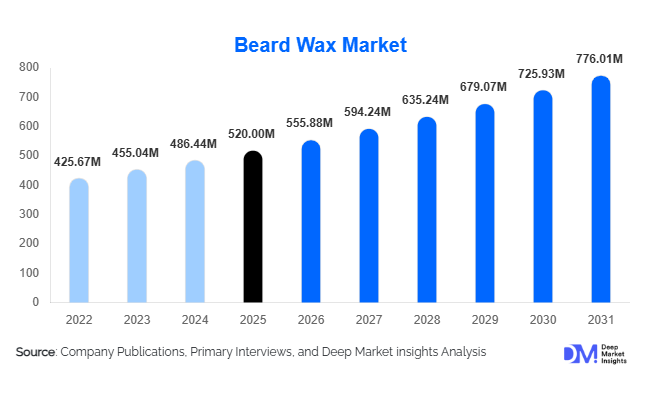
According to Deep Market Insights, the global beard wax market size was valued at USD 520 million in 2025 and is projected to grow from USD 555.88 million in 2026 to reach USD 776.01 million by 2031, expanding at a CAGR of 6.9% during the forecast period (2026–2031). The beard wax market growth is primarily driven by the rising popularity of facial hair styling, increasing consumer spending on premium men’s grooming products, and the expansion of professional barbershop culture worldwide.
Beard wax has evolved from a niche styling product to an essential component of modern men’s grooming routines. Consumers are increasingly adopting specialized products to maintain beard shape, texture, and structure while improving overall beard health. Growing awareness of personal grooming, particularly among millennial and Gen Z male consumers, has significantly increased demand for beard styling products, including wax, balms, and oils. In addition, the influence of celebrity grooming trends, social media content creators, and professional barbers has encouraged consumers to experiment with beard styles that require structured grooming solutions.
Natural ingredient formulations are also reshaping the market landscape. Consumers increasingly prefer beard wax products made from beeswax, shea butter, plant oils, and essential oils that provide both styling functionality and skin nourishment. This trend is encouraging manufacturers to introduce organic and cruelty-free formulations that align with the broader clean beauty movement. Furthermore, the rapid growth of e-commerce platforms has enabled niche grooming brands to expand their global reach through direct-to-consumer sales models. As a result, the beard wax market is witnessing continuous innovation in fragrance profiles, packaging formats, and ingredient sourcing strategies.
Key Market Insights
- Natural and organic beard wax formulations are gaining popularity, driven by consumer demand for chemical-free grooming products containing beeswax, essential oils, and plant-based ingredients.
- The expansion of premium men’s grooming brands is driving higher product innovation, fragrance differentiation, and luxury packaging formats.
- North America dominates the global beard wax market, supported by high disposable income and a well-established barbershop culture.
- The Asia-Pacific region is the fastest-growing market, driven by rising male grooming awareness and increasing e-commerce penetration in countries such as China and India.
- Professional barbershops are becoming influential distribution channels, as barbers recommend and retail beard styling products directly to customers.
- Digital marketing and influencer-led grooming trends are playing a significant role in shaping consumer preferences and brand visibility.
What are the latest trends in the beard wax market?
Growing Preference for Natural and Organic Grooming Products
The demand for natural grooming products has become one of the most prominent trends shaping the beard wax market. Consumers are increasingly scrutinizing product labels and avoiding synthetic chemicals such as parabens, sulfates, and petroleum-based ingredients. As a result, manufacturers are introducing beard wax products formulated with natural waxes such as beeswax, carnauba wax, and candelilla wax combined with nourishing oils like argan oil, jojoba oil, and coconut oil.
This trend is particularly strong in North America and Europe, where consumer awareness regarding cosmetic ingredient safety is high. Organic beard wax products are often marketed as skin-friendly and environmentally responsible, which appeals to consumers seeking sustainable personal care solutions. Companies are also pursuing certifications such as cruelty-free and vegan product labels to differentiate their offerings in a competitive market.
Rise of Premium Grooming and Designer Fragrance Products
The beard wax market is witnessing a strong shift toward premium grooming products that offer enhanced styling performance, sophisticated fragrance profiles, and luxury packaging. Consumers are increasingly willing to pay higher prices for products that combine grooming functionality with lifestyle branding.
Premium beard wax products often feature distinctive fragrance blends such as sandalwood, cedarwood, tobacco vanilla, and citrus spice combinations. These fragrances are designed to complement personal style and function as subtle grooming fragrances. Luxury grooming brands are also introducing limited-edition fragrance collections and collaborations with barbershops or fashion labels. This trend is expanding profit margins for manufacturers while elevating beard wax from a basic grooming product to a premium lifestyle accessory.
What are the key drivers in the beard wax market?
Increasing Popularity of Facial Hair Styling
The global popularity of beards and mustaches as fashion statements has significantly boosted demand for beard grooming products. Over the past decade, facial hair has transitioned from a niche style choice to a widely accepted grooming trend across professional and social environments. Celebrities, athletes, and social media influencers frequently showcase distinctive beard styles, encouraging consumers to adopt similar looks.
Maintaining structured beard styles requires specialized products such as beard wax that provide hold and control. As a result, beard wax has become an essential product for consumers seeking precise beard styling and long-lasting shape retention.
Expansion of the Men’s Grooming Industry
The rapid expansion of the men’s grooming industry has created strong demand for specialized grooming products tailored specifically for male consumers. Increasing disposable income and changing perceptions about male grooming are encouraging men to invest in personal care products that enhance appearance and self-confidence.
Companies are responding by expanding product portfolios that include beard oils, conditioners, balms, and waxes. Marketing campaigns targeting male consumers are also emphasizing self-care, style expression, and grooming routines, further supporting the growth of the beard wax market.
What are the restraints for the global market?
Competition from Multi-Functional Beard Grooming Products
One of the key restraints affecting the beard wax market is competition from alternative grooming products such as beard balm and beard oil. These products often provide conditioning, moisturizing, and light styling functions simultaneously, making them attractive to consumers seeking simplified grooming routines.
Many consumers prefer multi-purpose products that reduce the need for multiple grooming items. As a result, beard wax manufacturers must continuously innovate to differentiate their products through stronger hold, unique fragrance profiles, or premium ingredients.
Volatility in Raw Material Prices
The production of beard wax relies heavily on natural ingredients such as beeswax, essential oils, and plant-derived oils. Fluctuations in the supply and pricing of these raw materials can impact manufacturing costs and profit margins.
Environmental factors affecting bee populations, agricultural supply fluctuations, and international trade dynamics can influence ingredient availability. Companies must therefore develop resilient sourcing strategies and maintain diversified supply chains to mitigate potential cost pressures.
What are the key opportunities in the beard wax industry?
Expansion of Professional Barbershop Distribution Channels
The resurgence of traditional barbershops globally is creating new opportunities for beard wax manufacturers. Barbershops frequently serve as trusted grooming advisors, recommending specific products to customers based on beard type and styling requirements.
Many grooming brands are partnering with barbershop chains to supply professional-grade beard wax products designed specifically for styling services. This channel not only generates recurring product demand but also enhances brand visibility through direct consumer interaction during grooming sessions.
E-Commerce and Direct-to-Consumer Sales Growth
E-commerce platforms have transformed the way grooming products are marketed and sold. Online marketplaces and direct-to-consumer websites allow beard wax brands to reach global audiences without relying solely on traditional retail distribution.
Digital marketing strategies, including influencer partnerships, social media tutorials, and grooming blogs are playing a major role in driving online sales. Subscription-based grooming kits that include beard wax are also emerging as new revenue streams for manufacturers.
Report Scope
| Report Metric | Details |
|---|---|
| Market Size in 2025 | USD 520 Million |
| Market Size in 2026 | USD 555.88 Million |
| Market Size in 2031 | USD 776.01 Million |
| CAGR | 6.9% (2026-2031) |
| Base Year for Estimation | 2025 |
| Historical Data | 2022-2024 |
| Forecast Period | 2026-2031 |
| Report Coverage | Revenue Forecast, Competitive Landscape, Supply Chain Disruption, Growth Factors, Environment & Regulatory Landscape and Trends |
| Geographies Covered | North America, Europe, APAC, Middle East and Africa, LATAM |
| Countries Covered | U.S., Canada, U.K., Germany, France, Spain, Italy, Russia, Nordic, Benelux, Rest of Europe, China, Korea, Japan, India, Australia, Singapore, Taiwan, South East Asia, Rest of Asia-Pacific, UAE, Turky, Saudi Arabia, South Africa, Egypt, Nigeria, Rest of MEA, Brazil, Mexico, Argentina, Chile, Colombia, Rest of LATAM |
Explore more data points, trends and opportunities Download Free Sample Report
Product Type Insights
Natural and organic beard wax products dominate the global market, accounting for approximately 55% of total revenue in 2025. Consumers prefer formulations made from beeswax and plant-based ingredients due to their perceived safety and conditioning benefits for both beard hair and facial skin. Synthetic beard wax products remain relevant in mass-market segments because they provide stronger hold and lower production costs, making them suitable for entry-level grooming products. Premium grooming brands increasingly focus on organic formulations that combine styling functionality with skin nourishment. Continuous innovation in ingredient combinations and fragrance infusions is helping manufacturers differentiate products and capture growing consumer interest in high-performance beard styling solutions.
Application Insights
Personal grooming remains the largest application segment for beard wax, accounting for nearly 72% of global demand. Individual consumers primarily use beard wax to shape mustaches, maintain beard structure, and create defined grooming styles. Professional barbershops represent the fastest-growing application segment, driven by rising demand for professional beard styling services and product recommendations during grooming appointments. The fashion and entertainment industry also contributes to market demand, particularly in film production, television, and photography, where stylists frequently use beard wax for character styling. As grooming culture continues to expand globally, beard wax is expected to find new applications within fashion events, digital media production, and influencer-led content creation.
Distribution Channel Insights
Online retail channels dominate beard wax distribution, accounting for approximately 48% of global sales. E-commerce platforms provide consumers with access to a wide variety of grooming brands, competitive pricing, and detailed product reviews that influence purchasing decisions. Direct-to-consumer brand websites are also gaining popularity as companies invest in digital marketing strategies and subscription grooming services. Offline retail channels, including supermarkets, pharmacies, and specialty grooming stores, continue to play an important role in product accessibility. Professional barbershops represent a unique distribution channel where products are both used and sold directly to customers, strengthening brand loyalty and encouraging repeat purchases.
Consumer Age Group Insights
Millennials represent the largest consumer group within the beard wax market, accounting for a significant portion of product demand. This demographic values grooming products that combine performance, style, and lifestyle branding. Gen Z consumers are emerging as a rapidly growing segment, influenced heavily by social media trends and digital grooming tutorials. Gen X consumers maintain steady demand, particularly for premium grooming products that emphasize quality ingredients and long-lasting styling performance. Mature consumers aged above 55 years represent a smaller but stable market segment, often prioritizing fragrance-free or hypoallergenic formulations designed for sensitive skin.
Explore more data points, trends and opportunities Download Free Sample Report
Beard Wax Market Segmentations
By Product Formulation
- Natural / Organic Beard Wax
- Beeswax-Based Formulations
- Plant Wax Formulations
- Synthetic / Conventional Beard Wax
By Hold Strength
- Light Hold Beard Wax
- Medium Hold Beard Wax
- Strong Hold Beard Wax
- Extra-Strong Styling Wax
By Fragrance Profile
- Fragrance-Free / Hypoallergenic
- Wood-Based Fragrance
- Citrus-Based Fragrance
- Herbal / Botanical Fragrance
- Premium Designer Fragrance
By Distribution Channel
- Online Retail
- Supermarkets & Hypermarkets
- Specialty Grooming Stores
- Pharmacies / Drug Stores
- Barbershops & Salons
By Consumer Age Group
- Gen Z (18–25)
- Millennials (26–40)
- Gen X (41–55)
- Above 55 Years
Regional Insights
North America
North America holds the largest share of the global beard wax market, accounting for approximately 35% of revenue in 2025. The United States dominates regional demand due to strong consumer spending on grooming products and a well-established barbershop culture. Canadian consumers also demonstrate high adoption of premium grooming brands and organic formulations. The region benefits from strong e-commerce penetration and widespread availability of niche grooming brands.
Europe
Europe represents nearly 28% of the global market, driven by strong demand in countries such as the United Kingdom, Germany, France, and Italy. European consumers are particularly receptive to organic and cruelty-free grooming products. The region also has a vibrant barbershop culture that contributes to steady demand for professional beard styling products.
Asia-Pacific
Asia-Pacific is the fastest-growing regional market, expanding at an estimated CAGR of over 8%. Rapid urbanization, rising disposable income, and growing awareness of male grooming products are driving demand in countries such as China, India, Japan, South Korea, and Australia. E-commerce platforms are playing a major role in expanding market accessibility across the region.
Latin America
Brazil and Mexico represent the largest markets in Latin America. Rising urban populations and growing interest in male grooming trends are encouraging consumers to adopt beard styling products. Social media influence and international grooming brands are helping expand market penetration.
Middle East & Africa
The Middle East shows strong demand for beard grooming products due to cultural preferences for facial hair. Countries such as Saudi Arabia and the United Arab Emirates are witnessing increasing demand for premium grooming products. Africa is gradually emerging as a market for grooming products as urbanization and retail expansion continue to develop.
Key Players in the Beard Wax Market
- Honest Amish
- Beardbrand
- The Art of Shaving
- Captain Fawcett
- Proraso
- Hawkins & Brimble
- Beardilizer
- Viking Revolution
- Smooth Viking
- Grave Before Shave
- Wild Willies
- Rocky Mountain Barber Company
- Badass Beard Care
- Seven Potions
- Professor Fuzzworthy